Making enterprise AI an organizational asset
April 25, 2025/16 min read

Most enterprises do not have an AI problem. They have a coordination problem. According to McKinsey's 2025 State of AI survey, 88% of organizations now use AI in at least one business function, but only 6% qualify as high performers generating meaningful earnings before interest and taxes (EBIT) impact. The gap is not adoption. It is the organizational infrastructure that turns adoption into compounding business value.
This guide covers the operating models, governance frameworks, use-case prioritization methods, upskilling strategies, and measurement systems that close that gap.
Most enterprises accumulate AI projects but not AI value. The difference is whether AI operates as disconnected experiments or as a coordinated organizational capability.
Operating model choice (decentralized, CoE, hub-and-spoke, center for acceleration, embedded) determines how fast and how safely AI scales.
Governance must be embedded into AI workflows from the start, not applied at the end. According to "Global AI confessions report: data leaders edition," based on a Dataiku/Harris Poll survey, only 5% of data leaders say AI output is traceable 100% of the time.
Measurement tied to business outcomes, not activity metrics, is what protects AI budgets and ensures continued investment.
Scaling AI adoption matters because adoption alone produces no return. Value comes only when AI operates as a coordinated organizational capability rather than a scatter of isolated projects. The enterprises that capture compounding value are the ones that build the operating model, governance, and measurement systems to support AI at scale.
The data makes the gap clear. According to McKinsey's 2025 State of AI survey, 88% of organizations use AI, but nearly two-thirds remain stuck in experiment or pilot mode. Only about one-third have begun scaling AI across the enterprise. The organizations that break through share three characteristics:
They build cross-functional collaboration into the operating model rather than treating AI as a data science function. Business leaders, IT, analysts, AI engineers, and data scientists all play defined roles in how AI moves from idea to production. Isolated teams building isolated models produce isolated value.
They implement governance that scales alongside adoption. Enterprise AI systems must be transparent, adaptable, and compliant as they evolve. Governance applied after deployment is governance applied too late.
They treat AI as a business asset embedded into real-time operations, automation, and revenue-generating processes, not as a technology experiment running alongside the business.
Organizations that adopt this structured approach transition from isolated AI projects to enterprise-wide AI ecosystems that deliver sustainable, compounding value. The first decision that shapes that transition is the operating model.

Scaling AI requires the right operating model — a structured framework for how AI is managed, developed, and deployed across an enterprise. Organizations typically evolve through these five models as they mature in AI adoption.
1. Decentralized / siloed
Teams experiment independently, using different tools and methodologies with little collaboration across the business. While this phase is often short-lived, it serves to determine AI’s value before investing further.
However, as teams begin generating results, the need for shared infrastructure and specialization becomes evident. This realization often drives organizations to transition to a more centralized model, reducing costs and improving efficiency.
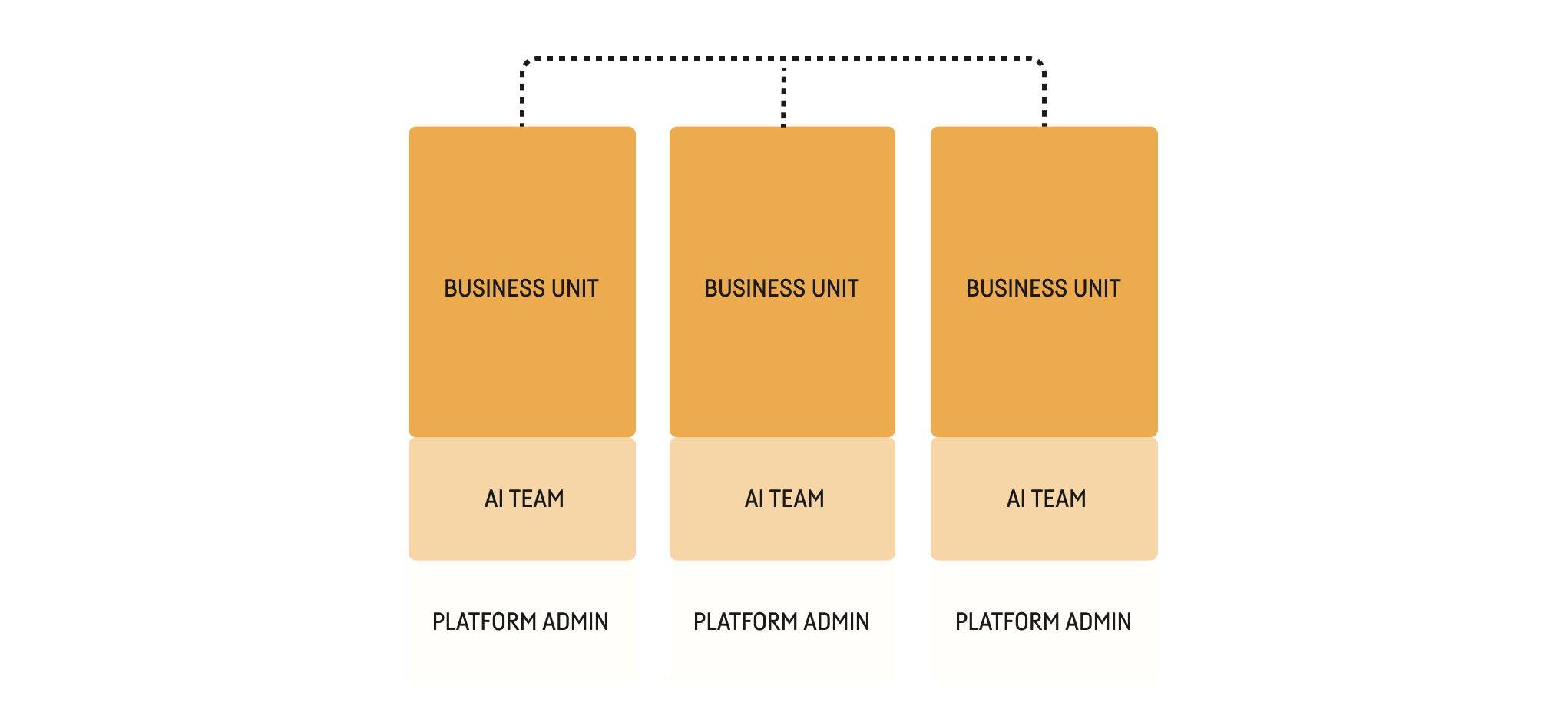
2. Centralized center of excellence (CoE)
A centralized team develops and maintains AI products for multiple business units, driving strategic alignment and accelerating AI adoption. Success depends on collaboration between technical experts and business teams to create a unified strategy.
Key tasks include prioritizing AI projects with measurable return on investment (ROI), building scalable data infrastructure, and promoting success stories to drive engagement. While this model jumpstarts adoption, the CoE typically evolves as organizations scale their AI efforts further.
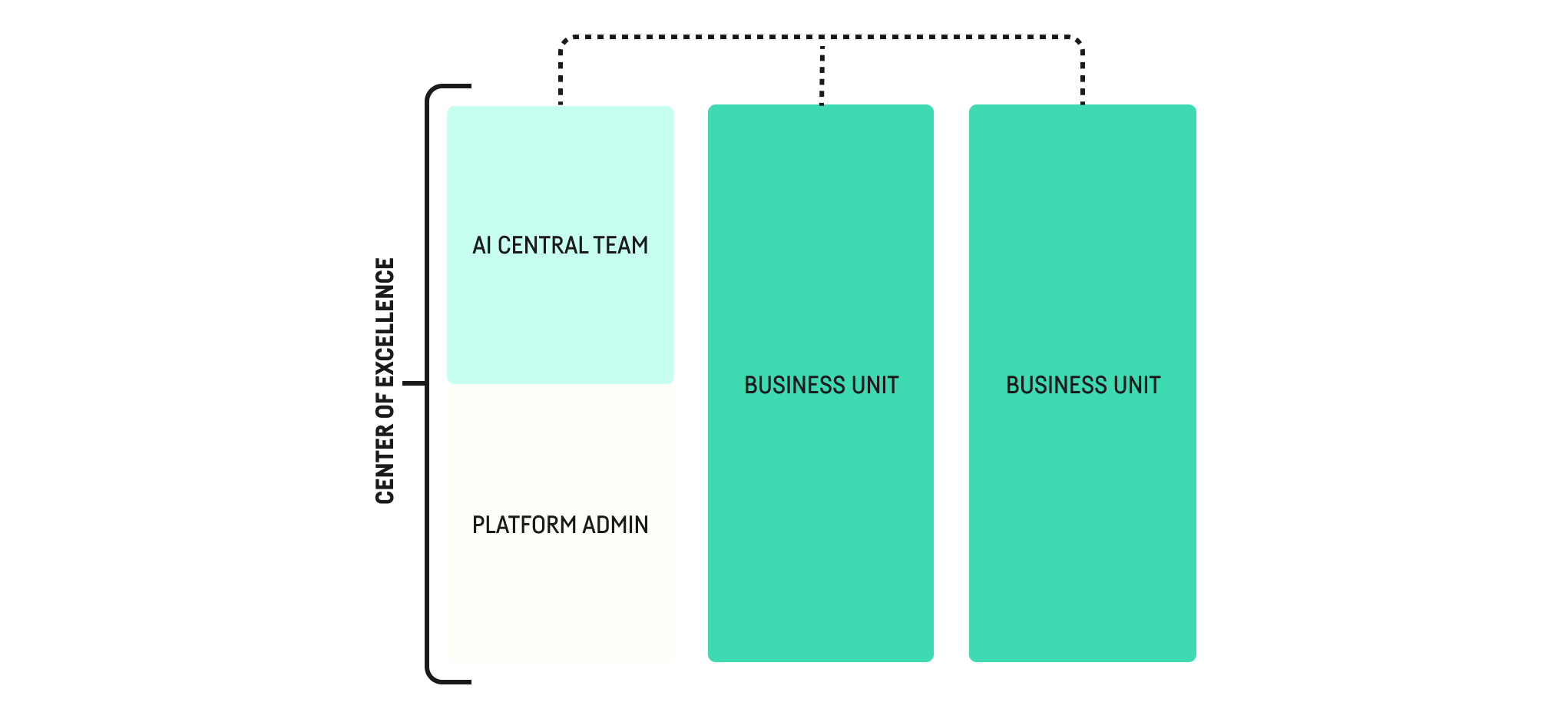
3. Hub and spoke
In the Hub and Spoke model, AI experts are in a central hub. Business units or functions take more control of AI product development. The hub focuses on infrastructure, governance, and innovation tracking, while the spokes prioritize AI use cases and drive adoption.
This structure helps data teams work better with business units. It makes sure that AI projects, including cutting-edge initiatives like GenAI deployments, align with business goals. Companies that successfully use AI are more likely to adopt this model. It balances central control with local execution.
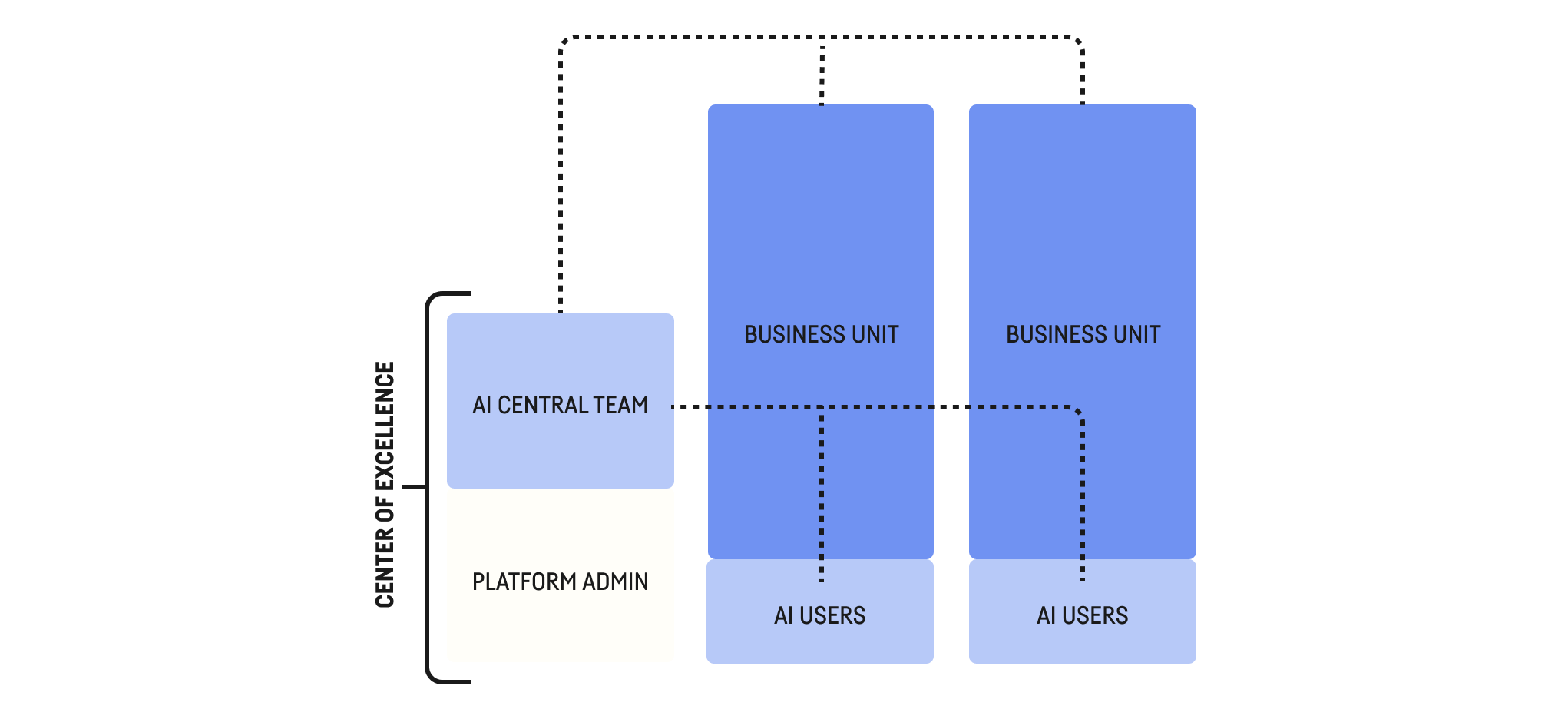
4. Center for acceleration
As organizations mature, they often transition to a Center for Acceleration, which promotes widespread AI adoption among domain experts. This model gives business units the responsibility for developing AI products. It still keeps centralized guidance on governance and infrastructure.
The result is increased innovation and agility, as domain experts bring their deep knowledge to the development process. This structure enables organizations to scale AI across multiple functions while driving measurable results.
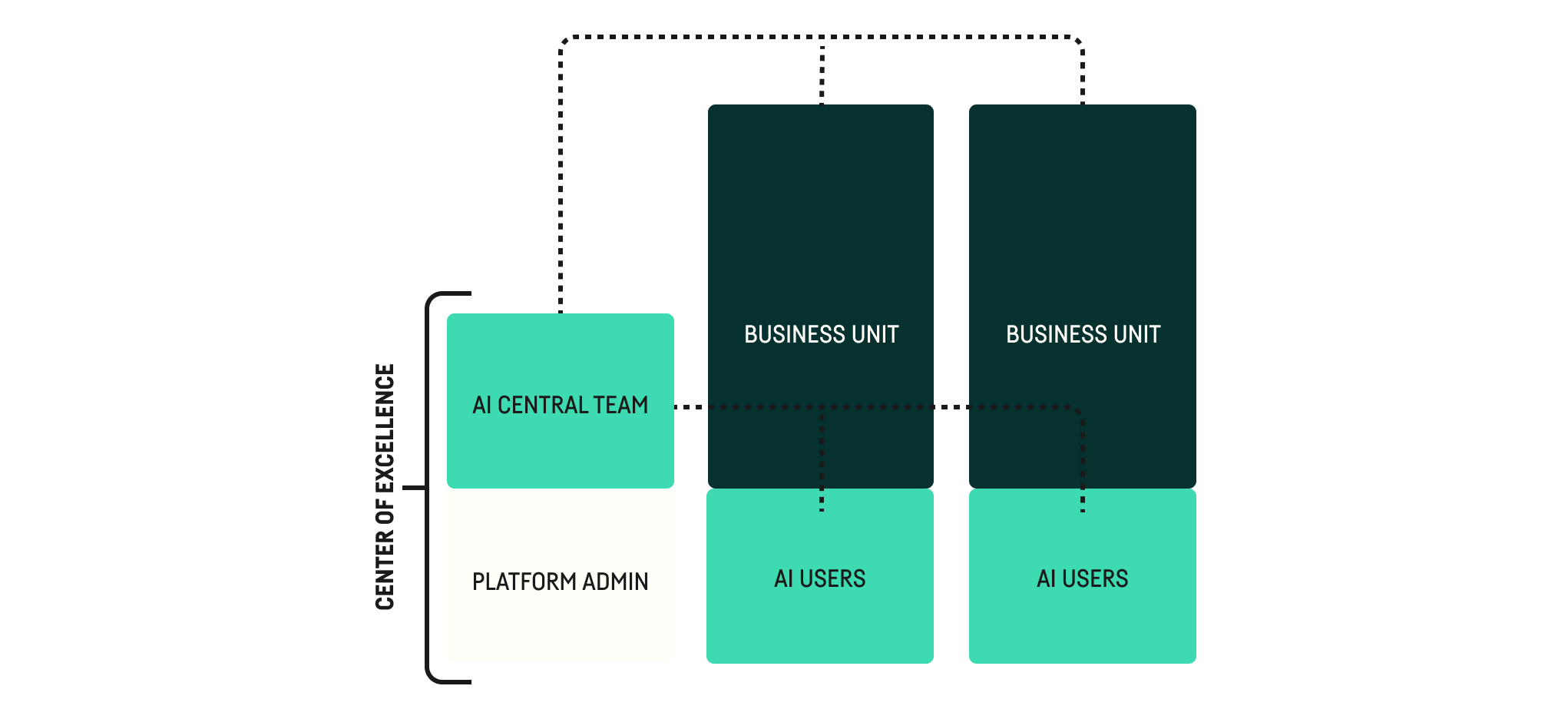
5. Embedded
The Embedded model represents the most decentralized and innovative approach to AI. Here, business units fully integrate AI capabilities with minimal central oversight. Shared resources, such as responsible AI guidelines and curated datasets, provide consistency, but business functions operate largely independently.
This model works best for mature organizations that have a strong data culture. It helps them innovate quickly while staying true to their core principles.
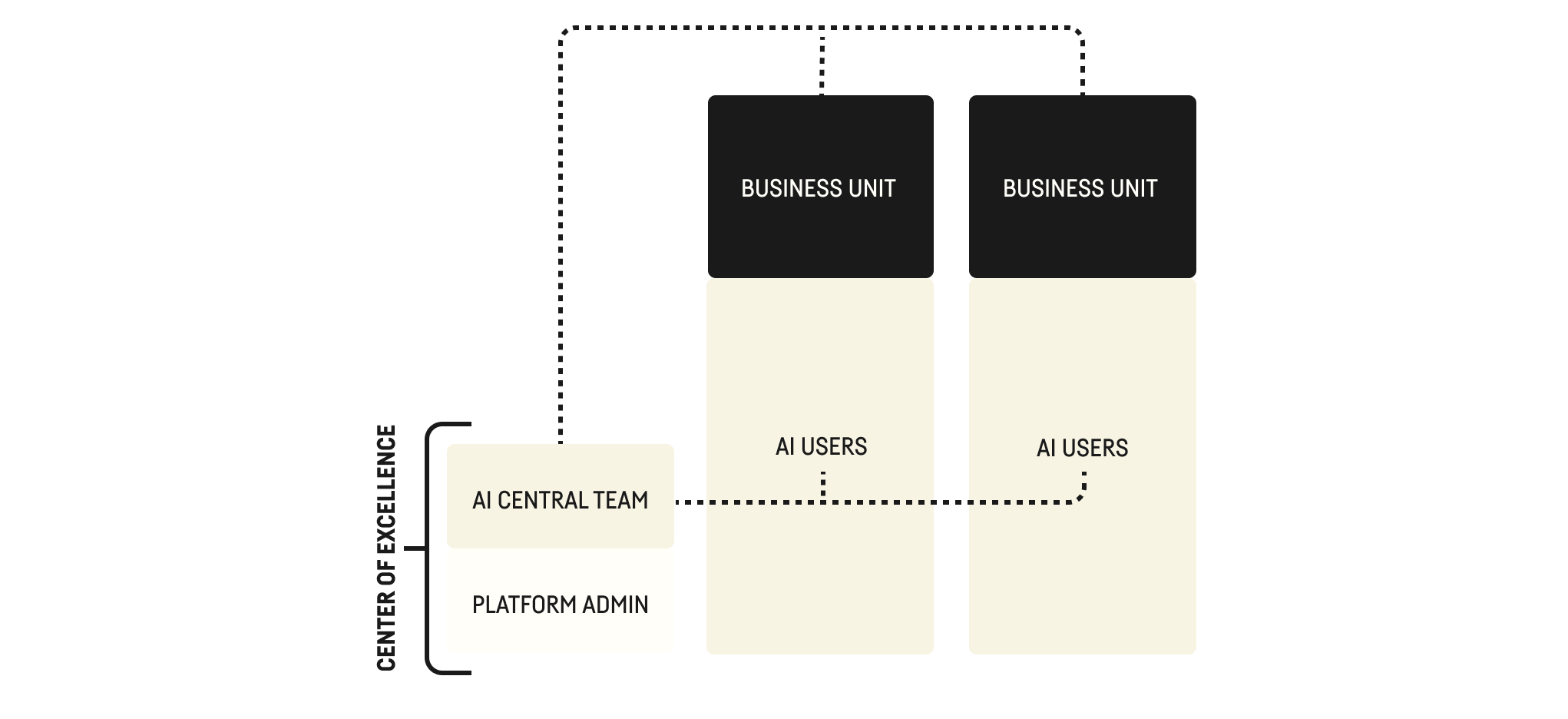
The right model depends on organizational maturity and AI adoption goals. As organizations move through these operating models, the challenge shifts from structuring AI teams to ensuring AI delivers sustainable impact.
Decentralized, center for acceleration, and embedded models tend to function as waypoints rather than destinations: An organization passes through them on its way to something else, or grows into them only after the underlying maturity is already in place.
Hub-and-spoke and centralized CoE are where most AI-mature organizations land, and where the operating model has the most direct influence on whether governance and scale work together instead of against each other. The rest of this section focuses there.
Most companies already have the skills needed to succeed with enterprise AI. They are just fragmented across teams, tools, and functions. Data and IT teams bring expertise in scaling infrastructure, ensuring security, and monitoring model performance. Business teams offer deep process knowledge, real-world use case insight, and day-to-day operational context. But without alignment between them, even strong capabilities fail to translate into enterprise-wide AI impact.
The hub-and-spoke model solves this.
The hub provides centralized governance, infrastructure, and expertise. The spokes provide business context, use-case prioritization, and domain knowledge. Most AI-mature companies adopt this model because it creates alignment between data, IT, and business teams without creating bottlenecks.
This is where the AI Success Formula maps directly:
People (the spokes bring domain expertise; the hub brings technical capability)
Orchestration (coordinating data, models, agents, and decision logic across the organization)
Governance (visibility, validation, and performance measurement embedded from design through production)
The hub-and-spoke model is the organizational structure that makes the formula operational.
At early maturity stages, a CoE performs four critical functions:
Setting organizational AI standards and best practices
Owning the model registry and reusable asset library
Running governance reviews and compliance checks before models reach production
Building the data infrastructure that all teams share
The CoE is not a permanent destination. It is a launch pad. Its purpose is to establish the foundations that enable the transition to hub-and-spoke or center-for-acceleration models as the organization matures.
Three signals indicate that an organization has outgrown its current operating model.
The CoE backlog exceeds six weeks. When business units wait more than six weeks for AI support, they start building independently, creating the fragmentation the CoE was designed to prevent.
Business units are building shadow AI. Models, agents, and data pipelines appearing outside governed processes signal that the current model cannot keep pace with demand. The fix is a structural shift to a model that distributes AI development capability while maintaining governance.
More than a third of AI requests come from non-technical roles. When domain experts are the primary source of AI demand, the organization needs a model that enables them to build, not one that requires them to wait in a queue.
Enterprise AI governance must evolve as GenAI and AI agents become more embedded in real-time decision-making. Traditional MLOps frameworks are no longer sufficient.
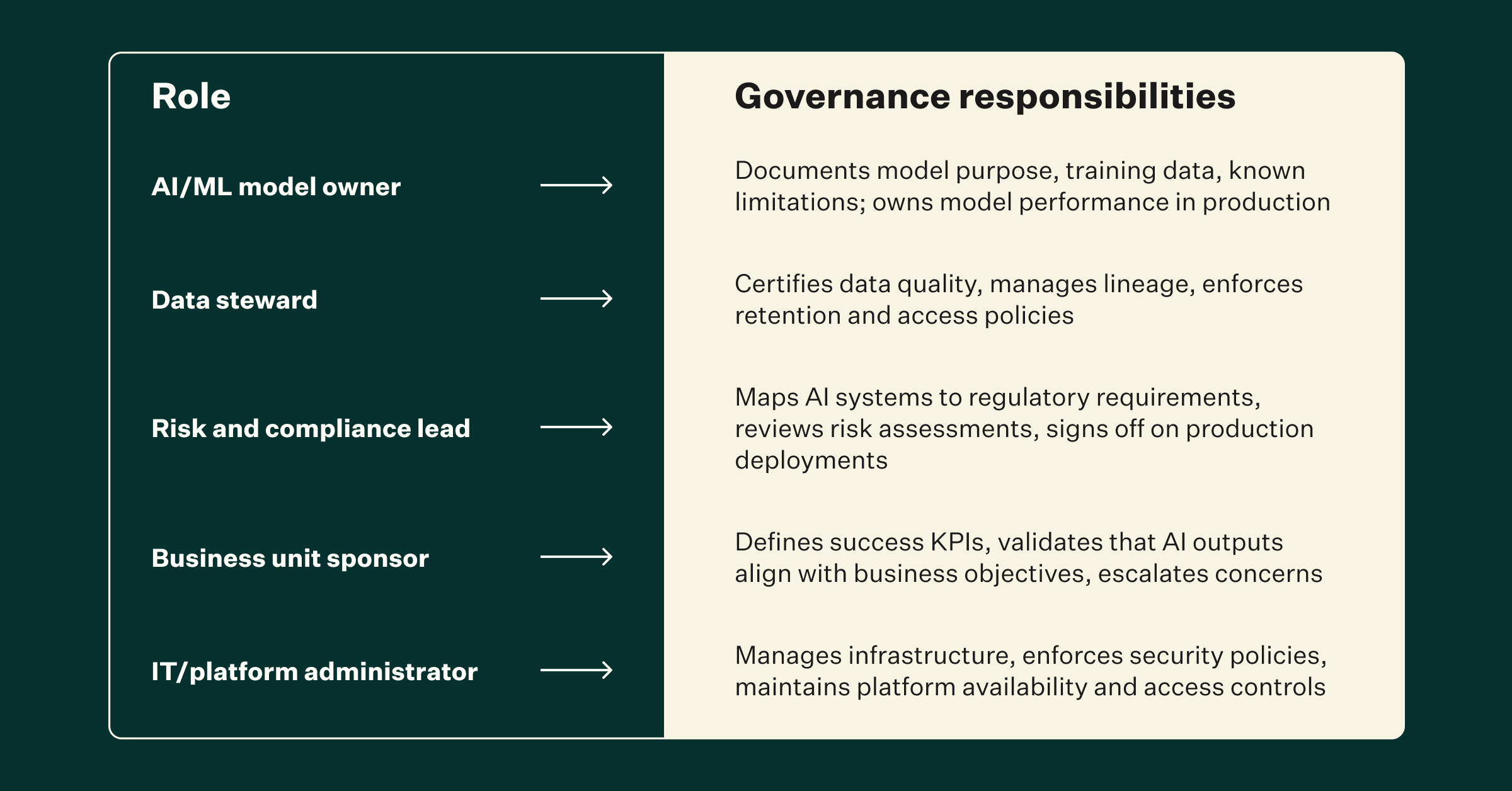
According to "7 career-making AI decisions for CIOs in 2026," based on a Dataiku/Harris Poll survey of 600 enterprise CIOs, 29% have been asked at least once to defend AI outcomes they could not fully explain. Governance is what closes that gap: ensuring that every AI system in production is traceable, auditable, and operating within defined boundaries.
Governance at scale depends on three practices:
Standardizing reusable AI assets (models, automation frameworks, data pipelines) so that governance controls apply uniformly rather than being rebuilt for each project
Orchestrating AI across business processes rather than managing it project by project
Embedding lifecycle management, including approval workflows, version tracking, and retirement policies, into the platform rather than managing it through spreadsheets and email
Dataiku, the Platform for AI Success, brings this lifecycle management together through Dataiku Govern: model documentation, approval workflows, risk assessments, and audit trails maintained in a single environment where every AI asset is visible and governed from development through production.
According to "Global AI confessions report: data leaders edition," based on a Dataiku/Harris Poll survey, only 5% of data leaders say AI output is traceable 100% of the time. Forty-two percent admit that less than half of their AI output includes a decision path.
A risk metrics checklist to close those gaps:
Traceability: Can you trace every production AI output back to the model version, data snapshot, and governance approval that produced it?
Decision path coverage: What percentage of AI-generated decisions include a documented reasoning trail?
Drift detection: Are you monitoring for model and agent behavioral drift continuously, or only during scheduled reviews?
Access control completeness: Is role-based access control (RBAC) enforced at the model, data, and agent level across all production AI?
Incident response: Do you have a defined playbook for AI failures, including who responds, what gets shut down, and how the root cause is investigated?
Compliance documentation: Can you produce audit-ready documentation for any AI system within 48 hours of a regulatory request?

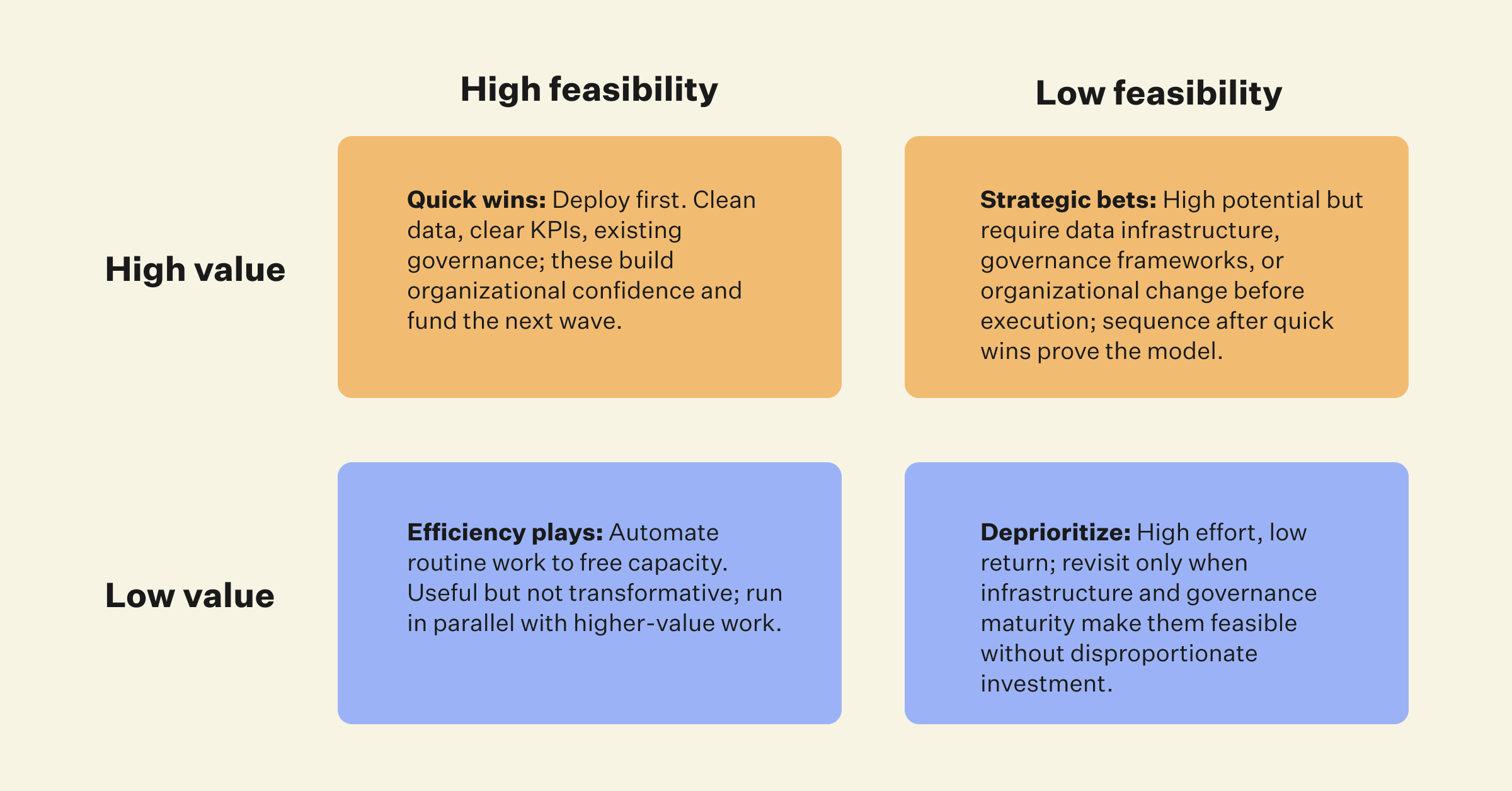
Successfully scaling enterprise AI requires balancing quick wins with long-term transformation. AI development is not always linear. What matters is building on what exists: starting with use cases that demonstrate measurable value and expanding from there.
Evaluate potential AI use cases against five criteria to identify quick wins:
Data readiness: Is the required data accessible, clean, and governed?
Process maturity: Is the target process well-understood and documented?
Measurable outcome: Can you define a KPI that will move within 90 days?
Stakeholder alignment: Does the business unit sponsor agree on the success criteria?
Governance fit: Can the use case operate within existing governance controls, or does it require new frameworks?
Use cases that score high on all five are quick wins. Use cases that score high on outcome potential but low on data readiness or governance fit are long-term transformation candidates.
Scaling AI requires champions to drive adoption, share successes, and inspire cultural change.
AI literacy for non-technical roles means four things:
Reading AI outputs critically (understanding confidence scores, recognizing when a model is uncertain)
Understanding what a model optimizes for (and therefore what it ignores)
Recognizing unexpected agent behavior (knowing that an agent acting confidently does not mean it is acting correctly)
Knowing when to escalate (identifying situations that exceed the AI system's design boundaries)
This is not data science training. It is the minimum knowledge required for anyone in the organization who consumes, reviews, or acts on AI-generated outputs.
Domain experts, from fraud analysts to demand planners, carry institutional knowledge that data science teams cannot replicate. The bottleneck is translation: turning that domain expertise into working AI without routing every request through a data science backlog.
Dataiku Cobuild addresses this directly. It generates complete AI projects as visual, inspectable flows that domain experts can review, adjust, and approve. The Dataiku Flow provides the visual environment where non-engineers build on enterprise data with AI-assisted tools, maintaining governance and quality controls throughout.
Four champion types drive enterprise AI adoption:
Business teams communicate AI's value in relatable terms, translating technical capabilities into business language that stakeholders understand.
Power users evangelize benefits and recruit colleagues, demonstrating through daily use that AI tools solve real problems rather than creating new ones.
Team leads promote upskilling and collaboration, ensuring that AI adoption is supported through training, resources, and protected time for learning.
IT managers ensure smooth rollouts while balancing governance and data access, making sure that the technical infrastructure supports adoption without creating security or compliance gaps.
These champions are instrumental in transitioning from isolated wins to widespread AI adoption.
According to "7 career-making AI decisions for CIOs in 2026," based on a Dataiku/Harris Poll survey of 600 enterprise CIOs, 98% of CIOs say board pressure to demonstrate measurable AI ROI has increased since 2024, and 71% say their AI budget will be cut or frozen if targets are not met by mid-2026.
Measurement is not a reporting exercise. It is the operational mechanism that determines whether AI programs survive their next budget cycle.
Organize KPIs into three categories:
Business impact: Revenue influenced by AI-driven decisions, cost reduction from automated workflows, cycle time improvements, error rate reduction, and customer satisfaction changes attributable to AI-powered processes
Adoption: Number of active AI users across the organization, percentage of business units with at least one production AI use case, frequency of AI asset reuse across teams, and time from use-case identification to production deployment
Governance health: Percentage of production AI systems with complete audit trails, model drift detection coverage, mean time to resolve AI-related incidents, and compliance documentation completeness across the portfolio
A functioning feedback loop follows a consistent cycle:
An AI system produces an output that does not meet expectations.
The issue is flagged (by a user, a monitoring alert, or an audit review).
The flag is routed to the appropriate owner (model owner, data steward, or business sponsor).
The root cause is evaluated: Is the problem data quality, model drift, governance gap, or misaligned KPIs?
The fix is implemented, tested, and redeployed through a governed workflow with approval gates.
Without this cycle, AI systems degrade silently. With it, every failure becomes an improvement that makes the next deployment more reliable.
Continuous tuning is distinct from one-time retraining. Retraining rebuilds a model on new data. Tuning adjusts the operational parameters around it: updating business rules, refining confidence thresholds, adjusting routing logic, and recalibrating monitoring alerts based on production experience.
Three triggers should initiate a tuning cycle:
Monitoring detects performance degradation beyond defined thresholds.
Business conditions change (new products, new markets, regulatory shifts) in ways the model was not designed for.
Feedback loop data reveals systematic patterns that incremental adjustment can address.
The tuning workflow should include documentation of what changed and why, approval from the model owner and business sponsor, validation in a staging environment before production deployment, and updated monitoring thresholds that reflect the new configuration.


Three actions define the path from isolated AI projects to enterprise-wide AI capability:
Orchestrating initiatives that build on past successes rather than starting from scratch with each new use case
Implementing governance and AI engineering operations that keep pace with expanding adoption
Upskilling teams so that AI is everyone's capability, not one department's responsibility
Dataiku unifies these three actions through the AI Success Formula: People (enabling domain experts, analysts, and engineers to contribute safely in a shared environment), Orchestration (coordinating data, ML models, GenAI, agents, business rules, and human judgment into real operational workflows), and Governance (embedding visibility, validation, and performance measurement from design through production).
The organizations moving from AI adoption to AI impact are the ones that connect these pillars in a single platform rather than managing them across disconnected tools.
The most effective strategies combine three elements: selecting an operating model that matches organizational maturity (hub-and-spoke for most scaling enterprises), embedding governance into AI workflows from the start rather than retrofitting it later, and upskilling teams across functions so that AI development is not bottlenecked by a single department.
They fail when three gaps compound: a people gap (AI remains siloed in data science teams without business involvement), an orchestration gap (models, agents, and data pipelines operate as disconnected components rather than coordinated systems), and a governance gap (compliance and risk controls are applied after deployment rather than embedded throughout development).
Safety at scale requires governance embedded at every stage of the AI lifecycle: data quality gates before model training, approval workflows before production deployment, continuous monitoring after deployment, and documented escalation paths when issues arise.
Operating models determine how AI is developed, governed, and deployed across the organization. A decentralized model enables fast experimentation but creates fragmentation. A CoE provides centralized control but can bottleneck adoption. A hub-and-spoke model balances central governance with distributed execution, which is why most AI-mature organizations adopt it as their primary structure.
Measurement spans three categories: business impact (revenue influenced, cost reduction, cycle time improvement), adoption (active users, production use cases, asset reuse), and governance health (audit trail coverage, drift detection, incident resolution time). According to "7 career-making AI decisions for CIOs in 2026," based on a Dataiku/Harris Poll survey of 600 enterprise CIOs, 98% of CIOs say board pressure to demonstrate measurable ROI has increased since 2024. Tying AI measurement to business outcomes is what protects budgets and ensures continued investment.