10 best enterprise agentic AI platforms (2026)
August 26, 2026/13 min read/Team Dataiku
Building agents has become tractable. Most platforms on this list make it possible to deploy a working agent in days. The harder problem is what comes after: knowing whether that agent is behaving as intended, staying within its defined scope, and delivering the business outcome it was deployed to achieve.
Most platforms solve the build problem. Fewer solve the accountability problem. That distinction is the lens this article uses to compare the ten leading enterprise AI agent platforms, with governance weighted more heavily than in most comparable guides because it is where enterprise deployments most commonly fail.
Governance, not build capability, is the real differentiator among enterprise AI agent platforms in 2026: Most tools make it easy to launch an agent, but far fewer make it easy to prove it's behaving correctly at scale.
Governance depth and deployment flexibility are the most differentiating factors across the platforms reviewed. Most cluster at medium governance capability.
Cloud-native platforms (Gemini, Copilot Studio, Bedrock AgentCore) excel within their ecosystems. Infrastructure-agnostic platforms (Dataiku, LangChain) excel across multi-cloud environments.
Building agents is the entry point. Governing them at scale, across departments, against business outcomes rather than just technical uptime, is what separates successful enterprise deployments from pilots that stall.

An enterprise AI agent platform is a software environment that provides the runtime, orchestration, memory, governance, and tool integration needed to build and deploy AI agents in production.
The distinction from classic AI frameworks matters: Frameworks handle model training and inference. Agentic platforms handle the full lifecycle: agent coordination, tool calling, memory management, human-in-the-loop controls, and production governance.
Consider a procurement agent that monitors supplier data, triggers contract review when cost thresholds are crossed, routes the review to the appropriate team with full context, and logs the decision for audit. That workflow requires more than a model and a prompt. It requires orchestration, memory, governance, and integration with existing enterprise systems.
According to "7 career-making AI decisions for CIOs in 2026," based on a Dataiku/Harris Poll survey of 600 enterprise CIOs, 74% regret at least one major AI vendor or platform selection made in the past 18 months. Governance infrastructure, not build capability, is the most cited gap driving that regret.
Seven criteria matter most while selecting enterprise AI agent platforms, with governance listed first because it is the most differentiating.
1. Governance and access controls: Role-based permissions, approval workflows, and audit trails determine whether the platform can meet regulatory requirements and internal accountability standards.
2. Integration breadth: The platform must connect to existing cloud infrastructure, data platforms, and enterprise applications without requiring migration.
3. Memory and RAG support: Persistent agent memory and retrieval-augmented generation capabilities affect whether agents can handle complex, context-dependent workflows.
4. Observability: Visibility into agent behavior, output quality, and business performance, not just technical uptime and error rates
5. Deployment flexibility: Cloud, on-premises, and VPC options for organizations with data residency requirements
6. Pricing model: Per-agent, per-seat, and platform license models have different cost profiles at scale
7. Vendor lock-in risk: Whether the platform ties the organization to a specific cloud provider, LLM, or data infrastructure
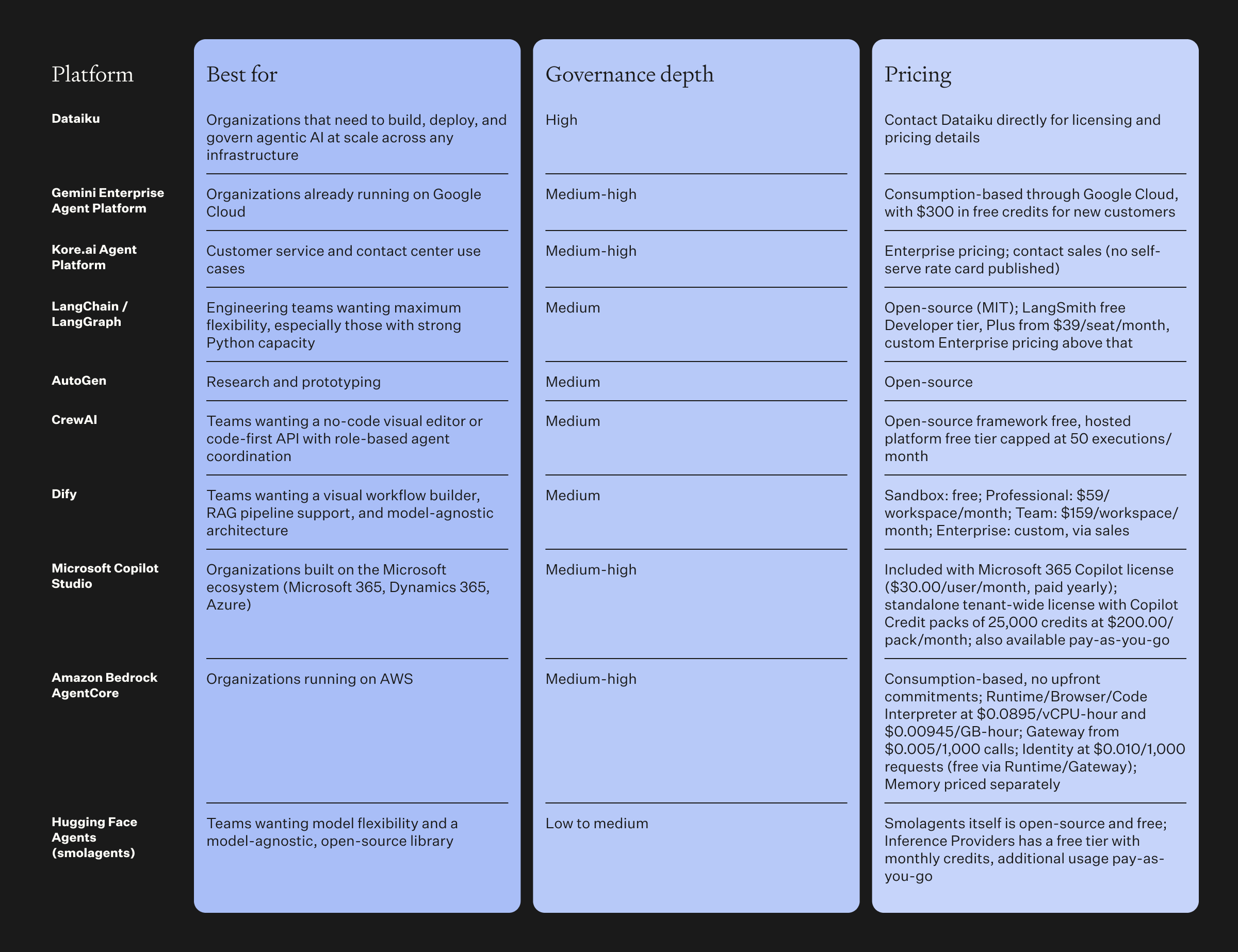
Note: The details in this table reflect information available as of July 2026. Pricing, governance features, and product capabilities for these platforms are subject to change.
Each review covers enterprise fit, governance depth, and pricing in a consistent format. Dataiku leads the reviews, consistent with its position as the strongest governance platform in the comparison.
Dataiku, the Platform for AI Success, is the enterprise AI agent platform for organizations that need to build, deploy, and govern agentic AI at scale across any infrastructure.
Dataiku connects and orchestrates agents across Amazon Bedrock, Microsoft Copilot, LangChain, Snowflake Cortex, and Databricks without requiring migration from existing tools. Agent Hub in Dataiku provides the build environment for designing and developing agents, whether teams prefer full-code flexibility or a code-free visual interface.
For organizations running high-stakes, multi-step operations, Dataiku also offers Reasoning Systems: pre-built, governed systems that connect data, models, agents, business rules, and human decision logic for specific domains. These are currently available for manufacturing operations, with supply chain and financial risk domains rolling out later.
Agent Hub includes centralized deployment, tool management, and visual debugging so teams can troubleshoot agent behavior with full transparency into agent actions. Governance capabilities include a model registry, audit logging, role-based access control, and cost and usage guardrails through Dataiku LLM Guard Services (Safe Guard, Cost Guard, Quality Guard). Dataiku Govern extends this oversight across the full agent lifecycle, from development through production monitoring.
Dataiku's newer agent-governance capabilities are still maturing in scope.
Contact Dataiku directly for licensing and pricing details.
Google's platform to build, scale, govern, and optimize enterprise-grade agents, launched as the evolution of Vertex AI
The platform spans Agent Studio for low-code design, the Agent Development Kit for code-first builds, RAG Engine for grounding agents in enterprise data, and broad model access through Model Garden. Agents built on the platform are delivered to employees through the Gemini Enterprise app.
Agent Identity, Agent Registry, and Agent Gateway provide centralized control, with IAM policies enforced through Agent Gateway. Standard and Plus editions support strict compliance workloads such as HIPAA and FedRAMP, with certifications documented per product.
By default, Google's published Gemini models cache customer data, including inputs, outputs, and derived data, in-memory to reduce latency
Google notes a regional constraint as Customer-managed encryption keys (CMEK) and Access Transparency (AXT) aren't supported in the global region.
Consumption-based through Google Cloud, with $300 in free credits for new customers
Kore.ai is a multi-agent orchestration platform with a unified workspace for visual and code-based agent authoring
Kore.ai's AI for Service spans the contact center stack. The platform connects to a broad set of enterprise systems.
The platform's newest Artemis release emphasizes full-session observability.
Kore.ai does not publish a public rate card, and pricing spans multiple concurrent billing models depending on product line.
For its Automation AI product specifically, usage is metered in 15-minute blocks, which makes long conversations costlier than the raw conversation count suggests.
Enterprise pricing; contact sales.
Kore.ai's own site lists no self-serve rate card anywhere in its navigation: every CTA routes to "Talk to an expert" or "Request a Demo"
An open-source agent orchestration framework with graph-based design for complex, stateful workflows
It has over 1,000 integrations, checkpoint-based state management, and LangSmith for production observability, with production deployments at Klarna, LinkedIn, Uber, and Replit. It is best for teams with strong Python engineering capacity.
LangSmith provides tracing and observability, and LangGraph supports human-in-the-loop approval at any point in a workflow.
Steep learning curve
Role-based access control and custom SSO are reserved for the Enterprise plan rather than included by default
LangSmith (which now covers the deployment tooling previously marketed as LangGraph Cloud) offers a free Developer tier for solo users with paid Plus plans starting at $39 per seat per month and custom Enterprise pricing above that.
Microsoft's open-source multi-agent framework with a three-layer architecture (Core, AgentChat, Extensions)
AutoGen Studio provides a no-code interface for rapid prototyping. AutoGen is now in maintenance mode with Microsoft Agent Framework 1.0 (GA April 2026) as the production-grade successor
Observability is available through the Extensions layer. Microsoft positions Agent Framework as the path to stronger governance for new projects
The framework is now in maintenance mode, with Microsoft shifting most investment to Agent Framework
Role-based multi-agent framework using a "crew" metaphor for agent coordination, with role-based agents that separate and simplify orchestration.
CrewAI supports building agents through either a no-code visual editor or a code-first API. Multi-LLM support spans native integrations with OpenAI, Anthropic, and Google Gemini, plus broader provider access (including open-weight and locally hosted models via Ollama) through LiteLLM. On the paid Enterprise tier, CrewAI adds real-time tracing with full cost accounting and RBAC with immutable audit trails.
The Enterprise plan adds role-based access control and single sign-on, both marked unavailable on the free Basic plan. CrewAI maintains a SOC 2 Type 2 certified security program at the company level.
CrewAI's process model is restricted to two built-in execution patterns, sequential and hierarchical, so workflows where the execution path isn't known at design time require custom logic layered on top rather than a native graph-based routing model.
A free, open-source Basic plan (50 workflow executions per month) and a custom-priced Enterprise plan.
Dify is an open-source platform for building AI agents, RAG pipelines, and workflow automations.
An open-source platform for teams that want a visual workflow builder and RAG pipeline support, native MCP integration and a model-agnostic architecture. The Community Edition is self-hostable via Docker.
A Human Input node lets workflows pause for review before resuming and the platform will include app version control soon. More advanced governance capabilities, including centralized access control, SSO, and multi-factor authentication, are available for the Enterprise edition.
Agentic RAG's iterative retrieval process adds latency and cost relative to simpler retrieval approaches
Sandbox: Free, meant for trying core features
Professional: $59 per workspace per month, aimed at independent developers and small teams
Team: $159 per workspace per month, for medium-sized teams needing collaboration and higher throughput
Enterprise: Pricing is not published; handled through direct sales contact
Microsoft's graphical, low-code tool for building agents, connected to the Microsoft ecosystem including Microsoft Graph, Dynamics 365, Microsoft 365, and Azure
Agents built in Copilot Studio can connect to Power Platform, Dynamics 365 data, and enterprise data sources including SharePoint, and SharePoint connections use the agent user's Microsoft Entra ID authentication. Copilot Studio continues as a separate low-code product line, with orchestration built either through low-code Copilot Studio or pro-code tools using frameworks like Semantic Kernel
Copilot Studio supports Microsoft Entra ID-based agent identities managed through the Power Platform admin center and data loss prevention policies configured the same way. Environments provide data isolation and security boundaries for agents
Custom engine agents that need to run outside Microsoft 365 require additional hosting, typically on Azure, at extra cost
Copilot Studio access is included with a Microsoft 365 Copilot license, which costs $30.00 per user per month, paid yearly, giving licensed users the ability to build and use internal agents within Microsoft 365 at no extra cost
Standalone Copilot Studio is sold as a tenant-wide license, including Copilot Credit capacity packs of 25,000 credits priced at $200.00 per pack per month. It's also available as a pay-as-you-go meter with no up-front license commitment. An Azure subscription is required to use agents.
Amazon's managed agent orchestration service with native access to Bedrock foundation models and AWS infrastructure
It offers native integration with AWS services including S3, DynamoDB, and Lambda, pre-built connectors such as (Web Search tool, Bedrock Managed Knowledge Base), and third-party services. Guardrails support content filtering and denied-topic controls
Access to AgentCore Runtime is controlled through IAM permissions, with AWS CloudTrail available to monitor runtime invocations. AgentCore Runtime and its built-in tools can also be deployed within a customer's own VPC.
AgentCore Runtime supports asynchronous workloads only up to a fixed ceiling, capped at 8 hours per session across any modality.
Idle sessions are also automatically terminated after a short inactivity window, which can interrupt long-running or intermittent agent tasks.
Consumption-based, with no upfront commitments or minimum fees; customers pay only for the individual AgentCore capabilities they use.
Runtime, Browser, and Code Interpreter are billed by active CPU and memory consumption ($0.0895 per vCPU-hour, $0.00945 per GB-hour), with no charge for idle or I/O wait time.
Gateway is billed per API invocation starting at $0.005 per 1,000 calls, plus separate search and tool-indexing rates.
Identity is billed at $0.010 per 1,000 token or API key requests, but is free when accessed through Runtime or Gateway.
Memory is priced separately across short-term events, long-term storage, and retrieval calls.
Hugging Face's smolagents is an open-source Python library for building and running agents with tool-calling capabilities.
It is the strongest for teams that want model flexibility, since the library is model-agnostic and can connect to LLMs hosted on the Hub, via APIs such as OpenAI and Anthropic, or run locally. Agents and tools can also be shared and loaded directly through the Hugging Face Hub.
Hugging Face documents an OpenTelemetry-based instrumentation approach for logging and tracing agent runs, but this requires wiring up an external observability platform such as Phoenix or Langfuse rather than built-in enterprise controls.
Smolagents remains an experimental API, and Hugging Face notes results can change as the underlying models or APIs evolve
Smolagents itself is open-source and free to use.
Running agents against Hugging Face's Inference Providers includes a free tier with monthly credits, with additional usage billed on a pay-as-you-go basis
Choosing the right platform comes down to matching your infrastructure constraints, engineering capacity, and governance requirements to the platforms built to handle them. The archetypes below offer a starting point; for a deeper breakdown of scenarios by industry and function, see this guide to AI agent use cases.
Cloud-standardized enterprises (committed to a single cloud provider): Prioritize managed runtime and native compliance tooling. Gemini Enterprise Agent Platform for GCP. Microsoft Copilot Studio for Microsoft. Amazon Bedrock AgentCore for AWS. Dataiku sits across all three: it connects to each cloud without requiring migration and adds cross-cloud governance where native tools stop.
Multi-cloud and infrastructure-agnostic organizations: Use platforms that orchestrate across providers without lock-in. Dataiku and LangChain are the primary fits.
Regulated and compliance-heavy enterprises (financial services, healthcare, legal): They need governance at the output level, not just the infrastructure level. Consider Dataiku with Agent Management for business-KPI accountability.
Three decision pivots cut across all archetypes:
Data residency requirements (eliminates cloud-only options for some organizations)
In-house engineering capacity (determines whether framework-based or platform-based approaches are viable)
Whether compliance is an IT best practice or a regulatory mandate (the latter requires audit-grade governance, not just logging)
Pilot any shortlisted platform against a governance checklist before committing at scale.
Selecting the right platform is only half the equation. The following practices determine whether an agent deployment succeeds or stalls once it moves past the pilot stage.
Start with a contained pilot. One agent, one workflow, measurable success criteria defined before deployment begins; the fastest path to organizational confidence is a single success with clear metrics.
Build evaluation sets and rollback procedures before go-live. Know what good output looks like and how to revert if behavior degrades. This investment pays for itself on the first production issue.
Implement role-based access control (RBAC) and secrets management from day one. Governance retrofitted after deployment is significantly more expensive than governance built in from the start.
Deploy observability against business outcomes, not just technical metrics. Uptime and error rate tell you the agent is running. KPI performance tells you whether it is working. Dataiku Agent Management monitors agents against defined business targets rather than infrastructure health alone.
Set spend guardrails before scaling. Per-agent cost visibility and budget caps prevent runaway inference spend as agent portfolios grow.
Dataiku brings these practices together in a single environment. Agent Hub provides the build environment for designing and developing agents, whether teams prefer full-code flexibility or a code-free visual interface, while Dataiku Govern extends oversight across the full agent lifecycle, from development through production monitoring.
For organizations running high-stakes, multi-step operations, Dataiku's Reasoning Systems add pre-built, governed systems that connect data, models, agents, business rules, and human decision logic for specific domains, currently available for manufacturing operations, with supply chain and financial risk domains rolling out later.
Discover Dataiku for enterprise AI agents
Build, govern, and measure AI agents at enterprise scale
No. Every platform on this list supports commercial LLM APIs out of the box. Custom or fine-tuned models are optional and typically only necessary for domain-specific tasks where off-the-shelf models underperform. Most enterprises start with commercial APIs and fine-tune only when measurable performance gaps justify the investment.
Through three mechanisms: deployment flexibility (VPC, on-premises, or dedicated cloud environments keep data within controlled boundaries), access controls (RBAC scoped to agent-level permissions), and audit trails (every agent action, tool call, and data access logged for regulatory review). The depth of these controls varies significantly across platforms. Evaluate against your specific regulatory requirements, not against vendor marketing claims.
For a well-scoped pilot (single workflow, clean data, defined KPIs), expect measurable results in eight to twelve weeks. The first metric to move is typically cycle time: Workflows that took hours or days start completing in minutes. Full ROI including headcount reallocation and compliance cost reduction typically materializes over six to twelve months as the platform scales beyond the pilot.
Yes, but the migration difficulty depends on how much custom governance, observability, and deployment infrastructure the team built around the open-source framework. Agent logic (prompts, tool definitions, workflow structure) is generally portable. Custom governance code is not. Platforms like Dataiku reduce migration friction by connecting to agents built on LangChain, CrewAI, AutoGen, and other frameworks without requiring the underlying agent logic to change.
Managed platforms require less engineering for infrastructure but more for customization. Framework-based platforms require more engineering for infrastructure but provide maximum flexibility. Infrastructure-agnostic platforms (Dataiku) sit in the middle: managed governance and observability with flexibility to connect to any framework or cloud. Expect one to two dedicated engineers for a pilot and three to five for enterprise-scale deployment, regardless of platform choice.
Gemini is a trademark of Google LLC. Kore.ai is a trademark of Kore.ai, Inc. LangChain is a trademark of LangChain, Inc. AutoGen and Microsoft Copilot Studio are trademarks of Microsoft Corporation. CrewAI is a trademark of CrewAI Inc. Dify is a trademark of LangGenius, Inc. Amazon Bedrock AgentCore is a trademark of Amazon Web Services, Inc. Hugging Face is a trademark of Hugging Face, Inc. Dataiku is not affiliated with or endorsed by any of the above companies. All product capabilities, pricing, and feature availability referenced in this article are sourced from publicly available vendor documentation as of mid-2026.
Tags