What is AI hallucination detection? Methods, tools, and enterprise rollout
September 9, 2026/7 min read/Team Dataiku
Confidently wrong is worse than obviously wrong. An AI system that returns an error is easy to catch. An AI system that fabricates a court citation, invents a policy, or synthesizes a plausible-sounding fact from nothing delivers its hallucination with the same fluency and authority as a correct answer, and most users cannot tell the difference. The consequences are already in case law.
In 2024, a Canadian tribunal ordered Air Canada to pay damages after its chatbot hallucinated a bereavement fare policy that contradicted the airline's actual terms, advising a customer they could retroactively apply for a discount that did not exist. The tribunal ruled that the company was responsible for the chatbot's inaccurate output regardless of whether correct information existed elsewhere on the website. In a separate case, a New York attorney was sanctioned after submitting legal briefs in Mata v. Avianca containing fabricated case citations generated by ChatGPT, citations that included fake case names, fake quotes, and fake internal references that neither opposing counsel nor the judge could locate.
These cases illustrate a predictableoutcome of deploying LLMs without a detection layer. This guide covers how AI hallucination detection works, compares four detection techniques, evaluates available tools, and outlines a rollout roadmap for enterprise implementation.
An AI hallucination is a model output that is factually incorrect, fabricated, or unsupported by the provided context,yet it is delivered with the same confidence as an accurate response.
Four core detection methods offerdifferent precision-recall trade-offs: LLM prompt-based detectors, semantic similarity checkers, BERT stochastic analysis, and token overlap scoring.
No single detection method catches all hallucination types. Production systems stack multiple methods for layered coverage.
Enterprise implementation requires integrating detection with semantic observability, human review loops, and governance workflows, not deploying a detector in isolation.
According to "Global AI confessions report: data leaders edition," based on a Dataiku/Harris Poll survey of 800+ global data leaders, only five percent say AI output is traceable 100% of the time. Hallucination detection is one layer of closing that traceability gap.
An AI hallucination is a model output that presents fabricated, incorrect, or unsupported information as fact. It differs from a normal model error in a critical way: The output is fluent, confident, and structurally indistinguishable from a correct response.
Typical manifestations in LLM outputs include:
Fabricated citations: Referencing papers, cases, or sources that do not exist
Incorrect facts delivered with authority: Wrong dates, wrong figures, wrong policy details
Unsupported claims: Assertions that sound reasonable but are not grounded in the provided context
Entity confusion: Attributing actions or statements to the wrong person or organization
According to Vectara's Hallucination Leaderboard, modern LLMs hallucinate anywhere from 1% to nearly 30% of the time even in retrieval-augmented generation tasks where responses are grounded in provided source documents. For enterprise applications where even a 3% error rate across thousands of daily interactions can creatematerial risk, making a dedicated detection layer essential.
This is why detection matters beyond model accuracy: A model can score 95% on benchmark evaluations and still hallucinate on the specific query that triggers a compliance violation, a customer complaint, or a legal liability. Detection catches the failures that aggregate accuracy metrics miss.
AI hallucination detection matters because the consequences of undetected hallucinations scale with the stakes of the decisions they inform.
AI-generated outputs that contain fabricated regulatory citations, incorrect policy details, or unsupported financial claims create liability for the organization that deploys the system. The Air Canada ruling established that companies are responsible for their AI's outputs, even when the AI contradicts information available elsewhere on the company's own website.
Customers who receive incorrect information from an AI-powered assistant do not blame the model. They blame the brand. Each hallucinated response that reaches a customer erodes trust, with the damage compounding over time.
When internal teams use AI-generated analysis for business decisions, hallucinated data points or fabricated references can redirect strategy based on information that does not exist. The danger increases when the hallucination confirms an existing bias, because the team has less reason to question it.
The alternative to automated detection is manual verification of every AI output, which eliminates the efficiency gains that justified deploying the LLM in the first place. A detection layer restores the value proposition by automating the verification that would otherwise require human review of every response.
The takeaway: Hallucination detection is a prerequisite to production LLM deployment, not a post-deployment enhancement.
Four methods address different hallucination types with different precision-recall trade-offs. Since no single method catches everything, production systems stack multiple methods for layered coverage.
The prompt-based approach uses a second LLM to evaluate whether a statement is supported by the provided context. The detector receives the original context (retrieved documents, knowledge base content), the generated statement, and a scoring prompt that asks: "Is this statement fully supported by the context? Score from 1 (completely unsupported) to 5 (fully grounded)."
# Pseudocode: LLM-based groundedness check
def check_groundedness(context: str, statement: str) -> float:
    prompt = f"""Score how well this statement is supported
    by the context. Score 1-5 (1=unsupported, 5=fully grounded).

    Context: {context}
    Statement: {statement}

    Return only the numeric score."""
    score = call_llm(prompt)
    return float(score)
Strengths
High precision on nuanced hallucinations that overlap methods miss
Understands semantic relationships, paraphrasing, and implicit support
Weaknesses
Token cost: Every evaluation requires an LLM call.
Latency: This adds inference time.
Evaluator bias: The judge model has its own failure modes.
The semantic similarity approach generates vector embeddings for both the source context and the generated output, then measures cosine similarity between them. Outputs that fall below a defined similarity threshold are flagged as potential hallucinations.
This method works well for detecting outputs that diverge significantly from source material. Threshold tuning is domain-specific: Legal and medical content typically requires higher similarity thresholds (0.85+) than general knowledge content (0.70+) because the cost of divergence from source material is higher.
Strengths
Fast
Cost-effective
No additional LLM call required
Weaknesses
Struggles with long outputs where some portions are grounded and others are not
Difficulties with cases where the hallucination is semantically similar to the truth but factually wrong: A date off by one year will have high semantic similarity to the correct date.
The stochastic approach generates N alternative answers to the same prompt (using temperature sampling), then compares consistency across the set using BERTScore.
The principle: If the model consistently produces the same information across multiple samplings, the information is more likely to be grounded. If the information varies significantly across samples, it is more likely to be hallucinated.
Consistency score = Average pairwise BERTScore F1 across N the generatedresponses. Low consistency (below 0.7) flags the output for review.
Strengths
High recall for detecting fabricated details that the model is uncertain about: The fabrication will vary across samples.
Weaknesses
Compute-intensive: Requires N forward passes
Not suitable for real-time detection
Misses consistent hallucinations: Information the model is confidently wrong about across all samples
The simplest method: Measure n-gram or BLEU overlap between the generated output and the source context. Outputs with very low overlap scores (below 0.1 BLEU) are flagged as potentially ungrounded.
Strengths
Extremely fast
No model inference required
Negligible cost
Useful as a cheap pre-filter that catches obvious hallucinations before more expensive methods are applied
Weaknesses
Low recall
Misses paraphrased hallucinations
Semantically divergent but lexically similar outputs
Any hallucination that uses words present in the source material
Best used as the first layer in a stacked detection pipeline, filtering out clear cases before passing the remainder to more expensive methods
The tooling landscape for hallucination detection is fragmented: Some tools focus on claim extraction, others on RAG grounding, and others on general AI-generated text identification. No single tool covers all four detection methods, which is why most production implementations combine tools rather than selecting one.
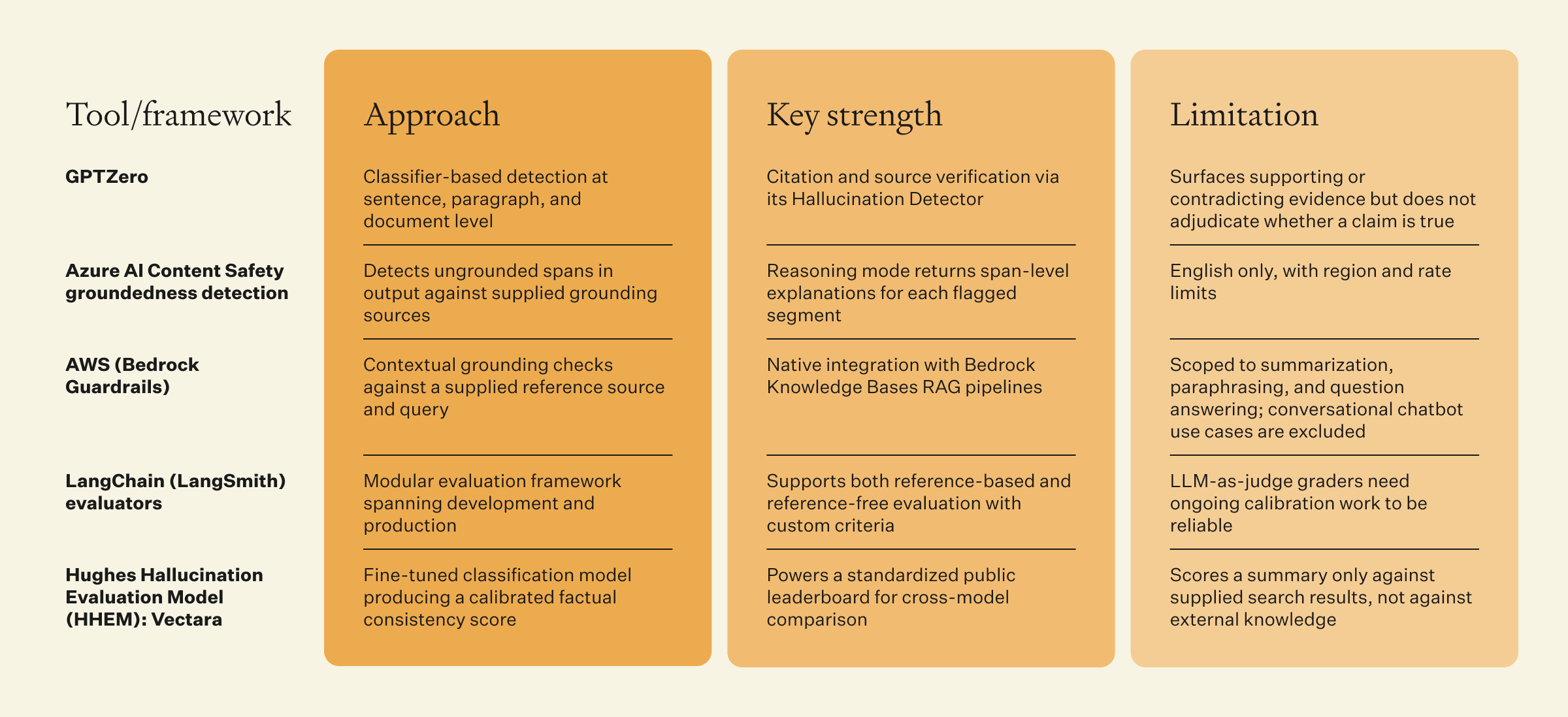
*Click on the image to see the full PDF
Implementation follows five steps that connect detection methods to the broader observability and governance infrastructure.
Two metrics anchor the program:
Groundedness score: Percentage of outputs that pass the detection pipeline
Drift rate: Change in groundedness score over time.
Set threshold targets per use case: A customer-facing chatbot may require 95%+ groundedness, while an internal research assistant may accept 85%.
Capture every LLM output along with its input prompt, retrieved context (for RAG systems), model version, and timestamp. This telemetry is the raw material for both real-time detection and retrospective analysis.
Select detection methods based on the precision-recall-cost trade-offs that match your volume and risk profile. A recommended stack for production: token overlap as a cheap pre-filter, semantic similarity as the primary screen, and LLM prompt-based evaluation for outputs that pass the first two layers but serve high-stakes use cases.
Surface detection results alongside operational metrics (latency, cost, throughput) so teams can correlate hallucination rates with model changes, data refreshes, or prompt updates. When groundedness drops after a model version update, the dashboard shows the correlation immediately.
Route flagged outputs to human reviewers. Feed review decisions back into the detection pipeline (confirmed hallucinations refine detector thresholds; false positives adjust sensitivity). Align data access policies with governance requirements: Detection systems that access retrieval context must comply with the same data governance controls as the production system.
Dataiku, the Platform for AI Success, offers Dataiku LLM Guard Services (Safe Guard, Quality Guard, Cost Guard) that embed guardrails and evaluation directly into the AI workflow, screening outputs at inference time rather than analyzing them after delivery.
Quality Guard evaluates output quality against defined standards. Safe Guard screens for safety and policy compliance. Cost Guardprevents token waste from recursive or unproductive agent loops. It traces spend by use case, user, and project, allowing administrators to define budget limits and quotas at the project, user group, or LLM provider level. When usage hits a defined threshold, Cost Guard alerts stakeholders or automatically blocks further queries.
Every detection method involves trade-offs that cannot be engineered away, only managed. The challenge is not finding a perfect detector. It is building a detection system that catches enough hallucinations to make the LLM trustworthy while keeping the cost and latency overhead low enough to justify the deployment.
LLM-based detection is the most accurate but also the most expensive per evaluation. Stacking cheaper methods as pre-filters reduces the number of outputs that need expensive evaluation.
Detection systems trained or calibrated on one domain (legal, medical, general knowledge) may underperform on another. Calibrate thresholds per domain and re-evaluate when the system's use cases expand.
As underlying models are updated, hallucination patterns change. Detection thresholds calibrated for one model version may not apply to the next. Re-benchmark after every model change.
The stochastic checker misses hallucinations that the model is consistently confident about. LLM-based detection and reference comparison are the only methods that catch these.
Four best practices for production deployment:
Stack multiple detection methods for layered coverage rather than relying on any single approach
Tune detection thresholds per domain and re-calibrate quarterly
Implement human spot-checks on a random sample of outputs that pass automated detection to catch systematic blind spots
Communicate detection limitations to users transparently: A "verified" label should mean something; do not apply it to outputs that have only passed a token overlap check.
Layered detection, semantic observability, and governance work together to close the gap between "the model generated an answer" and "the answer is trustworthy."
The concrete next step: Pilot one detection method against a representative sample of your production LLM outputs this week. Measure groundedness. Identify the failure patterns, and use those patterns to select which additional detection layers to stack.
Dataiku embeds hallucination guardrails and evaluation into governed AI workflows, so detection is part of the production pipeline rather than a separate monitoring exercise.
*Click on the image to see the full PDF
RAG-powered knowledge assistants (where retrieval quality directly affects answer accuracy), customer-facing chatbots (where hallucinated policy or product information creates liability), clinical decision support systems (where incorrect medical information creates patient safety risk), and legal research tools (where fabricated citations create professional sanctions risk). The common thread: any application where the user acts on the AI's output without independent verification.
LLMs generate text by predicting the most likely next token based on patterns in training data. They do not verify factual accuracy during generation. When the model encounters a query where training data is sparse, contradictory, or absent, it fills the gap with statistically plausible but factually unsupported text. Retrieval-augmented generation reduces this by grounding responses in retrieved documents, but does not eliminate it: The model can still hallucinate when synthesis of retrieved information introduces unsupported inferences.
No. Detection reduces hallucination rates but does not eliminate them. Every detection method has blind spots: Token overlap misses paraphrased hallucinations, semantic similarity misses factually wrong but semantically close outputs, stochastic checking misses consistent hallucinations, and LLM-based detection inherits the judge model's own limitations. The goal is layered coverage that catches the majority of hallucinations combined with human review processes that catch what automated detection misses.
LLM prompt-based detection offers the highest precision for nuanced hallucinations but at the highest cost per evaluation. Semantic similarity offers the best precision-to-cost ratio for most enterprise use cases. Stacking methods (token overlap as a pre-filter, semantic similarity as the primary screen, LLM-based evaluation for high-stakes outputs) provide the strongest layered coverage. The right combination depends on volume, latency tolerance, and the cost of an undetected hallucination in the specific use case.
Semantic observability provides the infrastructure context that makes detection actionable: reasoning traces that show which retrieved documents informed the output, evaluation scores that track groundedness over time, and feedback loops that route confirmed hallucinations back into detector calibration. Without semantic observability, detection operates in isolation: It flags individual outputs but cannot identify systematic patterns, trace failures to their source in the retrieval or generation pipeline, or measure whether detection is improving output quality over time.