Enterprise AI orchestration: what it is and why it matters
July 3, 2026/9 min read/Team Dataiku
Most enterprises have data, models, and cloud infrastructure. Very few have AI working at scale across their organization. The missing piece is not more technology. It is orchestration: the layer that connects everything and keeps it governed.
According to "7 career-making AI decisions for CIOs in 2026," based on a Dataiku/Harris Poll survey of 600 enterprise CIOs, 74% regret at least one major AI vendor or platform selection made in the past 18 months. A common driver of that regret: choosing tools that solved individual AI problems but left the coordination and governance gaps that prevent enterprise-wide deployment.
This guide covers what enterprise AI orchestration is, why it matters, its core components, the highest-impact use cases, and a six-step implementation roadmap.
Enterprise AI orchestration is the coordination layer that unifies AI models, data pipelines, agents, and business workflows into a governed, operational system.
Orchestration is not integration. Integration moves data between systems. Orchestration coordinates intelligence across systems and adapts as conditions change.
Some of the highest-impact use cases span finance (invoice exception handling), IT operations (autonomous ticket triage), supply chain (real-time disruption response), and marketing (personalized campaign orchestration).
A six-step roadmap from current-state assessment through pilot to governed production scale defines the implementation sequence.
Enterprise AI orchestration is the discipline of coordinating AI models, data pipelines, agents, business rules, and human judgment into unified workflows that operate reliably at organizational scale.
The critical distinction: Orchestration is not integration. Integration moves data between systems through connectors, ETL pipelines, and APIs. Orchestration, on the other hand, coordinates intelligence across systems, deciding which model handles which task, routing work between agents, enforcing governance policies, and adapting execution paths based on real-time conditions. A workflow engine executes a fixed sequence. An orchestration layer adapts.
When orchestration works, AI stops being a collection of disconnected projects and starts operating as an organizational capability that compounds value across every function it touches.
Enterprises are not failing at AI because they lack technology. They are struggling because they cannot organize people, orchestrate intelligence, and govern outcomes at scale.
Three scale challenges make orchestration necessary:
Model sprawl: Teams deploy models independently across different tools and cloud environments, creating duplicated effort and inconsistent governance.
Governance gaps: Without a coordination layer, compliance controls are applied unevenly or after the fact, creating regulatory exposure that grows with every new deployment.
Latency between insight and action: When AI outputs require manual handoffs to reach business processes, the speed advantage of AI is lost.
Consider a supplier disruption scenario:
Without orchestration: A risk model detects a supplier issue, an analyst reviews the alert hours later, manually checks inventory, contacts procurement, and initiates a reorder.
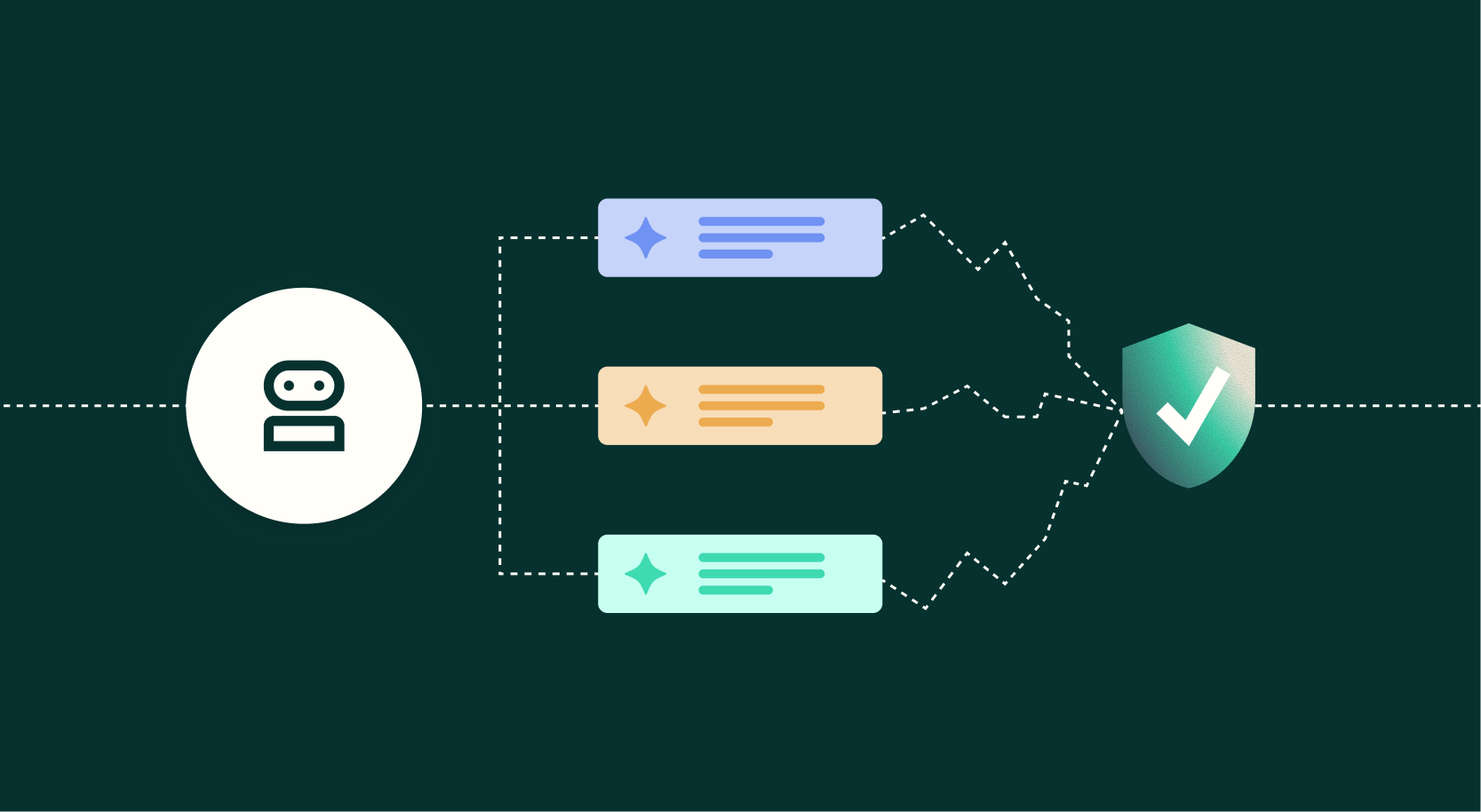
With orchestration: The risk model triggers an automated workflow that checks inventory levels, evaluates alternative suppliers, generates a procurement recommendation, and routes it to a human approver, all within minutes of detection.
The tangible benefits: Faster decision cycles, cost control through resource visibility, compliance through embedded governance, and reuse of AI assets across teams rather than rebuilding for each use case
Enterprise AI orchestration builds on three foundational components that work together to coordinate AI pipeline orchestration end to end.
The orchestration engine is the dynamic workflow coordinator that routes tasks to the right model, agent, or human based on real-time context. Unlike static scripts that execute the same sequence every time, a context-aware orchestration engine evaluates the incoming request, selects the appropriate processing path, and handles errors through defined fallback logic.
Example: In a fraud detection workflow, the orchestration engine routes low-confidence transactions to a secondary model for re-evaluation, high-confidence fraud flags to an automated blocking action, and ambiguous cases to a human analyst with full context attached.
Enterprise AI runs across cloud, on-premises, and edge environments simultaneously. The inference mesh manages model deployment across all three, routing requests to the right compute location based on data residency requirements, latency constraints, and cost optimization.
In many enterprise environments, moving large datasets to a model introduces latency and cost that running the model closer to the data avoids. Where data residency requirements or network constraints apply, deployment flexibility is an orchestration requirement, not just an infrastructure preference.
Every orchestrated workflow must operate within defined governance boundaries. RBAC controls who can access which models and data. Audit trails record every decision, tool call, and data interaction. Policy-as-code enforces compliance rules automatically at runtime rather than relying on manual review.
For regulated industries, explainability requirements vary by framework. GDPR establishes a right to explanation for automated decisions that significantly affect individuals. Sector-specific regulations — including financial services model risk guidance and healthcare data requirements — set their own standards.
Regardless of which frameworks apply, a production AI orchestration layer should maintain a traceable record from input through model inference to output, both to satisfy regulators and to support internal audit.
How does AI pipeline orchestration work end to end?
An orchestrated AI pipeline follows a lifecycle: data ingestion, model selection, agent execution, and monitoring.
Data ingestion
Source data arrives from transactional systems, APIs, streaming feeds, and document repositories. The orchestration layer validates data quality and routes it to the appropriate processing pipeline.
Model selection
The orchestration engine selects the right model based on the task type, cost constraints, and latency requirements. A simple classification task routes to a lightweight model. A complex reasoning task routes to a frontier LLM. This routing happens automatically through orchestration logic.
Agent execution
For multi-step workflows, agents execute tasks in sequence or parallel, using tools, querying data sources, and making decisions within defined boundaries. Human-in-the-loop checkpoints pause execution for approval at high-stakes decision points.
Monitoring
Production observability tracks performance, cost, accuracy, and drift across every component. Rollback and versioning ensure that any component can be reverted to a previous state if monitoring detects degradation.
The key difference between batch and real-time flows: Batch pipelines process historical data on a schedule (nightly retraining, weekly reporting). Real-time pipelines process live data as it arrives (fraud detection, customer service triage, dynamic pricing). Most enterprises run both, and the orchestration layer manages the handoff between them.
Four use cases consistently deliver the most measurable impact across enterprise AI orchestration deployments.
Before orchestration: Invoice exceptions are flagged in the ERP, routed to an accounts payable analyst, manually reviewed against contracts and purchase orders, and resolved through email chains.
Average resolution: Three to five days
With orchestration: An ML model classifies the exception type, an agent retrieves the relevant contract terms and PO data, a rules engine applies policy logic, and the system either auto-resolves or routes to a human with full context.
Resolution: Minutes for auto-resolved cases, hours for escalated ones
Before orchestration: Support teams manually classify incoming tickets, frequently misroute them to Level 2 or Level 3 due to unclear working instructions, and spend significant time searching for resolution guidance buried across past tickets and documentation.
With orchestration: An AI agent classifies each ticket by category, urgency, and complexity, surfaces relevant historical cases and resolution steps, and routes tickets to the correct specialist group, all within the existing support workflow. Routine issues such as password resets and access requests are auto-resolved. Complex issues reach the right team with diagnostic context already attached, reducing unnecessary escalations and eliminating overnight backlogs.
Geodis, the global logistics provider, deployed an AI IT Support Agent in Dataiku integrated directly with ServiceNow. The result: 60% faster ticket assignment and approximately 30 minutes saved per ticket, with Level 1 teams resolving a higher share of issues that previously required escalation.
Before orchestration: Supply chain teams monitor dashboards manually, detect disruptions hours or days after they begin, and coordinate responses through meetings and email.
With orchestration: Sensor data and supplier feeds trigger automated risk assessments. When a disruption is detected, the orchestration layer checks inventory, evaluates alternative suppliers, generates rerouting recommendations, and routes the recommendation to a human approver. Response time drops from days to minutes.
Response time drops from days to minutes.
Before orchestration: Campaign teams manually segment audiences, select content, and distribute across channels, with limited ability to adjust targeting based on real-time performance. Compliance checks happen after the fact, creating delays and regulatory exposure.
With orchestration: A segmentation model identifies target audiences. A content selection agent matches messaging to segment characteristics. A channel routing agent distributes content across email, web, and paid media. A performance feedback loop monitors campaign results and adjusts targeting in near real time. Compliance controls enforce consent management and data residency requirements at every step.
Enterprise AI orchestration requires governance controls embedded at the orchestration layer, not bolted on afterward.
Agent identity: Every agent operating in production has a defined identity, scope of authority, and documented owner.
Data residency controls: Data processing respects jurisdictional requirements automatically based on the request's origin and the data's classification.
Audit logging: Every model call, agent action, tool invocation, and data access is logged in an immutable audit trail.
Bias monitoring: Production outputs are monitored for disparate impact across protected characteristics, with alerts when thresholds are breached.
Rollback testing: Every model and agent version can be rolled back to a previous state without disrupting the production workflow.
Cost guardrails: Per-model, per-agent, and per-workflow token budgets prevent uncontrolled spending.
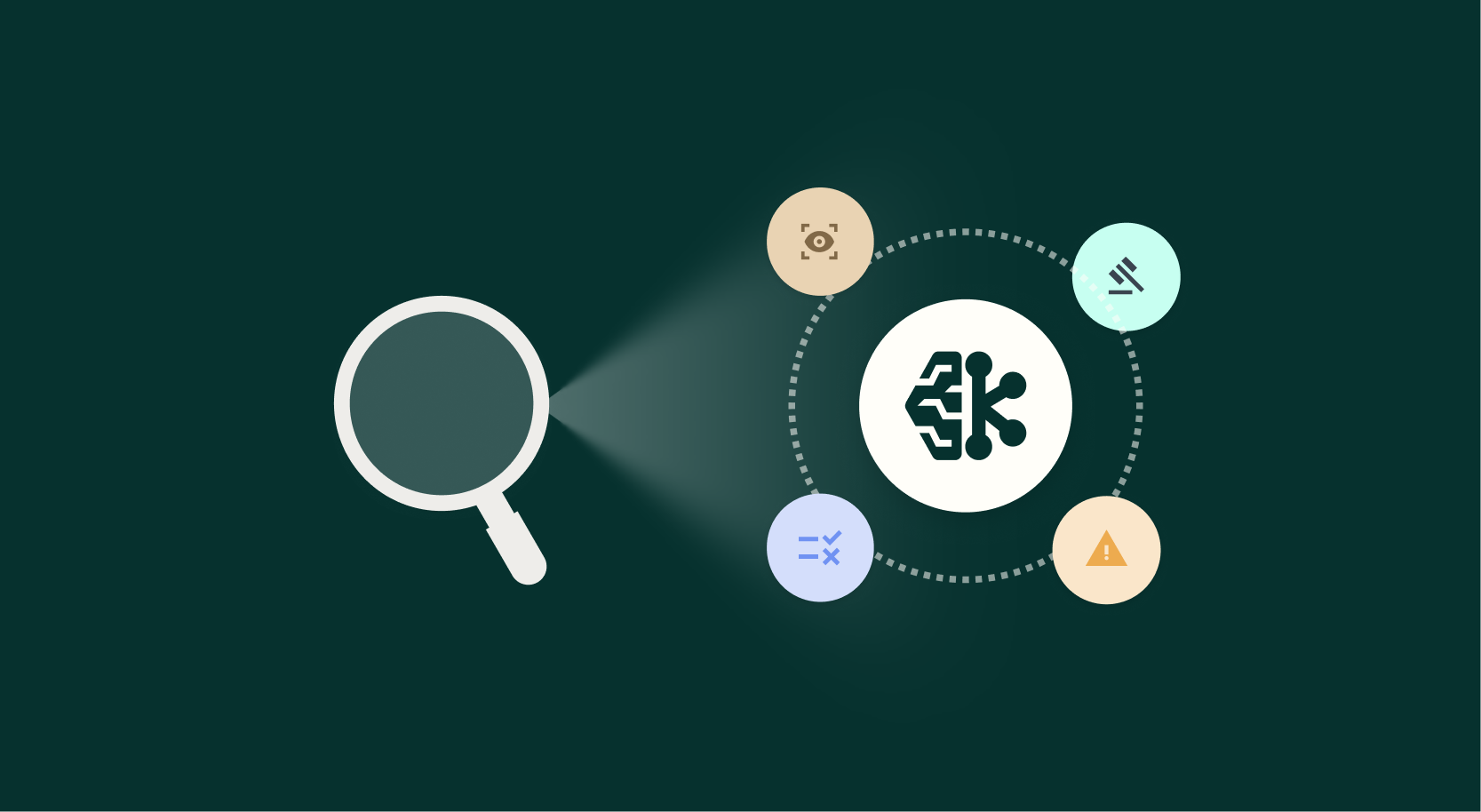
Dataiku, the Platform for AI Success, provides the enforcement mechanisms for this governance layer. Dataiku Govern manages lifecycle approvals and audit trails. Dataiku LLM Guard Services (Safe Guard, Cost Guard, Quality Guard) screen prompts and responses at runtime. The Dataiku LLM Mesh routes model requests through a governed gateway with cost tracking and provider management built in.
The terms orchestration, integration, and robotic process automation (RPA) describe different capabilities that often operate alongside each other.
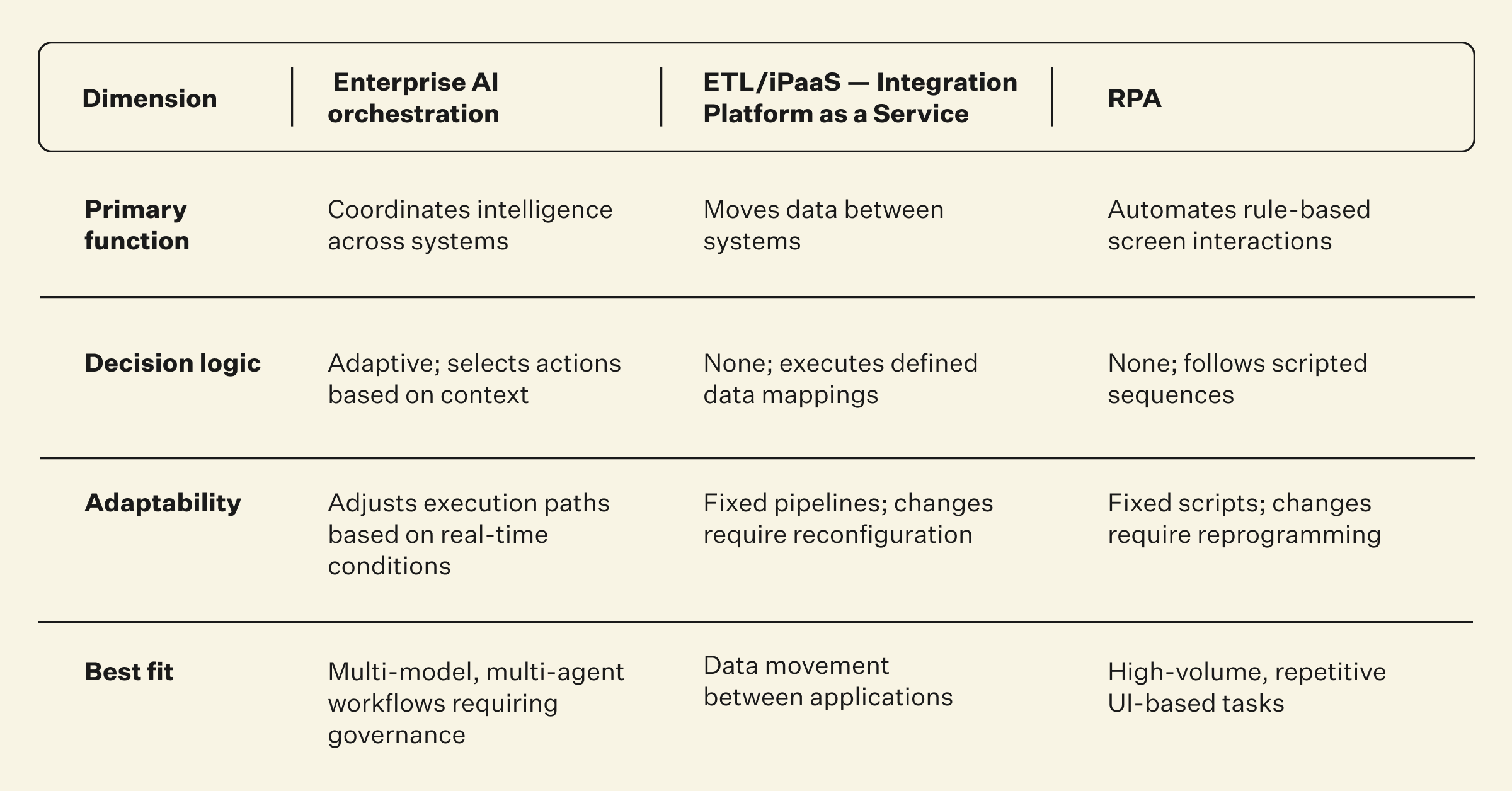
When to use each:
Integration for data movement between systems
RPA for automating repetitive screen-based tasks
Enterprise AI orchestration for coordinating intelligent workflows that require reasoning, adaptation, and governance
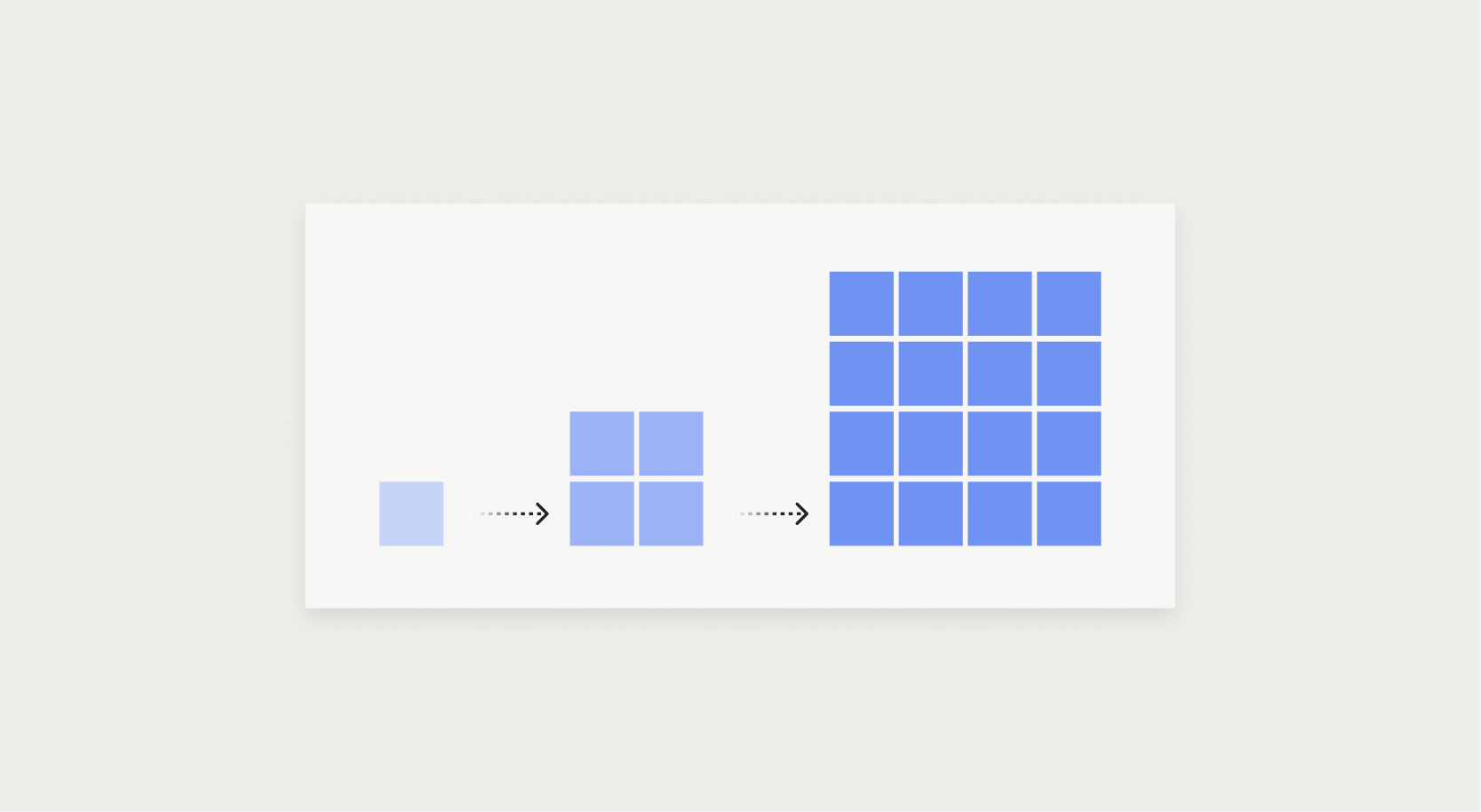
Most orchestration implementations fail not because the platform underperforms, but because the pilot was poorly scoped or the data was not ready. This roadmap sequences the work to avoid both.
Inventory existing AI assets: Models, agents, data pipelines, and governance controls.
Identify coordination gaps and duplicated effort.
Success metric: Complete AI asset inventory with documented ownership
Stakeholder: CDAO and IT leadership
Choose a workflow with high volume, clear KPIs, and an existing manual process that can serve as a baseline.
Success metric: Signed pilot scope with measurable outcome target
Stakeholder: Business unit sponsor and AI team lead
Verify that the data feeding the pilot workflow is accessible, governed, and quality-checked. This step is where most pilots stall.
Success metric: Data pipeline delivering quality-verified inputs to the orchestration layer
Stakeholder: Data engineering
Evaluate platforms against six criteria: Model and agent support, governance controls, deployment flexibility, integration breadth, observability, and total cost of ownership.
Success metric: Platform selection with documented evaluation rationale
Stakeholder: CIO and procurement
Define which decisions require human approval, what confidence thresholds trigger escalation, and how overrides are documented.
Success metric: Governance framework with defined approval gates
Stakeholder: Risk and compliance
Extend the pilot to adjacent workflows with centralized governance.
Track business KPIs alongside technical metrics.
Widen autonomy gradually as trust builds.
Success metric: Production deployment with continuous monitoring against business outcomes
Stakeholder: Cross-functional AI steering committee
Enterprise AI orchestration is the operating model that determines whether AI investments compound into organizational value or fragment into disconnected projects. The organizations that get this right share a common trait: They treat orchestration as an architectural decision, made early and built to scale.
Enterprise AI orchestration is the architectural decision that determines whether AI investments compound into organizational capability or fragment into disconnected projects. The organizations that scale AI successfully share a common trait: they treat orchestration as a foundation, built early and designed to grow, rather than a coordination problem solved after the fact.
Dataiku sits across your clouds, data platforms, and AI services as the orchestration layer that connects them into one governed system. That is where production AI at scale gets built.
AI orchestration is the coordination of AI models, data pipelines, agents, and business rules into unified workflows that operate reliably and are governed consistently. In practical terms, it is the layer that decides which model handles which task, routes work between agents, enforces policies, and adapts execution paths based on real-time conditions.
Integration moves data between systems through connectors and ETL pipelines. Enterprise AI orchestration coordinates intelligence across systems: selecting models, routing agent workflows, enforcing governance, and adapting execution based on context. Integration is a prerequisite for orchestration, but orchestration adds the decision logic, governance, and adaptability that integration does not provide.
Enterprises need AI orchestration because without it, AI assets (models, agents, data pipelines) operate in silos. This creates duplicated effort, inconsistent governance, and a gap between AI outputs and business processes. Orchestration closes that gap by coordinating AI into unified workflows with embedded governance, reducing the manual handoffs and fragmentation that prevent AI from scaling.
Three components are foundational: an orchestration engine that routes tasks dynamically based on context, an inference mesh that manages model deployment across cloud, on-premises, and edge environments, and a governance layer that enforces RBAC, audit trails, and policy-as-code at runtime. Production-grade platforms also include observability dashboards, cost controls, and rollback capabilities.
A focused pilot (single workflow, single team, defined KPIs) typically reaches production in 10 to 16 weeks. Enterprise-wide deployment across multiple business units, with full governance frameworks and change management, takes six to twelve months. The biggest variable is data readiness: If the data feeding the orchestration layer is not governed and quality-checked, the timeline extends regardless of how capable the platform is.