Best AI agent frameworks (2026)
August 17, 2026/7 min read/Team Dataiku
Choosing an AI agent framework is the build decision. It determines how agents reason, coordinate, and use tools during development. What it does not determine is whether those agents behave safely, stay within scope, and deliver their intended business outcomes once they are running in production at scale.
In 2026, the build problem is largely solved. The five agentic frameworks in this article make it possible to deploy capable agents faster than ever. The production accountability problem is newer, less discussed, and the reason enterprise AI deployments still fail at a higher rate than their pilots suggest they should.
Most enterprises can build an agent. Far fewer can scale one across the business with confidence. Frameworks aren't the bottleneck. Governance is.
This guide covers both: the five frameworks best suited to enterprise agent development, and the governance layer that production deployments require on top of them.
Five frameworks solve the build problem: LangGraph and LlamaIndex for workflow flexibility, CrewAI and AutoGen for rapid multi-agent prototyping, and Semantic Kernel for enterprise compliance tooling.
Match the framework to your team's language ecosystem first: Semantic Kernel and Microsoft Agent Framework for .NET or Java, the rest for Python-first teams.
Cross-model support and production observability are table stakes now, not differentiators, so they shouldn't drive the framework decision.
None of the five frameworks govern what happens after deployment: who approved the agent, whether it's hitting business targets, or how it behaves as models drift.
Dataiku sits above any framework as the governance layer, connecting to agents on LangGraph, CrewAI, AutoGen, Semantic Kernel, LlamaIndex, and beyond without requiring a framework change.

AI agent frameworks are software libraries that provide the building blocks for autonomous AI systems, including planning and reasoning loops, tool calling, memory management, and multi-agent orchestration.
They differ from building agents from scratch in the same way web frameworks differ from writing raw HTTP handlers: They abstract the coordination logic so developers focus on task definition and tool integration rather than infrastructure. The primary architectural choice is single-agent versus multi-agent support, which determines whether the framework can handle workflows where specialized agents collaborate on complex tasks.
Consider a fraud detection agent built on an agentic framework. It monitors transactions, calls a scoring tool, evaluates the result against business rules, escalates flagged cases to a human reviewer, and logs every decision.
Built from scratch, that is weeks of coordination code. Built on a framework, the reasoning loop, tool calling, and memory management are handled, and the team focuses on the fraud-specific logic.
Six criteria matter most for enterprise framework selection.
1. Scalability: Can the framework handle concurrent agent execution across large workloads without performance degradation?
2. Security and access controls: Does the framework support role-based permissions and secrets management, or does this need to be built separately?
3. Integration breadth: How well does it connect to the LLMs, data sources, and enterprise tools already in use?
4. Complexity and learning curve: What is the realistic time-to-first-deployment for a team at your engineering skill level?
5. Ecosystem maturity: Active community, stable APIs, and maintained documentation reduce long-term maintenance risk.
6. Licensing: Open-source, commercial, or hybrid licensing affects total cost of ownership and legal review requirements in regulated industries.
Two 2026-specific notes: Cross-model support (Gemini, Claude, Mistral, and open-weight models) is now expected, not differentiating. And production observability tooling (tracing, logging, cost tracking) has moved from nice-to-have to table stakes.
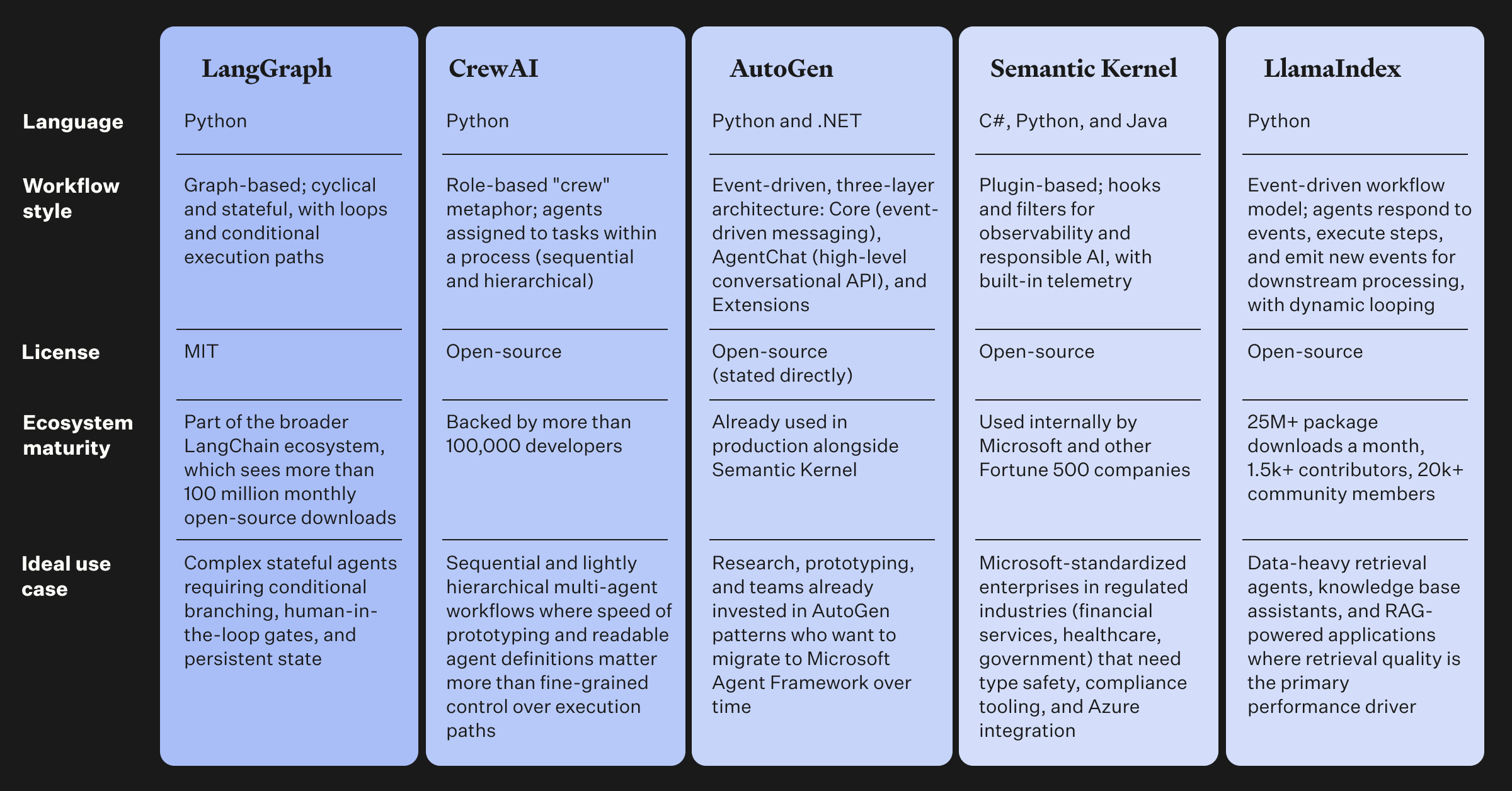
Click on the image above to zoom into full PDF
Note: Framework specifications and maintenance status sourced from each project's published materials. Verified as of July 2026.
These five were chosen based on community adoption, production readiness, and coverage across the primary enterprise agent workflow patterns.
LangGraph is a graph-based orchestration framework that enables cyclical, stateful agent workflows. Agents operate as nodes in a graph, with edges defining transitions based on runtime conditions. This architecture supports loops and conditional execution paths for iterative workflows.
Checkpoint-based state management means workflows can be paused, resumed, and replayed for debugging. LangGraph's durable execution model persists agent state automatically and supports pausing for human review at any point. LangGraph is part of the broader LangChain ecosystem, which sees more than 100 million monthly open-source downloads, with vendor-confirmed production deployments at Klarna, LinkedIn, Uber, and Replit, and LangSmith providing production observability.
Primary limitation: The graph abstraction introduces a learning curve beyond standard Python, particularly steeper for teams accustomed to procedural code.
Ideal for: Complex stateful agents requiring conditional branching, human-in-the-loop gates, and persistent state
CrewAI uses a role-based 'crew' metaphor: developers define agents with roles, goals, and tools, then assign them to tasks within a process, such as sequential and hierarchical. Multi-LLM support spans Claude, Gemini, GPT, and open-weight models.
CrewAI's 1.0 release added built-in observability at the framework level, with every execution shipping default visibility into runs. CrewAI AMP, the paid enterprise offering, adds a unified control plane, real-time tracing, and RBAC.
Primary limitation: CrewAI's Crews handle sequential and hierarchical flows out of the box, but complex branching workflows where the execution path is not known at design time require a separate primitive — Flows — layered on top.
Ideal for: Sequential and lightly hierarchical multi-agent workflows where speed of prototyping and readable agent definitions matter more than fine-grained control over execution paths
AutoGen is Microsoft's open-source framework built on a three-layer architecture: Core (event-driven messaging), AgentChat (high-level conversational API), and Extensions for LLM clients and tool integrations. The framework pioneered several multi-agent patterns including group chat and hierarchical agent-as-tool composition.
Important 2026 context: Microsoft has released Microsoft Agent Framework 1.0 (GA April 3, 2026) as AutoGen's enterprise-grade successor, merging AutoGen's agent abstractions with Semantic Kernel's enterprise features.
Primary limitation: AutoGen's Team abstraction has no built-in checkpointing, so persistence and recovery must be built externally, adding complex state management and serialization work that competing frameworks handle natively
Ideal for: Research, prototyping, and teams already invested in AutoGen patterns who want to migrate to Microsoft Agent Framework over time
Semantic Kernel is Microsoft's enterprise-grade AI framework with hooks and filters for observability and responsible AI, and built-in telemetry support. It supports C#, Python, and Java, and Microsoft has committed to non-breaking changes for existing 1.0+ workloads.
Important 2026 context: Microsoft Agent Framework 1.0 (GA April 3, 2026) is the consolidated successor that inherits Semantic Kernel's enterprise foundations alongside AutoGen's orchestration innovations. Microsoft has stated it will continue to address critical bugs and security issues in Semantic Kernel and bring some existing features to GA, but that the majority of new feature investment is now directed at Microsoft Agent Framework.
Primary limitation: Microsoft's own comparison flags reduced performance from this design, citing "optimized object creation and memory usage" as a benefit of its successor by implication. Ideal for: Microsoft-standardized enterprises in regulated industries (financial services, healthcare, government) that need type safety, compliance tooling, and Azure integration
LlamaIndex uses an event-driven workflow model where agents respond to events, execute steps, and emit new events for downstream processing. Dynamic looping allows agents to iterate on results, with loop conditions defined in plain Python logic.
The framework's core strength remains data connectivity: LlamaIndex's lower-level APIs let developers customize and extend data connectors, indices, retrievers, and query engines, making it a strong choice for agents that need to reason over large document corpora or structured datasets.
Primary limitation: Workflows are async-first by design, and LlamaIndex's documentation states that running one assumes an async environment, requiring a dedicated async entry point for standalone scripts.
Ideal for: Data-heavy retrieval agents, knowledge base assistants, and RAG-powered applications where retrieval quality is the primary performance driver
Your team has selected a framework. Agents are built. The harder question: How do you know those agents are performing as intended in production?
Frameworks handle agent logic. They do not handle who approved that logic before it reached production, which users can interact with which agents, whether outputs are meeting the business targets the agents were deployed to achieve, or what happens when agent behavior drifts as the underlying model updates.
Dataiku, the Platform for AI Success, provides the governance and orchestration layer that sits above any framework on this list. Dataiku Agent Management connects to agents built on LangGraph, CrewAI, AutoGen, Semantic Kernel, and LlamaIndex, as well as those running on AWS Bedrock, Microsoft Copilot, Snowflake Cortex, and Databricks, without requiring the underlying framework to change.
Business KPI monitoring rather than technical uptime: An agent can show 99% uptime and still be failing its actual purpose. Dataiku monitors against defined business outcomes and surfaces the difference.
Behavioral drift detection: As models update and input distributions shift, agent behavior changes in ways that technical monitoring does not catch. Dataiku identifies drift at the output level.
Governance workflows: Approval routing, compliance review, and remediation workflows before issues reach production, not after.
Audit trails and RBAC: Every agent interaction is logged, with role-based access controls determining which users can build, deploy, or modify agents.
The framework decision and the governance decision are sequential, not competing. Choose the framework that fits the build requirements. Then make sure what gets built has accountability infrastructure around it.
Choosing a framework and layering governance on top solves the architecture problem, but most agentic deployments fail or stall for more mundane operational reasons. The following practices address the gaps that show up once agents move from a demo to something a compliance team or executive has to sign off on.
Think one agent, one workflow, one measurable outcome before scaling. The fastest path to organizational confidence is a single success with clear metrics, not a multi-agent system that nobody can explain.
Cost caps, rate limits, and output filters are easier to implement before an agent is in production than after. Retrofitting guardrails onto running agents creates downtime and governance gaps.
Unbounded loops are among the most common and expensive failure modes in agentic deployments. Set termination conditions explicitly: maximum iterations, token budgets, and timeout thresholds.
Repeated identical prompts are a significant source of unnecessary inference spend. Implement prompt caching at the application level to reduce API costs without affecting output quality.
LangSmith and Semantic Kernel telemetry tell you if agents are running correctly. Dataiku Agent Management tells you if they are achieving their intended business purpose. Both layers are necessary for a production deployment that can be defended to a compliance team or executive stakeholder.
LangGraph for complex stateful workflows. CrewAI for role-based multi-agent coordination. AutoGen for research and experimental multi-agent systems (with an eye toward migration to Microsoft Agent Framework). Semantic Kernel for Microsoft-aligned regulated enterprises. LlamaIndex for retrieval-heavy data pipelines.
Primary evaluation rule: match the framework to the team's existing language ecosystem and the workflow's coordination complexity before evaluating any other criteria.
Pilot quickly. Measure against real business outcomes from the start. And build governance in before scale makes it expensive to retrofit.
Whichever framework a team chooses, Dataiku sits above it as the layer that turns a working prototype into a system a compliance team or executive can trust.
Deliver AI agents
Deliver AI agents
The frameworks themselves are free (all five are open-source). The costs come from three sources: LLM API spend (which scales with agent activity and model tier), infrastructure (compute for self-hosted models and framework hosting), and engineering time (development, testing, and ongoing maintenance). For a production agent running on a mid-tier LLM, expect $500 to $5,000 per month in API costs depending on volume, plus infrastructure and personnel.
Run the same agent workflow on two to three candidate frameworks against your actual data and tool set. Measure four metrics: end-to-end latency (time from input to final output), task completion accuracy (percentage of correct outcomes on a labeled test set), token consumption per task (the primary cost driver), and developer velocity (time from concept to working agent). Synthetic benchmarks are useful for initial screening, but production-representative workloads are what determine real-world performance.
Semantic Kernel leads with first-class .NET, Python, and Java support. AutoGen supports Python and .NET. LangGraph, CrewAI, and LlamaIndex are Python-first. Microsoft Agent Framework 1.0, built on Semantic Kernel's multi-language foundation, is the only .NET/Java path here.
Four features matter most: secrets management (how API keys, tokens, and credentials are stored and accessed), RBAC (who can build, deploy, and modify agents), audit logging (recording every agent action, tool call, and data access), and sandboxing (isolating agent execution to prevent unintended system interactions). Semantic Kernel provides the strongest built-in compliance tooling. For other frameworks, these features typically need to be built on top or provided by a governance layer like Dataiku.
Three trends are converging: the Microsoft Agent Framework is merging AutoGen and Semantic Kernel into a unified successor, which will consolidate the Microsoft ecosystem. MCP (Model Context Protocol) adoption is standardizing how agents discover and call tools, reducing framework-specific integration code. And production governance tooling (business outcome monitoring, behavioral drift detection, output audit trails) is moving from a separate concern to an expected framework capability, driven by enterprise demand for accountability alongside capability.