Top five alternatives to Cohere LLM (2026)
August 19, 2026/7 min read/Team Dataiku
Cohere's reranking and RAG capabilities are well-regarded, but enterprises are moving for reasons that range from cost pressure to data residency requirements to performance gaps on specific workloads. That is layer one of the problem.
Layer two is more important: The question behind "Which model should replace Cohere?" is "How do we stop this from being a disruptive re-engineering project every time the LLM market shifts?"
According to "7 career-making AI decisions for CIOs in 2026," based on a Dataiku/Harris Poll survey of 600 enterprise CIOs, 81% expect to rely on two or more LLM providers in 2026, and 93% agree that different LLMs perform better for different use cases, requiring continual evaluation and switching. Model selection is a point-in-time decision. Model strategy is an ongoing operating discipline.
This guide covers both: the five strongest Cohere alternatives for specific workloads, and the architectural question of how enterprises stay model-agnostic as the market evolves.
Five Cohere alternatives split across two categories: Mistral Large 3 and AI21 Jamba for generation, zerank-2, BGE Reranker, and Jina's m0 for retrieval reranking.
zerank-2 tops public reranker leaderboards and runs two to three times faster than Cohere at the median — the strongest pick when reranking accuracy is the priority.
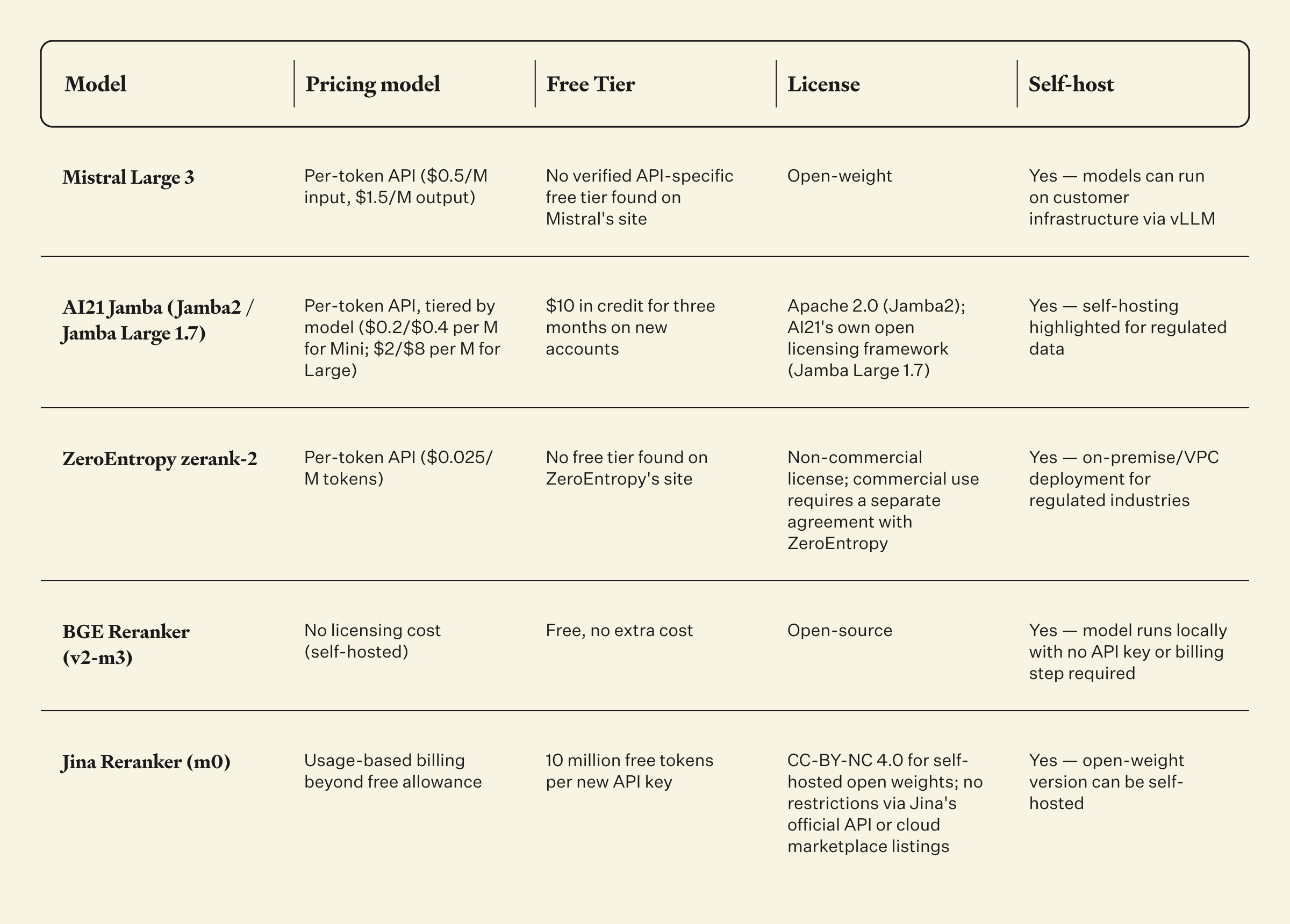
Pricing ranges from free (BGE, fully self-hosted) to $0.025 per million tokens (zerank-2) to premium generation pricing on Mistral and AI21 — the right pick depends on workload, not just cost.
Dataiku is the governance layer that keeps whichever models you choose from becoming a re-engineering project the next time the market shifts.

Click on the image above to zoom into full PDF
These five were selected because they address the specific workloads where enterprises most commonly outgrow Cohere: general-purpose LLM reasoning, multilingual content generation, and retrieval reranking for RAG pipelines. Each review covers strengths, limitations, pricing, and ideal use cases.
Mistral Large 3 is Mistral AI's flagship open-weight model. It runs on a sparse mixture-of-experts design with a 256,000-token context window and pricing of $0.5 per million input tokens and $1.5 per million output tokens. The model ships fully open and covers a wide language range.
Mistral ships its own retrieval components rather than only a generation model. For regulated deployments, models can run entirely on customer infrastructure. Mistral's own legal center frames its compliance work specifically around European regulation, a relevant differentiator for enterprises with EU data-governance requirements. Model customization is available, but only as a managed engagement.
Limitation: Mistral's own documentation confirms that its self-serve fine-tuning API is no longer supported.
Best for: Teams that want an open-weight, self-hostable generation model with EU-oriented governance credentials, rather than a self-serve fine-tuning workflow
AI21's current model family is Jamba, built on a hybrid architecture, combining Mamba's efficiency with Transformer quality. The Mini tier runs on a mixture-of-experts design. Every model in the family carries a context window of 256K and covers nine languages.
For regulated data, AI21 highlights self-hosting. Fine-tuning is directly supported through AI21's own documentation. Licensing differs by tier: Jamba2 ships under the Apache 2.0 License, while Large 1.7 is released under AI21's own open licensing framework.
Pricing on AI21's own site runs $0.2 / 1M input tokens and $0.4 per million output tokens for Jamba Mini, scaling to $2 and $8 per million for Jamba Large.
Limitation: AI21 does not claim uniform output quality across all prompts, and flags this directly in its model documentation. Teams evaluating Jamba for production use should account for this variability during testing rather than assuming Cohere-level consistency out of the box.
Best for: Teams that need long-context, multilingual generation with self-hosting flexibility and a self-serve fine-tuning path
zerank-2 is ZeroEntropy's flagship reranker, and the company's own launch post claims it outperforms every other reranker on accuracy and latency at half the price. ZeroEntropy's own product page backs this with a direct latency comparison against Cohere, running two to three times faster at the median, with the gap widening further under load. On accuracy, the same page reports a leaderboard-leading NDCG@10 score across 29 evaluation datasets.
Pricing is listed directly on ZeroEntropy's site at $0.025 per million tokens. Context is capped at 32K tokens, and enterprise deployment options include a hosted API, single-tenant deployment, and on-premise or VPC deployment for regulated industries.
Limitation: zerank-2's accuracy comes with a licensing catch: The model is released under a non-commercial license, and any commercial deployment requires contacting ZeroEntropy directly for a separate agreement, rather than a standard open-weight license teams can adopt unilaterally
Best for: Teams that need the highest reranking accuracy available and can run the managed API or provide GPU infrastructure
BGE Reranker v2-m3, from the Beijing Academy of Artificial Intelligence, is described in BAAI's own documentation as a lightweight, multilingual, fast-inference model. The same page lists it as a 568M-parameter model, the smallest and lightest in BAAI's current reranker lineup. BAAI's usage documentation shows the model loaded and run locally with no API key, billing step, or managed-service dependency, consistent with self-hosted deployment at no licensing cost — v2-m3 is one of the open-source models this description covers.
Limitation: BAAI's own model-selection guidance recommends v2-m3 for multilingual use, Chinese-or-English tasks, and efficiency — but names two other models specifically for teams prioritizing raw performance
Best for: Teams building a self-hosted retrieval stack where infrastructure cost and vendor independence matter more than chasing the top score on every benchmark
Jina's multimodal reranker, m0, is purpose-built to handle mixed text-and-image content. That makes it the only pick in this list that can rerank scanned pages, screenshots, and PDFs directly, rather than relying on OCR as a preprocessing step.
The open-weight version of Jina's rerankers, including m0, carries a CC-BY-NC 4.0 license restricting free use to non-commercial purposes. That restriction doesn't extend to ordinary commercial use, though: Jina's own licensing guidance confirms there are no restrictions for teams using its official API or official cloud marketplace listings — the non-commercial limit only applies to teams self-hosting the raw downloaded weights outside Jina's own service.
New API keys start with a meaningful free allowance of 10M tokens, and the models are also available for private cloud deployment. Beyond the 10 million free tokens, Jina describes usage-based billing rather than a flat subscription.
Limitation: m0's context window is considerably smaller than Jina's own text-only flagship reranker. Jina's own FAQ attributes limits like this to serving infrastructure rather than the model's architecture. The model also enforces a minimum image size of 28x28 pixels.
Best for: Teams whose corpora genuinely mix text and visual content; teams with text-only documents will get more context headroom from a dedicated text reranker like zerank-2 or BGE.
The five alternatives above solve the model selection problem. But they do not solve the model management problem: How do you run multiple models across multiple teams with consistent governance, cost controls, and auditability?
Dataiku, the Platform for AI Success, addresses this through the Dataiku LLM Mesh, which connects to a broad ecosystem of LLM providers and self-hosted models through a single governed gateway. When you switch from Cohere to zerank-2 for reranking, or from Cohere Command to another provider for generation, the change happens at the configuration level rather than requiring pipeline reconstruction.
Four capabilities make this work:
Model substitution without pipeline changes lets teams swap any model in the routing layer without touching application code.
Cost Guard monitors and traces LLM usage against budget, Safe Guard screens prompts and responses for sensitive information before they reach users, and Quality Guard evaluates output quality with standardized, code-free metrics — all three integrated directly into the LLM Mesh.
Full auditability and lineage trace how data, models, and agents connect, giving regulated environments visibility into how every decision was produced.
Routing based on cost, latency, or quality thresholds lets the system pick the right model for each task automatically.
Dataiku governs how models are used, by whom, at what cost, and with what auditability. For enterprises already planning for two or more LLM providers, that is not optional infrastructure. It is the operating layer that makes the multi-model strategy sustainable, and it's also what keeps AI dependency from becoming a board-level risk: the freedom to change providers only holds if the architecture underneath was built to let you.
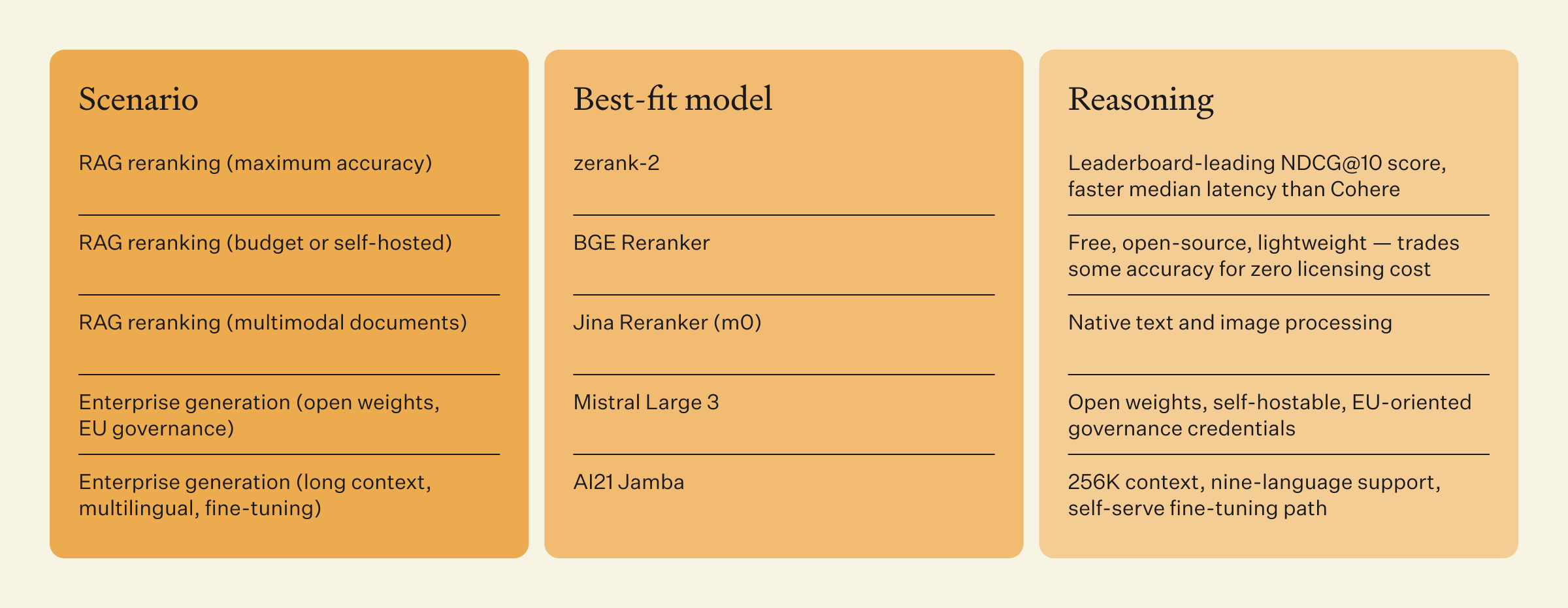
The right replacement depends on which Cohere capability you're replacing and what constraint is driving the switch. Use the table below to match your primary workload to the model that addresses it.
Click on the image above to zoom into full PDF
None of these five solve the model management problem on their own. Dataiku is where that layer lives — governing model routing, cost, and auditability across whichever of these five (or future) providers an enterprise chooses.
Shortlist two candidates and test them against your actual workload before committing. Then ask the harder question: Can your infrastructure absorb the next model switch without the same disruption? If not, the model-agnostic orchestration layer is worth evaluating alongside the model itself.
The Dataiku LLM Mesh
The Dataiku LLM Mesh
Migration difficulty depends on how tightly Cohere is integrated into your pipeline. If you call Cohere's API directly from application code, switching requires code changes at every call site. If you route through an orchestration layer (like the Dataiku LLM Mesh), switching is a configuration change. The architectural choice you make now determines how disruptive the next switch will be.
zerank-2 leads on reranking accuracy with a leaderboard-topping NDCG@10 score and faster latency than Cohere. BGE Reranker offers competitive, zero-cost self-hosted reranking. Jina's m0 handles multimodal, image-inclusive corpora natively. For the generation layer, Mistral Large 3 provides open-weight, self-hostable performance with EU-oriented governance.
Yes. BGE Reranker and Mistral Large 3 both ship under Apache 2.0. Jina's rerankers are open-weight under CC-BY-NC 4.0, unrestricted commercially via Jina's own API. AI21 Jamba2 uses Apache 2.0; Jamba Large 1.7 uses AI21's own open licensing framework, both permitting commercial use.
zerank-2 costs $0.025 per million tokens. BGE is free to self-host. Mistral Large 3 starts at $0.50/$1.50 per million tokens. AI21 Jamba starts at $0.20/$0.40 per million tokens for Mini, scaling to $2/$8 for Large.
Mistral is a trademark of Mistral AI. Jamba is a trademark of AI21 Labs. ZeroEntropy is a trademark of ZeroEntropy. BGE is a product of the Beijing Academy of Artificial Intelligence. Jina is a trademark of Jina AI, now part of Elastic N.V.Cohere is a trademark of Cohere Inc. Dataiku is not affiliated with or endorsed by any of the above companies. All product capabilities, pricing, and benchmark results referenced in this article are sourced from each vendor's own published materials as of July 2026.