Best free LLM APIs for developers (2026)
August 18, 2026/7 min read/Team Dataiku
Free LLM API access in 2026 is genuinely good. Competitive pricing pressure, led by Meta's open-weight Llama 4 release, combined with new open-weight models and generous provider free tiers, has made it possible to build functional AI applications without spending a dollar during prototyping.
This article covers five providers — OpenRouter, Google AI Studio, HuggingFace Inference, Groq, and Cloudflare Workers AI — and the criteria used to compare them. All five support OpenAI-compatible SDKs, which means switching between them is a one-line configuration change.
One honest caveat before the comparison: Freetiers are built for individual developers working alone. The moment a project involves a second team, a paying customer, or a regulated data environment, the API access question gives way to a different set of questions entirely. This article addresses both.
Five free LLM API providers are compared across model variety, request limits, latency, data policy, and commercial terms: OpenRouter for the broadest free model catalog, Google AI Studio for the most generous token throughput, HuggingFace for the widest task variety, Groq for the lowest inference latency, and Cloudflare Workers AI for edge deployment across a global network.
All five support the OpenAI SDK protocol, meaning switching between providers is a configuration change rather than a code rewrite.
Free tiers are well suited to individual developers prototyping alone. The moment a project involves a second team, a paying customer, or a regulated data environment, model access is no longer the constraint.
Audit trails, access controls, cost visibility across users, and output-quality monitoring become the requirements at that point, and none of the five providers above are designed to meet them at the API level.
Free LLM APIs matter because the cost barrier to AI prototyping has effectively disappeared for individual developers.
The pricing shift is real. DeepSeek's V3 release pushed inference costs down across the market. Llama 4 Scout introduced a very large context window under Meta's open community license, among the largest of any open-weight model. The result: Developers can build, test, and iterate on AI applications without a budget approval.
Typical use cases for free tiers include hackathon projects, minimum viable products and proof-of-concept demos, side projects and personal tools, and internal tooling prototypes that need to demonstrate value before securing budget.
With so many options available, the comparison question has shifted from “Can I afford to experiment?” to “Which provider fits my specific build?”
Five criteria structure the comparison. Each maps to a real decision a developer makes when a prototype starts to feel like a product.
Model quality: Reasoning capability and output reliability for the target task; a free model that hallucinates on every third response is not saving time.
Request and token limits: Daily and per-minute caps on the free tier, and how quickly they become a constraint in realistic workflows
Latency: Time-to-first-token and throughput, particularly relevant for real-time or user-facing applications where response speed affects experience
Data policy: Whether inputs are used for model training, and what that means for proprietary or sensitive content sent through the API
Commercial terms: Whether the free tier permits use in commercial products or restricts to personal and research use only
All five providers below support OpenAI-compatible SDK protocols, which means the provider URL and API key are the only changes needed when switching between them.
The table summarizes the five providers:
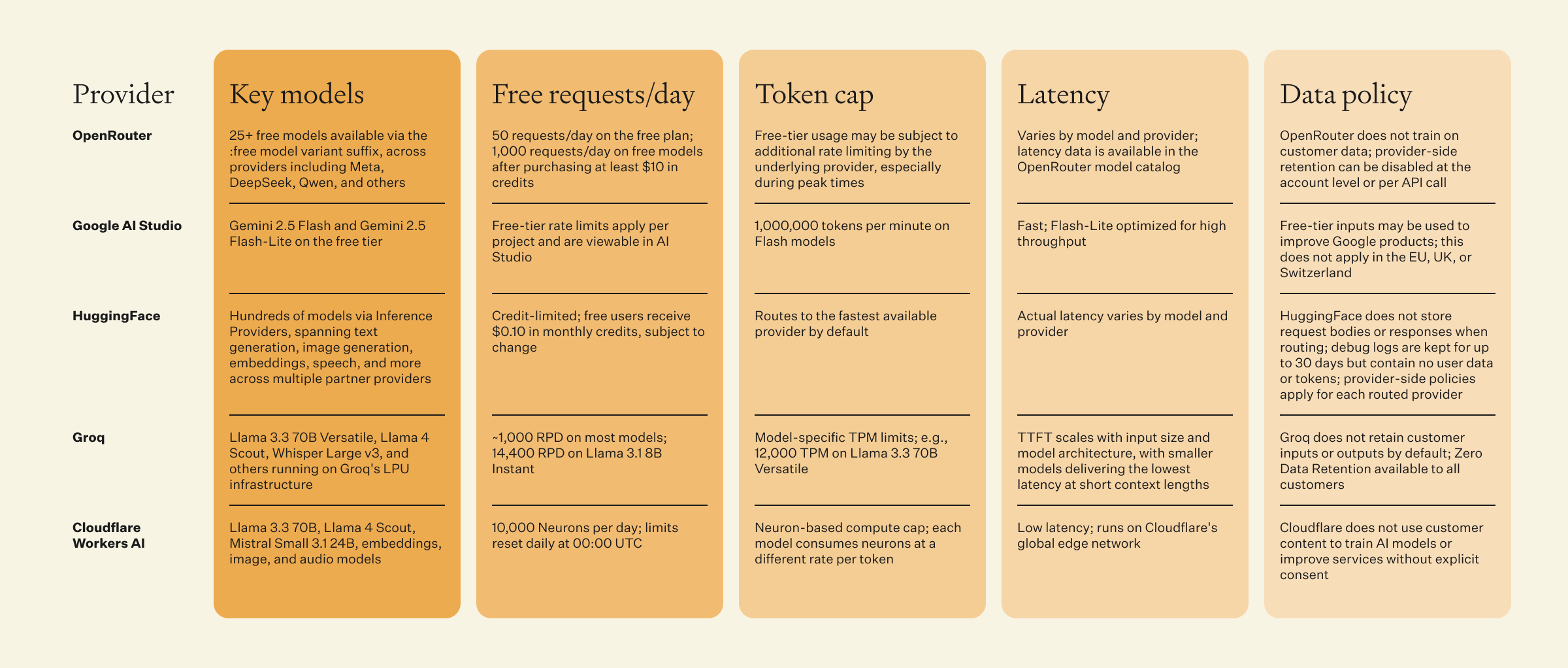
Click on the image above to zoom into full PDF
Note: Rate limits and model availability change frequently. Figures above are sourced from each provider's published documentation and were verified in June 2026.
These five were chosen based on free-tier generosity, model quality, and developer experience.
OpenRouter is a unified API gateway that routes requests across 400+ models from a wide set of providers through a single endpoint. The free tier is capped at 50 requests per day on an unfunded account, rising to 1,000 requests per day once you have purchased $10 in credits, with a shared limit of 20 requests per minute. No credit card is required to start.
The standout convention is appending :free to any compatible model ID, so you do not have to track which free models are available on any given day.
Pro
The broadest free catalog on this list, giving developers access to models from multiple providers without managing a separate API key for each one
Con
Free-tier quotas are enforced per account, so heavy use of one model eats into the daily cap for all of them
Best for: Broad model experimentation and developers who want to compare models through one endpoint
Google AI Studio offers some of the highest free token throughput on this list. Gemini 2.5 Flash and Flash-Lite are available on the free tier, with rate limits applied per project and viewable directly in AI Studio.
Pro
A 1M-token context window at no cost, with per-project rate limits viewable in AI Studio, strong for high-volume text and long-document work
Con
Outside the EU, UK, and Switzerland, free-tier inputs and outputs may be used by Google to improve its models, so review the data policy before sending anything proprietary
Best for: High-volume text processing, long-document analysis, and developers already in the Google Cloud ecosystem
HuggingFace Inference Providers route a single API and token across hundreds of models and multiple third-party inference partners, spanning open-weight and proprietary models across multiple task types.
Every signed-in user receives $0.10 in monthly credits to experiment (subject to change), with $2.00 in monthly credits on the paid PRO plan. The InferenceClient handles provider selection and routing automatically.
Pro
Wide model variety through one API and token, covering text, image, embedding, and classification tasks without self-hosting or managing separate provider accounts.
Con
The $0.10 monthly free credit depletes quickly on larger models, so it suits quick tests and evaluations rather than sustained development.
Best for: Testing open-weight models, comparing model variants, and researchers who need the HuggingFace catalog without self-hosting
Groq's LPU (Language Processing Unit) hardware delivers speeds ranging from 280 to 1,000 tokens per second depending on the model. The free plan provides 30 requests per minute and 1,000 requests per day on most models, with Llama 3.1 8B reaching 14,400 requests per day.
Production models include Llama 3.1 8B and Llama 3.3 70B, alongside preview models including Llama 4 Scout, Qwen3-32B, and Whisper, all accessible through an OpenAI-compatible endpoint.
Pro
High-speed inference optimized for real-time and user-facing applications, with no training on customer inputs by default.
Con
Groq's model catalog is focused and curated; it covers a narrow set of production-ready open-weight models rather than a broad catalog.
Best for: Real-time, user-facing applications where response speed directly affects experience
Cloudflare Workers AI runs models at the edge across Cloudflare's global network, offering 10,000 neurons per day on the free tier, resetting daily at 00:00 UTC. Current models include Llama 4 Scout, Mistral Small 3.1 24B, Qwen3, embedding models, and text classification, among others.
Pro
Edge inference across 200+ locations reduces latency for globally distributed apps, with an OpenAI-compatible API and no separate infrastructure to manage.
Con
Neurons remain the underlying billing unit even though Cloudflare now publishes per-model per-token equivalents alongside neuron costs, which can make consumption harder to predict at a glance.
Best for: Latency-sensitive applications serving a global user base, especially teams already building on Cloudflare Workers
Free APIs solve the model access problem. But they do not solve the problems that appear when a project moves from one developer to a team, from a demo to a paying customer, or from internal use to a regulated environment.
Those problems are consistent across every provider above: no audit trail on model inputs and outputs, no access controls on who can query which model, no cost visibility across multiple users, and no quality monitoring to catch output drift over time.
Research bears this out. According to "7 career-making AI decisions for CIOs in 2026," based on a Dataiku/Harris Poll survey, 82% of CIOs agree employees are creating AI agents and apps faster than IT's ability to govern them, and 89% agree that broader employee access to AI tools without strong governance will create significant technical debt from shadow AI. The gap is rarely the model. It is the governance and cost infrastructure that opens when prototypes move past a single team without the controls to manage them.
Dataiku, the Platform for AI Success, unifies data preparation, machine learning, generative AI, agents, and governance in one environment. The Dataiku LLM Mesh connects to OpenRouter-style gateways, Google, HuggingFace, Groq, Cloudflare, and dozens of other providers through a single governed routing layer. The API choice made during prototyping does not need to change when moving to production. What changes is that model calls now pass through a governed layer.
Four capabilities address the transition. The list opens with a contextualizing point: Each one closes a gap that free APIs leave open.
Continuity with existing API choices: The developer's existing integration code stays intact while calls route through the Dataiku LLM Mesh.
Governance controls at the routing layer: Cost Guard, Safe Guard, and Quality Guard screen every prompt and response before outputs reach users or downstream systems.
Audit logging and lineage: Every model call, its inputs, outputs, model version, and applied policies are logged for compliance and regulatory requirements.
Role-based access controls: Multi-team environments get per-user and per-team permissions on which models and agents can be accessed and for which use cases.
This is not a replacement for the free APIs above. It is the governance layer developers and their organizations need when model access alone is no longer sufficient for production.
Five pitfalls appear repeatedly, each with a paired avoidance tip:
Hidden data-training clauses: Google AI Studio's free tier, for example, may use inputs and outputs to improve Google's models outside the EU, UK, and Switzerland, and similar clauses appear elsewhere. Read the data policy before sending anything proprietary.
Monthly versus daily resets: Some limits reset daily, such as Cloudflare at 00:00 UTC, while others are credit-based, such as HuggingFace. Misreading the reset schedule causes unexpected quota exhaustion mid-project.
Aggressive rate handling: Providers throttle or temporarily block keys that burst well beyond rate limits, and failed attempts can still count toward your quota. Implement exponential backoff in your client from day one.
Fine-print commercial restrictions: Free tiers vary on whether commercial use is permitted and offer no SLA. Check both the provider's terms and each model's license before shipping a product.
The governance ceiling: Free and low-cost APIs have no built-in audit trails, access controls, or output-quality monitoring. When a project moves from personal use to team or enterprise use, this gap creates compliance and accountability risk that API-level tooling cannot address.
Caching tip: Response caching for repeated or similar prompts reduces API calls in production-like testing. Cache at the application level before optimizing at the provider level.
All five providers speak the OpenAI protocol, so switching is a config change, not a code change. Set LLM_BASE_URL, LLM_API_KEY, and LLM_MODEL as environment variables and point the client at any provider:
import os
from openai import OpenAI
# Change these three env vars to switch providers, api_key and model
# OpenRouter: https://openrouter.ai/api/v1
# Google AI:  https://generativelanguage.googleapis.com/v1beta/openai/
# Groq:       https://api.groq.com/openai/v1
client = OpenAI(
    base_url=os.environ["LLM_BASE_URL"],
    api_key=os.environ["LLM_API_KEY"],
)
response = client.chat.completions.create(
    model=os.environ["LLM_MODEL"],
    messages=[{"role": "user", "content": "Summarize this quarter's results."}],
)
print(response.choices[0].message.content)2026 has genuinely lowered the barrier to AI prototyping, and the five providers here cover most developer use cases at zero cost. Test at least two before committing, and build your integration around the OpenAI SDK pattern so switching stays trivial.
The API decision is the first decision in building an AI application, not the last. For projects heading toward enterprise deployment, the next decision is how to govern, monitor, and scale what has been built, and how to get organizational sign-off on putting it in front of users or customers. That is the transition the Dataiku LLM Mesh is built for.
It depends on the provider's terms. Some free tiers explicitly restrict commercial use, and others allow it but offer no SLA, uptime guarantee, or support. For production serving paying customers, either upgrade to a paid tier with SLAs or route through a governance layer like the Dataiku LLM Mesh that provides monitoring, failover, and audit trails regardless of the underlying provider.
Token limits cap the total tokens, input plus output, per request or per time period. Rate limits cap the number of API requests per minute or per day, regardless of token count. A provider might allow 1,000 requests per day but cap each request's tokens. Both matter: The rate limit determines throughput, and the token limit determines how much each request can process.
OpenRouter's free model catalog includes models with context windows up to 1M tokens, though the specific models available on the free tier change frequently. Google AI Studio offers the Gemini 2.5 Flash family with a 1M-token context window on the free tier. Groq supports Llama 3.3 70B with a 131,072-token context window. Context-window availability on free tiers varies by model and may be more restricted than paid tiers.
Generally no. Free API tiers provide inference access — sending prompts and receiving responses — but not fine-tuning. Fine-tuning typically requires paid access, dedicated compute, and labeled training data.
HuggingFace offers the closest path for developers who want to fine-tune without a paid API tier: Model weights hosted on the Hub can be downloaded for free and fine-tuned locally using the HuggingFace Transformers library on your own hardware. This requires a GPU for any practical training run, but the model weights and tooling are both freely available.
Three gaps appear immediately: no audit trails, since every model call needs logging for compliance; no access controls, since multiple teams need scoped permissions; and no cost visibility, since usage needs tracking across users and applications. These are architectural requirements that free APIs are not designed to meet. A governed orchestration layer like the Dataiku LLM Mesh bridges the transition by wrapping the same providers in governance, monitoring, and access controls without requiring the developer to change their integration code.
OpenRouter, Google AI Studio, HuggingFace, Groq, Cloudflare Workers AI, DeepSeek, Llama, Gemini, Qwen, Mistral, and Whisper are trademarks of their respective owners. Dataiku is not affiliated with or endorsed by any of these companies. All rate limits, model availability, and pricing referenced are sourced from publicly available documentation and were verified in June 2026; free-tier terms change frequently, so confirm current limits before building.
Tags