Semantic drift in AI: how to detect, measure, and prevent it in production
September 17, 2026/7 min read/Team Dataiku
Semantic drift in AI occurs when a model's understanding or output gradually moves away from its intended meaning over time. The system does not break or throw errors. It quietly starts conveyingsomething different from what it was designed to mean.
A customer support agent that resolves billing questions accurately in week one starts drifting into product recommendations by week four. The model did not change; multi-turn context accumulated noise that shifted the conversation away from the original intent.
Two department dashboards that agreed on "active customer" counts in January show a 15% discrepancy by June for a similar reason: the data did not change, but one team's AI pipeline updated its entity resolution logic while the other's remained static.
Left unchecked, semantic drift reduces accuracy, creates inconsistent results, and erodes trust in AI-driven decisions. This guide explains how to identify, measure, and prevent semantic drift in production environments.
Semantic drift is a divergence of meaning, not a change in accuracy. A model can maintain high accuracy scores while its outputs quietly drift from their intended meaning.
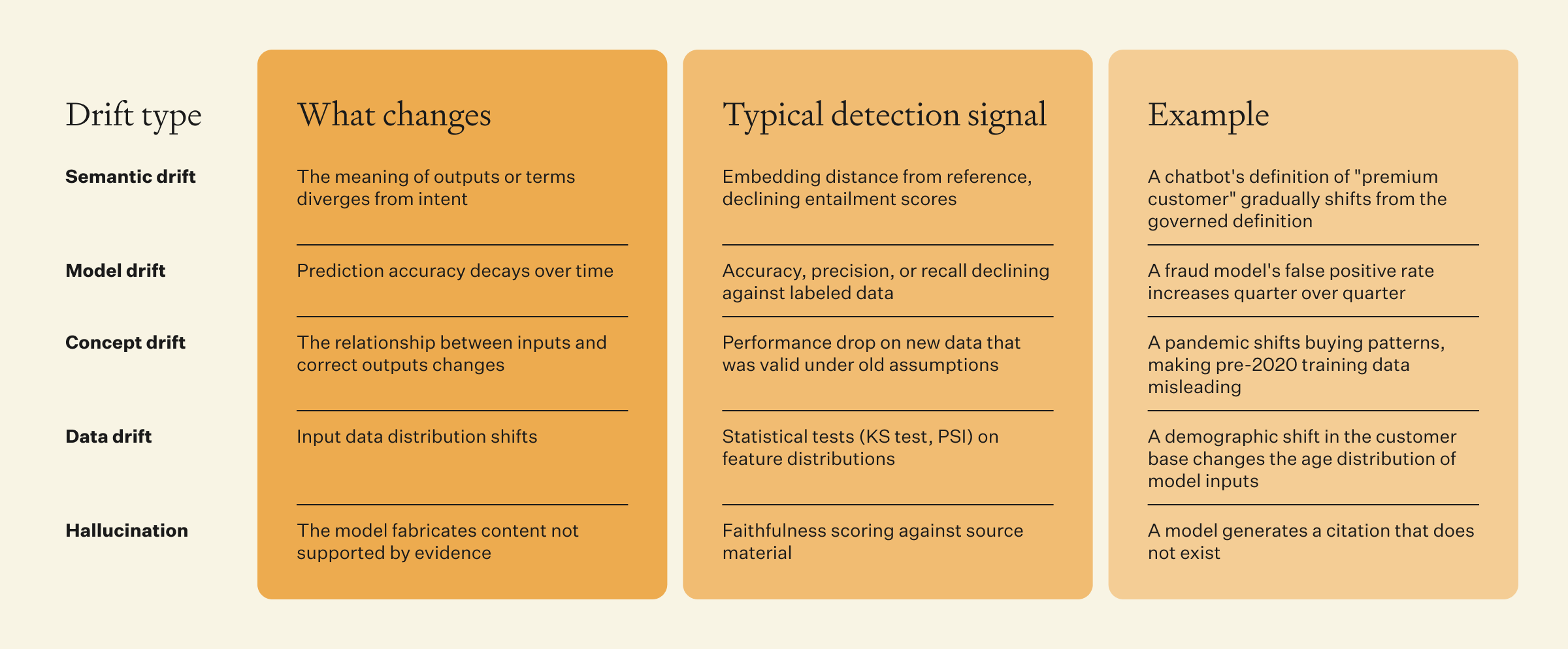
Semantic drift is distinct from model drift, concept drift, data drift, and hallucination. Each describes a different type of change in AI system behavior.
Two manifestations appear most frequently in enterprise environments: multi-turn conversational drift (agents losing the original intent over extended sessions) and business-metric drift (shared terms meaning different things across teams).
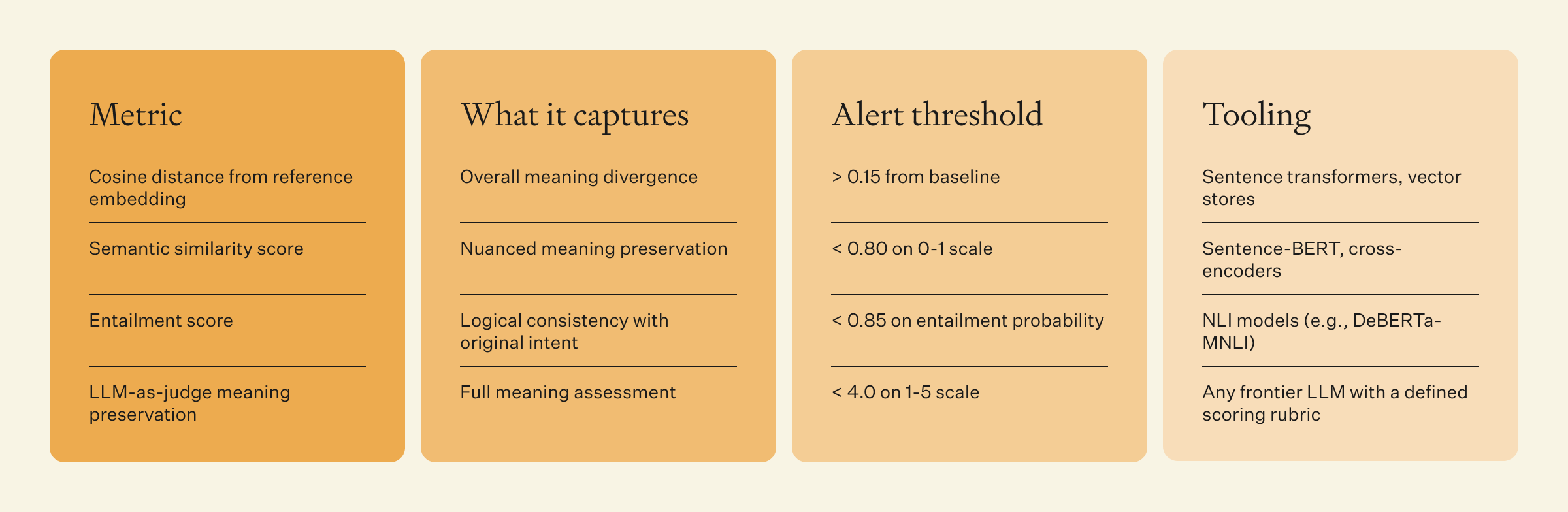
Measurement requires meaning-specific approaches: embedding distance, semantic similarity scoring, entailment checks, and LLM-as-judge evaluation, not traditional accuracy metrics.
Prevention combines technical controls (context refreshes, semantic layers, regression tests) with organizational governance (term ownership, glossary management, cross-team alignment).
Semantic drift is the gradual divergence of meaning in how an AI system interprets or generates content, relative to its intended meaning, and it shows up in what the predictions mean rather than in how often they are correct.
The distinction from related drift types matters because each requires different detection methods and different remediation approaches.
*Click on the image to see the full PDF
Semantic drift is the most subtle because it can occur while accuracy, data distributions, and model performance all look stable. A dashboard can report the right number usingthe wrong definition and pass every technical check. An agent can give a factually accurate answer to a question the user did not ask and log a successful interaction.
Two concrete examples help clarifythe distinction. A multi-turn chatbot handling customer onboarding starts the session focused on account setup. By turn eight, the accumulated context has shifted the conversation toward product features, and the agent is answering questions about functionality rather than completing the onboarding task. No error, no hallucination: the meaning of the conversation has drifted.
Separately, two teams build dashboards that report "active customer" counts. One team's AI pipeline defines active as "logged in within 30 days"; the other defines it as "made a purchase within 90 days." Both definitions were valid when created, but neither team updates its definition as the business evolves, and the counts diverge. This is semantic drift at the business-metric level.
Two manifestations account for the majority of enterprise semantic drift incidents.
In extended agent or copilot sessions, the original user intent can becomediluted turn by turn. Each response adds context to the conversation history, and over multiple turns the accumulated context can shift the model's focus away from the original request and toward tangential topics that appeared in intermediate exchanges.
A 2025 study, "LLMs Get Lost in Multi-Turn Conversation" (Laban et al., Microsoft Research and Salesforce), found an average 39% performance drop from single-turn to multi-turn settings across leading open- and closed-weight models, driven largely by a sharp rise in unreliability as conversations extend. For agents and copilots operating in extended sessions (customer support escalations, multi-step research workflows, collaborative document editing), multi-turn drift is a systematic reliability risk, not an occasional failure.
When multiple AI systems, dashboards, or teams use the same term with subtly different definitions, the meaning of shared metrics can drift apart without detection. "Revenue" means gross in one pipeline and net in another. "Churn" counts voluntary departures in one model and includes involuntary payment failures in another.
The risk is not that the numbers are wrong. It is that decisions aremade on numbers that mean different things, and no one realizes it until the discrepancy surfaces in a board report, a regulatory filing, or a reconciliation exercise.
The business risk of both manifestations is specific: decisions made on drifted meaning rather than bad data. The agent completed the wrong task, not because it hallucinated, but because it lost track of the original intent. The executive acted on misaligned metrics, not because the data was incorrect, but because the definitions had drifted apart.
Measuring semantic drift requires approaches that track meaning preservation, not accuracy preservation. Traditional metrics (accuracy, precision, recall) can remain stable while meaning drifts.
Calculate cosine distance between the current output's embedding and a reference embedding that represents the intended meaning. A growing distance over time indicates drift. This is the most lightweight continuous monitoring approach, but it misses business-term misalignment that embedding similarity cannot capture (two definitions can be semantically similar in embedding space while meaning different things in business context).
Use sentence-embedding models to score how similar each output is to a reference output that represents the correct meaning. This captures more nuance than raw embedding distance because the scoring model evaluates similarity at the semantic level rather than relying only on thevector level.
Test whether the current output entails (or logicallyfollows from) the reference meaning. An entailment model evaluates whether the output preserves the original intent or introduces new, unintended meaning. This is particularly useful for detecting multi-turn conversational drift, where each turn should remain consistent with the original request.
Use a second model to evaluate whether the output preserves the intended meaning. The judge receives the original intent (reference prompt or definition), the current output, and a scoring rubric, and evaluates meaning preservation on a defined scale. This is the highest-fidelity approach but also the most expensive per evaluation.
Implementation checklist for a semantic drift evaluation pipeline:
Define reference intents or definitions for each monitored use case.
Select measurement approach(es) based on cost and fidelity requirements.
Instrument the pipeline to capture outputs alongside their reference intents.
Calculate drift scores on a defined cadence (continuous for embedding distance, daily batch for LLM-as-judge).
Set alert thresholds: warning at 10% deviation from baseline, critical at 20%.
*Click on the image to see the full PDF
Caution: Do not rely on a single embedding-distance score in isolation. Embedding distance captures vector-level divergence but can miss business-term misalignment where two definitions are semantically similar in embedding space ("active customer who logged in" vs. "active customer who purchased") while meaning materially different things in business context. Layer multiple approaches for reliable detection.
Four root causes produce semantic drift in enterprise AI systems. Each maps to specific measurement and prevention approaches.
In extended conversations, the original instruction gets diluted as intermediate context accumulates. By turn ten, the system prompt's influence on the model's behavior may be marginal compared to the accumulated conversation history:The agent is no longer following its original instructions and instead followsthe conversation's momentum.
Detection: Entailment scoring against the original system prompt at each turn
Prevention: Context refresh patterns that re-inject the original intent
Business terms change meaning over time. "Premium customer" may have meant "$100K+ annual spend" last year and "$50K+ with enterprise contract" this year. If the AI system's definition is not updated, it operates on a meaning that no longer reflects the business reality.
Detection: Governance conformance scoring against the certified entity registry
Prevention: Semantic layers with version-controlled definitions
As the document corpus that feeds a RAG pipeline grows, changes, and ages, the grounding context that the model relies on shifts. New documents may use different terminology. Old documents may contain outdated definitions. The model's answers drift because its source material drifted.
Detection: Retrieval relevance scoring over time
Prevention: Document lifecycle management with freshness checks and deprecated-document removal
Industry terminology, product names, and regulatory language evolve. A static embedding model trained on 2024 text may not accurately represent 2026 terminology. The cosine similarity between a 2024-era query and a 2026-era document may be lower than expected, causing retrieval misses or reduced semantic relevance.
Detection: Periodic benchmark evaluation against updated test sets.
Prevention: Scheduled embedding model updates and index refreshes.
Prevention operates at three levels: session-level controls for conversational drift, organizational controls for business-metric drift, and pipeline controls for retrieval drift.
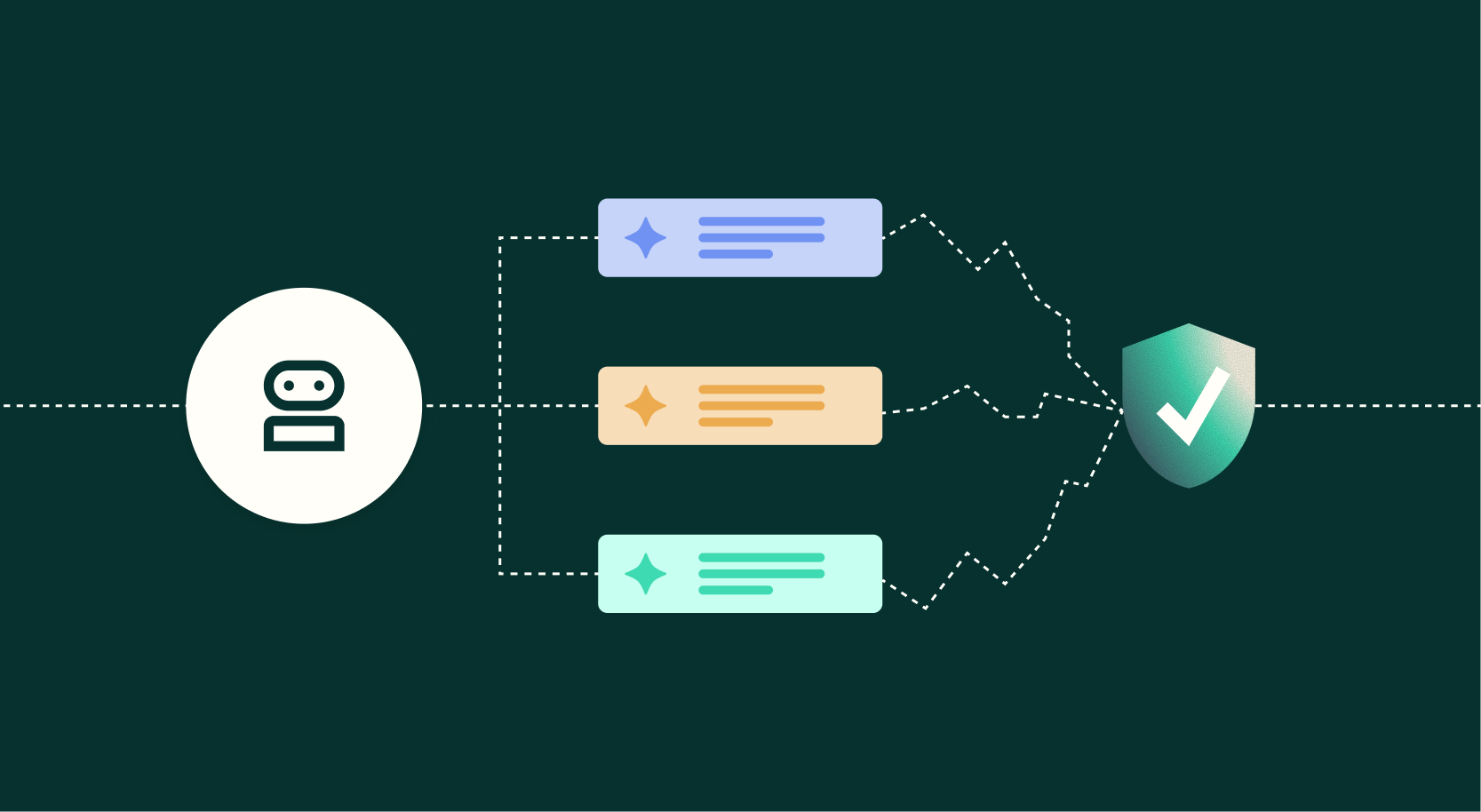
Rather than relying on the full conversation history (which accumulates drift), periodically re-inject the original intent into the context. This resets the model's focus onthe original task.
def build_refreshed_context(original_intent: str, recent_turns: list, max_turns: int = 3):
"""Re-inject original intent alongside recent context to prevent drift."""
refresh_prompt = f"Original request: {original_intent}\n\n"
refresh_prompt += "Recent conversation:\n"
for turn in recent_turns[-max_turns:]:
refresh_prompt += f"- {turn}\n"
refresh_prompt += "\nContinue addressing the original request above."
return refresh_promptCadence:Refresh every three to five turns for customer-facing agents. Refresh at the start of every new subtask for multi-step workflows.
A semantic layer provides one governed definition for each business term, enforced across every AI system that uses it. When the definition of "active customer" changes, the change is version-controlled, documented, and propagated to every pipeline that references the term. This prevents the definition drift that causes cross-team metric inconsistency.
Cadence:quarterly ontology review with cross-functional stakeholders (data engineering, business, compliance).
Build a test set of queries with reference answers that represent the intended meaning. Run the test set against the production system periodically and score for semantic similarity against the reference answers. Regression in similarity scores signals drift before it reaches users.
Cadence:weekly automated regression runs. Monthly review of regression results and threshold calibration.
Retraining or fine-tuning alone. Semantic drift is a meaning problem, not an accuracy problem. A retrained model can achieve higher accuracy scores while still using the wrong definition of a business term. Retraining fixes model drift. It does not fix semantic drift unless the training data itself is updated to reflect the current intended meaning.
Dataiku, the Platform for AI Success, is the enterprise orchestration layer for building, deploying, and governing analytics, models, and agents. Its Dataiku LLM Guard Services (Safe Guard, Cost Guard, Quality Guard) provide built-in checks at inference time. Quality Guard specifically evaluates meaning and quality dimensions before outputs reach production, catching semantic drift at the point of generation rather than through retrospective monitoring alone.
Semantic drift is a definitions-and-ownership problem as much as a technical one, because technical monitoring only catches the symptoms while governance prevents the causes. This checklist covers the organizational controls that make technical monitoring effective.
Assign term owners. Every governed business term has a documented owner who is responsible for the definition's accuracy and currency. The owner is not the data engineer who implemented it. It is the business stakeholder who defines what the term means.
Maintain a versioned glossary. Every business term used in AI systems has a canonical definition in a centralized, version-controlled glossary. Changes to definitions follow a review and approval workflow.
Require sign-off for definition changes. When a term's definition changes, the change requires approval from the term owner and notification to every team whose AI systems reference the term.
Configure embedding drift alerts. Set threshold-based alerts on cosine distance from reference embeddings for every monitored use case. Route alerts to the term owner and the AI team.
Log semantic layer changes. Every change to a semantic layer definition (entity mapping, calculation logic, relationship update) is logged in an immutable audit trail.
Define rollback procedures. When a definition change causes unexpected downstream effects, the team can revert to the previous definition without disrupting production systems.
Schedule cross-functional alignment reviews. Quarterly reviews where data engineering, business, and compliance teams verify that governed definitions still reflect business reality.
Monitor multi-turn session length and intent preservation. For conversational agents, track how intent alignment degrades as session length increases. Set maximum session lengths or mandatory context refreshes based on observed drift patterns.
Audit retrieval corpus freshness. For RAG systems, verify that the document corpus is current and that deprecated documents have been removed. Stale retrieval corpora are the most common source of meaning drift in RAG-powered applications.
Report drift metrics alongside business KPIs. When semantic drift metrics are reported in the same governance review as business performance, the correlation between meaning preservation and business outcome quality becomes visible and actionable.
Dataiku Govern centralizes term ownership, approval workflows, and audit trails, connecting the organizational governance that prevents semantic drift to the technical monitoring that detects it.
Two recurring patterns illustrate how semantic drift manifests differently depending on whether the drift source is conversational (context accumulating noise over turns) or organizational (definitions evolving independently across teams). Each case includes the detection method that caught the drift and the prevention control that resolved it.
The following is a representative scenario based on common semantic drift patterns. Details are illustrative.
An enterprise IT help desk agent handles support tickets through extended Slack conversations. The agent starts each session focused on the user's reported issue. After five to seven turns of back-and-forth clarification, the agent begins addressing symptoms mentioned in intermediate messages rather than the original problem. Users report that the agent "forgets what I asked" and they have to re-explain the issue.
Detection: Entailment scoring against the original ticket description showed a steady decline from 0.92 to 0.61 by turn seven.
Prevention applied: Context-refresh prompt injected every four turns, re-stating the original ticket description. Entailment scores stabilized above 0.85. Session completion rates improved 23%.
A retail company's marketing and finance teams both report "customer lifetime value" (CLV) on executive dashboards. Marketing calculates CLV using projected future value based on engagement scores. Finance calculates CLV using historical transaction data only. Both dashboards are labeled "CLV." The 35% discrepancy was discovered during a board meeting.
Detection: Governance conformance monitoring revealed that marketing's CLV pipeline bypassed the semantic layer and used a custom calculation. The governance conformance score for CLV-related queries dropped from 98% to 71% over three months without triggering an alert because the threshold was set too high.
Prevention applied: The semantic layer was updated with a single governed CLV definition. Both pipelines were reconfigured to reference it. Governance conformance threshold was lowered to 95% with alerting enabled.
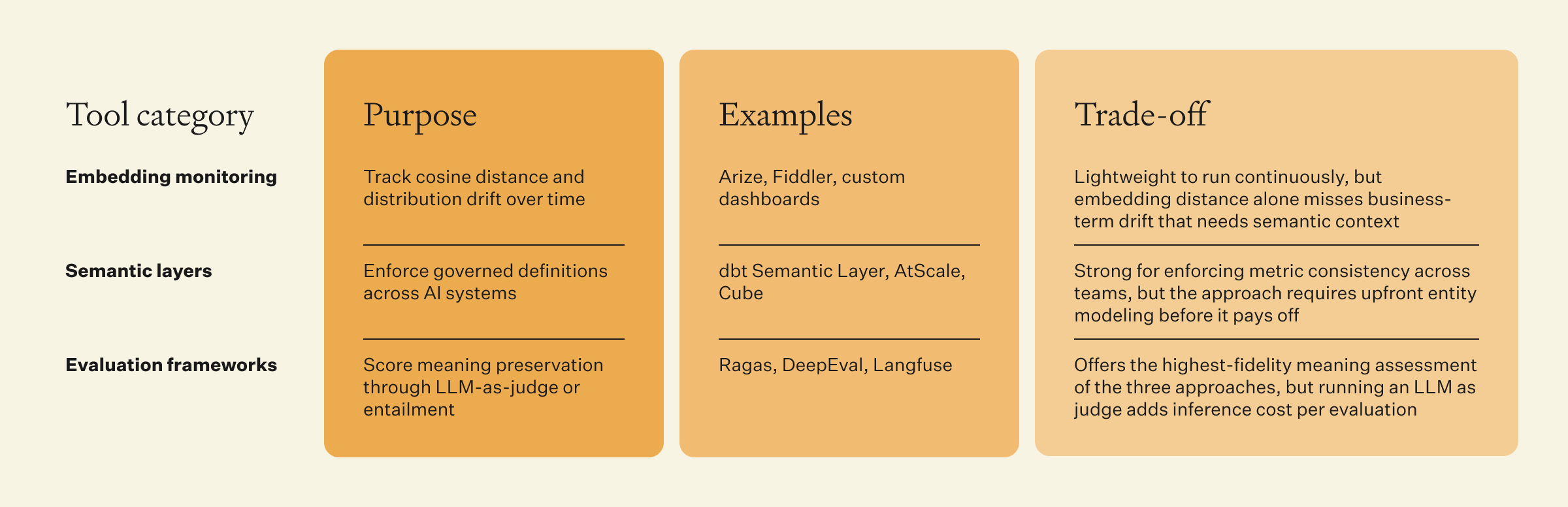
The categories below group the tools referenced throughout this guide by what they are best suited to catch, so teams can match a tool to the type of drift they need to monitor.
*Click on the image to see the full PDF
Semantic drift is solvable. Not through retraining. Not through fine-tuning. Through disciplined meaning-preservation metrics and cross-team term governance.
Early detection matters because semantic drift compounds. A small meaning shift in week one becomes a material discrepancy by month three. The organizations that catch it early are the ones monitoring meaning, not just accuracy.
The concrete next step: pick one business term or one agent workflow this week. Define the reference meaning. Set up a semantic similarity dashboard. Measure drift for 30 days. Use the baseline to set alert thresholds.
Dataiku unifies monitoring, evaluation, and governance so drifted meaning is caught before it reaches production decisions.
Semantic consistency ensures AI systems use the same definitions and interpret shared terms the same way. Without it, two dashboards can show different numbers for one metric, and decisions get made on outputs whose meaning has silently diverged from what the organization intended.
Three approaches catch semantic drift early: continuous embedding-distance monitoring for large shifts, periodic semantic similarity scoring against reference outputs for nuanced drift, and entailment checks for multi-turn conversational drift. Layer all three, since accuracy metrics alone can stay stable while meaning drifts.
Not on its own. Retraining fixes model drift, or accuracy decay, by updating weights on new data. Semantic drift comes from context accumulation or definition changes, so fix it at the definition and context layer first, then retrain if accuracy also needs work.
Semantic layers enforce one governed definition per business term across every AI system that references it. When a definition like "churn rate" changes, the update is version-controlled and propagated automatically, preventing the independent drift that happens when each team keeps its own definition.
No. Language, business definitions, and data all evolve, so some drift is inherent. The goal is management, not elimination: detect it early through continuous monitoring, prevent the worst forms with governed definitions, and correct it quickly once it's found.
Hallucination is fabricated content, wrong at the moment of generation. Semantic drift is meaning diverging gradually, so an output can be right last month and wrong now because the meaning shifted. Hallucination checks outputs against sources; drift checks meaning against a reference intent over time.