7 best LLM tools for businesses in 2026
August 5, 2026/8 min read/Team Dataiku
Most enterprises are not choosing between one large language model (LLM) and another. They are running several at once: different teams using different models for different tasks, with no consistent way to track cost, enforce policy, or prove business value.
According to "7 career-making AI decisions for CIOs in 2026," based on a Dataiku/Harris Poll survey of 600 enterprise CIOs, 81% expect to rely on two or more LLM providers in 2026, and 55% have already switched providers at least once, mainly to reduce costs.
The model ranking question is real and worth answering. But it is only half the problem. This article covers which models fit which business workloads today, and what infrastructure your organization needs so the next provider switch does not cost as much as the first one.
No single model is the right choice across all workloads. Customer-facing interactions, internal analytics, content generation, and code-assist each prioritize different attributes, and the best model for one task may be the wrong choice for another.
Open-weight models such as DeepSeek V4 and Llama 4 Maverick offer cost and data-control advantages for on-premises and budget-constrained deployments. Proprietary models such as GPT-5.5, Claude Opus 4.8, and Gemini 3.1 Pro offer stronger out-of-the-box performance and managed infrastructure.
Most enterprise AI programs will run more than one model simultaneously. Eighty-one percent of CIOs expect to rely on two or more LLM providers in 2026, which makes the governance infrastructure around those models as important as which models are chosen. Dataiku, the Platform for AI Success, provides that layer through the Dataiku LLM Mesh.
Choosing the right LLM matters because different business workloads prioritize fundamentally different model attributes, and a mismatch between workload and model creates cost waste, performance gaps, or compliance exposure.
Four workloads drive most enterprise LLM selection decisions:
Customer-facing interactions (chatbots, support agents, live assistants) weigh latency and safety controls. A model that reasons deeply but responds slowly fails the user experience.
Internal analytics (document analysis, financial review, research synthesis) weigh reasoning depth and context length. A model with a short context window cannot process the 200-page contract your legal team needs analyzed.
Content generation (marketing copy, reports, communications) weighs output quality and cost per generation. Premium models produce better content but may be overkill for high-volume, lower-stakes output.
Code-assist and workflow automation weigh accuracy on structured tasks and tool-use capabilities.
Understanding which workload you are solving for determines which evaluation criteria matter most.
Six criteria structure the model comparison that follows:
Task performance: Benchmark accuracy for the specific workload type, not general capability scores. A model that leads on reasoning benchmarks may underperform on customer-service latency requirements.
Cost at scale: Per-token or per-call pricing at realistic production volumes, not sandbox pricing; A model that costs a fraction of a cent per call in testing can cost tens of thousands of dollars per month at enterprise throughput.
Context window and memory: How much the model can hold in a single prompt; long-document analysis, multi-turn conversations, and codebase review all require large context windows.
Deployment flexibility: Cloud API, on-premises, or VPC deployment options for data residency and compliance requirements
Data privacy and regulatory alignment: Vendor data-handling policies, GDPR and HIPAA considerations, and whether model inputs and outputs are used for training
Operational manageability: Can usage be tracked, spending capped, models swapped, and outputs audited without rebuilding the application each time? Most organizations discover this criterion matters only after deployment. It is where individual model APIs fall short at enterprise scale, regardless of which model is chosen.
The table below summarizes the seven models across the criteria that matter most in production, including indicative API pricing per million tokens.
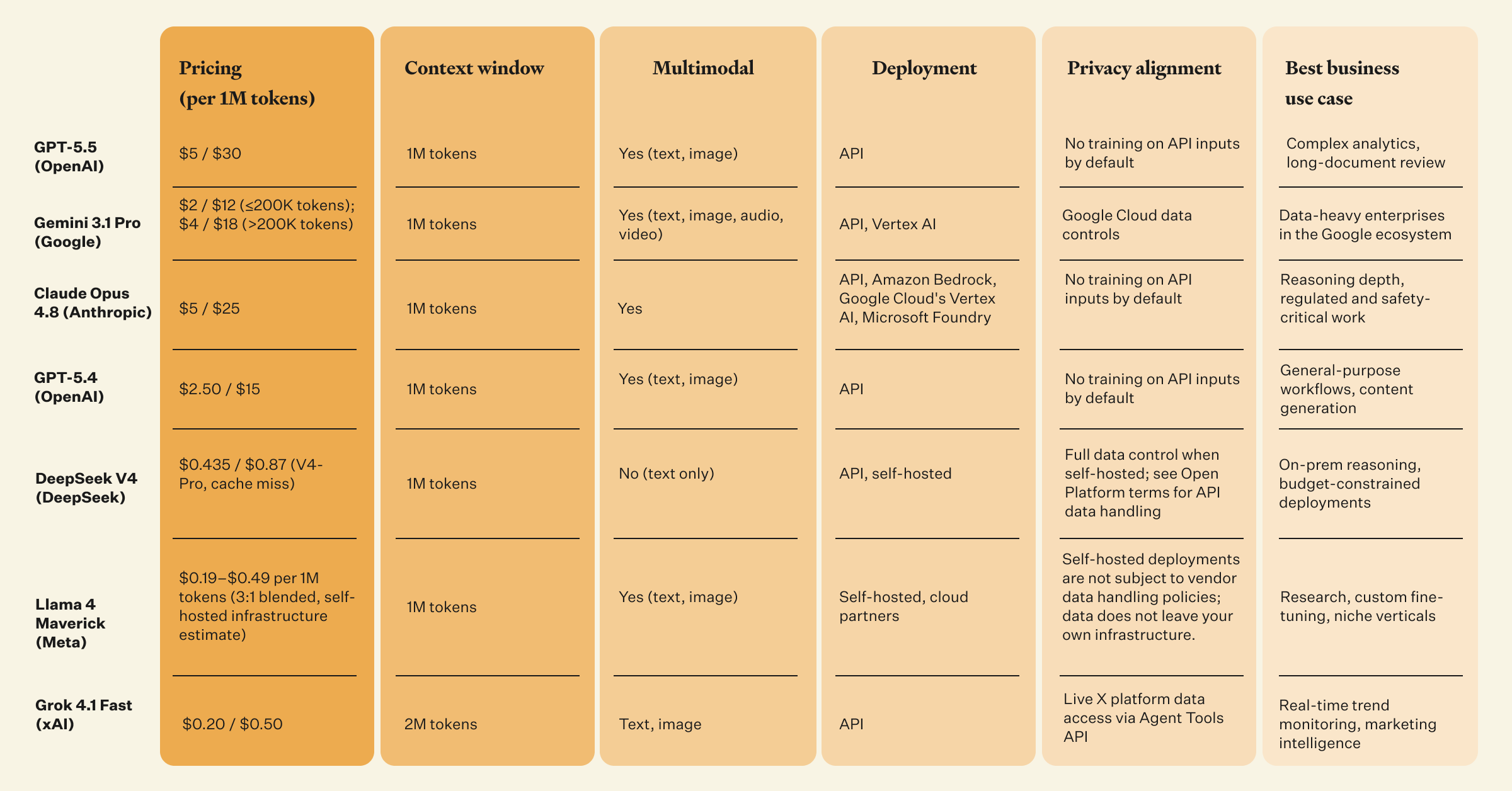
Click on the image above to zoom into full PDF
Pricing, context windows, and deployment details reflect publicly available information as of June 2026 and are subject to change. Confirm current terms directly with each provider before making procurement decisions.
Each model was assessed against the six criteria above, weighted toward enterprise deployment readiness rather than benchmark leaderboard position alone.
GPT-5.5 is OpenAI's current flagship, combining frontier reasoning and coding in a single model with a 1,050,000-token context window and multimodal support across text and image inputs.
For enterprises running complex analytical workloads, long-document review, and multi-step reasoning chains, it is among the strongest performers available. The API inputs are not used for model training by default.
The trade-off is cost. GPT-5.5 is priced at $5 per million input tokens and $30 per million output tokens. For high-volume workloads where reasoning depth is not critical, such as simple classification or templated responses, the cost per output can be disproportionate to the value delivered.
Pairing a flagship model with a lower-cost model for simpler tasks can reduce total LLM spend, with the exact savings depending on volume and routing logic.
Limitations
Premium pricing at $5 / $30 per million tokens
Pricing: $5 per million input tokens and $30 per million output tokens at standard rates.
Gemini 3.1 Pro is Google DeepMind's current Pro-tier flagship, released February 19, 2026, with a 1M-token context window, native integration across the Google Cloud ecosystem, and multimodal reasoning across text, images, audio, video, and code.
Gemini 3.1 Pro supports three thinking levels (low, medium, and high), letting developers control the depth of internal reasoning against response latency per request.
Gemini's advantages are strongest within Google Cloud, so enterprises running multi-cloud or on-premises infrastructure will find less integration value than those committed to the Google stack.
Limitations
Advantages concentrated inside the Google Cloud ecosystem
Pricing steps up to $4 / $18 per million tokens above the 200K-token threshold
Pricing: $2 per million input tokens and $12 per million output tokens for prompts up to 200K tokens; $4 and $18 above that threshold.
Claude Opus 4.8 is Anthropic's flagship Opus model, released May 28, 2026, with a 1M-token context window enabled by default and frontier-level performance on coding, agentic tasks, and long-context reasoning. Anthropic's data policy is clear: By default, API inputs and outputs are not used for model training.
For enterprises in regulated industries such as healthcare, financial services, and government, the safety-first design and data-handling policies make Claude Opus 4.8 a strong default.
Limitations
Premium pricing at $5 / $25 per million tokens
Fast mode carries a higher $10 / $50 tier
Pricing: $5 per million input tokens and $25 per million output tokens (standard); Fast mode at $10 and $50.
GPT-5.4 is OpenAI's recommended production model, priced at $2.50 per million input tokens and $15 per million output tokens, exactly half the cost of GPT-5.5. GPT-5.4 supports up to 1.05 M tokens in context with opt-in API configuration; the default context window is 272K tokens and multimodal support across text and image inputs.
API inputs are excluded from training by default. For content generation, general-purpose team workflows, and business applications where frontier reasoning is not required, it delivers a strong cost-to-performance ratio in the OpenAI lineup.
For the hardest analytical tasks, GPT-5.5 pulls ahead. The practical approach is to pair the two: route complex tasks to the flagship and high-volume, simpler tasks to GPT-5.4.
Limitations
Reasoning depth trails GPT-5.5 on the hardest tasks
Pricing: $2.50 per million input tokens and $15 per million output tokens.
DeepSeek V4 is an open-weight model released April 24, 2026, available in a 1.6-trillion-parameter Pro variant and a lighter Flash variant (284B total parameters), both with a 1M-token context window.
When self-hosted, the open weights mean data never leaves your own infrastructure — no vendor API exposure and no per-token fees beyond infrastructure costs. Best fit: enterprises with on-premises requirements, budget constraints, or compliance needs that prohibit sending data to third-party APIs.
Limitations
Text-focused; does not support multimodal input.
Pricing: DeepSeek V4-Pro at $0.435 per million input tokens (cache miss) and $0.87 per million output tokens via the DeepSeek API; no per-token fee when self-hosted.
Llama 4 Maverick is Meta's open-weight model with native multimodal support and a mixture-of-experts design with 17 billion active parameters drawn from a 400-billion-parameter pool across 128 experts. Its sibling, Llama 4 Scout, extends the context window to 10M tokens for extreme-length document processing.
The advantage is flexibility: full access to model weights enables custom fine-tuning for niche verticals and use cases where off-the-shelf models underperform.
Limitations
Infrastructure burden: GPU capacity, scaling, and engineering effort required to self-host a 400B-parameter model
Pricing: Meta estimates infrastructure costs for self-hosting Llama 4 Maverick at approximately $0.19 per million tokens for distributed inference and $0.30–$0.49 per million tokens on a single host, with no per-token license fee.
Grok 4.1 Fast is xAI's high-volume tool-calling model with a 2M-token context window. When paired with xAI's Agent Tools API, it gains real-time access to X platform data for trend monitoring and social intelligence, alongside web search and code execution.
Best fit: marketing, PR, and communications teams that need real-time social intelligence as a supplement to a primary enterprise LLM, not as a standalone platform.
Limitations
Real-time social-data advantage requires the Agent Tools API
Tool calls priced separately at $5 per 1,000 successful invocations
Pricing: $0.20 per million input tokens and $0.50 per million output tokens; tool calls priced separately from $5 per 1,000 successful invocations.
Choosing the right model for a specific task is a solvable problem. The harder problem is what happens at scale: five teams running five different models with no shared cost controls, no unified auditability, and no way to swap providers without rebuilding integrations.
This is also where most AI programs stall. Gartner® states, "Over 40% of agentic AI projects will be canceled by the end of 2027, due to escalating costs, unclear business value or inadequate risk controls, according to Gartner, Inc." The model is rarely the reason a project fails. The operating layer around it usually is.
That is the problem the Dataiku LLM Mesh solves. Dataiku, the Platform for AI Success, unifies data preparation, machine learning, generative AI, agents, and governance in one environment, and the Dataiku LLM Mesh sits above the models in this article as a governed routing layer that connects to all of them through a single interface.
When a provider's pricing changes, a better model launches, or a compliance requirement mandates switching, the change happens at the configuration level rather than the application level.
Four capabilities make this work:
Centralized cost controls and usage tracking across all connected providers: Every team's token usage, spend, and model selection is visible from a single dashboard.
Dataiku LLM Guard Services: Safe Guard, Cost Guard, and Quality Guard screen prompts and responses at the routing layer before outputs reach users, so safety, cost, and quality controls are enforced consistently regardless of which model is selected.
Full audit trails on every model call for regulatory and compliance requirements. Every input, output, model version, and governance policy applied is logged and traceable.
Consistent governance whether the model is used by a marketing analyst or a data scientist: The same policies apply to every model consumer in the organization.
Dataiku is not one of the models to choose from. It is the infrastructure that makes any choice on this list sustainable at enterprise scale.
Match your workload to the model that fits it best, then build the governance infrastructure to manage them together. The decision table below maps common scenarios to best-fit models from this list.
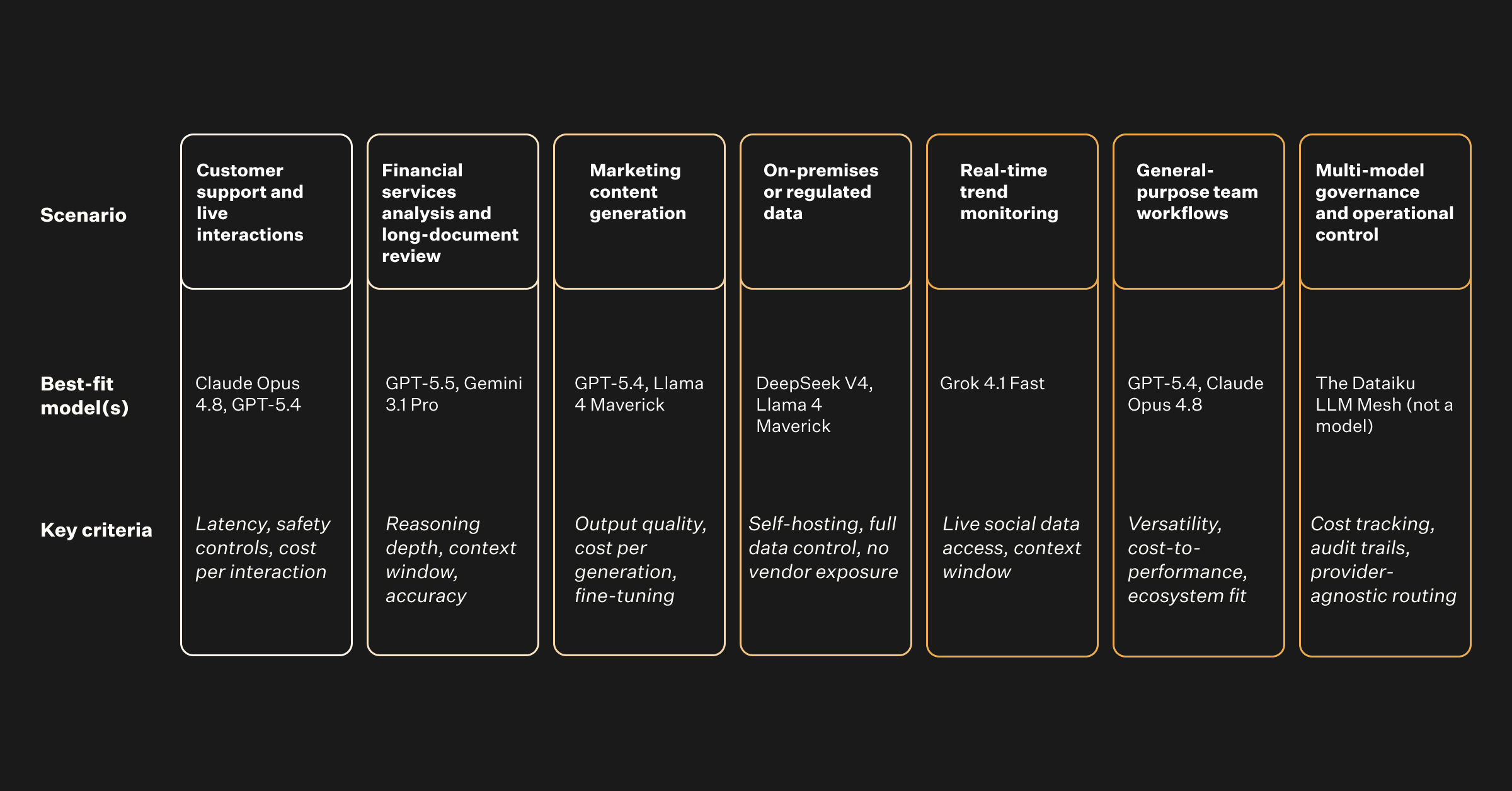
Click on the image above to zoom into full PDF
No single model is the best LLM for business across every workload. The evaluation criteria matter more than any ranking, because the right model depends on whether you are optimizing for reasoning depth, cost efficiency, data privacy, or deployment flexibility.
The multi-model reality is already here for most enterprises. The 81% of CIOs expecting to run two or more providers are not hedging. They are responding to the fact that different tasks require different models, and that locking into a single provider creates the kind of risk diversification reduces.
Start by pilot testing two or three candidates against your highest-priority workload, measuring task performance, cost per output, and user satisfaction against your current baseline. Then ask the platform question: How will you govern, monitor, and manage these models as adoption scales across the organization?
For enterprises running models across multiple teams and use cases, the Dataiku LLM Mesh answers that question: routing requests to the right model, enforcing cost and safety controls consistently, and maintaining a full audit trail across every provider. The answer determines whether your LLM investments compound into business value or fragment into ungoverned cost.
Three factors dominate: per-token pricing (input and output tokens are priced differently), volume (enterprise agreements typically include discounts versus pay-as-you-go API pricing), and model tier (flagship models can cost 10 to 50 times more per token than mid-tier or open-weight alternatives). Hidden costs include infrastructure for self-hosted models, fine-tuning compute, and the engineering time required to build monitoring and governance around each provider's API.
Yes. Open-weight models such as Llama 4 and DeepSeek V4 provide full model weights for custom fine-tuning on proprietary data. Proprietary providers offer fine-tuning APIs with varying levels of customization. The trade-off is cost and complexity: fine-tuning requires labeled training data, GPU compute, and ongoing evaluation to prevent regression as the base model updates.
Privacy depends on the provider's data-handling policy and the deployment model. Major providers offer enterprise agreements that exclude API inputs from training data by default. Self-hosted open-weight models provide the strongest privacy guarantee, because no data leaves the organization's infrastructure. For regulated industries, evaluate GDPR and HIPAA alignment, data residency options such as VPC and on-premises deployment, and audit-trail coverage for every model call.
Open-weight models offer lower cost, full data control, and maximum customization. Proprietary models offer higher out-of-the-box performance, managed infrastructure, and vendor support. The practical trade-off is engineering capacity: open-weight models require internal teams to handle deployment, scaling, monitoring, and security, while proprietary models shift that burden to the vendor in exchange for higher per-token costs and some flexibility constraints.
Through a centralized orchestration and governance layer that sits above individual model APIs, providing unified cost tracking, consistent policy enforcement, audit trails, and the ability to swap providers without rebuilding applications. The Dataiku LLM Mesh is designed for this purpose: routing requests to the right model based on task type, cost constraints, and governance requirements while maintaining full auditability across every provider.
Trademarks: GPT-5.5 and GPT-5.4 are products of OpenAI. Gemini is a product of Google. Claude is a product of Anthropic. DeepSeek is a product of DeepSeek. Llama is a product of Meta Platforms. Grok is a product of xAI. Dataiku is not affiliated with or endorsed by any of these companies. All capabilities, pricing, and specifications are sourced from publicly available vendor documentation as of June 2026.