Best AI agent integration platforms (2026)
August 13, 2026/7 min read/Team Dataiku
Integration platforms solve connectivity: auth management, pre-built connectors, and tool calls that let agents interact with enterprise systems. What they do not solve is accountability: whether agents connected to those systems are actually achieving their business purpose.
According to "Global AI confessions report: data leaders edition," based on a Dataiku/Harris Poll survey of 800 data leaders, CIOs and CDOs are most likely to be credited when AI delivers results (46%), but even more likely to be blamed when it fails (56%). That asymmetry is exactly why accountability, not just connectivity, is the real evaluation stake.
Most enterprises evaluating AI integration platforms are focused on the first problem. The teams deploying agent fleets at scale have already discovered the second one.
This guide covers both: the five leading integration platforms for connecting agents to enterprise tools, and what the governance layer above them needs to look like when connected agents become a managed fleet.
Five leading AI integration platforms — Composio, Nango, Arcade, Merge, and Workato — are compared across connector depth, managed auth, developer experience, observability, scalability, and cost.
MCP adoption is accelerating fast: According to Anthropic, the protocol has grown to over 10,000 active public MCP servers and 97 million+ monthly SDK downloads in its first year, pushing integration platforms to add native MCP support.
All five platforms solve connectivity well, but differ sharply on observability depth: most track whether tool calls succeed, and none track whether agents are actually achieving business outcomes.
Integration solves connectivity; it does not solve accountability. As agent fleets scale, that gap becomes the operational risk, and it's why connected agents need a governance layer above the integration layer to become truly managed ones.
AI agent integration platforms matter because the complexity of connecting agents to enterprise systems has crossed the threshold where manual management is viable.
Three drivers are accelerating adoption: 1. Model Context Protocol (MCP) adoption is standardizing agent-to-tool communication. MCP gives agents a consistent interface for discovering and calling tools, but someone still needs to manage auth, monitor calls, and maintain connectors as APIs evolve.
According to Anthropic, MCP has grown to more than 10,000 active public MCP servers and over 97 million monthly SDK downloads across Python and TypeScript in the year since launch. 2. SOC 2 requirements now extend to agent-to-system access. When an agent authenticates to a CRM, ticketing system, or financial platform, the auth flow must be auditable, tokens must be managed securely, and access must follow least-privilege principles. 3. Connector counts make manual management untenable. An enterprise agent connecting to 15 SaaS tools requires 15 separate auth flows, 15 API schemas, and 15 maintenance commitments. At 50 tools, that math breaks any team managing it manually.
The evaluation question has shifted from "Can we connect to this tool?" to "Which platform manages the connection lifecycle reliably, securely, and at the scale our agent fleet requires?"
Six criteria structure the AI agent integration platform comparison:
1. Connector depth: Breadth and quality of pre-built connectors, plus the ease of adding custom ones
2. Auth and security: Managed OAuth 2.0 flows, token lifecycle management (refresh, rotation, revocation), credential isolation, and compliance certifications (SOC 2, GDPR)
3. Developer experience: SDK quality (Python, TypeScript), CLI tooling, documentation, and time from zero to a working integration
4. Observability: This is where platforms diverge most. Connection-level observability tracks whether tool calls succeed, latency per call, and error rates. Outcome-level observability tracks whether the agent achieved its business objective. Most integration platforms provide the former. None of the five reviewed here provide the latter.
5. Scalability: Concurrent execution limits, rate limit handling, and the ability to manage hundreds of agent-to-tool connections without degradation
6. Cost model: Free tier generosity, pricing curve at production scale, and total cost of ownership including infrastructure for self-hosted options
Here's a scannable comparison table based solely on the information provided.
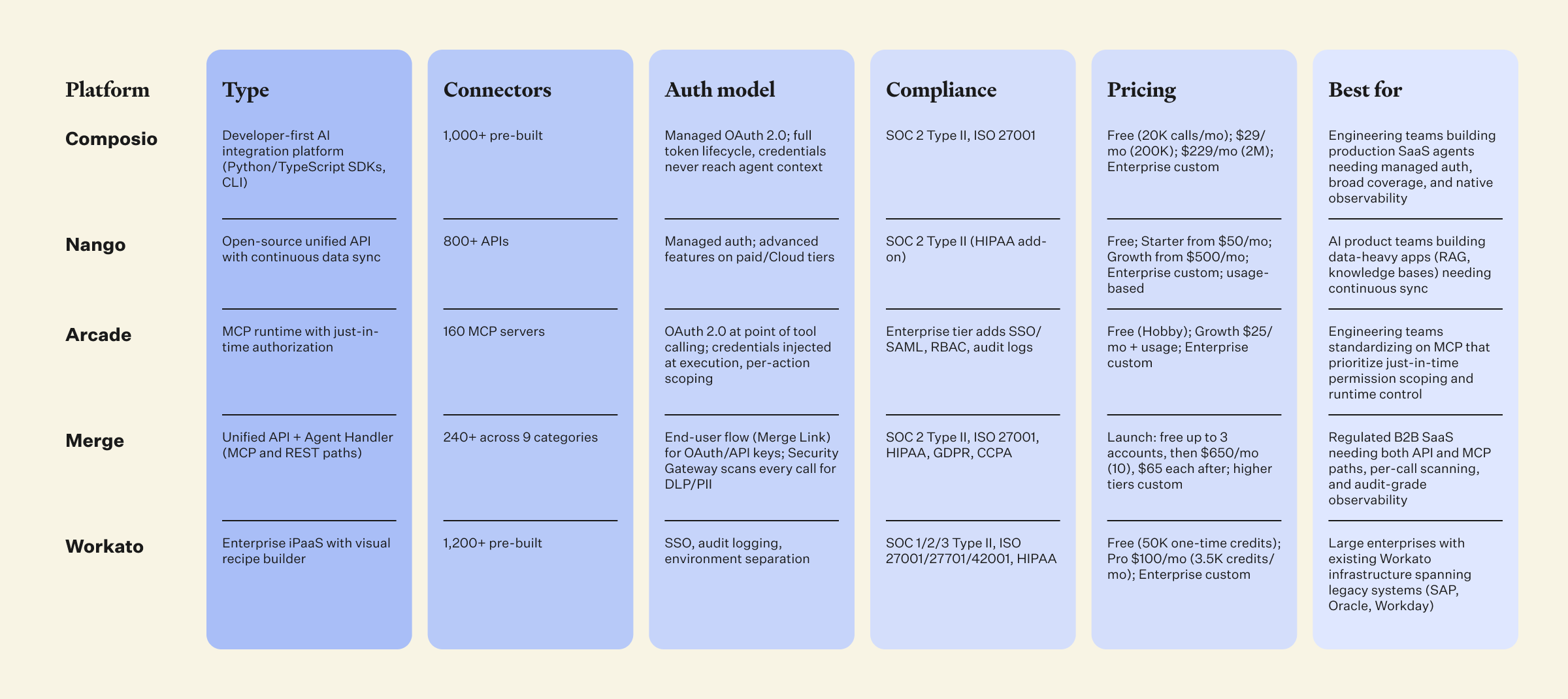
*Click on the image above to zoom into full PDF
Connector counts and feature claims sourced from each platform's published materials; verified as of June 2026.
All five solve the connectivity problem well. The differences emerge in auth maturity, observability depth, and how far each platform extends beyond tool calling into production-grade agent management.
These five platforms were selected based on market adoption, auth and security maturity, and relevance to enterprises deploying agent fleets at scale. Each review follows a consistent structure: overview, standout strengths, watch-outs, and ideal users.
Composio is a developer-first AI integration platform built specifically for AI agents. It provides over 1,000 pre-built connectors with managed OAuth 2.0 authentication, SDKs for Python and TypeScript, and a CLI for local testing and deployment.
Managed auth handles the full token lifecycle (refresh, rotation, revocation) so credentials never reach the agent's context.
Built-in observability traces every tool call with replay capability for debugging.
It is SOC 2 Type II and ISO 27001 compliant.
Free (20K tool calls/mo)
$29/mo (200K calls, then $0.299/1K)
$229/mo (2M calls, then $0.249/1K)
Enterprise custom
The breadth of the platform creates a learning curve for teams new to agent integration patterns.
As a newer entrant, enterprise reference customers are still building.
Best for: Engineering teams building production SaaS agents that need managed auth, broad connector coverage, and native observability without building infrastructure from scratch
Nango is an open-source unified API with continuous data sync capabilities. It normalises data from 800+ APIs into consistent schemas, making it particularly strong for RAG pipelines and data-heavy AI applications that need ongoing data freshness rather than one-time tool calls.
Continuous sync keeps retrieved data current, which is critical for RAG applications where stale data degrades retrieval quality.
Open-source core, SOC 2 Type II compliant, with self-hosting on Kubernetes or Docker.
Free ($0)
Starter from $50/mo
Growth from $500/mo
Enterprise custom
Teams self-hosting on the free tier get auth and API proxying, but advanced capabilities — data syncs, webhooks, MCP server, and custom functions — are locked to Enterprise self-hosting or Nango Cloud.
Best for: AI product teams building data-heavy applications (RAG, knowledge bases, analytics) that require continuous data synchronization from multiple SaaS sources
Arcade is an MCP runtime that handles OAuth 2.0 authorization at the point of tool calling: when an agent calls a tool and the required permissions haven't been granted, Arcade Engine intercepts the call, coordinates the OAuth flow with the service provider, and manages the resulting tokens on the agent's behalf. Arcade's MCP framework and toolkit SDK are open source under the MIT license, while the Engine and other platform components (Coordinator, Worker, Dashboard, and Experience API) are distributed as prebuilt container images rather than something you compile from source.
Credentials are injected at execution time and never exposed to agents or MCP clients.
Teams can run MCP servers in their own environment (on-premises, private cloud, or VPC) while Arcade's cloud engine routes tool calls to them via a secure tunnel.
Authorization is evaluated per action at runtime, scoped to the intersection of what the user can do and what the agent is allowed to do, with every tool call logged alongside the agent identity, the user acted on behalf of, the scope, and the policy decision applied.
Hobby (free; 100 user challenges, 1,000 standard + 50 pro tool executions, 1 hosted MCP server)
Growth $25/mo + usage
Enterprise custom
The integration catalogue currently lists 160 MCP servers, which is smaller than the catalogues of Composio (1,000+ apps) or Nango (800+ APIs).
Best for: Engineering teams standardising on MCP that prioritise just-in-time permission scoping and execution speed, and that accept a smaller integration catalogue in exchange for runtime control
Merge provides a unified API combined with an Agent Handler that supports both MCP and traditional REST API integration paths. Agent Handler launched in October 2025, adding governed agent access with a Security Gateway that scans every tool call for DLP and PII violations, rule enforcement, and a complete audit trail.
It has 240+ integrations across categories including HRIS, ATS, CRM, accounting, ticketing, file storage, knowledge base, and chat.
Audit-grade observability with detailed logging of every tool call — arguments, result, latency, user identity, redactions applied, and errors — plus SIEM export via webhooks.
Merge adheres to SOC 2 Type II, ISO 27001, HIPAA, GDPR, and CCPA compliance frameworks.
An end-user authentication flow (Merge Link) handles OAuth and API key connections with support for custom branding on the OAuth consent screen.
Launch: free for first 3 production-linked accounts, then $650/mo up to 10, $65 per account after
Professional and Enterprise contract-based (no public pricing)
The Launch Plan starts at $650/month for up to 10 linked accounts, with $65 per linked account thereafter; Professional and Enterprise tiers are contract-based with no published list pricing.
Best for: Regulated B2B SaaS companies that need both API and MCP integration paths, per-call security scanning, and audit-grade observability for compliance requirements
Workato is an enterprise iPaaS with 1,200+ pre-built connectors, a visual recipe builder that lets business and IT teams build workflow automations in a low-code studio and named connectors for legacy enterprise systems including SAP, Oracle, and Workday.
On compliance, Workato holds SOC 1, SOC 2, and SOC 3 Type II reports, ISO 27001, 27701, and 42001 certifications, PCI-DSS v4.0.1 Level 1, and HIPAA, and supports GDPR, IRAP, and NIST 800-171 requirements.
Featured in the 2026 Gartner Magic Quadrant for iPaaS
Enterprise governance features including SSO, audit logging, and environment separation.
Free (50K one-time credits)
Pro $100/mo (3.5K credits/mo)
Enterprise custom
Workato does not publish standard list pricing; all contracts are arranged through a sales conversation.
The platform is built around a low-code recipe and visual workflow model designed for business and IT collaboration, not as an SDK-first developer tool.
Best for: Large enterprises with existing Workato infrastructure and integration requirements that span legacy systems, where the breadth of connectors matters more than developer experience
Integration platforms confirm that tool calls succeeded. They do not confirm that the outputs are accurate, compliant, or meeting business targets. For enterprises managing a fleet of deployed agents, that gap becomes the operational problem and Dataiku, the Platform for AI Success, solves for it.
Dataiku Agent Management is the outcome-monitoring layer that sits above existing integration infrastructure. It works above Composio, Merge, Workato, and other integration platforms without replacing them.
What it adds is the accountability layer that integration platforms were not designed to provide:
Business KPI monitoring versus uptime tracking: Integration platforms tell you the agent is running. Dataiku tells you whether the agent is achieving its business objective: Is it reducing resolution time, improving decision accuracy, or lowering cost per transaction?
Behavioral drift detection: Agents that perform well at deployment can degrade over time as data distributions shift, APIs change, or business conditions evolve. Dataiku Agent Management detects when an agent's behavior drifts from expected patterns and routes the issue through governance workflows before it reaches production outcomes.
Output-level audit trails: Integration platforms log tool calls. Dataiku logs what the agent decided, why it decided it, and whether the decision was within governance boundaries. For regulated industries, that distinction is the difference between connection logging and compliance.
Follow four steps to match the right platform to your requirements.
Step 1: Define agent actions. Map every tool call your agents need to make: read data, write data, trigger workflows, call APIs. This determines your minimum connector requirements.
Step 2: Assess volume and latency. High-volume, low-latency use cases (real-time customer support) need platforms built for speed. Lower-volume, data-heavy use cases (RAG sync, analytics) prioritize data freshness over call latency.
Step 3: Evaluate data residency. If agent-to-tool traffic must stay within specific geographic or infrastructure boundaries, self-hosted options or VPC-deployed options matter more than connector count.
Step 4: Match to team skill set. Developer-first teams get more from Composio or Arcade. Non-technical teams benefit from Workato's visual builder. Merge fits B2B SaaS teams embedding integrations into their product.
Run a 14-day proof-of-concept before committing. Test against your actual tool set, auth requirements, and production volume, not against the demo environment.
Composio for developer-first agent teams, Nango for data-heavy AI products, Arcade for MCP-native lightweight deployments, Merge for regulated B2B SaaS, and Workato for enterprise-scale legacy integration. Pilot before scaling.
The governing frame for every evaluation: Integration solves connectivity; governance solves accountability. Both decisions matter as agent fleets grow, and the second one becomes more important than the first once agents are operating inside production business processes.
This is where Dataiku fits: Its Dataiku Agent Management capabilities sit above your integration platform of choice, monitoring whether connected agents are meeting their business objectives rather than simply confirming that tool calls succeeded. Once agents become a managed fleet, that outcome-level accountability is what separates a connected deployment from a governed one.
Traditional iPaaS solutions manage data movement and workflow automation between systems through predefined triggers and actions. AI integration platforms are designed for agents that dynamically decide which tools to call based on context. The key differences: AI platforms support MCP and agentic tool calling, manage per-agent auth scoping, and handle non-deterministic execution paths where the same input may trigger different tool calls depending on reasoning.
MCP (Model Context Protocol) is an open standard that provides AI agents with a consistent interface for discovering and calling tools. It standardizes how agents find available tools, understand their capabilities, and execute calls. For integration platforms, MCP adoption means moving from custom API wrappers per tool to a unified protocol that agents interact with consistently. Platforms with native MCP support simplify the integration architecture significantly.
Not all require it, but managed authentication is strongly recommended for production use. It automates token refresh, rotation, and revocation, keeps credentials out of an agent's context, and reduces the audit surface for compliance requirements like SOC 2 and GDPR.
Yes. Some platforms are fully open-source and self-hostable on Kubernetes or Docker, with cloud, VPC, and on-premises deployment options. Self-hosting gives full control over data residency, credential storage, and infrastructure security.
Yes, though overhead varies significantly by platform. Some add under 100 milliseconds per tool call. For real-time, customer-facing use cases, benchmark latency under production conditions rather than relying on vendor-published numbers.