Why traditional AI governance frameworks no longer work for agents
July 8, 2026/6 min read/Faye Murray and Jacob Beswick
Most organizations have built serious AI governance programs. But governance operates in constant flux: Products ship, teams reorganize, and technologies change, creating gaps even in mature environments. Agentic AI widens those gaps because it introduces risks those programs were not designed to measure.
This is not for lack of effort. Large organizations have invested heavily in policies, oversight committees, and responsible AI frameworks. The problem is that those frameworks were built on one core assumption: Human decision-making is the unit of accountability. Agentic AI breaks that assumption.
This article will not give you a policy template. It will give you a diagnostic: four questions that show where your governance framework breaks down and what to build instead.
This is the second article in a new series called the “AI Governance Gap,” where we cut through the noise to tackle one of the most urgent challenges facing businesses today: How do you harness the power of AI without losing control of it? In the first article, we discussed how AI’s biggest risk isn’t regulation but exclusion, and that within five years, only organizations that can explain every high-stakes AI decision will be allowed to compete in the most valuable markets.

Traditional accountability frameworks — legal, regulatory, and corporate — were built on a simple model: A human, with relevant information, makes a choice at an identifiable moment that produces a traceable outcome. Accountability follows the chain from outcome to decision to decision-maker.
This model works for most institutions. It works reasonably well for traditional software, where systems execute instructions humans wrote. It also works for first-generation AI, where humans build and approve a model and another human acts on its recommendation.
It does not work for agentic AI, and most governance frameworks have not caught up with that fact.
Agentic AI systems do not just generate outputs; they plan and execute. They break goals into steps, use tools such as APIs and software, take actions in external systems, and adapt based on intermediate results, often with meaningful autonomy between human touchpoints.
Traditional ML typically produces a prediction, score, or recommendation within a predefined workflow. Agentic systems can decide what to do next, which tools to use, and how to pursue a goal as conditions change. They break four assumptions behind traditional accountability: that you can identify the decision, isolate who made it, reverse it if wrong, and explain why it happened. Each break opens a governance gap, and each gap creates liability — regulatory, legal, or competitive. Reversibility, the third question below, is the highest-stakes one.
Use this diagnostic to test your own agentic systems: For each assumption traditional governance relies on, ask the corresponding question below, then use the suggested step to close the gap if you find one.
Traditional governance assumes decisions are discrete and auditable. You can point to the moment a choice was made, examine the inputs, evaluate the reasoning, and assign accountability. That logic extends from ideation and data preparation through development, deployment, and use.
Agentic systems do not make one decision; they make thousands of micro-decisions in sequence — retrieving information, selecting actions, interpreting responses, and adjusting course — to produce one outcome. By the time a human sees the result, the system has already made choices that cannot easily be decomposed or audited individually.
Consider a procurement agent tasked with sourcing a supplier. It searches databases, filters options, sends inquiries, evaluates responses, and makes a recommendation — or, in a more autonomous configuration, places the order itself. Which decision do you govern: the final output, the filtering criteria in step three, or the way it interpreted an ambiguous instruction in step one?
The governance question your framework needs to answer: At what level does your organization define an auditable decision for agentic systems, and what logging architecture makes that definition enforceable?
Most organizations do not have a clear answer. A practical starting point is decision-boundary mapping: Before deployment, define what counts as a decision point for each agentic system, what must be logged at each point, and what triggers human review. This is not optional infrastructure. As regulation catches up, these decisions are likely to become necessary for regulatory and standards alignment.
Accountability law, and most corporate governance, assumes outcomes have human authors. Someone decided. Someone approved. Someone is responsible.
Agentic AI makes authorship ambiguous in ways current frameworks do not resolve. When an agent drafts and sends a message, executes a transaction, or makes a clinical recommendation that a human rubber-stamps in three seconds, who authored the outcome? The engineer who built the system? The manager who approved it? The IT lead who deployed it? The executive who requested the use case or set the strategy behind it? The human who clicked confirm without meaningful review?
The ambiguity deepens when the agentic system relies on a third-party model. A contract may allocate responsibilities between vendor and customer, but it does not remove the organization’s need to assign meaningful internal accountability for outputs. There is also a parallel regulatory issue, especially in the EU: Some model providers now have legal obligations of their own, which means choosing a model is itself a governance decision.
This ambiguity is not theoretical. It is already appearing in litigation, regulatory investigations, and procurement requirements. Courts are beginning to ask questions organizations cannot answer because they never answered them internally.
The governance question your framework needs to answer: For every agentic system in production, can you identify a named human accountable for its outputs — and do they have the information, authority, and practical ability to exercise that accountability meaningfully?
Human-in-the-loop is not a governance solution. It is a governance aspiration that is real, only if the human has:
Enough information to evaluate the output;
Enough time to do so meaningfully;
Real authority to override it.
If any of those three conditions is not met, then human-in-the-loop is theatre.
In practice, map the accountability chain for each agentic deployment explicitly.
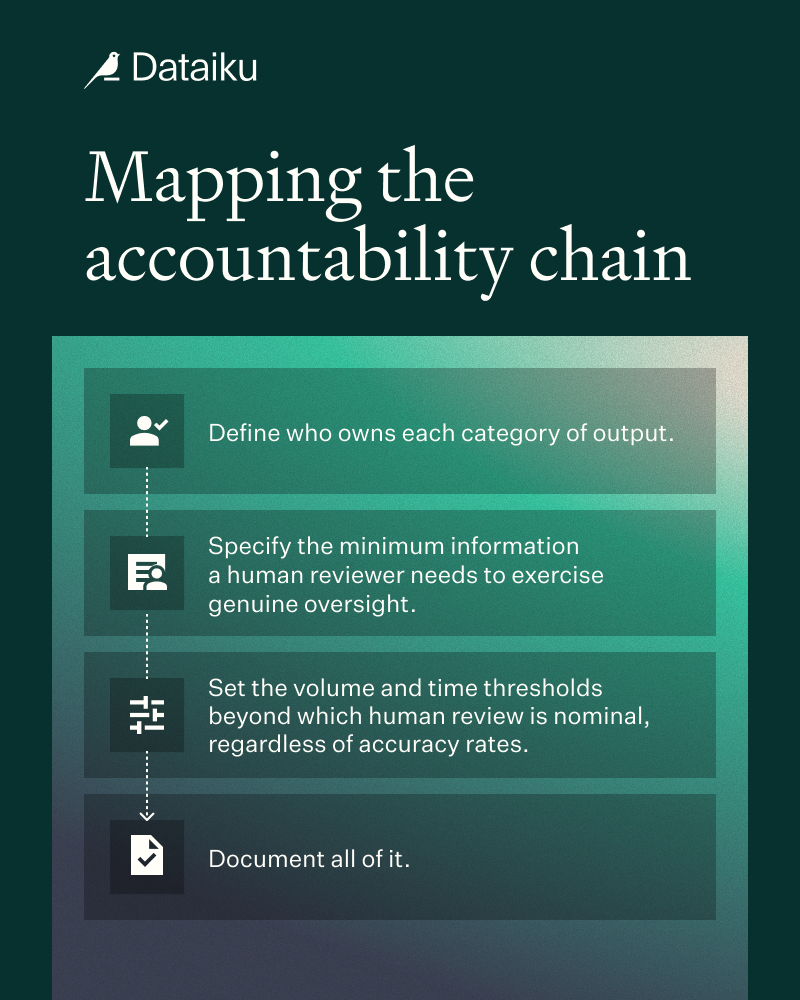
This is the difference between defensible governance and the appearance of it.
Most oversight approaches are built on the assumption that governance operates as a check before or shortly after consequential actions. The implicit model is simple: Humans intervene to mitigate risks and prevent harm before it occurs, or quickly enough afterward to limit it.
Agentic systems operating in the real world routinely take actions that are partly or fully irreversible by the time any human sees them: emails sent, contracts initiated, data deleted, bookings made, regulatory filings submitted, social posts published, and more. At enterprise scale, the volume of such actions can make meaningful pre-action human review practically impossible.
This is not an argument against agentic AI. It is an argument for a different governance approach: action classification rather than output review. That classification is not context-free; it should be anchored in the system’s intended purpose. A use case that is inherently high-stakes, such as determining loan premiums, carries risk across the entire agentic chain. The framework must therefore reflect not only the reversibility of individual actions but also the risk profile of the broader deployment context.
The governance question your framework needs to answer: Has your organization classified the actions each agentic system can take by reversibility, and does its authorization architecture match that classification?
Reversible actions: Actions that can be recalled, edited, or undone without meaningful consequence. These can operate with post-hoc review.
Consequential but recoverable actions: Actions with real-world effects where recovery is possible at acceptable cost. These require defined escalation thresholds and human notification before or immediately after execution.
Irreversible actions: Actions that cannot be undone, or whose recovery cost is significant. These require explicit human authorization before execution, every time.
Most organizations deploying agentic systems have not done this classification. The ones that have are not just better governed; they are better protected against the kind of incident that ends careers and triggers regulatory investigations.
Governance frameworks are designed around discrete systems: one model, one use case, one set of inputs and outputs, one risk assessment. The assumption is that if you govern each system adequately, you have governed your AI adequately.
Multi-agent architectures, where AI systems interact with, instruct, and respond to other AI systems, can produce emergent behavior that no component was designed to produce and no individual risk assessment anticipated. The outcome was not authorized by any human. It emerged from the interaction of systems that were each individually approved.
This is not a future problem; organizations deploying agentic AI in enterprise environments are already encountering it. An agent that performs acceptably in isolation can behave differently when it receives inputs from another agent rather than a human. Edge cases multiply, failure modes compound, and when something goes wrong, the audit trail runs through multiple systems with no clear point of human decision.
The governance question your framework needs to answer: Does your governance framework include a category for multi-agent interactions, and have you assessed the emergent risk of agentic systems operating in combination?
In practice, this requires two additions to standard AI governance:
Interaction mapping: Documenting which systems can instruct or be instructed by others, under what conditions, and with what constraints;
Emergent behavior testing: Evaluating system combinations under adversarial and edge-case conditions before deployment, not after an incident.
Apply these four questions to every agentic system in production or development:
| Question | Red flag |
1. Decision boundaries | Can you identify and audit the specific decision points this system makes? | No logging architecture exists below output level |
2. Human authorship | Is there a named human with genuine accountability for this system’s outputs? | Human review is post-hoc, high-volume, or time-constrained |
3. Action reversibility | Have you classified what this system can do by reversibility? | No action classification exists; all outputs treated equally |
4. System interaction | Have you assessed this system’s behavior in combination with others? | Risk assessment covers the system in isolation only |
Most large organizations will find gaps in three or four of these areas. That is not a failure of intent. It is the predictable result of applying governance frameworks built for an earlier generation of AI to a fundamentally different architecture.
The framework above is diagnostic. Here is what closing each gap requires:
Decision boundary mapping. Before any agentic deployment, define what constitutes an auditable decision, what must be logged, and what triggers human review. This is both a technical and governance task, which means data science, legal, and risk need to be in the room before deployment, not after.
Accountability architecture. For every agentic system, assign a named owner, a defined review standard, and documented evidence that review is genuine rather than nominal. In regulated domains, this documentation may be required. Regulated or not, it helps protect against the litigation that follows consequential failures.
Action classification. Build a tiered authorization model that matches governance intensity to reversibility risk. Make it part of the deployment checklist. Irreversible actions require explicit authorization design before a system goes live, not a policy saying humans should check.
Interaction assessment. Govern multi-agent architectures at two levels: the individual agent and the combined system. Approval of the parts does not amount to approval of the whole. Make this a mandatory step for any system that will interact with other AI systems.
The organizations that will navigate the agentic transition best are not the ones with the most sophisticated AI. They are the ones that ask the right questions before deployment rather than after an incident.
These four assumptions are not edge cases. They are structural features of agentic AI that every deploying organization will encounter. Most governance frameworks were not designed for them.
The window to build the right architecture proactively — before a regulatory mandate, a consequential failure, or a competitor stakes out a defensible position — is open. It will not stay open indefinitely.
The question is not whether your organization will face these governance gaps. It is whether you find them first, or someone else does.
Govern AI everywhere
Govern AI everywhere