How semantic observability strengthens AI governance and audit readiness
September 15, 2026/7 min read/Team Dataiku
When a regulator asks why your AI system made a specific decision, "The model was running within normal parameters," is not an answer. Neither is a latency graph, nor a token usage report. What they need is a traceable record of what the system decided, how it reasoned, and whether that reasoning was within the boundaries required by your governance framework.
Operational monitoring cannot produce that record, because it was never designed to capture reasoning. Semantic observability was built for exactly that.
This guide explains how semantic observability provides the evidence layer that AI governance and audit readiness require. It covers the metrics that matter for compliance, the five-step implementation framework, and the regulated-industry use cases where the gap between operational monitoring and semantic observability can determine whether an audit is passed or failed.
Semantic observability monitors meaning-level signals (intent alignment, policy adherence, reasoning quality) rather than just operational metrics (latency, uptime, cost).
It maps directly to governance mandates: the EU AI Act's transparency requirements, ISO/IEC 42001's operational controls, and sector-specific audit obligations all require evidence that semantic observability produces.
Five metric pillars (cognition, traceability, performance, security, and governance) define what a production semantic observability program measures.
An AI model audit trail built on semantic observability captures not just what the model did, but why it did it and whether the reasoning was within policy boundaries.
Implementation follows a five-step framework (instrument, tag, evaluate, alert, and report) that can be piloted in 30 days.
Semantic observability is the practice of capturing and analyzing meaning-level signals from AI systems: what the model intended, how it reasoned, whether it adhered to policy, and whether the output aligned with the user's actual question.
The distinction from operational monitoring is fundamental. Operational monitoring captures infrastructure signals: response time, error rate, token consumption, and modelversion. These signals confirm the system is running. Semantic observability captures quality signals:
Was the output accurate?
Did it follow the organization's content policy?
Did the reasoning path include unsupported inferences?
Did the response drift from the expected behavior pattern for this query type?
Meaning-level signals are captured through several mechanisms. Policy tags label outputs with metadata indicating which governance policies were evaluated and whether the output passed or failed each one. Intent classification scores measure how well the output addressed the user's actual question versus a related but different question. Reasoning traces record the step-by-step path from input through retrieval andgeneration, making the model's decision process inspectable.
A concrete example: Anenterprise chatbot receives a customer query about account cancellation. Operational monitoring confirms the response was delivered in 180 milliseconds with no errors. Semantic observability confirms the response cited the current cancellation policy (rather thana discontinued version), addressed the customer's specific account type (rather thanproviding a generic answer), and did not include any retention language that violates the organization's compliance guidelines for cancellation requests.
Both layers detected that the system responded. Only semantic observability detected whether the response was correct, compliant, and appropriate.
Semantic observability maps directly to the evidence requirements that AI governance mandates impose.
The EU AI Act's transparency and logging requirements for high-risk AI systems were originally set to take effect in August 2026. The Digital Omnibus on AI (Regulation (EU) 2026/1744), which entered into force on July 27, 2026, deferred those obligations to December 2, 2027.
The deadline moved; the evidence requirement did not. Semantic observability produces what enterprises will need regardless of the exact date: reasoning traces that show how outputs were generated, policy adherence logs that demonstrate compliance, and drift monitoring that proves the system's behavior remained within defined boundaries over time. Building this evidence layer now avoids a compliance scramble when the deadline arrives.
Clause 8 (Operation) requires documented evidence that AI systems perform within defined parameters with appropriate human oversight. Semantic observability provides the operational data that satisfies this clause: evaluation scores, policy tag results, and escalation records.
Financial regulators require explainable credit decisions. Healthcare regulators require traceable clinical recommendations. Insurance regulators require documented claims processing rationale. In each case, the auditor needs more than a log showing the model was called. They need evidence of what the model decided, why it made that decision, and whether that decision was within policy.
Decision traceability is the compliance backbone. According to "Global AI confessions report: data leaders edition," based on a Dataiku/Harris Poll survey of 800 data leaders, 95% admit they cannot fully trace how an AI system reached a specific decision. An AI model audit trail built on semantic observability connects every output to its reasoning path, the policy checks it passed, the data it accessed, and the governance approval under which it operated. When an auditor asks "show me why this model recommended denial for this applicant," the audit trail provides a traceable answer rather than a log entry showing the model was invoked.
Risk dashboards that link semantic drift alerts to specific governance policies close the monitoring-to-action loop. When an alert fires because policy adherence scores drop below a defined threshold, the dashboard shows which policy is being violated, on which query types are affected, when the issue began, and routes the issue to the appropriate reviewer.
Five metric pillars define what a production semantic observability program measures. Each pillar includes specific KPIs that feed into service-level objectives (SLOs) and governance reporting.
Measures the quality of the model's reasoning and output. KPIs: hallucination rate (percentage of outputs containing unsupported claims), intent alignment score (percentage of outputs that address the user's actual question), and reasoning coherence (whether the output's logic follows from its premises).
Measures the completeness of the decision record. KPIs: audit trail completeness (percentage of outputs with full reasoning traces, source citations, and policy tag results) and data lineage coverage (percentage of model inputs with documented provenance from source to feature).
Measures output effectiveness against business objectives. KPIs: task completion rate (percentage of agent interactions that achieve the defined outcome) and user satisfaction score (collected through structured feedback on output quality).
Measures the integrity of AI system boundaries. KPIs: privileged API call rate (frequency of agent actions that access sensitive systems or data), prompt injection detection rate (percentage of adversarial inputs caught before reaching the model), and personally identifiable information (PII) exposure incidents (count of outputs containing personal information that should have been masked).
Measures the effectiveness of governance controls. KPIs: policy adherence rate (percentage of outputs that pass all applicable policy checks), escalation response time (time from governance alert to human action), and drift detection latency (time from a behavioralshift to detection).
These metrics feed into SLOs that define acceptable quality thresholds. Example: "95% of customer-facing outputs must achieve a policy adherence score of 4 or higher on a 5-point scale, measured weekly." Review cadence: monthly for stable systems, weekly during the first 90 days of deployment or after model updates.
A five-step framework sequences the implementation from instrumentation through compliance reporting.
Capture every AI interaction with structured metadata: input prompt, retrieved context (for retrieval-augmented generation (RAG) systems), output response, model version, timestamp, and user/session identifiers. This telemetry layer is the foundation for everything that follows.
Apply policy tags to every output. Each tag records whether the output passed or failed a specific governance check (including factualaccuracy, policy compliance, safety screening, and format adherence). Tags are attached at inference time, not retrospectively, so the governance record is created alongside the output.
Score outputs against the five metric pillars using automated evaluation (LLM-as-judge for reasoning quality, semantic similarity for accuracy, rule-based checks for policy compliance) and human review on a sampled basis.
Configure threshold-based alerts that fire when any metric drops below its SLO. Route alerts to the appropriate stakeholder: cognition alerts to the AI team, security alerts to the security team, and governance alerts to the compliance team. Alert fatigue is a real risk, so tune thresholds to minimize false positives and review alert volume monthly.
Generate audit-ready compliance reports from the telemetry, tag, and evaluation data. Reports should be producible on demand (for regulatory requests) and generated automatically on a quarterly cadence (for internal governance reviews).
Data lineage capture for the AI model audit trail: Everymodel input should be traceable back to its source system, through every transformation applied, to the feature value that reached the model. This lineage is the forensic evidence that allows auditors to reconstruct why a specific output was produced.
The rollout follows a simple weekly cadence:
Week one: Instrumenttelemetry on one production AI system.
Week two: Configurepolicy tags and automated evaluation.
Week three: Setup alerting and dashboards.
Week four: Generatethe first compliance report and review it with stakeholders.
Four roles carry the framework end to end:
DevOps owns instrumentation and alerting infrastructure.
Risk owns metric threshold definition and SLO setting.
Compliance owns report review and regulatory mapping.
The AI team owns evaluation methodology and tag configuration.
Full evaluation on every output is expensive at scale, so sampling has to be deliberate:
Apply full evaluation to a five percent to 10 percent random sample.
Run lightweight checks (policy tags and rule-based filters) on every output.
Trigger full evaluation automatically on any output flagged by the lightweight checks.
Dataiku, the Platform for AI Success, centralizes sign-offs, audit trails, and lifecycle tracking through Dataiku Govern, providing the compliance infrastructure that connects semantic observability findings to governance action. When an evaluation identifies a drift issue, the remediation workflow (investigation, fix, re-evaluation, and approval) runs within the same platform where the model operates.
Three tool categories support semantic observability for governance, each addressing a different layer of the stack.
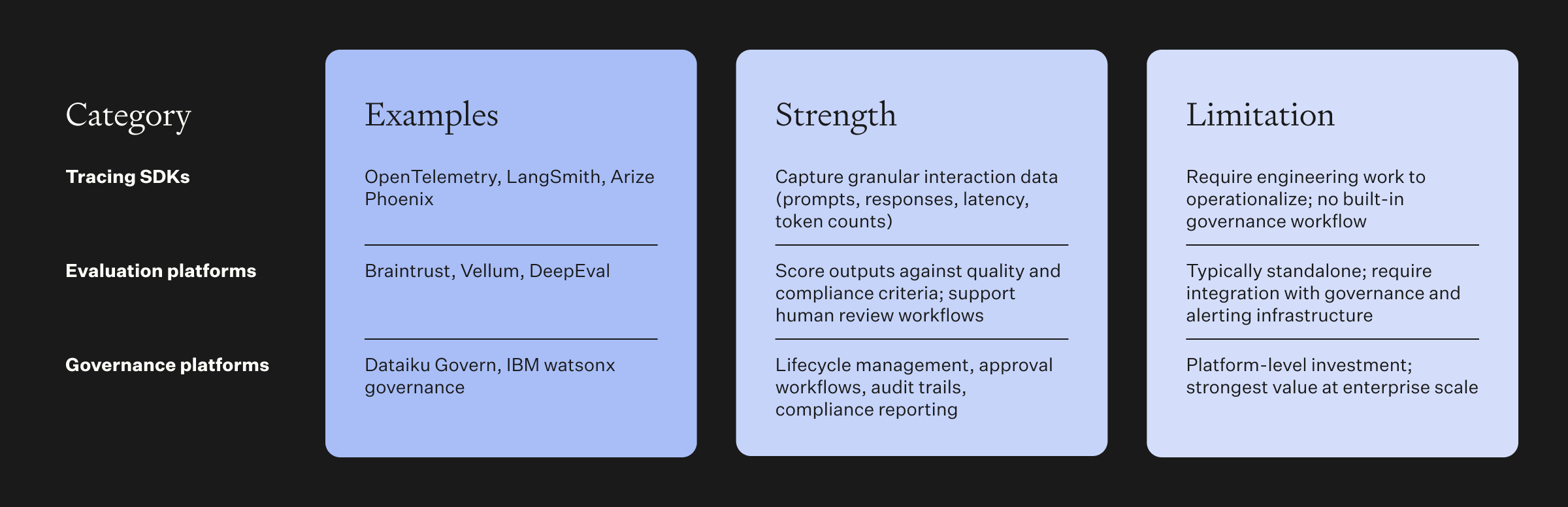
*Click on the image to see the full PDF
The open standards trend: OpenTelemetry is emerging as the default instrumentation standard for AI systems, providing vendor-neutral telemetry collection that feeds into any downstream analysis or governance platform. Teams starting from scratch should instrument with OpenTelemetry rather than proprietary SDKs to preserve flexibility.
Integration with existing security systems: Semanticobservability data should feed into the same security information and event management (SIEM) infrastructure that monitors other enterprise systems. This eliminates the visibility gap between AI operations and existing security operations, and ensures that AI governance alerts are handled through established incident response workflows.
Cost and privacy considerations: Tracingand evaluation generate significant data volumes. Define retention policies based on regulatory requirements (rather thanonstorage capacity) and apply data minimization principles: capture what governance requires, not everything technically possible.
A loan underwriting agent evaluates applications using credit data, income verification, and risk models. Semantic observability captures the reasoning trace for every decision: which factors contributed to the score, which policy rules were applied, and whether the decision was within the agent's authorized scope. When a fair lending audit requests evidence for a specific denial, the audit trail produces the complete decision path, including the data inputs, model version, and policy checks that were evaluated.
Key metric: 100% audit trail completeness for all decisions affecting consumer credit.
Retention period: At least 25 months under ECOA's Regulation B, though many institutions retain lending records for several years longer under internal risk and BSA/AML policies.
A clinical documentation agent accesses protected health information (PHI) to generate discharge summaries. Semantic observability monitors which PHI fields the agent accessed, whether access was within the agent's authorized scope, and whether the generated summary included any information that should have been redacted based on the recipient's access level.
Key metric: Zero unauthorized PHI exposure incidents per quarter
Retention period: Six years per HIPAA
A claims processing agent evaluates damage reports, cross-references policy terms, and generates settlement recommendations. Over time, the agent's recommendations may drift from intended behavior as data patterns shift or policy terms are updated without corresponding agent reconfiguration. Semantic observability detects this drift by comparing current recommendation distributions against historical baselines and alerting when the shift exceeds defined thresholds.
Key metric: Recommendation drift below five percent deviation from baseline per quarter
Retention period: Per state insurance regulatory requirements, typically five to 10years
Semantic observability transforms AI governance from a periodic review exercise into a continuous operating discipline. The benefits are specific:
Transparency: Every AI decision has a traceable reasoning path.
Compliance: Audit-ready evidence is generated automatically, not assembled after a request.
Faster remediation: Drift and policy violations are detected in real time rather than discovered during annual audits.
Trust: Stakeholders can verify that AI systems are operating within approved boundaries.
Three actions get a program moving this quarter:
Prioritize the five metric pillars based on your highest-risk AI systems and most stringent regulatory requirements.
Pilot the five-step implementation framework on one production system using the 30-day rollout timeline.
Set SLOs for each metric pillar and review results at the 30-day mark to calibrate thresholds.
Dataiku embeds governance and observability across models and agents so audits become routine rather than fire drills.
Regulatory frameworks like the EU AI Act and ISO/IEC 42001 increasingly require evidence that AI systems produce compliant, explainable outputs. Operational monitoring only proves the system ran; semantic observability proves it ran correctly, within policy, with reasoning an auditor can trace.
A production-grade AI model audit trail should include model version, input provenance, retrieved context, the full reasoning trace, policy tag results, the delivered output, and any human review actions, each timestamped and stored in immutable logs that match applicableregulatory retention periods.
Semantic observability supports AI audit readiness by generating evidence continuously: policy tags record compliance at inference time, reasoning traces capture decision rationale, and drift monitoring flags behavioral shifts before they become findings, rather than after the fact.
Four gaps appear consistently: incomplete audit trails, undocumented model changes deployed without governance approval, unmonitored drift between scheduled reviews, and inconsistent policy enforcement across AI systems or teams.
Semantic observability detects compliance risks through three mechanisms: policy adherence monitoring flags failed governance checks in real time, behavioral drift detection catches baseline shifts that may violate compliance standards, and reasoning trace analysis surfaces unsupported inferences or biased logic that aggregate metrics miss.
IBM watsonx is a trademark of International Business Machines Corporation. Dataiku is not affiliated with IBM. All product capabilities referenced are sourced from publicly available information as of May 2026.