5 AI operating models that enable scalable success
August 6, 2026/7 min read/Conor Jensen
Most enterprises can build an AI pilot. Far fewer can scale from the pilot stage. As proofs of concept pile up without reaching production, leaders are discovering that the blocker is rarely the technology. Instead, it is how people, governance, and infrastructure are organized around AI.
That structure is your AI operating model, and choosing the right one often separates a pile of experiments from AI that compounds value across the business. This article breaks down five proven operating models, the roles and metrics behind each, and a framework for selecting and evolving the one that fits.
AI operating models define how enterprises organize people, processes, technology, and data to scale AI beyond isolated pilots.
The five core models (siloed, center of excellence, hub-and-spoke, center for acceleration, and embedded) trade central control for distributed ownership as AI matures.
There is no single best model. The right choice depends on people's readiness, data maturity, governance needs, and your technology stack.
A shared platform and deliberate adoption effort underpin every model and protect the return on your structure.

An AI operating model is the way an organization structures its people, processes, technology, and data to develop, deploy, and govern AI at scale. It defines who builds models, who owns outcomes, how infrastructure is shared, and how risk is managed across the business.
It differs from a traditional IT operating model in a meaningful way. Traditional IT centralizes delivery and treats technology as a service that the business consumes. AI value, by contrast, depends on tight collaboration between technical and domain experts, continuous iteration, and governance that follows models into production.
The operating model decides how roles and responsibilities are distributed, from a small central team to AI embedded in every function, and how governance keeps that work safe as it spreads. The five models below trace that progression.
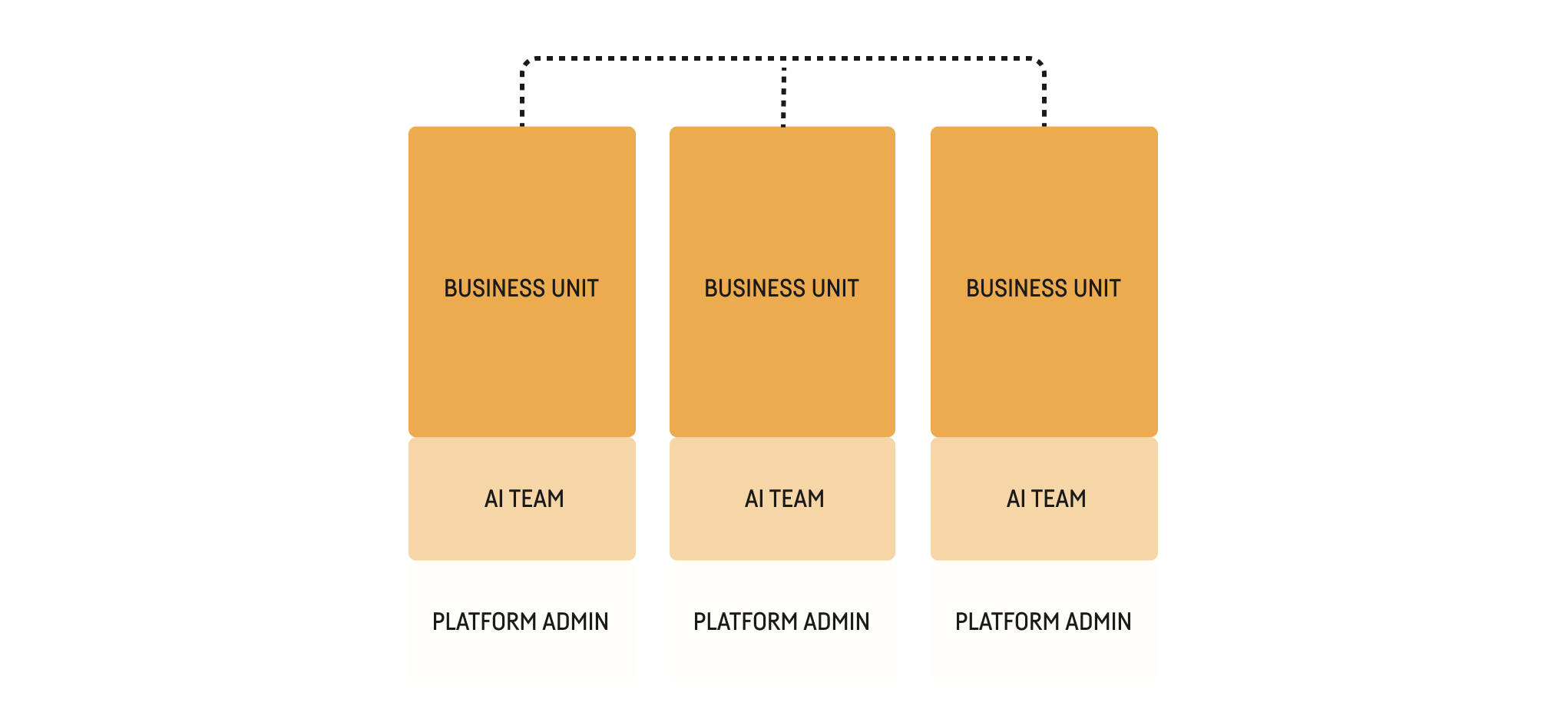
This is the initial organizational structure for most companies where each team does their own independent experimentation with AI. There’s little or no sharing of infrastructure, data, best practices, or talent beyond perhaps a Slack or Teams channel and a wiki hub.
The goal in this phase is simple: Figure out if AI is worth further investment. The siloed model is almost always temporary, and as soon as teams begin generating value, the duplicated effort and cost push them toward shared models.
Run quick, low-cost pilots to test whether AI delivers value for a specific use case.
Prove feasibility with open-source tools or external partners before committing budget.
Capture early lessons so wins can be repeated, since duplicated effort across teams is the main risk in this phase.
Identify which use cases justify shared investment.
Use the siloed model when your organization is just beginning to explore AI and needs to learn fast without heavy coordination. It suits the earliest maturity level, where the goal is to discover whether AI is worth pursuing rather than to scale it.
Time to value: How quickly a pilot produces a usable result
Cost per proof of concept: The spend required to test a single use case
Pilot-to-production rate: The share of experiments worth carrying forward
Once siloed experiments show that AI is worth the investment, the natural next step is to concentrate that effort centrally. A center of excellence (CoE) is designed to go fast and jumpstart the adoption of AI within an organization. It is a centralized team that develops and maintains AI products for many business units and functions. Ideally, the center is interdisciplinary because even though it’s centralized, success depends on business/tech collaboration and the creation of unicorn teams.
FINRA built a Center of Excellence to upskill employees in AI agent development and scale AI adoption across the organization, concentrating expertise to build momentum quickly.
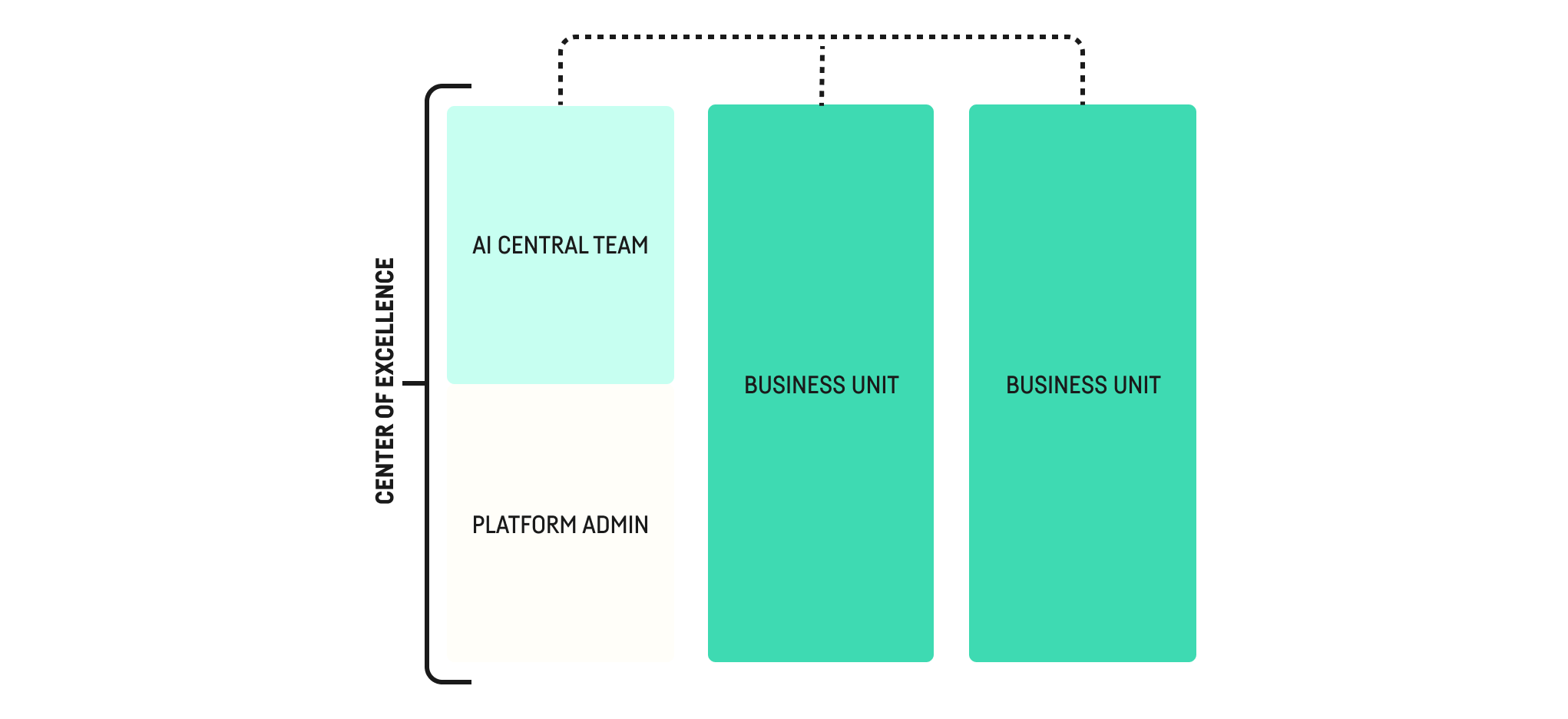
Manage a portfolio of AI products and prioritize the backlog, resisting intriguing but impractical "science projects."
Build scalable data architecture and infrastructure, from storage on Snowflake, AWS Redshift, or Azure SQL Database to compute for retrieval-augmented generation (RAG).
Track AI industry innovation, including LLMs and architectures like the Dataiku LLM Mesh.
Develop champions in each business unit and capture value stories that build momentum.
Choose a center of excellence when you have early wins to build on and need to accelerate adoption across many business units. It works best when AI talent is scarce and worth concentrating, and when consistent governance and shared infrastructure matter more than local autonomy.
ROI and value generated: The business return the CoE's portfolio produces, the clearest signal of whether to keep funding or evolve the model
Backlog size and time to value: A growing backlog or slowing delivery signals that maintenance is crowding out new work, the point at which an AI platform, or AI factory, becomes necessary to manage cost and risk
Champion coverage: The share of business units with an active champion, a leading indicator of demand and adoption
A hub and spoke model distributes the center of excellence's capabilities across the organization. AI experts sit in a central hub, business units form the spokes, and the two collaborate on product development rather than trading requests and evangelism.
Analytics and AI programs may stall when data teams stay isolated from the business, building things the business doesn't end up using. A hub and spoke structure closes that gap by putting AI experts and business units in direct, ongoing collaboration rather than a queue of requests.
Spreading analytics work out from the center also spreads data skills and accountability, building a broader data culture across the organization. That combination, closer collaboration plus wider skills, is what tends to separate organizations that scale AI successfully from those stuck running one-off projects.
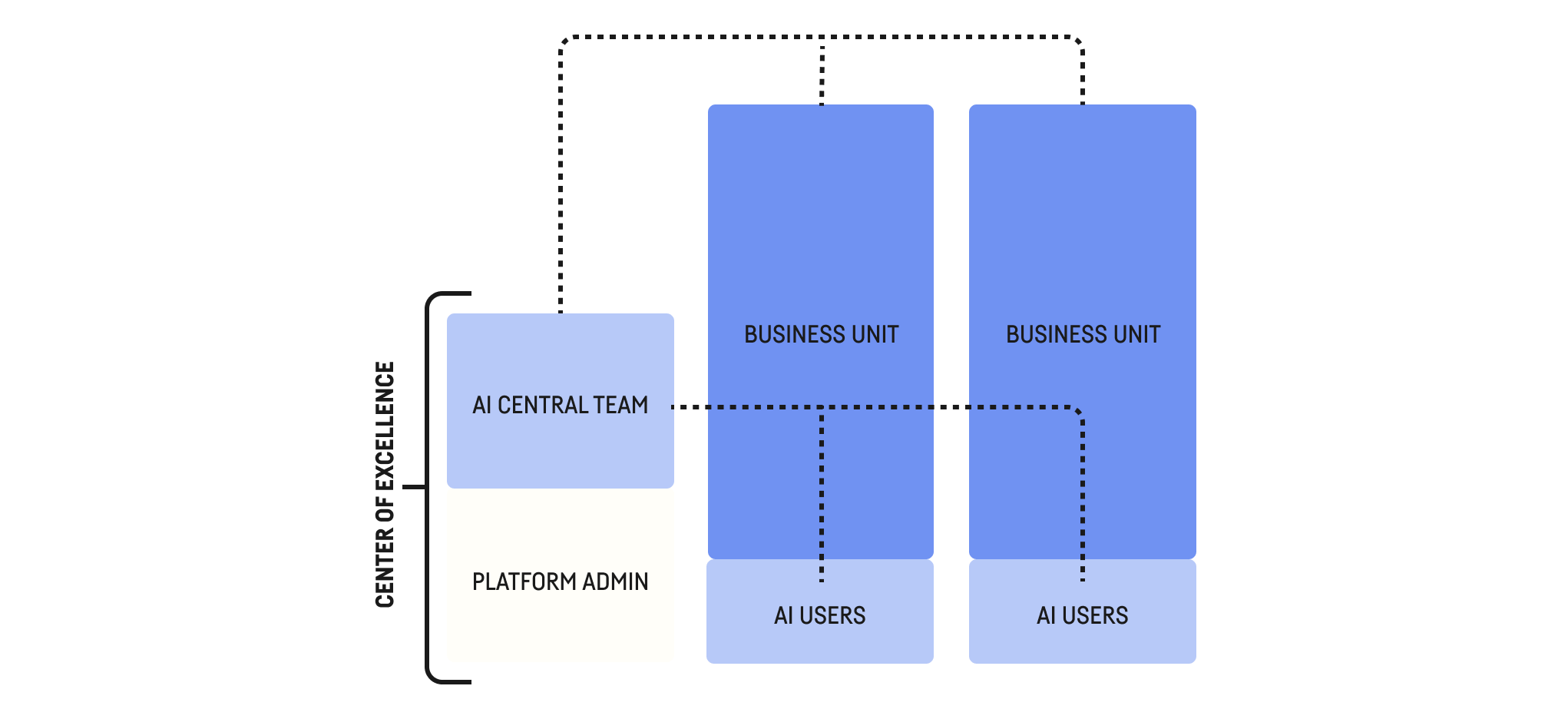
Maintain shared infrastructure, standards, and industry-innovation tracking from the hub.
Embed hub experts with spoke teams to co-develop AI products.
Transfer ownership of prioritization, adoption, and performance to the spokes.
Spread data skills and accountability outward to build data literacy.
Adopt hub and spoke when a center of excellence has matured, and the bottleneck has shifted from capability to capacity. It fits organizations ready to trade some central control for closer business collaboration and faster, more relevant delivery.
Value generated per spoke: How much each business unit produces, reflecting distributed ownership
Adoption and performance by product: Tracked in the spokes that now own outcomes
Data literacy reach: Growth in skilled contributors outside the central team
If a CoE is designed for fast AI adoption, then a center for acceleration is designed for broad AI adoption among frontline domain experts. It’s a refinement of hub and spoke and is what Dataiku, the Platform for AI Success, recommends for many of its customers who already have a mature CoE.
This model recognizes a critical but often overlooked challenge: scaling modern AI, GenAI, and AI agent development practices across both data scientists and business analysts. This structure shifts the onus for AI product development out of the center and into business units and functions. It aims to create unicorn teams in every spoke.
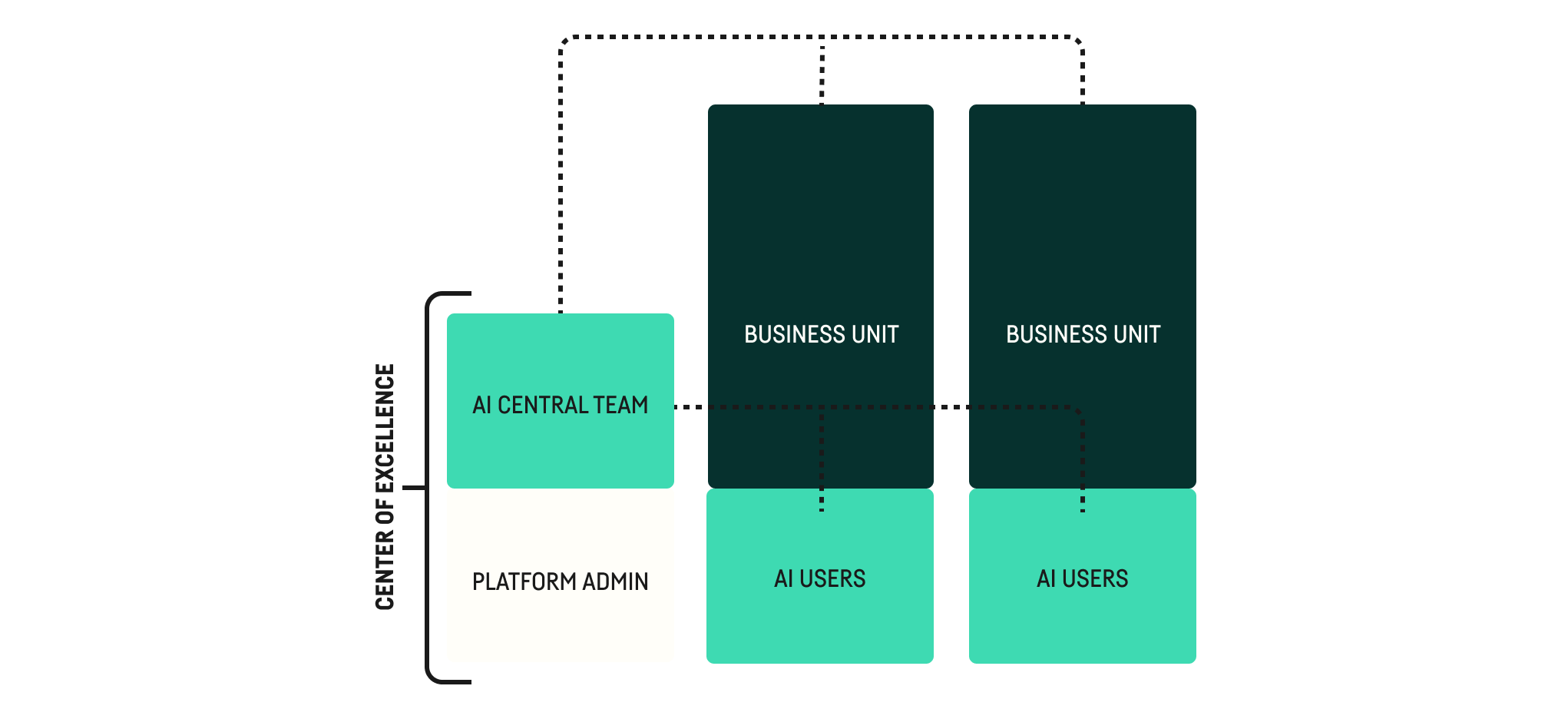
Enable business analysts and data scientists with training, templates, and reusable components.
Standardize development practices for modern AI, GenAI, and agents across roles.
Provide self-service tooling so domain experts can build within guardrails.
Track performance at the business unit and function level.
Move to a center for acceleration when you already run a mature hub and spoke and want AI development to reach frontline domain experts, not just data teams. It suits organizations aiming to put AI, GenAI, and agent-building capability into every business function.
Active builders per business unit: How widely development has spread beyond the center
Use case ROI by function: The value created where the business invests its own effort
Time to production for distributed teams: Whether enablement is translating into shipped products
If a center for acceleration spreads AI building across the spokes, the embedded model removes the center almost entirely. It is the most decentralized structure: AI lives inside every business function, and only a thin central layer remains: shared rules such as responsible AI guidelines, common infrastructure, and a few curated datasets.
As one sophisticated customer put it, they no longer outsource data science to IT but embed it in every business function. Digital natives such as Amazon, Google, and Uber have always worked this way, but most organizations haven't caught up: McKinsey's 2025 research on agentic organizations found that 89% of companies still operate with industrial-age structures, while only 1 percent have moved to a fully decentralized network model.
With so much autonomy, governance safeguards are what keep the model safe.
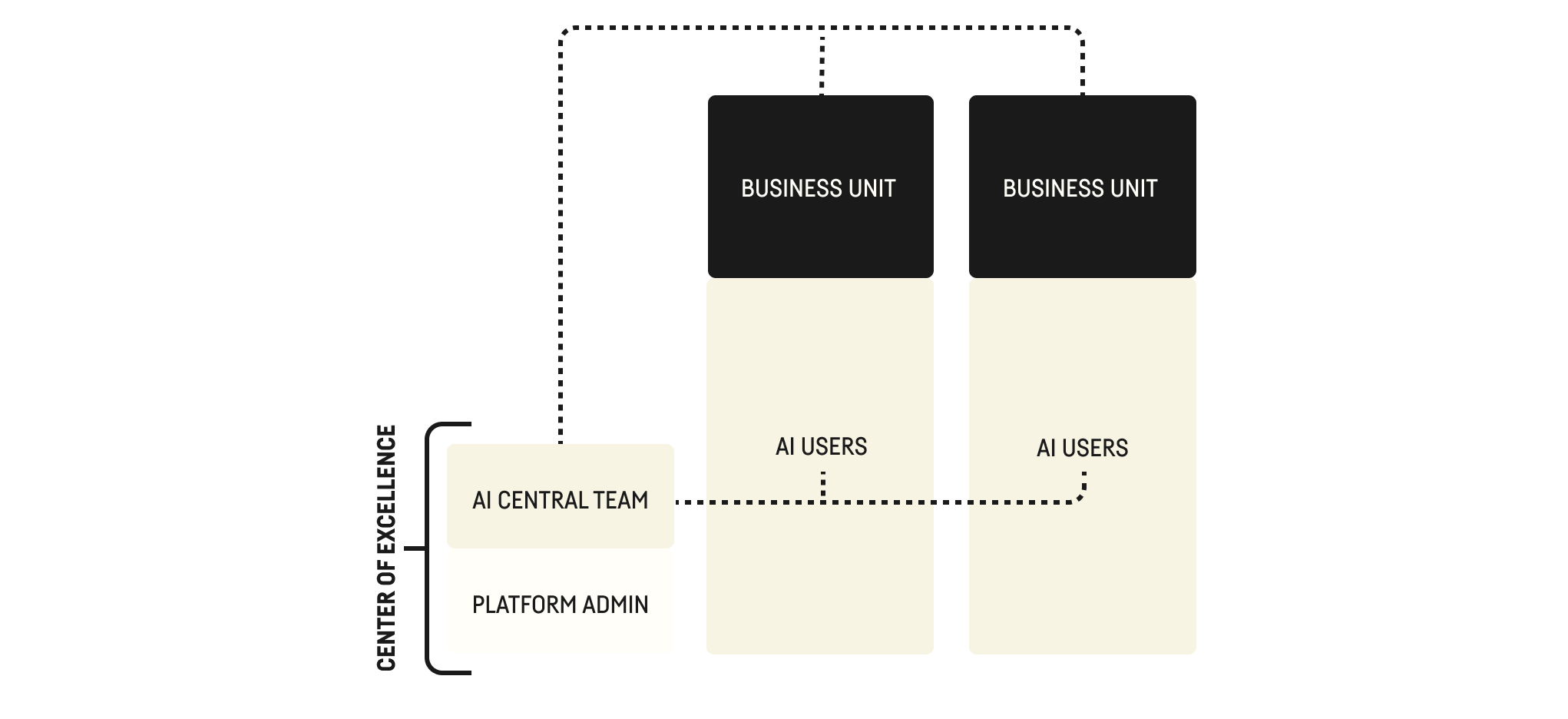
Maintain the minimal shared layer of responsible AI guidelines, core infrastructure, and curated datasets.
Set guardrails that let functions move fast without creating risk.
Curate and share reusable data and components across the organization.
Monitor for consistency, drift, and compliance across distributed teams.
Choose the embedded model when AI fluency is high across the business, and functions can own development end-to-end. It fits digital natives and mature enterprises that want maximum agility and are confident their governance guardrails can hold without central control.
Functions running AI independently: The breadth of embedded capability
Compliance and risk adherence: How reliably distributed teams follow shared guardrails
Cross-function reuse: How often datasets and components are shared rather than rebuilt
Whichever model you choose, a common platform is what makes it work. A lot of AI is still developed the way goods were made before the Industrial Revolution: handmade by small groups of artisanal experts, with low productivity and high maintenance. The Industrial Revolution changed that with automation, specialization, reuse, and collaboration.
The same is now happening to AI. A common AI platform enables interdisciplinary team collaboration, high reuse, and automation covering the entire AI product lifecycle including:
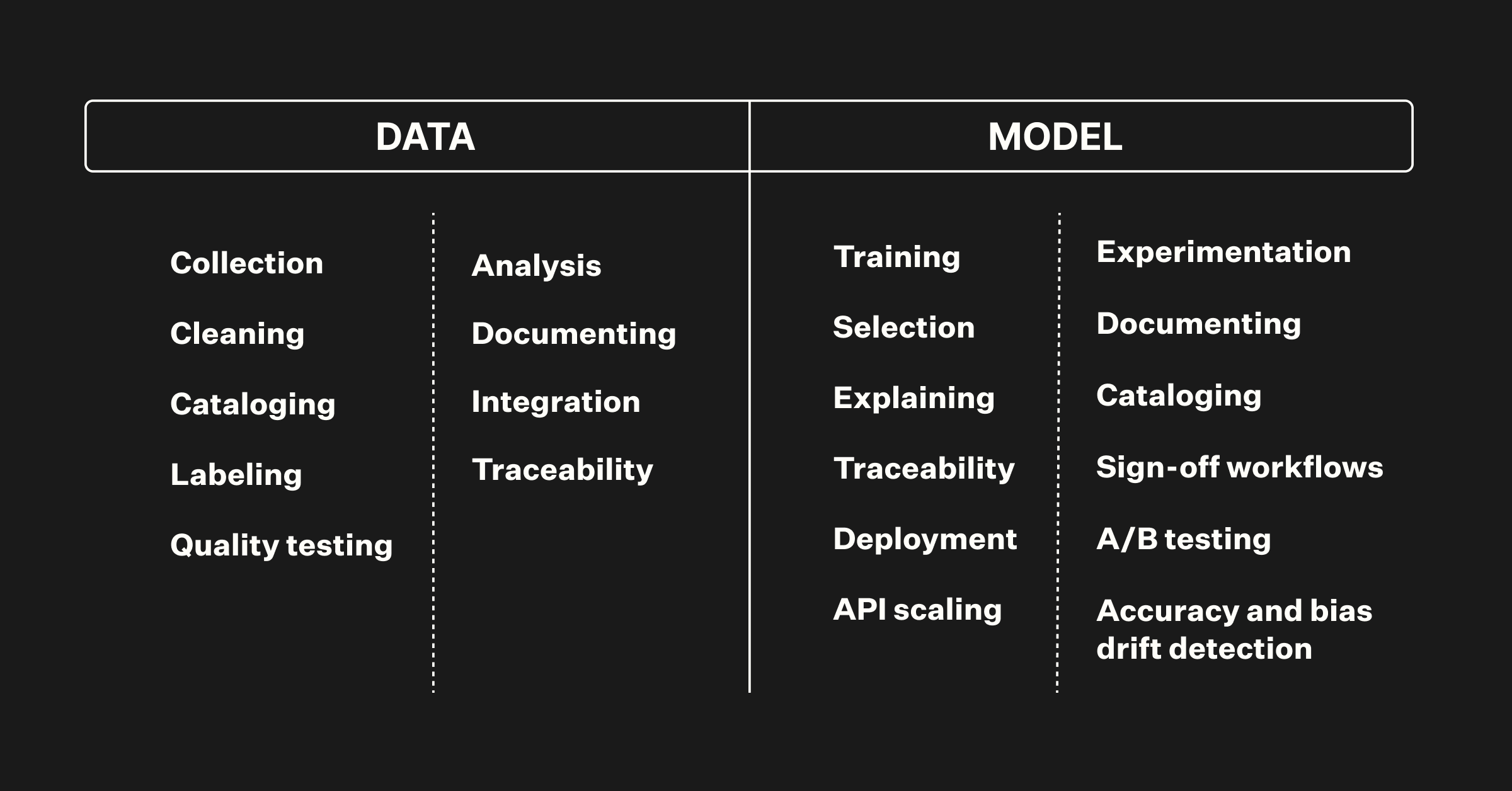
The benefits hold across siloed teams and embedded functions alike:
Usability for every skill level: Visual pipelines for non-coders and notebooks for coders, so business analysts and graduate-level data scientists can work in one place
Automation that compounds: Dataiku customers see automation gains grow the longer they use the platform. Prologis increased its AI/ML projects in production twelvefold, from 5 to more than 60, after centralizing its AI efforts on Dataiku, evidence that automation and reuse pay off more as adoption matures.
Built-in monitoring and control: Quality checks, sign-offs, and always-on monitoring for drift, bias, and model risk
Usability is more than ease of use. Text editors are easy to use, but most people still cannot write decent poetry. Usability is generally understood to have five components:
Learning curve
Efficiency
Memorability
Error prevention
Satisfaction
Efficiency and satisfaction in particular drive broad adoption, because if a platform does not make work easier, people revert to old habits. One customer, an Executive Director of Bioinformatics in the healthcare and biotech industry, called the experience with Dataiku "unmatched versatility" that "exceeded my expectations with outstanding quality, remarkable performance, and thoughtful design," calling it "a game-changer."
Key tasks in managing a common platform include:
License and vendor management
Data architecture best practices
Tracking industry innovation
Defining and reporting user service level agreement (SLA) metrics
Key performance metrics are:
Developer adoption rate
Monthly active users
AI products per monthly active user
Mean time between SLA violations
Recent SLA violations
When a platform is truly usable, teams stick with it — and that’s when adoption takes root. It’s not just about access, but about efficiency, collaboration, and ongoing business value.
Even the best structure and platform deliver nothing if no one uses them, and adoption is where many mature AI programs quietly stall. Driving uptake takes deliberate effort on two fronts.
People tactics:
Internal champions and branding that make AI visible and credible across business lines
Upskilling programs that close the AI talent gap and give teams the confidence to build
Process tactics:
Structured onboarding and A/B-tested workflows that lower the barrier to a first success
SLAs and monitoring that keep the experience reliable enough for people to depend on
With the five models mapped and adoption accounted for, the practical question is which one to commit to. There's no universally best operating model. The right one depends on where your organization sits across four dimensions, weighed against your appetite for scale and your budget. Read each model as a stage you may grow through rather than a permanent choice, and revisit the decision as you mature.
Assess how much AI talent you have and how it is distributed. Scarce, concentrated talent favors a center of excellence, while broad fluency across functions supports a center for acceleration or an embedded model. Treating AI as an organizational asset rather than a specialist function is what makes the more distributed models work.
Consider how mature your data infrastructure and practices are. Centralized models suit organizations still building shared pipelines and standards, while distributed models depend on reliable, well-governed data that functions can use independently.
Match the model to your governance appetite. The more decentralized the structure, the more you rely on guardrails, monitoring, and clear accountability to manage risk without central control.
Weigh the scale your platform must support and the budget behind it. A shared, multipersona platform lets you start centralized and decentralize over time without retooling, which is why technology choices should anticipate the model you are growing toward.As these dimensions shift, so should your model, which is why aligning structure to maturity is an ongoing exercise rather than a one-time decision.
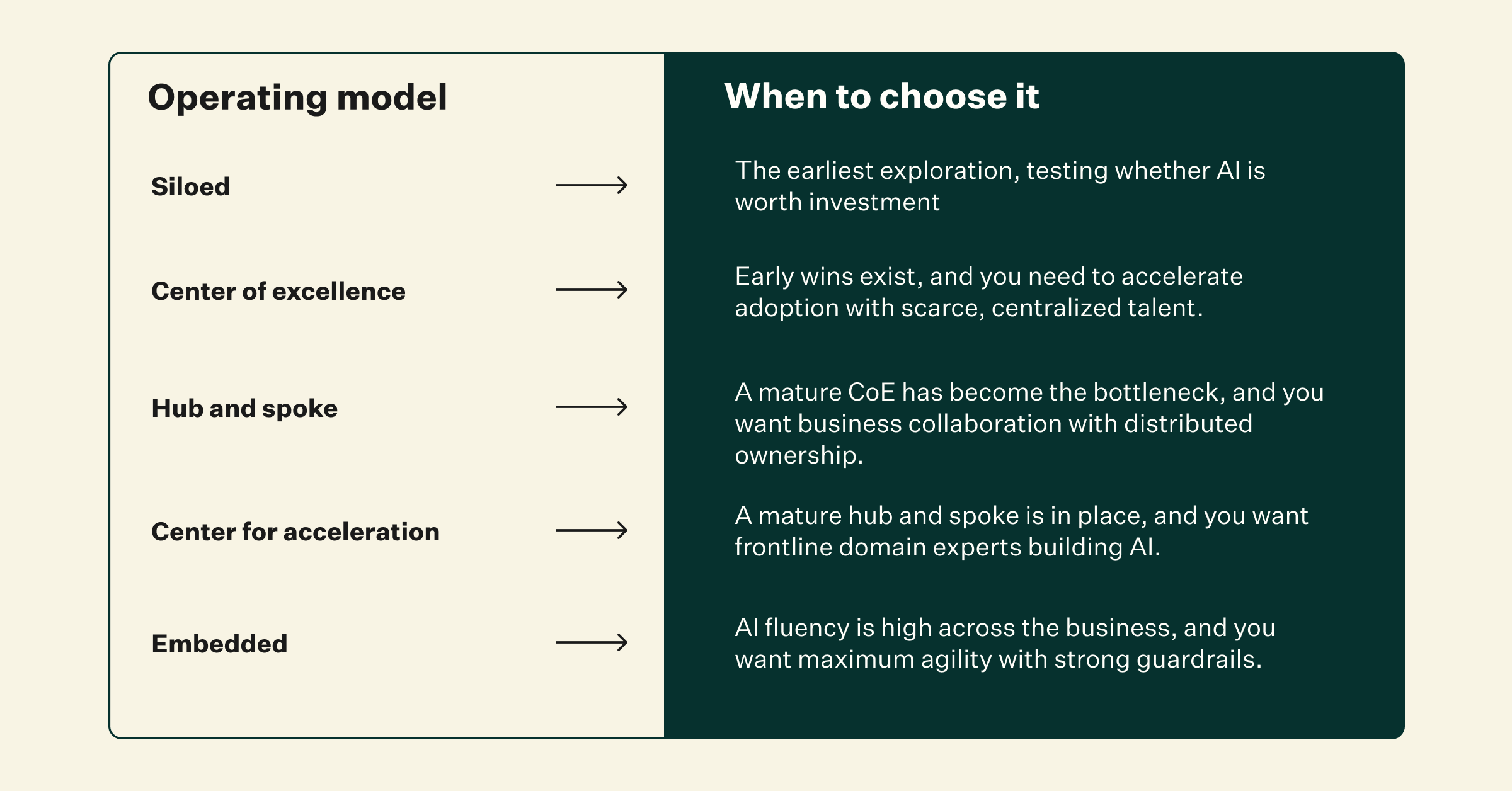
The takeaway is straightforward: Structure plus a shared platform drives value, and neither works alone. The right operating model organizes your people and governance, while a common platform gives every model the automation and control it needs to scale.
With Dataiku, automation gains grow the longer teams use the platform, the equivalent of expanding your team's capacity without additional hiring. Wherever you sit on the path from siloed experiments to embedded AI, the combination of the right structure and the right platform is what turns intent into impact.
Unite your enterprise AI
Unite your enterprise AI
AI operating models are the structures organizations use to organize people, processes, technology, and data so they can develop, deploy, and govern AI at scale. The five common models are siloed, center of excellence, hub and spoke, center for acceleration, and embedded.
They are important because most AI programs fail for organizational reasons, not technical ones. The right operating model reduces duplicated effort, aligns talent with business needs, and keeps governance in place as AI spreads, which is what lets pilots scale into production value.
The best operating model for enterprise AI adoption depends on maturity. Early-stage enterprises benefit from a center of excellence to concentrate scarce talent, while mature ones gain more from hub and spoke, center for acceleration, or embedded models that distribute ownership and increase ROI.
Roles and responsibilities shift with the model. A central team of data scientists and engineers leads in a CoE, while hub and spoke and embedded models add business-unit owners, champions, and domain experts who build and own AI products, supported by a central group that maintains standards and infrastructure.
The operating model shapes speed, ROI, and risk. Centralized models deliver consistency and fast early wins, while decentralized models generally increase ROI and innovation because the business invests its own effort, provided governance and a shared platform keep quality and risk under control.