LLM orchestration: managing models, providers, and pipelines
August 3, 2026/9 min read/Team Dataiku
Enterprise AI teams are deploying generative AI and autonomous agents across business functions: running different models for different tasks, using different providers for different risk profiles, and connecting LLMs to retrieval systems, tools, agents, and workflows.
Without orchestration, each application — whether a retrieval-augmented generation (RAG) chatbot, a code-generation tool, or a multi-agent workflow — handles prompts, retries, logs, costs, and guardrails differently. That fragmentation makes AI harder to govern and scale, and compounds quickly as agent deployments multiply.
The governance gap is already showing up in the data. Dataiku's "Global AI confessions report: data leaders edition," based on a Dataiku/ Harris Poll survey, found that 95% of data leaders admitted they could not fully trace AI decisions end-to-end if asked by regulators. For organizations under pressure to demonstrate responsible AI use, that is not a future risk but a present one.
This guide covers LLM orchestration architecture, framework comparisons, security requirements, and a 10-point implementation checklist to help enterprise teams build AI that is not just powerful but governable.
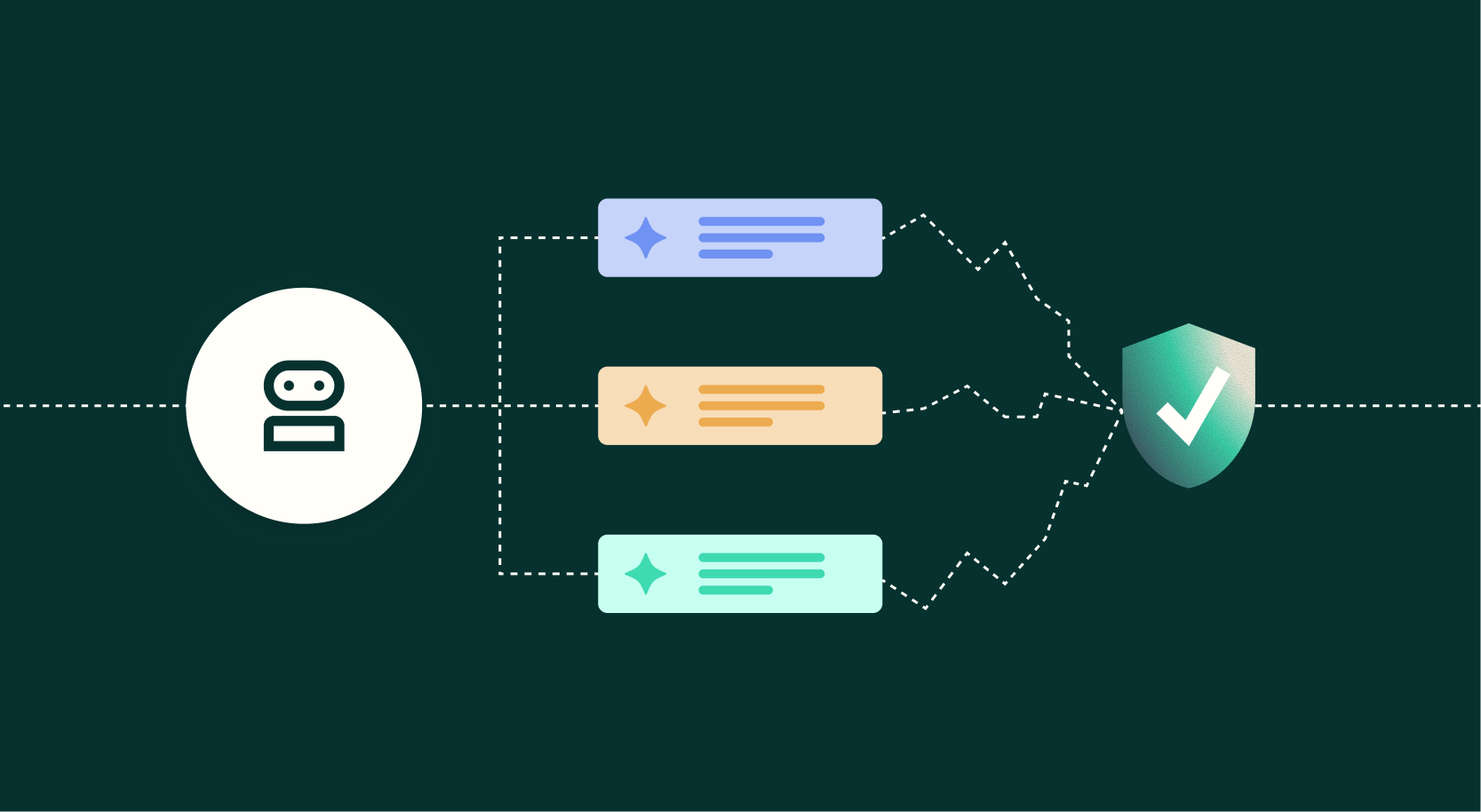
LLM orchestration coordinates prompts, routing, retrieval, tools, agents, evaluations, guardrails, logs, and costs into a single controllable layer.
Enterprises need orchestration because multi-model AI introduces provider risk, compliance exposure, latency variation, and fragmented token spend.
LangChain, LangGraph, LlamaIndex, Haystack, and IBM watsonx each fit different enterprise patterns, from broad application development to stateful agents to document pipelines.
The Dataiku LLM Mesh adds a governed model access and routing layer across providers, with controls for cost, performance, safety, and auditability.
LLM orchestration is the coordination layer that controls how large language models interact with the rest of an enterprise AI stack, including prompts, tools, data sources, policies, and other models. Rather than letting each application manage these interactions independently, orchestration centralizes that logic into a governed, reusable layer that can be monitored, audited, and adjusted without rewriting every downstream application.
In practice, it answers four questions that production teams encounter constantly:
Which model handles this request?
What data does it retrieve?
What happens if it fails?
How is the output checked before it reaches the user?
IBM describes orchestration frameworks as tools for prompting, chaining, managing, and monitoring LLMs, sitting between applications and model execution in a typical enterprise architecture.
Core capabilities include prompt chaining, agent and model routing, and resource management across tokens, latency, retries, tools, and provider quotas.
It is also worth separating orchestration from adjacent disciplines.
LLM orchestration coordinates live model workflows, LLMOps manages the lifecycle of LLM applications, and MLOps governs traditional machine learning models.
For CIO, CDAO, and AI transformation teams, this distinction matters because orchestration creates a common control point for fast-moving application teams, makes cost, latency, model choice, and usage visible, and applies governance consistently across providers and workflows.
Adoption of generative AI is no longer the challenge. Extracting value from it is. According to McKinsey's "State of AI in 2025" report, nearly nine out of ten companies had deployed AI in at least one business function by the end of 2025, yet 94% of respondents reported not seeing "significant" value from those investments.
LLM orchestration helps address four production problems that fragmentation creates.
API limits and failover: If one provider is rate-limited or unavailable, an orchestration layer can route traffic to another approved model.
Multi-vendor risk: Central routing reduces hard-coded dependency on a single model provider.
Compliance and auditability: Orchestration can record prompts, retrieved context, model choice, output, tool calls, and approval status.
Cost control: Dynamic routing can send simpler tasks to lower-cost models while reserving stronger models for high-value or high-complexity work.
Latency is a fifth consideration that often gets overlooked until production. The Awesome Agents AI Speed and Latency Leaderboard, which draws on Artificial Analysis data, shows Groq delivering consistent sub-400ms time-to-first-token, while SambaNova offers competitive first-token latency with strong sustained throughput on large models. These figures are directional; always test with your own prompts, retrieval context, concurrency, guardrails, and logging enabled before committing to a provider.
Performance is only one part of production readiness.
Security is a separate and equally pressing reason to centralize ownership. A 2025 National Vulnerability Database entry documented an access-control flaw that allowed normal users to access and modify app orchestration, a reminder that orchestration layers need role-based permissions, audit logs, and security review before broad rollout. IBM's orchestration guidance reinforces this: In enterprise environments, monitoring and guardrails mean access controls, audit logs, approval paths, and policy checks around every model call.
Dataiku, the Platform for AI Success, addresses this at the orchestration layer through Dataiku LLM Guard Services: Safe Guard enforces content and PII policies, Cost Guard enforces token budgets, and Quality Guard evaluates model output before it reaches users.
These operational and governance requirements should shape framework selection before teams compare framework features. Security and governance requirements apply across all orchestration frameworks, but implementation approaches differ significantly depending on architecture and operating model.
Use these eight criteria before shortlisting vendors or open-source projects.
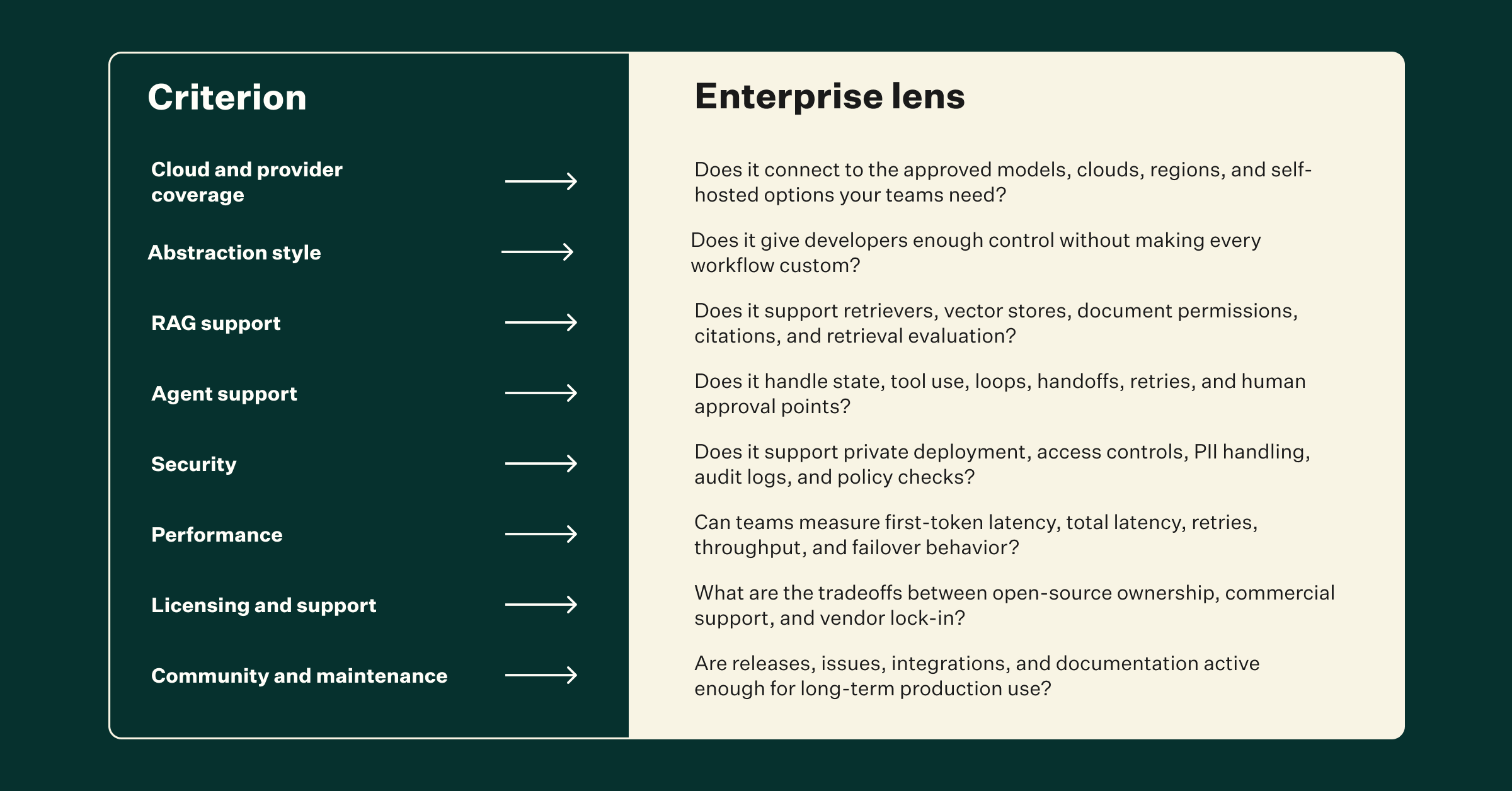
Click on the image above to zoom into full PDF
With those evaluation criteria established, the next step is understanding how the leading orchestration frameworks differ in enterprise environments.
These five represent distinct enterprise paths: broad framework, stateful agents, retrieval-first, document pipelines, and commercial platform.
LangChain is an open-source framework for building agents and LLM-powered applications, with pre-built architectures and integrations for any model or tool.
Strength: Modular ecosystem with 1,000+ integrations; swap models, tools, and databases without rewriting your application
Limitation: LangChain's abstraction layers speed up early development but can become friction points when debugging edge cases.
retrieve -> prompt -> model -> evaluate -> log
LangGraph is a low-level agent orchestration framework with durable execution, built-in state management, and human-in-the-loop controls.
Note: LangGraph is built by the LangChain team and serves as the framework's modern agent layer, which is why LangChain's quickstart guides increasingly default to LangGraph constructs; the two are listed separately here because LangChain remains the broad application framework while LangGraph targets stateful, long-running agents.
Strength: Explicit state management through durable execution, built-in memory, human-in-the-loop support, and checkpointing
Limitation: LangChain has acknowledged that LangGraph's adoption came with a steeper learning curve than its predecessor.
state -> node -> edge -> tool/model -> supervisor
LlamaIndex focuses on connectors, indexing, retrieval, and QA evaluation.
Strength: Purpose-built for context augmentation, with data connectors across APIs, PDFs, and SQL databases, data indexing, retrieval pipelines, and evaluation integrations.
Limitation: LlamaIndex has narrowed its focus from general-purpose framework abstractions toward document processing infrastructure, a scope narrower than broader multi-agent orchestration frameworks.
ingest CRM + docs + warehouse -> index -> retrieve -> generate
Haystack uses component pipelines and hybrid retrieval for document-heavy industries.
Strength: Explicit, modular pipeline architecture that gives developers full control over retrieval, ranking, memory, tools, and generation, with each component independently testable and replaceable
Limitation: Haystack's pipeline serialization currently supports only YAML, with broader format support still rolling out
retriever -> ranker -> prompt_builder -> generator -> evaluator
IBM watsonx Orchestrate is a proprietary workflow platform with a governed agent catalog and IBM ecosystem alignment.
Strength: Enterprise vendor credibility backed by built-in security, governance, and compliance, with a catalog of pre-integrated enterprise-ready agents and tools
Limitation: IBM caps monthly data transfer on the watsonx Orchestrate Cloud service at 10 GB to protect the platform from high-traffic issues.
Framework selection is only part of enterprise orchestration strategy. Teams also need to decide how orchestration workflows themselves are structured operationally.
Most enterprise LLM orchestration programs use one of three patterns:
Single-agent RAG: A user query goes through retrieval, prompt construction, model generation, response checks, and logging.
Multi-agent workflow: Specialized agents handle different sub-tasks, share state, call tools, and escalate to a supervisor or human reviewer.
Gateway routing: A gateway centralizes provider access, retries, failover, usage monitoring, and cost controls before traffic reaches models.
Regardless of which pattern your teams adopt, the following operational practices apply across all three and become more important as deployments scale.
Use dynamic model routing for cost, latency, and task fit.
Add observability for prompts, responses, tools, errors, and spend.
Apply guardrails before and after model calls.
Treat context engineering as an owned discipline, including retrieval quality and source refresh.
Limit tool access by role, workflow, and environment.
Monitor latency, cost, quality, safety, and business outcomes.
The goal is not to standardize on one framework everywhere, but to establish governed orchestration across model access, risk, cost, and traceability. That governance model becomes operationally important during implementation, where decisions around permissions, monitoring, rollback, and cost controls directly affect production reliability.
Moving LLM orchestration from pilot to production is where most enterprise programs encounter their first serious friction.
The checklist below covers the ten decisions and configurations that teams most commonly skip during early deployments, and that most frequently cause problems at scale. Work through each item before any production rollout, not after the first incident:
Document data sources, permissions, and PII classes.
Approve provider contracts, fallback rules, regions, and rate limits.
Size the infrastructure for expected concurrency.
Complete security review for orchestration-layer access controls.
Monitor latency, errors, quality, safety, and token spend.
Set budgets by application, team, provider, and model.
Version prompts, routing rules, and retrieval settings.
Test retrieval and output quality against known questions.
Define human review for high-risk decisions or actions.
Assign rollback, pause, and incident response ownership.
Even teams that complete the checklist above can run into predictable failure modes once agents are in production. The table below maps the most common orchestration pitfalls to their mitigations, drawing on patterns seen across enterprise deployments.
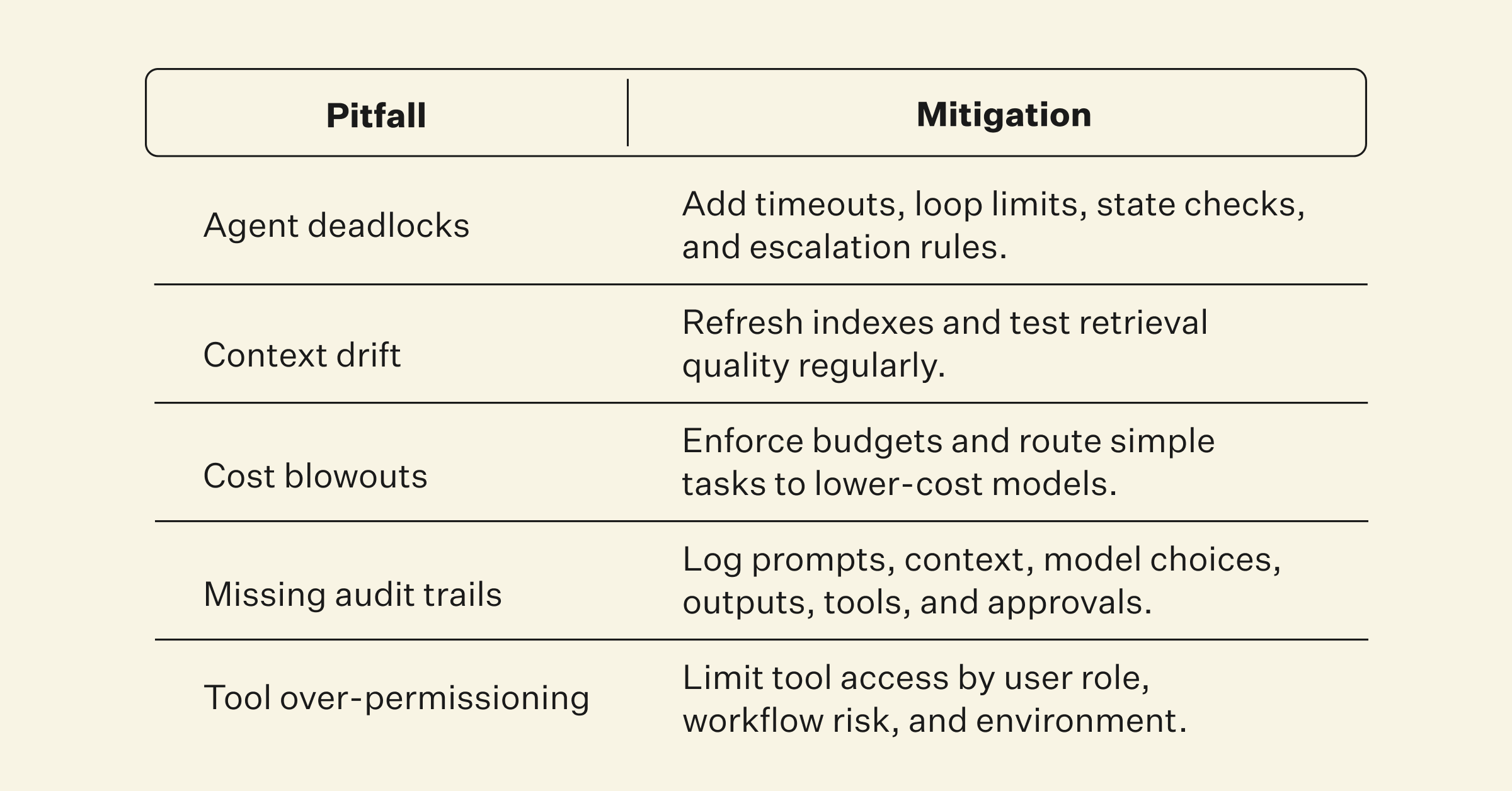
Click on the image above to zoom into full PDF
The most common orchestration failures are rarely model-related. In enterprise environments, operational controls around permissions, observability, escalation paths, and budget enforcement usually determine whether orchestration systems remain governable at scale.
No single framework solves every orchestration problem, and most enterprise environments will end up running more than one. The practical question is not which framework wins, but where to establish your first control point and build from there.
Framework-first: Use LangChain for broad application development, LlamaIndex for retrieval, LangGraph for stateful agents, or Haystack for document pipelines.
Gateway-first: Centralize provider routing, logging, rate limits, retries, failover, and cost controls before standardizing every application framework.
Platform-first: Use a commercial platform when procurement, support, auditability, and governed production are more important than maximum framework flexibility.
For organizations running multiple frameworks and providers, Dataiku offers Dataiku LLM Mesh: a centralized layer to connect to approved LLMs, monitor cost and performance, enforce policies, and avoid binding every application to a single provider.
The practical next step is an internal pilot with an evaluation worksheet covering latency, cost, retrieval quality, auditability, security controls, and business KPI impact.
If your teams are building with multiple LLM orchestration frameworks, evaluate where model access, routing, cost controls, audit logs, and guardrails should live. Dataiku can help move GenAI pilots into governed production across models, providers, and pipelines.
LLM orchestration coordinates live model, retrieval, tool, agent, and routing workflows in real time. LLMOps manages the broader lifecycle of LLM applications, including testing, deployment, monitoring, versioning, and evaluation. Both disciplines are necessary in production, but they operate at different layers.
Yes. Most enterprise patterns mix model types and route requests by cost, latency, data sensitivity, availability, and task complexity. A well-designed orchestration layer makes the model choice transparent to the application, so teams can swap or add providers without rewriting downstream logic.
Gateways operate at the infrastructure level: They normalize APIs, route traffic, track usage, enforce rate limits, and handle retries across providers. Frameworks operate at the application level, adding workflow logic, agent state management, retrieval pipelines, tool integration, validation, and output evaluation. Both can coexist in the same architecture.
For chat applications, first-token latency matters more than total response time because users react to when the answer starts appearing. Acceptable targets vary by use case, but sub-500ms first-token latency is a common enterprise threshold. Always benchmark with real prompts, retrieval context, concurrency levels, and guardrails enabled.
Set budgets by team, application, provider, and model tier. Route simple or high-volume tasks to lower-cost models, cache repeatable responses to avoid redundant inference calls, and cap runaway workflows before they compound costs. Monitor spend daily and require explicit approval before scaling any workflow beyond its baseline volume.