
Best legal software for cross-functional teams in 2026
August 14, 2026/9 min read/Team Dataiku
Most legal departments have become de facto AI buyers. But the tools they pick rarely talk to each other, to finance, or to their governance stack. Contracts are reviewed in one platform, invoices are analyzed in another, and research is done in a third, and no one can see the full picture.
When something goes wrong (a rogue clause, an unapproved outside counsel engagement, a hallucinated citation), the accountability gap is painfully visible. That is an orchestration problem.
In this article, we compare five leading legal AI tools by the departmental relationship each one bridges: enterprise-wide intake into legal, collaboration with clients and stakeholders, contracting with sales and procurement, spend with finance, and contract intelligence for every business function.
We set out the criteria that matter when legal AI crosses departmental lines, and show where an orchestration and governance layer becomes necessary once point tools reach their ceiling.
Generative AI adoption among in-house counsel more than doubled to 52% in one year, but tool sprawl across departments has outpaced governance design.
Five tools qualify as cross-functional by a specific test: Business users outside legal submit into it, work inside it, or act on its outputs. Streamline AI, HighQ, Ironclad, Brightflag, and Luminance each bridge legal to a different function.
A feature comparison covers cross-functional reach, AI verification, integrations, security certifications, and pricing, since no single tool wins on every dimension.
Even a well-chosen tool stack leaves a gap: Nothing tracks what all the AI activity is doing across departments, who approved it, or where the risk sits.
Dataiku sits above these point tools as an orchestration and governance layer, connecting their outputs and maintaining the audit trail compliance eventually requires.
Legal software for cross-functional teams matters because AI-generated legal decisions now carry financial, operational, and regulatory consequences that a single department cannot own alone. Without shared tools, shared visibility, and shared governance, the risk lands on the enterprise and the accountability gap lands on the CIO.
The adoption numbers reflect the urgency. The "Generative AI's Growing Strategic Value for Corporate Law Departments" report published in 2025 found that 52% of in-house counsel now actively use generative AI.
That pace has created a new problem: tool sprawl with no central governance. According to the Thomson Reuters 2026 AI in Professional Services Report, 77% of professionals surveyed across legal, tax, accounting, and risk functions expect agentic AI to be central to their workflow by 2030. Agentic workflows do not stop at the legal department boundary.
Your challenge is that legal tool procurement has outpaced enterprise governance design. Finance analytics teams buy one legal AI product. Procurement buys another. Legal ops buys a third. None of those tools was designed to report to a central governance registry, share audit trails, or flag risk across departments.
Tool sprawl at this scale tracks how quickly legal responsibilities have expanded into finance, operations, and procurement. Before comparing platforms, we'll define what cross-functional means, and the criteria that matter most when legal AI crosses departmental boundaries.
A legal AI tool qualifies as cross-functional if its normal operation involves more than one business function: People outside legal (sales, procurement, finance, or HR) submit work into it, act inside it, or consume and act on its outputs. An integration logo alone does not qualify; departmental reach through people does.
There is a second, higher tier that no point tool reaches: coordinating and governing AI activity across all of those tools and functions as one accountable system. That distinction matters, because a tool can serve multiple departments well and still leave you with no enterprise-wide view of what its AI is doing. We return to that gap after the comparison.
Evaluate each platform across six criteria:
Cross-functional reach: People outside legal should be able to submit into the tool, work inside it, or act on its outputs.
AI accuracy and fact-checking: For legal outputs that inform business decisions, verifiable citations and source-grounded responses matter more than fluent summaries.
Integration with business systems: Cross-functional legal software needs to connect to CRMs, ERPs, collaboration tools, and document systems already used across departments.
Security and compliance: Role-based access (RBAC), data controls, and audit logging determine whether legal AI can operate safely in regulated workflows.
Pricing model: Per-seat, spend-based, and platform licensing models create different cost profiles as adoption expands beyond legal.
Scalability and governance: As legal AI spreads across multiple business units, leaders need visibility into workflow performance, approvals, and risk over time.
The first five criteria are well served by the tools in this article. Criterion six is where point tools reach their ceiling, and the orchestration question begins.
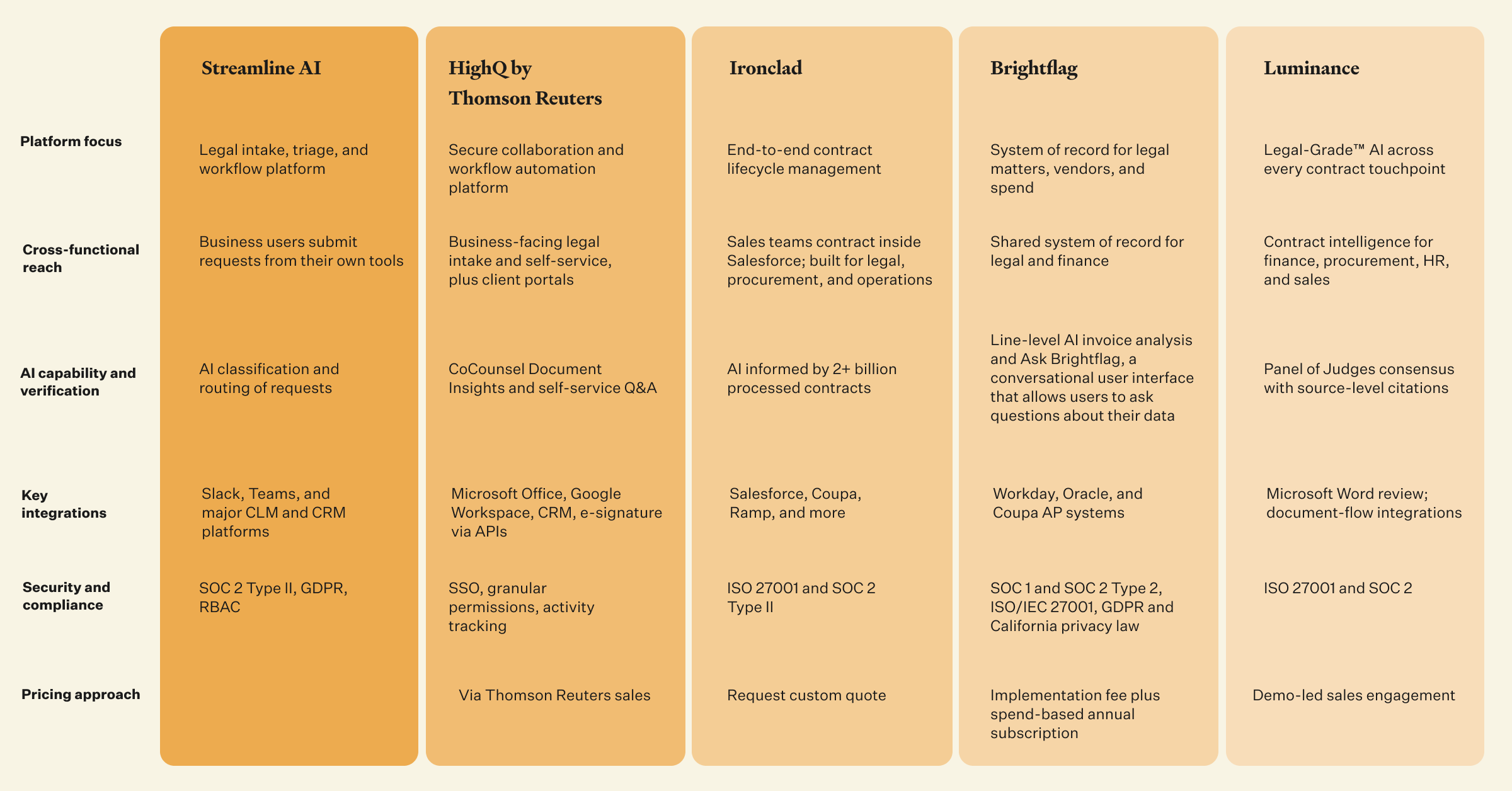
Comparison accurate as of July, 2026. Each row compares the vendor's generally available commercial offering.
A quick preference guide:
For high-volume routing, start with intake.
For regulated multi-party collaboration, prioritize secure workspaces.
For legal-sales velocity, evaluate contract lifecycle management (CLM).
For spend control, focus on the legal-finance bridge.
For verifiable contract intelligence across every function, test citation-backed AI.
These tools were selected because each one bridges legal and at least one other business function as part of its core design, alongside market traction and AI capability depth.
Streamline AI is an AI-powered operating platform for in-house legal teams. Rather than functioning as a CLM system, it sits upstream of contracting and manages legal work across all request types.
Its cross-functional axis is intake: Business users across the company submit legal requests from the tools they already work in, such as Slack, Teams, and email, and AI classifies and routes each request automatically.
Its core strength is volume management. Streamline AI reports a 50% reduction in resolution time, 40% outside counsel savings, and a 65% reduction in response times. Legal ops teams configure intake and routing without relying on IT, and live dashboards give leadership the data to manage capacity.
Streamline AI is SOC 2 Type II certified, GDPR compliant with configurable data residency, and supports enterprise SSO and role-based access control.
Streamline AI maintains a published pricing page with Pro and Enterprise plans, with final quotes handled through sales. One consideration for cross-functional buyers: Slack and Microsoft Teams integrations are included at the Pro tier, while Salesforce and CLM (Ironclad) integrations are listed under the Enterprise plan.
In our assessment, teams seeking contract negotiation, legal research, or spend analytics capabilities will need additional tools alongside Streamline AI. Its value is precisely its stated scope: intake, triage, and workflow across the full lifecycle of legal requests.
Legal operations leaders managing intake-heavy environments where routing requests from sales, HR, procurement, and finance into legal is the primary bottleneck
HighQ is Thomson Reuters' collaboration and workflow platform, used by more than one million users. Its centralized platform covers secure document sharing, collaborative workspaces, and client portals.
Its cross-functional axis runs in two directions:
Inward, corporate legal departments use it to give the business structured access to legal, through customized intake and self-service.
Outward, it structures collaboration with clients, outside counsel, and other stakeholders through portals and virtual data rooms.
In October 2025, Thomson Reuters integrated CoCounsel's generative AI into HighQ, adding document insights and a self-service Q&A experience that lets stakeholders query curated document sets in natural language. The same announcement covered CoCounsel's regional expansion in French, German, and Japanese.
For connecting to the wider stack, HighQ offers APIs and native integrations with productivity systems, and its solution templates cover matter intake and contract lifecycle workflows.
HighQ provides single sign-on, granular user permissions, and activity tracking.
Pricing runs through Thomson Reuters sales rather than a published rate card.
In our view, teams needing deep legal research, AI contract analysis at scale, or spend analytics will use HighQ as one tool in a broader stack. It is a collaboration and workflow governance layer, and a strong one; it is not a legal research platform or a dedicated CLM.
Enterprise legal teams managing complex, multi-party matters where document security, structured collaboration with clients and outside counsel, and workflow auditability are the primary requirements.
Ironclad is a contract lifecycle management platform whose AI is informed by patterns across more than two billion processed contracts. Its coverage runs end to end, including no-code workflow automation, native AI for redlining and insights, deep integrations with tools like Salesforce, full contract visibility, and a native e-signature capability.
Its cross-functional axis is the commercial teams that contracts touch: Ironclad positions itself for teams from legal to procurement to operations, and its Salesforce integration puts contracting inside the sales team's own system. Integrations extend across the enterprise stack.
Its no-code Workflow Designer lets legal ops teams configure approval automations without custom code, and its AI applies negotiation playbooks to redlining automatically.
Ironclad carries ISO 27001 and SOC 2 Type II certifications and enforces data controls around its AI.
Ironclad does not publish pricing on its site; you need to get a custom quote.
In our assessment, Ironclad's depth is contract-specific. Teams that need multi-department intake beyond contracts, legal spend analytics, or research capability will pair it with other tools in this list rather than stretch it beyond its lane.
Legal teams supporting high-volume commercial contracting, particularly in organizations where Salesforce is the primary sales platform and procurement runs on connected systems
Brightflag addresses the slice of legal operations that most AI tools ignore: the financial relationship between the legal department, its outside counsel, and the finance function. The platform acts as a system of record connecting matters, vendors, and spend, analyzing every invoice line with AI.
Its cross-functional axis is finance: The platform serves as a shared record across finance and legal, and it connects directly into the AP systems finance owns.
On governance, its e-billing goes beyond invoice review. Its Ask Brightflag capability gives teams conversational access to their own spend and matter data, and AI-generated vendor profiles support panel management and RFPs.
Brightflag is SOC 1 Type 2 and SOC 2 Type 2 compliant and certified in ISO/IEC 27001 and complies with GDPR and California privacy law.
Pricing is based on a spend-linked subscription rather than seats.
Legal operations teams with significant outside counsel spend where cost visibility, invoice analytics, budget governance, and the finance partnership are the primary pain points.
Luminance is a Legal-Grade™ AI platform built around contracts as an enterprise asset. More than 1,000 customers use it, with reported time savings of 90% on contract review.
Its cross-functional axis is the broadest in this list, making contract intelligence usable by every function that depends on it: Luminance states this directly: "From Finance and Procurement to HR and Sales, all these teams rely on contract information to make decisions – Luminance makes this knowledge accessible." It also offers dashboards configurable per team.
For legal teams evaluating AI tools for cross-checking legal arguments and facts, two Luminance capabilities matter. Its Panel of Judges architecture cross-validates outputs across multiple models, and its insights carry traceable citations back to the source text. In our assessment, this is one of the clearest implementations of verifiable AI output in legal software today.
Negotiation work runs where lawyers already draft, and the platform carries ISO 27001 and SOC 2 certifications.
Luminance does not publish pricing on its site; evaluation begins with a demo request.
In our assessment, Luminance is contract-centric by design. Teams needing multi-department request intake, matter management beyond contracts, or spend analytics will pair it with the intake and finance tools above; its overlap with Ironclad is real but runs along a different line, with Ironclad owning the contract process and workflow of record while Luminance supplies AI-native review, negotiation, and portfolio intelligence on top of contract data.
Enterprises where contract data drives decisions in finance, procurement, sales, and HR, and where verifiable AI output is a hard requirement
The five tools above are strong at what they do. But none of them was designed to answer the question that eventually lands on your desk: Where is all of this AI activity, who approved it, and what is it doing to enterprise risk?
That question describes the orchestration gap, one of the three gaps (alongside the people gap and the governance gap) that define why AI programs grow more complex without producing better results. Legal ops teams build workflows you cannot see. Finance analysts run spend queries that legal cannot trace. Agents are deployed for contract monitoring and regulatory alerts with no central performance tracking.
Dataiku, the Platform for AI Success, addresses this as an orchestration layer. Legal AI tools produce data, decisions, and risk indicators. Dataiku connects those outputs to the enterprise AI stack, applies governance and accountability controls, and lets you see across all of it.
The AI Success Formula makes this concrete: People + Orchestration + Governance = AI Success.
Legal point tools serve the People layer. Dataiku provides the Orchestration and Governance layers that make those tools enterprise-grade.
Dataiku is not a legal platform and does not replace Streamline AI, HighQ, Ironclad, Brightflag, or Luminance for their specific legal functions. It is relevant when the coordination problem across those tools has become larger than the problems each tool individually solves.
Two Dataiku capabilities are directly relevant to legal AI governance:
It provides a centralized model and AI asset registry, approval workflows, AI risk qualification, and audit trails. When a legal AI tool produces a decision that affects a contract, a vendor relationship, or a regulatory filing, Dataiku Govern maintains the approval chain and audit record that compliance teams and boards require.
Meeting your AI compliance requirements means having a documented chain of custody for every AI-driven decision, not just the tool that generated it.
It extends that governance to agentic workflows. The Thomson Reuters 2026 AI in Professional Services Report found that 77% of professionals surveyed across legal, tax, accounting, and risk functions expect agentic AI to be central to their workflow by 2030. Legal teams are already beginning to deploy agents for contract monitoring, vendor assessment, and regulatory alert management.
Dataiku Agent Management connects to agents across platforms (including AWS Bedrock, n8n, Salesforce, and Dataiku), evaluates them against business KPIs, and flags performance drift before it creates legal or operational risk.
The scale that becomes possible when AI is governed as a unified program is significant. SoftBank built an AI-agent-powered sales operating model in Dataiku, with a projected 250,000+ hours reclaimed annually. Legal AI at that scale requires the same architectural discipline: one governed system where every tool is accountable.
Knowing where the architecture falls short is step one; building a practical adoption plan that accounts for it is step two.
The core implementation tips are to map stakeholders, pilot one workflow before scaling, phase training by user type, track KPIs from day one, and design governance ahead of tool selection.
That order matters because cross-functional legal AI deployments fail for the same reason every enterprise AI program does: Tool selection happens before governance design. The AI regulation playbook for CIOs describes a consistent pattern: Organizations choose tools, deploy them, and discover the governance requirements after the first incident.
The order should be reversed. Before scaling legal software across departments, establish four things:
Stakeholder mapping: Identify which departments generate the highest request volume and which workflows carry the most compliance exposure.
Pilot with one workflow: Prove value on a contained process before expanding to broader legal, finance, HR, or procurement use cases.
Phased training: Legal operations tools require different onboarding for sales and HR users than for counsel; plan for both.
KPI tracking: Define success before deployment, including turnaround time, request resolution rate, and compliance incident reduction.
Once those requirements are clear, tool selection becomes more tractable. A tool that performs well inside the legal department may require a governance wrapper before it operates safely in cross-departmental workflows. A CLM platform with deep Salesforce integration may need additional approval chain logic before it auto-executes high-value contracts.
The organizations that get cross-functional legal AI right treat the governance architecture as the product. The tools are components inside it.
Each platform here bridges legal to one function well. But none of them can answer what happens once several are running at once: who approved what, and what one tool's output does once it becomes another department's input.
That's the orchestration gap this article opened with, and it's why governance belongs in the tool selection conversation from day one, not a retrofit after the first incident. Dataiku doesn't replace any of these five tools; it sits above them, connecting their outputs and giving you the audit trail compliance will eventually ask for.
Dataiku Govern
Dataiku Govern
Explore Dataiku's AI governance leadership
See how Dataiku governs AI across your enterprise stack
It depends on the request pattern. High-volume intake favors tools built around collecting requests from wherever business users already work. Contract-heavy workflows favor end-to-end lifecycle platforms. Making contract data usable by every function favors tools designed for cross-departmental access.
Most enterprise-grade platforms apply role-based access control, single sign-on, and full audit logging so only authorized users see sensitive matters. Look for recognized certifications like SOC 2 and ISO 27001, plus GDPR compliance, before extending access beyond legal.
Yes. Leading platforms connect natively to CRMs like Salesforce, ERPs, e-signature tools, and collaboration platforms like Slack and Teams, so business users can submit and track legal work without leaving the systems they already use daily.
Prioritize platforms with published security certifications, role-based governance, and audit trails from day one. Confirm the tool works within existing systems rather than requiring a separate login, and plan phased training since legal, sales, and finance users need different onboarding.
AI automatically classifies and routes incoming requests, applies playbooks to redlining and review, and surfaces answers from existing documents through conversational search, cutting the manual triage and back-and-forth that typically delays legal work.
Streamline AI is a trademark of LegalDesk, Inc. HighQ and CoCounsel are trademarks of Thomson Reuters. Ironclad is a trademark of Ironclad, Inc. Brightflag is a trademark of Brightflag. Luminance and Legal-Grade are trademarks of Luminance Technologies Ltd. Dataiku is not affiliated with or endorsed by any of the above companies. All product capabilities, pricing, and features referenced in this article are sourced from each vendor's own publicly available pages. Sources are dated July 2026.
Standard Chartered prevented ~$90M from being laundered by helping investigators surface higher-risk accounts faster
Sep 21, 2026
Aviva turned hours of audit research into seconds with Q!, a series of AI agents
Sep 21, 2026
Semantic drift in AI: how to detect, measure, and prevent it in production
Sep 17, 2026