Agent benchmarking: how enterprises compare agent performance
November 25, 2026/7 min read/Team Dataiku
Deploying an AI agent is only the beginning of the accountability challenge. The question shifts from "Can we build this?" to "How do we know it works, how much does it cost, and can we prove it to stakeholders?"
Agent benchmarking provides that proof. It is the systematic evaluation of AI agents across controlled task suites, measuring not just whether agents complete tasks correctly but whether they do so efficiently, reliably, safely, and within cost constraints.
The distinction from single-model evaluation matters: An LLM benchmark tests whether a model generates a good answer. An agent benchmark tests whether a system can reasonthrough a multi-step workflow, selects the right tools, handles failures gracefully, and produces a correct outcome at an acceptable cost.
Princeton's "AI Agents That Matter" research, since peer-reviewed and published in TMLR in 2025, found that on HumanEval, a state-of-the-art agent (LATS) cost more than fifty times as much as a simple baseline strategy for comparable accuracy, and that twelve of seventeen popular benchmarks failed basic holdout criteria. The implication for enterprise teams is that the benchmarks you choose and the metrics you track determine whether you are measuring real capability or rewarding expensive complexity.
This guide covers leading benchmarks, core evaluation metrics, enterprise testing strategies, and practical steps for building a benchmarking program that connects agent performance to business outcomes.
Agent benchmarking evaluates AI agents across controlled task suites that test reasoning, tool use, error handling, and multi-step execution.
Leading benchmarks (AgentBench, Terminal-Bench, WebArena, GAIA, ToolEmu, BFCL) test different capability dimensions. No single benchmark covers the full enterprise evaluation surface.
Production monitoring data across many deployed agents consistently shows a gap between benchmark scores and real-world reliability, which is why continuous production monitoring has to complement pre-deployment benchmarking.
Enterprise benchmarking programs should combine standardized benchmarks for cross-agent comparison with custom task suites for business-specific evaluation. Pair both with continuous production monitoring for real-world reliability tracking.
Agent benchmarking is the systematic evaluation of AI agents across controlled task suites designed to measure interactive, tool-using, multi-step performance, rather than the single-turn text generation that traditional LLM benchmarks assess.
The distinction from single-model evaluation is fundamental. An LLM benchmark
presents a prompt and scores the response, whereas an agent benchmark presents a goal, provides access to tools and environments, and evaluates the full trajectory: how the agent planned its approach, which tools it selected, how it handled intermediate failures, and whether it achieved the correct end state.
A model that generates a perfect SQL query usually scores well on an LLM benchmark. An agent that connects to a database, runs the query, interprets the results, identifies an anomaly, and escalates it to the appropriate team typically scores well on an agent benchmark.
AgentBench, one of the earliest broad-scope agent evaluation frameworks, established the pattern of testing agents across diverse environments (operating systems, databases, web navigation) with end-to-end success as the primary metric. Newer benchmarks keep appearing because no single one tests everything an enterprise agent needs.
Enterprise teams face three categories of risk when deploying agents without structured benchmarking, and each category affects a different stakeholder group. Gartner® states, "Over 40% of agentic AI projects will be canceled by the end of 2027, due to escalating costs, unclear business value or inadequate risk controls, according to Gartner, Inc."*
Without cost-normalized benchmarking, teams discover that an agent costing $0.50 per task achieves 89% accuracy while another costing $12.00 per task achieves 91%. The two-point accuracy difference may not justify a 24x cost increase, but without the comparison data, the team defaults to the more expensive agent because it scored higher on a cost-blind benchmark. CIOs and finance teams need cost-accuracy trade-off data to make informed investment decisions.
An agent that scores 92% on a benchmark may achieve 65% in production because the benchmark did not test for the edge cases, data quality issues, and adversarial inputs that production traffic includes. Risk management and compliance teams need reliability metrics (pass@k scoring, variance analysis, adversarial testing) alongside accuracy to assess production readiness.
Regulated environments require evidence that agent behavior was evaluated against defined standards before deployment. Audit teams need documented benchmark results, evaluation methodology, and performance thresholds as part of the deployment approval record.
The Princeton research also found that many benchmarks lack adequate holdout sets, and agents frequently overfit through shortcuts rather than genuine capability. For enterprise teams, this means that benchmark scores without rigorous methodology can provide false confidence that may be worse than no evaluation at all.
Six benchmarks cover the primary evaluation dimensions that enterprise agents require. The right selection depends on the agent's function and the capability gaps the team needs to assess.
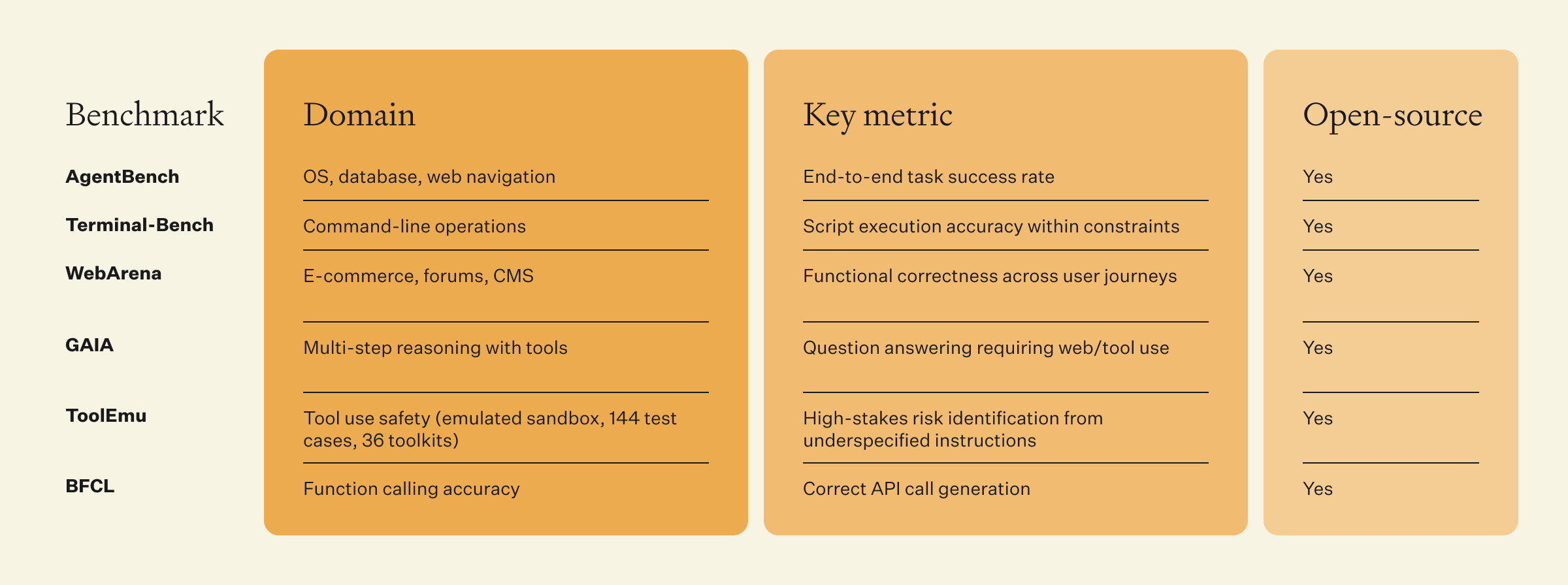
Click on the image above to zoom into full PDF
AgentBench evaluates end-to-end agent success across eight diverse environments:
Operating system
Database
Knowledge graph
Digital card game
Lateral thinking puzzles
House-holding
Web shopping
Web browsing
The breadth makes it a reasonably strong starting point for full-spectrum capability assessment, particularly for agents that need to operate across multiple system types. Enterprise teams typically use AgentBench to establish a baseline before drilling into domain-specific benchmarks.
Terminal-Bench tests command-line autonomy: file operations, script execution, system configuration, and troubleshooting within constrained environments. The focus on terminal operations makes it directly relevant for DevOps and IT automation agents that interact with production infrastructure through CLI tools. The constrained execution environment tests whether agents respect operational boundaries, which is a proxy for the governance controls that production deployment requires.
WebArena presents multi-domain web tasks across e-commerce and forum environments, along with content management systems, with success defined as functional correctness across realistic user journeys. The web-based task format serves as a useful proxy for customer-facing agent workflows: navigation, form completion, information retrieval, and multi-step transaction processing. Related suites (VisualWebArena, WorkArena) extend coverage to visual understanding and enterprise application interaction.
Five metric categories cover the evaluation surface that enterprise benchmarking programs should address. Tracking accuracy alone, as Princeton's research demonstrated, leads to unnecessarily expensive agents and mistaken conclusions about what drives performance.
The percentage of benchmark tasks completed correctly, verified against the expected end state rather than just the final answer. A task where the agent produces the right answer through an unsafe or unauthorized path should not count as a success. End-state verification catches this distinction.
Total cost per task completion, combining token pricing (input and output) and infrastructure time, plus API calls to external tools. Reporting cost alongside accuracy enables Pareto analysis: plotting accuracy against cost reveals which agents achieve the best accuracy per dollar, rather than the best accuracy at any cost.
Cost-normalized score calculation:
def cost_normalized_score(accuracy: float, cost_per_task: float, baseline_cost: float = 1.0):
"""Score that rewards accuracy while penalizing excessive cost."""
return accuracy / (cost_per_task / baseline_cost)Pass^k (pass-caret-k), introduced in τ-bench, measures whether an agent succeeds on all k attempts of the same task across different random seeds. An agent with high pass@1 but low pass^4 is fragile: it can succeed on individual attempts while failing to produce consistent results across repeated runs. Enterprise deployments need consistency, which is why pass^k is a more useful reliability metric than single-attempt accuracy.
Note: This is distinct from the standard pass@k definition (Chen et al., HumanEval), which measures the probability that at least one of k attempts succeeds and therefore rises as k increases. Pass^k is the stricter reliability measure.
Adversarial prompt testing evaluates whether the agent maintains correct behavior when inputs are designed to mislead it or inject instructions that trigger out-of-scope actions. This is particularly important for customer-facing agents where adversarial inputs are not hypothetical but inevitable.
This dimension covers three measures that enterprise safety evaluation should track:
Policy adherence rate: The percentage of benchmark runs that stay within defined governance boundaries
Unauthorized action attempts: Tool calls or data access outside the agent's authorized scope
Safety violation rate: Outputs that fail content or policy screening
ToolEmu approaches this differently: it uses an LM-emulated sandbox across 144 test cases and 36 toolkits to surface high-stakes risks that emerge from underspecified instructions, giving evaluators a way to identify failure modes before they reach production rather than scoring predefined violation categories.
End-to-end latency, measured at the P50 and P95 percentiles, and memory consumption should both be tracked during benchmark runs. For enterprise agents where response time affects user experience or SLA compliance, performance testing should be part of the benchmark suite.
Five steps build a benchmarking program from task selection through compliance-ready result storage.
Choose benchmark tasks that align with the agent's actual business function. A procurement agent should be evaluated on supplier evaluation and purchase order tasks. Combine standardized benchmark tasks (for cross-agent comparison) with custom tasks derived from production query logs (for business-specific evaluation).
Spin up isolated execution environments using Docker or Kubernetes. The sandbox should mirror production access patterns (which tools are available, which data sources are accessible) without connecting to production systems. AgentBench provides a quickstart configuration that can be adapted for custom environments.
Capture every agent action in a structured trace: tool calls with parameters, reasoning steps, intermediate outputs, and the final result. Scoring scripts evaluate each trace against the expected end state and record pass/fail with the supporting evidence. This instrumentation provides the audit trail that compliance teams require.
Execute each benchmark task across multiple random seeds (typically three to five) to measure consistency. Track token consumption and cost per run. Aggregate results into accuracy, cost, and consistency metrics per task and across the full suite.
Persist every benchmark run as a versioned artifact: agent configuration (prompt, model, tools), task suite version, individual task results, aggregate metrics, and cost data.
These artifacts serve three purposes:
Compliance evidence: proof the agent was evaluated before deployment
Historical comparison: performance trends across agent versions
Cross-agent evaluation: comparing candidates on the same task suite
Reading a benchmark score well means turning a raw accuracy number into a decision about cost, deployment readiness, and where to invest next.
The most actionable visualization in agent benchmarking is the Pareto curve: accuracy on the y-axis, cost on the x-axis, one point per agent configuration. Agents on the Pareto frontier represent the best accuracy achievable at each cost level. Agents below the frontier are strictly dominated: another configuration achieves equal or better accuracy at lower cost.
Princeton's research demonstrated that on HumanEval, simple baseline agents sat on the Pareto frontier while the complex, expensive agents it tested sat below it. The practical implication: Teams should evaluate whetherthe most expensive agent outperforms cheaper alternatives when cost is accounted for, rather than selecting the highest-accuracy agent by default.
Three patterns should trigger immediate investigation before any deployment decision.
High variance across runs (strong single-attempt accuracy but low pass^k consistency scores) indicates fragile behavior that will manifest as inconsistency in production.
Compliance failures on any benchmark task indicate governance gaps that need remediation regardless of accuracy.
Cost per task exceeding the defined budget threshold indicates an architecture or model selection issue that should be addressed before scaling.
If benchmark results show accuracy below threshold but reasonable cost and consistency, prompt tuning or few-shot refinement is typically the right intervention. If results show accuracy at threshold but cost far above budget, model routing (using cheaper models for simpler subtasks) tends to be more effective than trying to optimize a single expensive model.
If results show fundamental capability gaps (the agent cannot complete the task type at all), the architecture needs redesign.
Benchmark results establish the pre-deployment baseline. Production monitoring tracks whether that baseline holds under real-world conditions. The gap between benchmark performance and production performance is itself a metric worth tracking: A widening gap indicates that the benchmark suite no longer represents production reality and needs updating.
Dataiku, the Platform for AI Success, ties benchmark baselines to production KPIs through its agent management capabilities, showing whether agents that scored well in evaluation continue to perform in deployment. When a technically healthy agent misses its business targets, Agent Management surfaces the gap before stakeholders discover it through downstream impact.
Agent benchmarking is an ongoing practice that evolves alongside the agents it evaluates. Models get updated and prompts get rewritten. The data feeding an agent shifts too, often without a matching update to how it's evaluated. So, a benchmark result from three months ago may no longer reflect the agent's current behavior.
Four actions help enterprise teams start or refine a benchmarking program:
Select two to three standardized benchmarks from the comparison table that align with your agents' primary functions.
Build a custom task suite of 50 to 100 tasks derived from production query logs for business-specific evaluation.
Establish a cost-normalized scoring framework so every evaluation reports both accuracy and cost.
Schedule periodic re-benchmarking at a cadence appropriate to the agent's risk profile, alongside continuous production monitoring, to catch the gap between lab performance and real-world reliability.
Dataiku helps enterprises benchmark, monitor, and govern agents against the KPIs that matter, connecting pre-deployment evaluation to production accountability in one governed environment.
Agent benchmarking evaluates AI agents across controlled task suites that test reasoning and tool use, alongside multi-step execution. For enterprises, it supplies the evidence behind deployment decisions and budget allocations, alongside compliance approvals.
LLM evaluation tests single-turn text generation quality. Agent benchmarking tests interactive, multi-step workflows involving tool use, planning, error recovery, and end-state verification. The evaluation surface is broader and the metrics are more complex.
Start with task success rate and cost per run together, since they reveal the accuracy-cost trade-off that drives most enterprise decisions. Add pass@k consistency scoring and compliance checks before production deployment.
Benchmark before every deployment and after every prompt or model change, then again quarterly for production agents that haven't changed. Continuous production monitoring bridges the gaps in between.
AgentBench for broad capability assessment, Terminal-Bench for DevOps agents, WebArena for customer-facing workflows, ToolEmu for safety evaluation, and OpenAI Evals or Evidently for custom evaluation suites. Dataiku connects benchmark baselines to production KPIs through its agent management capabilities.
Tags