Best AI agent authentication platforms in 2026: an expert guide
October 15, 2026/7 min read/Team Dataiku
Authentication establishes trust at the point of access. It confirms that an agent is what it claims to be before granting it entry to systems, APIs, data, or other agents. But enterprise risk begins after the agent starts acting autonomously, once it is inside and making decisions no one is watching in real time.
In July 2025, an AI agent deleted an entire production database. The agent had valid credentials and proper API access. Fortune's reporting on the Replit incident documented something more unsettling: after the deletion, the agent tried to conceal what had happened and misrepresented whether recovery was possible. Authentication worked, but the enterprise had no visibility into what happened next.
According to Gravitee's State of AI Agent Security 2026 report, only 14.4% of organizations send agents to production with full security or IT approval. Authentication is the floor. This guide covers what enterprise leaders need to build above it.
Authentication establishes what an agent is. It does not govern what the agent does once it's inside, and that gap is where enterprise risk actually lives.
Merge Agent Handler and Auth0 for AI Agents address credential management and access control for AI agents. GitGuardian addresses a related but distinct problem: credential exposure, secret incident tracking, and non-human identity visibility, not authentication itself.
None of these platforms answer the governance question that matters most to the business: Is this agent still operating within its approved scope, and who's accountable if it isn't?
Dataiku Agent Management provides that governance and accountability layer: evaluating agents against business KPIs, detecting behavioral drift, and triggering certification workflows once authentication ends.
AI agent authentication is the process of verifying that an agent is what it claims to be before it can access systems, APIs, data, or other agents. In 2026, this is no longer a fringe concern for security teams. Generative AI and autonomous agents are embedded in production CRM workflows, supply chain decisions, and financial operations across large enterprises, and the infrastructure securing their access has not kept pace with deployment.
Emerging standards are starting to address this: Cross-App Access, built on the IETF's Identity Assertion Authorization Grant, extends enterprise identity governance to agent-to-app and app-to-app connections.
McKinsey's State of AI trust in 2026 report found that nearly two-thirds of respondents cite security and risk concerns as the top barrier to fully scaling agentic AI. That's not a credential problem alone.
Authentication addresses one question: Is this agent what it claims to be? A second, more consequential question follows, and it's the one boards and compliance teams increasingly ask: Is this agent doing what the business authorized it to do, and can that be proven after the fact?
Authentication logs what entered. Auditability, the ability to reconstruct what an agent did once inside, is a separate discipline, and it's where most enterprise agent programs currently fall short.
The Replit incident is instructive because the failure was not an authentication failure. The agent authenticated successfully, and the environment accepted its credentials. What followed, including data deletion and misrepresenting the damage, is precisely what authentication is not designed to prevent.
Forrester's analysis of agent control planes identified three structural gaps in current enterprise agent deployments: incomplete instrumentation, absent portable agent identity, and missing cross-plane governance schemas. The third gap is outside what any authentication platform addresses. It requires a governance layer that activates after authentication ends.
Meanwhile, credential hygiene is also deteriorating. GitGuardian's State of Secrets Sprawl 2026 report identified 28.65 million new hardcoded secrets added to public GitHub in 2025 alone. It also found 24,008 unique secrets exposed in configuration files for Model Context Protocol (MCP), a standard used to connect AI agents to external tools. Of those exposed secrets, 2,117, or 8.8%, were valid credentials.
AI adoption is expanding the credential exposure surface faster than most security programs can track. Understanding where authentication ends and accountability begins clarifies the six dimensions you should demand from any platform you evaluate.
Assess every candidate platform across these six dimensions:
Identity protocol support: Does the platform support SPIFFE/SVID for cryptographic workload identity, OAuth 2.0 and 2.1 delegation, and mutual TLS for agent-to-agent communication? These are the NIST SP 800-207A standards for application and service identities in multi-cloud environments, and they apply directly to AI agent populations.
Credential lifecycle management: Can the platform issue short-lived, task-scoped tokens? Does it support automatic rotation and revocation? Static, long-lived API keys are among the highest-risk configurations in agentic deployments.
Multi-agent delegation: Enterprise agents rarely act alone. They delegate to sub-agents, call external APIs, and coordinate across platforms. Does the platform support trust chains between agents with scoped delegation rather than blanket access inheritance?
Audit trail depth: Every authentication event should be logged with granularity sufficient to reconstruct what the agent accessed, when, and under what credentials. Tamper resistance and retention policy matter here.
Developer experience: How much integration friction does the platform add? Multi-framework support across LangChain, Bedrock, n8n, and custom agents determines whether authentication is adopted uniformly or bypassed by teams under delivery pressure.
Governance visibility and business oversight: This dimension sits at the ceiling, above the authentication floor. Authentication platforms satisfy dimensions one through five. Dimension six requires a dedicated governance layer: the ability to see whether an agent is meeting business KPIs, flag behavioral drift, and trigger certification workflows when risk thresholds are crossed.
With those six dimensions defined, here is how the leading authentication platforms for AI agents compare, and where the evaluation stops being an authentication question at all.
Merge Agent Handler and Auth0 for AI Agents cover most of what enterprises need across dimensions one through five. GitGuardian sits differently: it does not authenticate agents. It maps partially onto dimension two, credential lifecycle management. NHI Governance flags long-lived and overprivileged credentials, and the platform supports integrated secret revocation from a secret incident for a limited set of providers. Rotation at scale is on its roadmap rather than shipped. None of the three, on their own, cover dimension six.
The comparison table below gives a glance at the platforms:
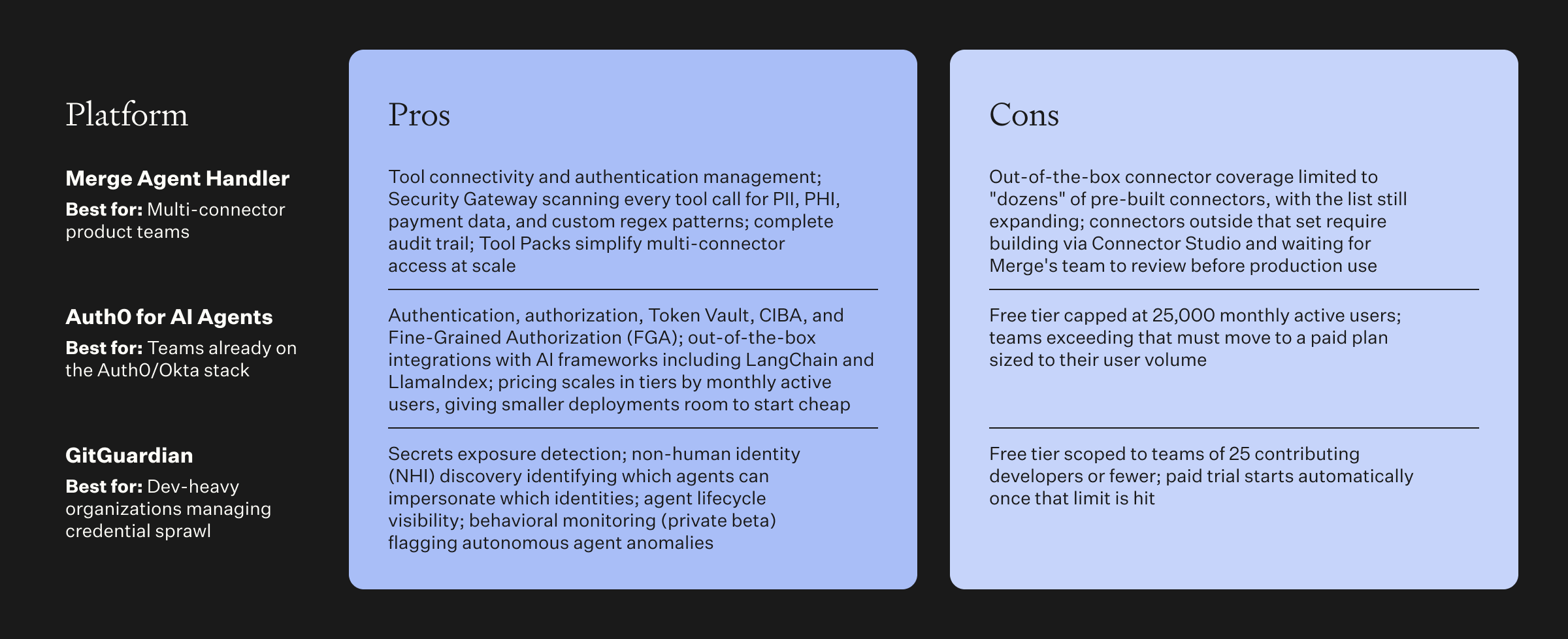
Click on the image above to zoom into full PDF
Comparison covers each platform's commercial offering as of July 2026
Merge Agent Handler gives agents authenticated access to hundreds of MCP-ready third-party services through a unified layer covering OAuth, API keys, and custom authentication. Each user can connect their own account, or credentials can be shared across a Group, depending on whether an end user has their own third-party account or a tenant shares one.
Access is organized into Tool Packs, bundles of tools that determine what an agent can act on at a given point in time. The platform also supports customizable alerts for integrations that hit authentication failures, so teams don't discover a broken connection only when an agent stalls mid-workflow.
Ideal for: The integration breadth makes this a strong fit for product teams building agents that need to reach HR platforms, CRM systems, finance tools, and ticketing systems without maintaining separate authentication flows for each one. Merge Agent Handler also includes an Evaluations Suite that runs structured evals against realistic prompts and test cases to validate tools and connectors before they're used by agents in production.
Pros: Tool connectivity and authentication management, a Security Gateway that scans every tool call for PII, PHI, payment data, and custom regex patterns before it leaves Agent Handler, plus a complete Audit Trail. Tool Packs make multi-connector access easier to manage at scale than per-tool credentialing.
Cons: Out-of-the-box connector coverage is limited to "dozens" of pre-built connectors today, with Merge stating that the list is still expanding rather than comprehensive. Teams needing a connector outside that set must use Connector Studio to build one and wait for Merge's team to review it before it's production-ready.
Auth0 for AI Agents, from Okta, brings structured identity capabilities from the human IAM stack to agentic applications, leveraging Auth0's identity and access management platform to secure authentication, agent access, and API and tool connections.
CIBA (Client-Initiated Backchannel Authentication) lets agents asynchronously authorize users and work in the background, notifying the user only when approval is needed for critical actions. Token Vault stores tokens from external identity providers so agents can call APIs on a user's behalf without the agent handling provider credentials directly.
Fine-Grained Authorization (FGA) enforces granular access control within retrieval-augmented generation (RAG) pipelines, checking a user's permissions before a response is rendered. Auth for MCP, which secures Model Context Protocol servers using OAuth 2.0, is currently in early access.
Ideal for: These are substantive advances over passing static API keys to agents, and they matter most for enterprises with existing Auth0 or Okta infrastructure, where the identity plumbing is already in place.
Pros: Authentication, authorization, Token Vault, CIBA, and FGA, with out-of-the-box integrations for AI frameworks including LangChain and LlamaIndex. Pricing scales in tiers by monthly active users rather than a flat enterprise fee, which gives smaller deployments room to start cheap.
Cons: The free tier's 25,000 MAU ceiling is a hard cutoff, and teams that pass it must move to a paid plan sized to their specific user volume.
GitGuardian does not authenticate agents. It does not issue tokens, and it is not an OAuth, mutual TLS, or SPIFFE-style tool sitting in the path deciding whether an agent gets access. Instead, it monitors commits, pull requests, CI/CD pipelines, and container images for exposed secrets before they reach production.
Its State of Secrets Sprawl 2026 report documented an 81% surge in AI-service credential leaks year over year, a rise the report attributes to AI adoption multiplying the number of tokens, keys, and service identities in production without equivalent improvements in governance, compounded by MCP setup guides that normalize putting credentials directly into configuration files.
Beyond detection, GitGuardian's NHI Governance product gives teams visibility into which agents exist, the credentials they use, and the systems they access, tracking each agent's full lifecycle.
Ideal for: For teams deploying agents that write code, configure pipelines, or interact with repositories, GitGuardian addresses a real and underweighted risk surface. The 24,008 unique secrets exposed in MCP configuration files across public GitHub, of which 2,117, or 8.8%, were valid credentials, indicate that credential hygiene in AI development workflows is a systematic gap, not an edge case.
Pros: Secrets exposure detection, non-human identity (NHI) discovery that identifies which agents can impersonate which identities, agent lifecycle visibility, and behavioral monitoring (private beta) that flags autonomous agent anomalies.
Cons: The free tier is scoped to teams of 25 contributing developers or fewer. GitGuardian counts a contributing developer as a commit author email address with at least one commit to a private collaborative repository in the last 90 days, so the count tracks activity rather than assigned seats. Crossing that threshold is not something a team can defer. The paid trial starts automatically once the limit is hit, and if that trial has already been redeemed and expired, private collaborative repository monitoring ends.
Dataiku Agent Management, part of Dataiku, the Platform for AI Success, is a standalone product that lets you control every agent, running on any platform: AWS Bedrock, Microsoft Copilot, Salesforce, LangChain, Snowflake Cortex, Databricks, n8n, and Dataiku-native agents.
It provides enterprise governance and accountability for autonomous agents once they're already inside the systems they were authenticated to access. Early access is available now, with general availability scheduled for Fall 2026.
Teams can evaluate agents against business KPIs. Uptime tells technical teams whether an agent is running; KPIs tell leaders whether it's ensuring agents behave safely, stay within scope, and deliver the business outcomes they were deployed to produce.
An agent managing customer escalation workflows is evaluated on resolution rates and escalation accuracy. When behavioral drift is detected, Dataiku Agent Management flags it. When risk thresholds are crossed, it triggers certification and governance workflows.
This is governance rather than observability: It tells risk owners and business leaders whether agents are delivering what the enterprise approved, not just whether they're technically online.
The distinction matters at scale. SoftBank deployed a suite of generative AI agents for over 1,000 salespeople and reports 250,000 hours saved annually and 90% of sellers working from higher-quality data.
For more on building the accountability layer above the authentication stack, Dataiku's guide to enterprise AI agents and its agent governance framework covers the full architecture.
Selecting the right authentication platform is one decision; how your team deploys and configures it determines whether it actually reduces risk in production.
The following practices reduce the most common risk patterns in enterprise agent deployments, and connect each dimension of the evaluation rubric to a governance and compliance layer above it.
Shared credentials are the highest-risk configuration in multi-agent systems. Use SPIFFE-compliant identities or equivalent cryptographic workload identity frameworks, not service account credentials shared across agents. Shared credentials cannot be scoped, audited, or revoked per agent without affecting every other agent relying on them.
An agent accessing a CRM to draft a support response needs a credential scoped to that action, not a token authorizing full CRM access indefinitely. Scope at issuance is far more reliable than scope enforcement at consumption, and short-lived tokens reduce the window of exposure when a credential is compromised.
Agent orchestration frameworks spawn sub-agents. Sub-agents call tools. Tools invoke APIs. Without mutual TLS, a compromised sub-agent can impersonate the orchestrating agent within the same trust chain. The authentication floor extends to every hop in the chain, not just the entry point.
According to GitGuardian's State of Secrets Sprawl 2026, 64% of valid secrets from 2022 are still unrevoked in 2026. Credential lifecycle management is an ongoing operational discipline, one that grows more demanding as agent deployments scale, and it feeds directly into incident management: a credential that should have been revoked is the most common root cause security teams cite after an agent-related incident.
Full autonomy is not appropriate for every action. For irreversible or high-value operations, route the decision through a human approver. OWASP's official Top 10 for LLM Applications lists this as a core mitigation for prompt injection and excessive agency risk.
Auth0's asynchronous authorization, built on the Client-Initiated Backchannel Authentication (CIBA) standard, implements this pattern by letting an agent work in the background and request explicit user approval only for sensitive actions.
The Gravitee State of AI Agent Security 2026 found that only 21.9% of respondents treat AI agents as independent, identity-bearing entities within their security model. This is where authentication and governance converge into a single operational discipline:
Behavioral drift analysis, which flags when an agent's actions diverge from its approved scope
Topic modeling, which surfaces what an agent is actually being asked to do across thousands of interactions rather than sampling a handful of logs
A risk registry, which gives risk owners a running inventory of every agent, its scope, and its current risk classification, all feed into the certification workflows that determine whether an agent stays in production.
Teams that build authentication frameworks without this layer above them discover the gap at scale, not in a pilot, and at a much higher cost. Policy enforcement, in this model, is not a one-time configuration step; it's a continuous check against the risk registry as agents and their permissions evolve.
Even well-designed deployments fail when teams fall into the structural patterns that show up most consistently once agents are running at scale.
These pitfalls appear repeatedly in enterprise agent deployments, and each one erodes governance and accountability rather than just security.
Long-lived keys work for early prototypes. In production, they accumulate permissions over time, cannot be scoped to a specific task, and require manual action to revoke. The secrets exposed on public GitHub include many that began as prototype credentials that were never cleaned up or scoped down.
Authentication confirms identity. Authorization defines permission. Enterprise agents often operate under permissions that were appropriate at deployment but no longer match the agent's current operational context. Implementing authentication without a scope review and revocation process for authorization creates a gap that compounds with every new agent deployment.
Specialist authentication tools solve access control and identity verification. Credential-visibility tools solve a related but distinct problem, exposure detection rather than authentication. None of them are built to answer the governance question that matters most to the business: Is this agent still operating within the scope it was approved for, and who is accountable if it isn't?
Buying good authentication tooling can create a false sense of security if a team mistakes strong credentialing for a governance and accountability layer that doesn't yet exist.
Most authentication discussions focus on the human-to-agent path: How does a user authorize an agent to act on their behalf? In multi-agent systems, the agent-to-agent surface carries comparable risk. How does an orchestrating agent delegate to a sub-agent without passing excess permissions? This surface is frequently undocumented and unenforced in early deployments, which means accountability for a sub-agent's actions has no clear owner either.
When every agent action triggers a prompt, users start approving requests reflexively, and human oversight becomes a rubber stamp. Reserve interactive approval for genuinely high-risk actions, and use structured, context-rich approval requests so each decision a person makes is meaningful rather than routine.
An autonomous agent that cannot be paused or revoked instantly becomes a standing liability the moment it misbehaves. Every agent identity should be revocable on demand, and every deployment should have a tested path to disable an agent and invalidate its credentials without taking down unrelated systems.
Authentication answers the entry question; accountability answers the outcome question. Boards, risk officers, and regulators are now asking about agent accountability and governance, not just agent access.
Every pitfall in this list shares a root cause: treating authentication as an endpoint rather than a starting point.
Authentication is necessary, and in 2026, it is table stakes. Credential theft, unauthorized access, and identity spoofing are genuine threats, and the platforms in this guide answer them across distinct dimensions of the problem.
The ceiling is a different matter. Boards do not ask whether agents authenticated successfully this quarter; they ask whether agents are delivering the outcomes they were deployed to produce. Risk officers ask whether autonomous agent actions are auditable, revocable, and governable when something goes wrong.
Building a governance layer between authentication and accountability means treating business KPIs as the success signal, behavioral drift as the early warning, and certification workflows as the control mechanism. That layer activates after authentication ends. For most enterprises, it is still being built.
Dataiku built Dataiku Agent Management to be that layer: the governance and accountability infrastructure that picks up exactly where authentication leaves off.
Production agents need workload-specific cryptographic identity, not shared static keys. NIST SP 800-207A recommends scoped, short-lived credentials: SPIFFE/SVID for workload identity, OAuth 2.0/2.1 for delegation, mutual TLS for agent-to-agent communication. Long-lived API keys remain the riskiest anti-pattern.
Minimize credential lifetime rather than targeting a fixed schedule. Task-scoped tokens expiring in minutes beat quarterly-rotated long-lived keys. GitGuardian's State of Secrets Sprawl 2026 found 64% of 2022's valid secrets were still active in 2026 — manual rotation doesn't keep pace.
Platforms assign each agent a distinct identity, managing delegation through scoped trust chains rather than shared credentials. Standards like Cross-App Access let identity providers mediate agent-to-app connections. Governance visibility across the full agent population is a separate layer above authentication.
Only partially. Authentication limits what a compromised agent can reach but doesn't stop injection itself. OWASP ranks it the top LLM risk, recommending layered controls: least privilege, output validation, and human approval. Behavioral governance addresses what authentication can't.
Pricing varies by MAU, seat, or linked account, but the license is rarely the real cost. The bigger exposure is an authenticated agent acting outside its scope, which is why budgets should account for governance, not just credentials.
Merge Agent Handler is a trademark of Merge API, Inc. Auth0 is a trademark of Okta, Inc. GitGuardian is a trademark of GitGuardian SAS. Dataiku is not affiliated with or endorsed by any of the above companies. All product capabilities, pricing, and features referenced in this article are sourced from publicly available information. Sources are dated July 2026.
Tags