From agent sprawl to agent control with Dataiku and AWS
November 17, 2026/9 min read/Ankit Mathur and Ludwig Ehlert
Most enterprises already run more AI agents than they can keep track of. Deploying them stopped being the hard part a while ago. What is harder is knowing what value each agent brings once it is live, and that only gets harder as your Amazon Bedrock AgentCore footprint grows.
Organizations have scrambled to drive company-wide adoption of generative AI and agentic capability. Across legacy systems, processes, and structures, the “how” has been more important than the “why” (or the “why not”).
A customer service team sees the need for customer facing functionality and spins up an agent. The finance team identifies another opportunity and deploys using an entirely different framework against a production database. The procurement group quietly builds a third, and then abandons it when the owner changes role. Each one is built to deliver value, but no one has a clear view of the value and risk each agent carries, or who is accountable when something goes wrong.
This is agent sprawl, and without the right tools and process, is raising alarms across compliance teams and the executive suite.
The numbers back it up. In a Dataiku/Harris Poll survey of 800+ global data leaders, 75% of respondents say trust in their AI agent deployments is a concern based on real-world scenarios around AI agent governance, control, and production quality. Data leaders struggle to audit and recognize the agents being deployed and lack the frameworks to effectively quantify return on investment at scale.
Traditional observability was designed for infrastructure: Is the server up? Is latency within bounds? Agents break that model. They reason, call tools, and act on what they find. Ones that go wrong may have already moved money, changed a record, or started a downstream workflow before anyone sees an alert.
The questions that matter now are different. Did the agent reach for a tool it should not have touched? Did it expose something sensitive in a response, or run up cost on every call? Did the agent action actually improve the efficiency of a business process? Answering those means looking at prompts, tool calls, data access, and the decisions an agent makes, not just the server it runs on.
But better signals alone don't solve the problem. You still need to act on them, across every platform, from deployment through to measuring business impact. That's the gap Dataiku built Agent Management to close, available on AWS.
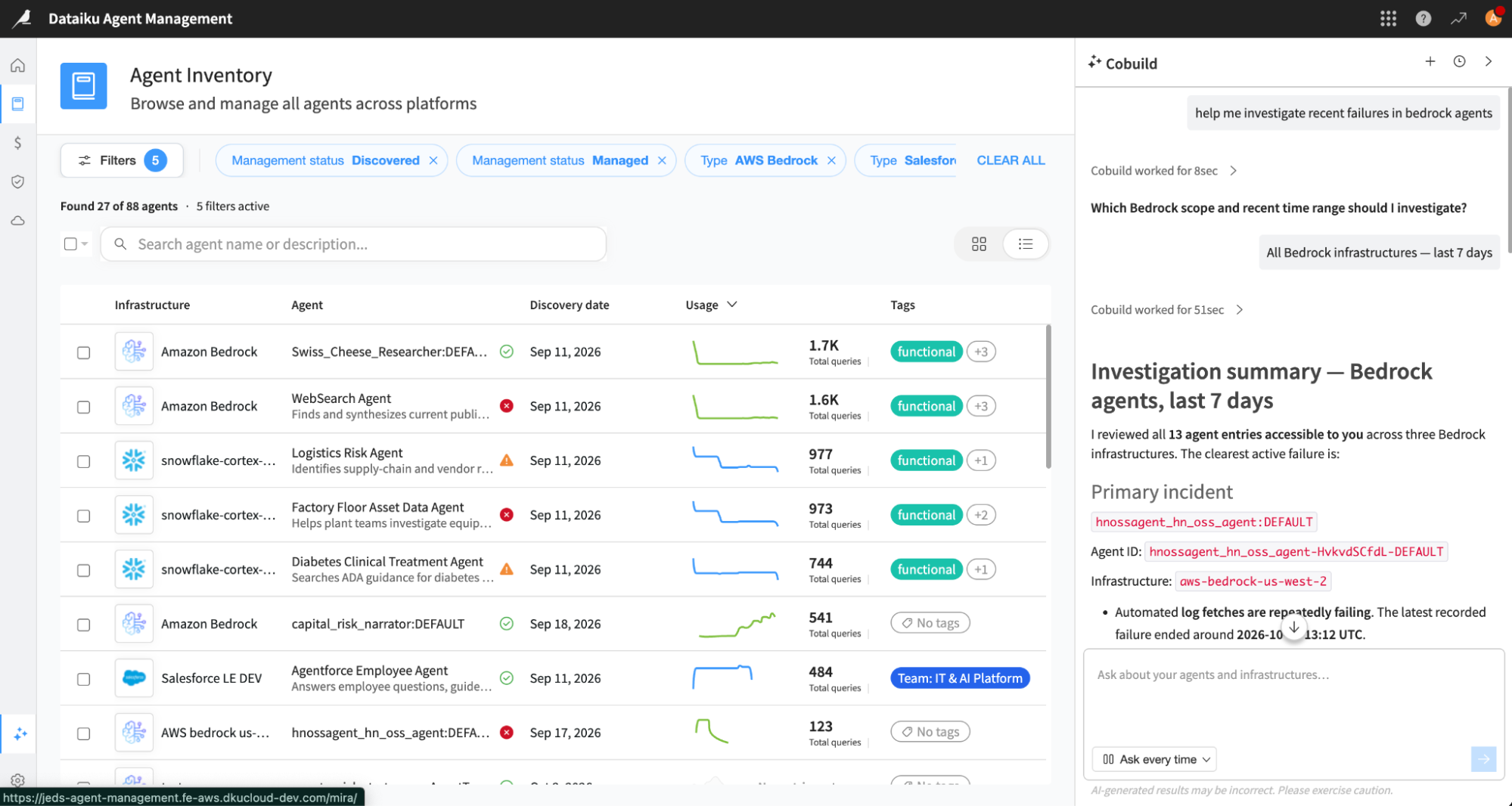
If you already have agents running across multiple platforms, Dataiku Agent Management gives you a single place to manage them. It sits above your agent infrastructure and brings everything into one centralized view, whether those agents run on Amazon Bedrock AgentCore, Snowflake Cortex, Databricks Apps, Dataiku DSS, or a homegrown framework.
From that one interface, you get visibility into what each agent is doing, how it's performing, and whether it's operating within policy. No more switching between platform-specific dashboards to piece the picture together.
Teams can identify agents in production, see performance shifts or cost changes before it becomes a problem, and get a clear read on what each agent actually costs versus what it returns. That's a gap most legacy tooling and observability solutions do not cover, because they weren’t designed with agents in mind.
You don't need the full Dataiku platform to get started. Agent Management works on its own, and you can expand into Dataiku's broader capabilities later if your needs grow.
The first problem is the simplest to state and hardest to solve at scale: what agents exist across your Bedrock accounts and beyond?
You connect Agent Management to each service directly — Amazon Bedrock AgentCore and Amazon Bedrock Agents Classic — and it continuously discovers the agents running in each, recording the configuration each platform declares along with activity data and usage patterns for every agent.
For Amazon Bedrock Agents Classic, Agent Management covers discovery, metadata, health status, CloudWatch metrics, and offers uptime test functionality. For AgentCore agents, traces are also collected.
The result is a unified registry across accounts, regions, and frameworks. You can finally answer basic questions that have been unanswerable until now:
How many agents do we have running on AWS, and across our other platforms?
Which ones are in use, and how heavily?
Are any duplicating the same function?
What tools, data sources, and knowledge bases is each agent connected to?
That inventory stays current automatically as agents are added, retired, or reconfigured.
Discovery alone is not enough. Operational confidence comes from knowing, continuously, whether each agent is working as it should.
Dataiku Agent Management tracks the operational fundamentals for every monitored agent over time: uptime, errors, latency, interaction volume, token use and active users. For agents running on Amazon Bedrock AgentCore, that picture is reinforced by AgentCore's own unified observability model, which consolidates trace spans, prompts, structured logs, and standard output into a single per-agent Amazon CloudWatch log group.
Dataiku Agent Management is built to draw on that same operational data and normalize it alongside every other platform in your estate, so a Bedrock agent and a Snowflake Cortex agent show up in the same monitoring view instead of two disconnected dashboards.
On top of operational monitoring, Agent Management uses AI to help owners make sense of what they’re seeing. Working across Agent Management, Dataiku Cobuild surfaces agent incidents and notable events, providing useful insight for root-cause analysis with recommendations on actions and potential areas of further investigation.
Leveraging Agent Management and Cobuild, customers can establish and monitor agent KPIs, identify top performers across specific business metrics, and seamlessly uncover the drivers behind cost drift.
Legacy agent tooling and observability solutions typically fail to consider and measure agent value. Agent owners define custom business KPIs specific to each agent’s purpose, and this is where Dataiku Agent Management’s foundations are set.
Whether its knowledge base utilization rates, grounding accuracy, resolution rates, or cost per resolved interaction, Dataiku Agent Management provides the metrics to answer the question every CFO and CIO eventually asks: is this agent actually delivering the value we deployed it for?
For AWS customers running dozens of Bedrock agents across business units, this turns agent inventory into an investment ledger. Agent value is ascribed to specific agents, rather than buried in a platform-wide invoice with no granularity. Now you're tracking returns per agent.
With over a decade providing AI and ML orchestration capability, Dataiku recognizes that control for autonomous agents cannot work the way it worked for traditional ML models. Where a model produces a prediction for a human to review, an agent acts. Effective agent accountability has to match an autonomous reality where agents are calling APIs, accessing data, and triggering workflow.
Here's what that looks like in Agent Management:
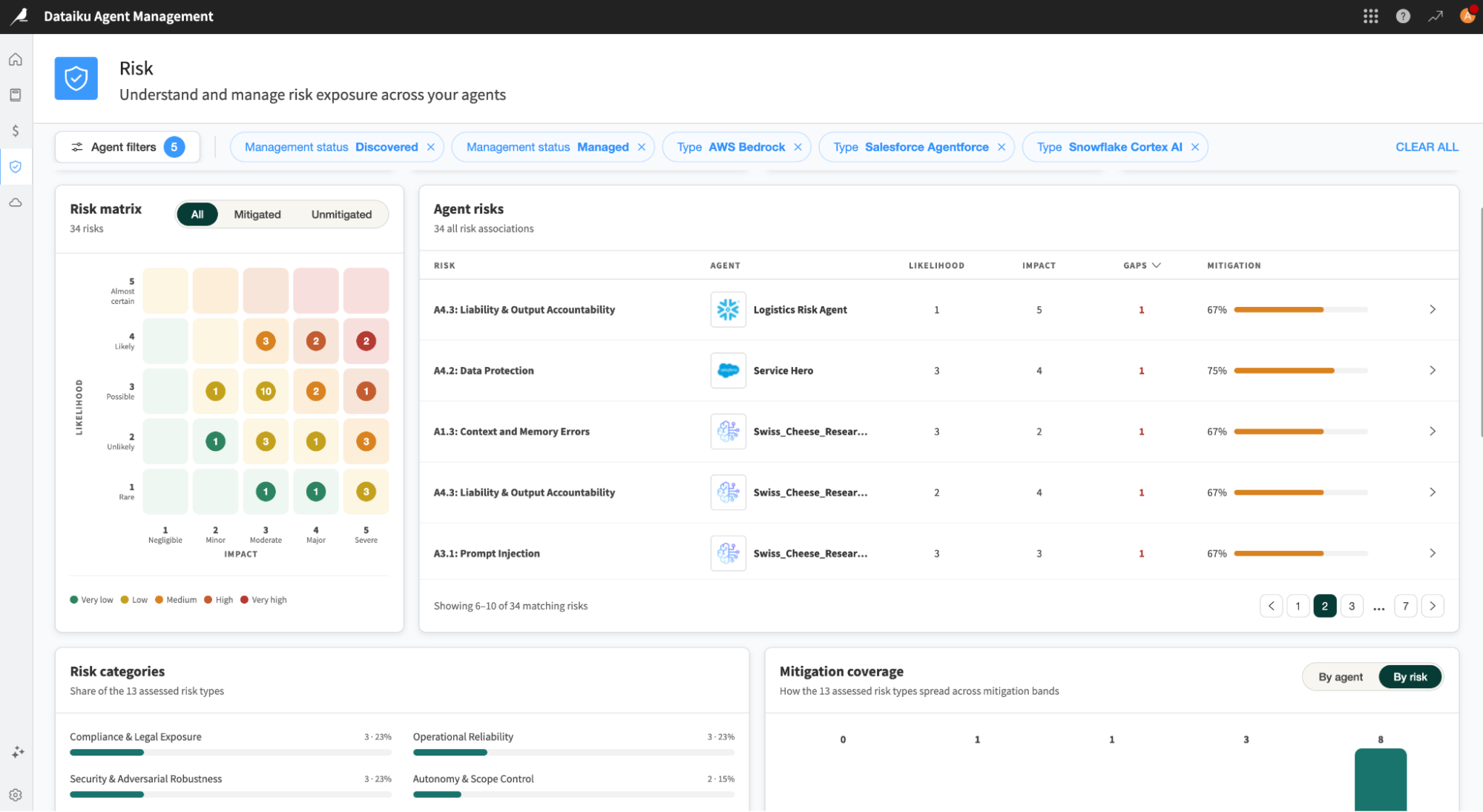
Every agent gets a risk profile. The assessment looks at what data it can reach, what decisions it's authorized to make, how accountable its outputs are, and how likely it is to hallucinate. Risk categories are customizable to match organizational standards.
Agents that fall short of your policy thresholds are identified for review, quarantine, or termination. Owners and administrators are notified via established alerts and escalation paths, who then determine the appropriate response, with an emergency kill switch available as a last resort.
For compliance and regulatory alignment, Agent Management allows teams to assign operational risk to agents to ensure alignment with internal compliance policies, while for broader regulatory compliance and AI laws, Dataiku Govern is the appropriate tool. For Bedrock AgentCore users, this works alongside the IAM scoping and CMK encryption controls you already have at the individual agent level.
Agent Management is part of the agent lifecycle from day one, allowing teams to move fast without losing control - not bolted on as an afterthought.
The AWS integration approach is simple. You integrate, and Dataiku Agent Management takes care of the rest.
Once connected, agent configurations, usage data, operational metrics, and telemetry flow into the management layer automatically. For agents running on Amazon Bedrock AgentCore, Dataiku Agent Management is built to work with AgentCore's per-agent CloudWatch log groups, drawing on the same traces, prompts, and structured logs that AgentCore already produces rather than asking teams to instrument agents twice.
This matters for connector strategy going forward. As more Bedrock and Bedrock AgentCore agents get invoked through Amazon Quick Automate, that pathway becomes a natural extension point for how Dataiku Agent Management discovers and monitors agents operating in that layer of the AWS stack.
Your data stays where you put it. Dataiku Agent Management runs analytics on data in your environment, whether that's your AWS account, your data warehouse, or your object storage. When you self-host, no data leaves your perimeter unless you choose otherwise. With the SaaS edition, Agent Management keeps agent metadata and operational metrics in Dataiku's account, and collected and processed telemetry can go to Amazon S3 buckets you provide.
Enterprise AI rarely lives in one account or one framework. Agent Management gives you a single console across all of it, with Amazon Bedrock as a first-class citizen rather than something you monitor separately.
According to Teleport's 2026 State of AI in Enterprise Infrastructure Security report, organizations running over-privileged AI systems experience a 76% security incident rate, compared with 17% for those enforcing least-privilege access, a 4.5x difference driven by a single governance control.
Agent Management runs on AWS either way you deploy it: as a SaaS service hosted on AWS, or self-managed in your own AWS environment, customers get a wide range of services to build on, room to run agents across many accounts and regions, and a security model their teams already know.
AWS brings reliability, security, and cost-effectiveness, with teams building on Amazon Bedrock starting with solid controls including IAM scoping, customer managed key (AWS KMS) encryption that AWS lets customers apply to each agent's telemetry, and AWS agent-level observability through AgentCore.
Agent Management provides the essential layer on top: a cross-platform inventory, business-value measurement, and policy enforcement, so a CISO or CIO can see what every agent is doing even when the estate runs beyond Bedrock. By bringing telemetry and trace data from external agent frameworks and non-AWS platforms directly into the AWS environment, organizations gain a centralized view that reinforces AWS as the operational core of their multi-platform AI architecture.
Agent Management is available today with agent discovery, operational, cost and business analytics, and risk governance, including native support for Amazon Bedrock. The roadmap builds on that foundation, guided by the same goal: giving enterprises confidence that every agent does the job for which it was deployed. Features include;
AI helpers maintain metadata integrity across thousands of agents, filling in agent information automatically and flagging duplicate agents or inconsistencies to ensure agent inventories stay up to date without constant manual review.
Behavioral analysis will look beyond operational health to how agents are actually used. By tracking tool drift and applying topic modeling to conversations, Agent Management will be able to identify patterns outside an agent’s purpose, such as a procurement agent that suddenly starts fielding HR questions, before they become governance problems.
Agent Management will continue to expand AI ecosystem integration, introducing native support for OpenAI and Anthropic Claude.
These capabilities are in active development and will roll out progressively post-launch. Join us at AWS re:Invent November 30 – December 4 in Las Vegas, booth #467 for a hands-on demo.
Dataiku Agent Management is available today as a standalone solution, offering flexible pricing which scales with the number of agents under management. Reach out to your Dataiku or AWS representative for specifics.
Expect more details at AWS re:Invent later this year. Agent Management is designed for enterprises that need one place to see, measure, and control agents running on Bedrock and beyond.
The bottom line – Agent Management exists so your teams can keep shipping agents without losing sight of what those agents are actually doing.