AI governance and accountability: best practices for enterprise agents
August 24, 2026/7 min read/Team Dataiku
Building an AI agent is the first step. Knowing who is responsible when that agent makes a decision that affects a customer, a contract, or a compliance obligation is the harder one.
As enterprises deploy more AI systems and autonomous agents, governance becomes as important as model performance. Organizations need clear ownership, oversight, risk controls, and accountability to ensure AI operates safely, responsibly, and in line with business objectives.
According to "Global AI confessions report: data leaders edition," based on a Dataiku/Harris Poll survey of 800+ global data leaders, only five percent say AI output is traceable 100% of the time. That traceability gap is where governance and accountability either hold or break.
This guide covers the five pillars of AI governance and accountability, practical governance frameworks, and best practices for managing agentic AI at enterprise scale.
AI governance defines the policies, controls, and oversight structures that determine how AI systems operate. Accountability defines who is responsible when those systems produce unexpected outcomes.
Five pillars form the foundation: transparency and explainability, fairness and bias mitigation, privacy and security, human oversight, and continuous monitoring.
Governing autonomous agents requires capabilities beyond traditional model governance: explicit task boundaries, real-time guardrails, sandbox testing, and business-KPI measurement.
According to "7 career-making AI decisions for CIOs in 2026," based on a Dataiku/Harris Poll survey, 92% of CIOs have been asked to defend AI outcomes they could not fully explain. Governance infrastructure helps organizations produce the evidence and ownership structures needed to respond.
Organizations that embed governance into the AI lifecycle rather than applying it as a periodic audit move faster through compliance cycles and build more durable stakeholder trust.

AI governance and accountability matter because the regulatory, financial, and reputational consequences of ungoverned AI are no longer hypothetical. According to Grant Thornton's 2026 AI Impact Survey of 950 business leaders, 78% lack strong confidence they could pass an independent AI governance audit within 90 days. That gap between deployment and defensibility is exactly what the rest of this guide addresses.
The EU AI Act began enforcing prohibited-practice rules on February 2, 2025, with penalties for violations reaching up to 35 million euros or seven percent of global turnover from that same date. High-risk AI system requirements follow in August 2026. In the U.S., California, Colorado, and Texas have introduced state-level AI transparency and governance obligations effective 2026.
The financial exposure extends beyond fines. When a hiring algorithm discriminates, a credit model produces a decision the organization cannot adequately explain, or an autonomous agent takes an action no one authorized, the reputational damage is harder to recover from than the regulatory penalty: customers leave and don't come back, key talent looks for the exit, and boards start asking questions leadership can't answer.
The upside of governance done well: faster regulatory approvals, reduced compliance remediation costs, and the stakeholder trust that enables AI adoption to scale rather than stall.
Five pillars organize the controls that enterprise AI governance and accountability programs require. Each maps to specific risk categories and feeds directly into the governance framework steps that follow.
Transparency means stakeholders can see how an AI system was built,its intended purpose, its key limitations, thedata it was trained on, and what policies govern its behavior. Explainability means they can understand why a specific output was produced for a specific input.
Two practical mechanisms: model cards that document training data, known limitations, and intended use cases, and XAI visualizations (SHAP values, feature importance charts) that show which inputs drove individual predictions. Both are regulatory requirements under the EU AI Act for high-risk systems, not optional best practices.
Enterprise example: A bank's credit scoring model must explain to an applicant why their application was denied. "The model decided" is not acceptable under fair lending laws or GDPR Article 22.
Algorithmic bias in enterprise AI produces discriminatory outcomes that create regulatory exposure and erode customer trust. Bias enters through training data (historical patterns reflecting systemic inequities), feature selection (proxies for protected characteristics), and evaluation metrics (aggregate accuracy that masks disparate impact on subgroups).
Two testing methods: disparate impact analysis (measuring whether outcomes differ across protected groups at rates that exceed legal thresholds) and counterfactual evaluation (testing whether changing a protected attribute changes the model's output). Both should run before deployment and continuously in production, because the data keeps changing and so does the bias.
Note: The correct tests and thresholds depend on the use case, jurisdiction, and affected population; there is no single universal fairness threshold.
Data minimization, encryption at rest and in transit, and role-based access controls (RBAC) are the baseline. For agentic AI systems that ingest live data streams, privacy controls must extend to real-time data access: which agents can access which data sources, under what conditions, and with what audit trail.
The overlap with existing data governance programs is significant. Privacy controls for AI should build on established frameworks rather than creating parallel infrastructure.
Clear roles define accountability: An AI governance committee sets organizational standards, model owners are responsible for individual system behavior, and compliance leads sign off before production deployment. These roles must have authority, not just visibility.
Sign-off checkpoints should exist at each stage of the AI lifecycle, from initial design through post-deployment monitoring, with the specific gates detailed later in this guide.
For high-risk agents that take autonomous actions affecting customers, money, or compliance, a kill switch requirement ensures that any agent can be immediately suspended when its behavior falls outside defined boundaries.
Runtime monitoring and periodic audits serve different purposes. Runtime monitoring catches issues as they happen: drift, performance degradation, anomalous agent behavior. Periodic audits evaluate whether governance controls are operating as designed over time.
Two KPIs to track:
Model or agent drift: Is the system's behavior changing in ways that were not anticipated?
False-positive rate in monitoring alerts: Are governance alerts flagging real issues or generating noise that the team ignores?
Immutable logs stored for forensic analysis ensure that when a regulator or internal auditor asks "what happened and why," the answer is traceable. Dataiku, the Platform for AI Success, brings this together through Dataiku Govern, which provides built-in audit trails, lineage tracking, and approval workflows that support continuous improvement without requiring teams to build compliance infrastructure from scratch.
The five pillars define what needs to be governed. The framework defines how to operationalize it.
Map a RACI chart (Responsible, Accountable, Consulted, Informed) for every stage of the AI lifecycle. The data scientist who builds the model is not the same person who approves it for production or who is accountable when it fails. The product owner defines the business requirements. The compliance lead validates regulatory alignment. The committee provides escalation authority for edge cases.
ISO/IEC 42001 provides role guidance that enterprise teams can adapt rather than building from scratch.
Governance applied after deployment is governance applied too late. Embed gate reviews and risk assessments at each lifecycle stage.
Design: Risk-level classification, data ethics review, and use-case approval before development begins
Development: Bias testing, explainability hooks, and documentation standards enforced during model or agent building
Deployment: Conformity assessment, approval workflow, and production-readiness review before go-live
Monitoring: Continuous drift detection, performance tracking, and scheduled governance audits post-deployment
Model cards, data sheets, and version control are the minimum documentation requirements. Every model and agent in production needs a documented record of its training data provenance, design decisions, testing results, approval history, and known limitations.
Automated logging tools reduce the documentation burden. Manual documentation does not scale, and incomplete documentation creates compliance risk when regulators request evidence on demand. Automated records still require human review to ensure that business purpose, risks, limitations, and approval rationale are captured accurately.
The EU AI Act's risk-based classification (prohibited, high-risk, limited, minimal) provides a starting framework. GDPR adds data protection requirements for AI systems processing personal data. NIST AI RMF provides a voluntary but increasingly referenced U.S. governance structure. ISO/IEC 42001 provides a certifiable AI management system.
Map your AI portfolio against applicable regulations by jurisdiction and use case. Revisit this mapping at least annually and whenever a material change occurs, because the regulatory environment is evolving faster than most annual governance review cycles.
Agentic AI introduces governance challenges that traditional model governance was not designed for. Agents that plan, reason, use tools, and act autonomously require controls that address their specific failure modes.
Every agent deployed in production needs a documented scope: what actions it is authorized to take, what data it can access, what outputs it can produce, and what decisions require human approval. Actions outside that scope should trigger an automatic escalation rather than silent execution.
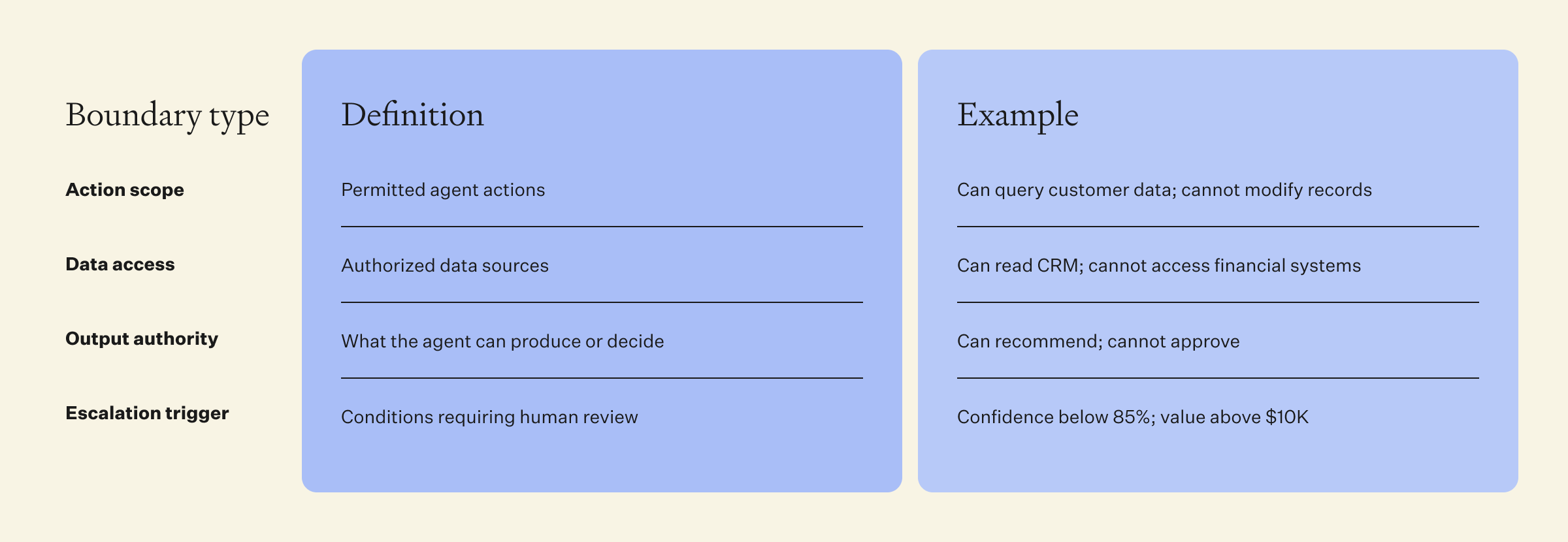
Click on the image above to zoom into full PDF
Avoid relying on one universal confidence threshold. Escalation rules should reflect the agent’s risk, evidence quality, action type, and system-specific confidence measures.
Policy-check APIs evaluate agent actions against governance rules before execution. Human confirmation loops pause high-stakes actions for review. Kill switches suspend agent operation immediately when behavior exceeds defined boundaries.
The latency trade-off is real: Guardrail checks add processing time. For customer-facing agents where response speed matters, design guardrails as asynchronous post-checks on lower-risk actions and synchronous pre-checks only on high-stakes decisions.
Scenario testing before production deployment catches failure modes that unit testing cannot: edge cases, adversarial inputs, unexpected tool interactions, and cascading errors across multi-agent workflows. Run agents through representative scenarios including deliberate stress tests before granting production access.
The exit criterion from sandbox: the agent demonstrates stable behavior across test scenarios, meets defined performance thresholds, and passes governance review with documented results.
Track four KPIs for every production agent:
Business ROI: Is the agent delivering measurable value?
Error rate: How often does the agent produce incorrect or out-of-scope outputs?
Escalation count: How frequently does the agent need human intervention?
Behavioral drift: Is the agent's behavior changing over time?
Schedule monthly reviews with findings reported to business sponsors. Store performance reports in a central registry for audit access. Dataiku Agent Management tracks agent KPIs, behavioral drift, and business performance across platforms from a single view, providing the accountability infrastructure that governance programs require.
The following is a representative composite based on common implementation patterns across enterprise AI governance programs rather than a single named customer engagement; details have been generalized.
A top-20 global bank serving 30+ million customers across four continents faced a familiar trigger: a regulatory inquiry about an automated lending decision that the bank could not fully explain. The inquiry did not result in a penalty, but it exposed a governance gap the board decided to close before the EU AI Act's high-risk requirements took effect.
The bank cataloged 140+ AI systems across retail lending, fraud detection, customer service, and marketing. Each system was classified by risk level using the EU AI Act's tiered framework, with 23 systems qualifying as high-risk.
For high-risk systems, the bank implemented gate reviews at design, development, deployment, and monitoring stages. Model cards and data sheets became mandatory. Approval workflows required sign-off from the model owner, compliance lead, and business sponsor before any high-risk system reached production.
Continuous monitoring was deployed across all high-risk systems: drift detection, bias checks, performance tracking, and immutable audit logging. A governance dashboard gave the compliance team and board risk committee real-time visibility into system health.
The outcomes after 12 months: Regulatory response time dropped from weeks to 48 hours (audit-ready documentation was always current), two bias issues were caught during monitoring and remediated before they affected customers, and the governance program became a differentiator in enterprise client procurement reviews.
Ten items that every enterprise AI governance and accountability program should have in place:
A complete inventory of every AI system in production, development, and planning is maintained, with documented ownership.
Each system is classified by risk based on applicable regulations and business impact.
A RACI chart maps roles and responsibilities across the AI lifecycle.
Gate reviews with documented approval are conducted at the design, deployment, and monitoring stages.
Bias testing across protected characteristics is performed before deployment and continuously in production.
Explainability mechanisms, such as model cards, SHAP values, and feature importance, are in place for every high-risk system.
Immutable audit logs capture every model inference, agent action, and governance decision.
Escalation paths and kill switch procedures are defined for autonomous agents.
Continuous monitoring dashboards track drift, performance, bias, and cost.
An annual regulatory alignment review maps AI systems to current obligations by jurisdiction.
Note: The checklist should be adapted based on the risk and regulatory requirements of each system.
Enterprises cannot afford to delay AI governance and accountability. The regulatory timeline is fixed. The reputational risks compound with every ungoverned system deployed. Governance is not only a defensive measure. It can help organizations approve appropriate use cases faster, reuse trusted controls, and expand AI adoption with greater confidence.
The path is repeatable:
Establish the five pillars.
Build the governance framework.
Apply agent-specific practices
Measure continuously.
Start with the checklist above. Dataiku unifies governance, monitoring, and accountability across analytics, models, agents, and GenAI in one governed environment.
AI governance is the set of policies, controls, and oversight structures that determine how AI systems are built, deployed, and monitored. AI accountability defines who is responsible when those systems produce unexpected or harmful outcomes. Together, they ensure that every AI system in the enterprise has clear ownership, documented decision trails, and defined escalation paths.
The model or agent owner is typically responsible for the system's behavior in production. However, accountability is distributed across roles: the data scientist who built the system, the product owner who defined its scope, the compliance lead who approved it for deployment, and the business sponsor who authorized the use case. A RACI chart that defines these roles before deployment prevents accountability ambiguity after an incident.
AI governance defines the rules: policies, controls, approval workflows, and monitoring systems. AI accountability defines who answers when those rules are insufficient or when the system behaves outside expectations. Governance is the system. Accountability is the human responsibility within it. Both are required because governance without accountability produces controls that no one enforces, and accountability without governance gives individuals responsibility without the tools to exercise it.
Start with the highest-risk AI system in production. Apply the five pillars to that single system: document it, test for bias, implement monitoring, define ownership, and establish an escalation path. Use that as the template for onboarding additional systems. Platform-based governance tools (like Dataiku Govern) reduce the manual overhead that makes governance feel unscalable for small teams. Technology can support the process, but it does not replace clear ownership or appropriate legal, privacy, security, and risk review.
Governance platforms automate four functions that manual processes cannot sustain at scale: model and agent documentation (auto-generated model cards and lineage records), approval workflows (digital sign-off chains replacing email-based reviews), continuous monitoring (automated drift, bias, and performance alerts), and audit trail generation (immutable logs produced automatically at every lifecycle stage). No tool automatically makes an organization compliant or accountable. It must be configured around the organization's policies, roles, thresholds, and evidence requirements. Dataiku provides these capabilities across ML, generative AI, and agentic AI from a single environment.