AI agent governance: policies, guardrails, and oversight for production AI
August 27, 2026/7 min read/Team Dataiku
Many governance programs fail at enforcement. Companies create policy documents, discuss the guardrails, and draft the checklists. However, agents still ship without any of it because there was no mechanism to stop it.
This guide provides the mechanism. It covers what a production-grade AI agent governance program requires: the five components that define it, the controls that apply at each stage of the agent lifecycle, the standards frameworks that give it regulatory standing, and a ten-point deployment checklist that functions as a gate between an agent and production.
According to "Global AI confessions report: data leaders edition," based on a Dataiku/Harris Poll survey of 800+ global data leaders, only five percent say AI output is traceable 100% of the time. The governance program outlined provides a practical framework for improving that traceability.
AI agent governance is the set of policies, runtime controls, and oversight mechanisms that ensure all AI agents operate within defined boundaries in production. Autonomous agents operating without human oversight require additional controls on top of this foundation.
Five components form the core program: policy and authority boundaries, access and identity controls, development and evaluation requirements and practices, runtime guardrails, and monitoring with incident response.
The distinction from traditional model governance: A model outputs something that a human then acts on; an agent produces a change of state in the world directly, without requiring a human intermediary. Governance must therefore control what agents do across the full lifecycle, not just evaluate what they output.
Governed agent deployment requires controls embedded across the full lifecycle (development through decommission), not applied as a pre-deployment gate alone.
Standards alignment (NIST AI RMF, ISO/IEC 42001, EU AI Act, OWASP Agentic Top 10) accelerates both regulatory readiness and internal executive buy-in.

AI agent governance matters because the volume and autonomy of agentic workloads are expanding faster than the controls around them.
According to McKinsey's "The State of AI in 2025" survey, 62% of organizations are at least experimenting with AI agents, but only 23% report scaling an agentic AI system anywhere in their enterprise.
According to "Global AI confessions report: data leaders edition," based on a Dataiku/Harris Poll survey of 800+ global data leaders, 86% of respondents say AI has become embedded into their daily operations. Most of those agents were deployed without the governance infrastructure that production systems require: documented scope boundaries, runtime guardrails, audit trails, and defined accountability for when things go wrong.
The distinction from traditional model governance is whether an AI asset produces an output that a human then acts on, or whether it produces a change of state in the world directly. A model outputs a prediction and a human decides what to do with it. An agent acts without requiring a human intermediary. Governance for agents must therefore control what they do across the full lifecycle, not just evaluate what they output.
Three risk categories drive the urgency:
Execution risks: Agents take actions that may be difficult, expensive, or impossible to reverse, and can accumulate scope beyond their original boundaries as edge cases prompt additional permission grants over time.
Data risks: Agents access, expose, alter, or combine information beyond their authorized scope.
Identity risks: Agents operate under permissions that exceed what their function requires.
Addressing these risks requires a governance program that translates policy into enforceable controls.
Five components define what a production-grade AI agent governance program must cover. Each addresses a specific risk category and maps to the standards and lifecycle controls covered later in this guide.
Policy boundaries define what an agent is authorized to do, what it is prohibited from doing, and what requires human approval before proceeding.
The policy hierarchy typically includes at least three levels, though organizations may add further layers depending on their structure:
Corporate policies set enterprise-wide boundaries that apply to every agent (no agent may access PII without documented authorization).
Regulatory policies incorporate specific requirements from applicable frameworks (for example, EU AI Act transparency obligations, which apply to limited-risk AI systems including many agentic deployments, with additional requirements for providers of high-risk AI systems).
Agent-specific policies define the individual agent's scope (this procurement agent can generate purchase recommendations up to $5,000; orders above that threshold route to a human approver).
Every agent deployed in production should have a boundary statement following this template: "[Agent name] is authorized to [permitted actions] using [permitted data sources] within [permitted systems]. It is prohibited from [restricted actions]. Decisions involving [escalation criteria] require human approval before execution."
Each agent should operate under permissions scoped to its specific function. For many enterprise deployments, this means a dedicated service account per agent; the appropriate identity model depends on the deployment context and should be confirmed with your security team. Regardless of the identity model chosen, permissions should be scoped to what the agent's task requires and no broader.
Controls include, but are not limited to:
Scoped tokens that grant access only to the systems and data the agent needs
Token rotation on a defined cadence (quarterly at minimum, monthly for high-risk agents)
A per-agent identity registry that documents every agent's identity, permissions, owner, and last access review date
The ability to revoke access immediately, detect unusual credential use, and review whether permissions remain necessary — rotation on a schedule isn't a substitute for real-time control.
Runtime guardrails enforce governance policies during agent execution, not before or after. They operate at the action layer, applying deterministic allow/deny logic to every tool call and system interaction.
Actions that should be restricted by default until explicitly authorized include, but are not limited to:
Database schema modifications (DROP, ALTER)
Financial transactions above defined thresholds
Mass communications (bulk email, customer notifications)
Governed agent deployment means these restrictions are enforced by the policy engine, not by the agent's own logic. An agent should not be able to override its own guardrails.
Sandboxing isolates agents in a controlled environment that mirrors production without affecting real systems. A kill switch mechanism provides immediate suspension capability without requiring a code deployment.
Every agent's access to data needs to be mapped against the regulatory obligations that apply to that data, not granted generically. An agent pulling customer records for a financial services workflow inherits different compliance requirements than one summarizing internal documentation, and the governance program needs to encode that distinction rather than treat all agent data access the same way.
This means agent data access should trace back to the same data lineage and quality tracking used for the underlying data platform. If an agent's output can't be traced back to the specific data it drew from, the compliance review has nothing concrete to evaluate.
According to "Global AI confessions report: data leaders edition," based on a Dataiku/Harris Poll survey of 800+ global data leaders, 55% fear AI agents could expose sensitive data to unauthorized parties. Data and compliance alignment is the component that turns that fear into a checkable control: which regulatory frameworks apply (GDPR, EU AI Act, industry-specific regimes such as GxP), what data the agent can see, and who signed off on that access.
Monitoring closes the loop between what a governance program authorizes and what an agent actually does in production. It operates on three layers:
Metrics that track operational health
Immutable logs of every action and tool call
Anomaly detection that flags deviations from established baselines
Logging should be comprehensive enough to support investigation and accountability without unnecessarily recording secrets, sensitive data, or information that the organization is not permitted to retain.
When a threshold is breached, a four-step incident response process takes over: detect, isolate, communicate to stakeholders, and remediate before the agent resumes production.
Before selecting frameworks, identify what your organization needs to govern and why. Start with company principles (what behaviors are non-negotiable for AI agents regardless of regulation), specific regulatory obligations (which jurisdictions and sectors apply), and the risk profile of your agent deployments (what failure modes carry the most consequence). That starting point determines which frameworks are relevant and how much of each applies.
Once you know what matters, map it against established standards to find where requirements are already codified and where gaps exist. If multiple frameworks are engaged, align on shared requirements to avoid duplicating controls and identify conflicts early.
The table below shows which governance needs each framework is best positioned to address. Use it as a mapping tool, not a compliance checklist.
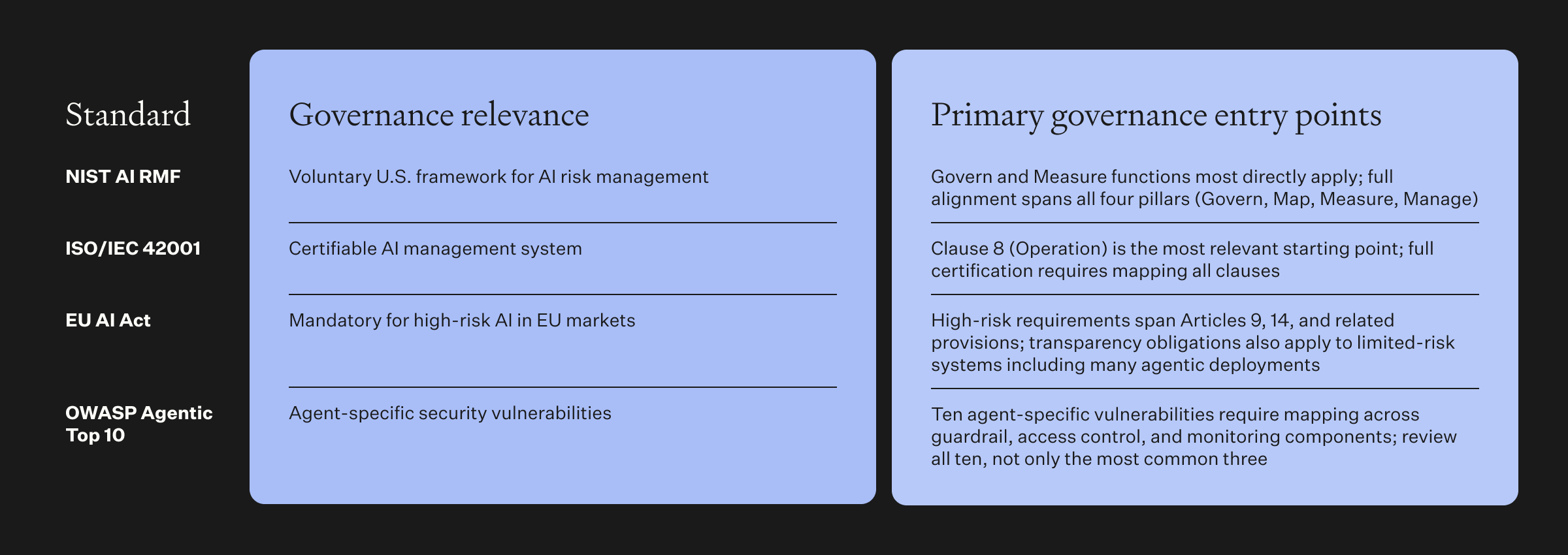
Click on the image above to zoom into full PDF
From that mapping, make decisions on controls and actions: which requirements can share a single control, which require distinct implementations, and which gaps need purpose-built solutions that no existing framework covers.
Governance applies at every stage of the agent lifecycle, not just at deployment.
Document the agent's authorized scope, data access, risk classification, and escalation paths before building begins. Governance requirements should be version-controlled and reviewed alongside the agent's logic. Where governance workflows can be encoded as conditional logic, that structure should be maintained with the agent's code rather than managed separately.
Validate that required controls are configured before advancing: Some checks can be automated (confirming logging is active, verifying access scopes are within approved boundaries); others require manual sign-off. Run the agent through boundary validation (does it respect its scope?), adversarial testing (does it resist prompt injection?), and edge-case scenarios before any deployment decision.
A formal review and approve gate, not an informal sign-off. The agent owner, compliance lead, and business sponsor each confirm that development requirements were met and testing passed. Provision permissions, activate guardrails, and configure monitoring as part of deployment. Documented evidence that testing passed and controls are active is required before the gate clears.
Monitor: Detect behavioral anomalies, cost overruns, scope violations, and drift. Alert when thresholds are breached and trigger incident response.
Version/update: When scope, tools, data access, or the underlying model changes, reassess through development and the deployment decision gate before changes reach production.
Decommission: Revoke permissions, archive audit logs, confirm no downstream dependencies, and document lessons learned.
Monitoring findings and incident reviews feed back into development requirements for subsequent agents.
Monitoring typically operates across the following layers, which organizations may extend based on their risk profile:
Metrics track operational health, including execution latency, error rates, cost per action, and throughput.
Logs capture every agent action, tool call, data access, and decision in immutable records.
Anomaly detection identifies behavioral patterns that deviate from established baselines.
Human-in-the-loop thresholds define when monitoring escalates to human review.
Example: If an agent's error rate exceeds five percent over a 24-hour window, or if a single action exceeds the defined cost threshold, the monitoring system alerts the designated human reviewer and suspends the agent's autonomous authority until the review is complete.
Incident response follows a workflow that includes, at minimum, the following steps:
Detect: Monitoring alerts surface anomalous behavior or control failures.
Isolate: The agent is suspended or restricted to prevent further impact.
Communicate: The incident is reported to the governance committee, business sponsor, and affected stakeholders with a preliminary impact assessment.
Remediate: Root cause is identified, the impact of what the agent did is assessed (including whether actions taken can be reversed or require remediation beyond fixing the performance problem), controls are updated to address the gap, and the agent is reassessed through testing before resuming production. For agents that took irreversible actions, remediation includes determining the downstream business impact and the response owed to affected parties.
Store all evidence (logs, alerts, investigation records, and remediation actions) for compliance audits. Regulators expect evidence on demand, not evidence assembled after a request.
Dataiku, the Platform for AI Success, brings these three monitoring layers and the four-step incident response workflow into a single system through Dataiku Agent Management, which connects to agents across platforms and provides a single view of business performance, behavioral drift, and governance status, closing the gap between monitoring what agents are doing and understanding whether they are doing it well.
Every component and lifecycle control covered in this guide converges at one point: the moment an agent is cleared for production. The following ten items define what that clearance requires. Some can be automated (logging configuration, access provisioning, monitoring setup); others require documented human decisions (scope approval, compliance sign-off, ownership assignment). Both matter before the agent runs.
Agent is registered in the organizational inventory with documented ownership and scope.
Service account is provisioned with least-privilege permissions scoped to the agent's function.
Policy boundary statement is documented and approved by agent owner and compliance lead.
Sandbox testing is complete with documented results across boundary, adversarial, and edge-case scenarios.
Immutable audit logging is configured and capturing every action, tool call, and data access.
Cost alerts and token budget caps are active with defined thresholds.
Escalation owners are identified and documented for both operational issues and governance violations.
Compliance sign-off is obtained for regulatory alignment with applicable standards.
Drift monitoring is configured with baseline behavioral metrics established.
Decommission plan is documented, including permission revocation and audit log archival procedures.
Dataiku Govern supports through approval workflows, audit trails, and model registry controls that document the governance status of every AI asset across its lifecycle.
Note: The checklist should be treated as a minimum deployment gate, not proof that every risk has been eliminated. Higher-risk agents may require additional controls, independent validation, or more frequent review.
AI agent governance is not a one-time setup but a continuous operating discipline that evolves alongside the agent fleet and the regulatory environment. Policies define boundaries. Guardrails enforce them at runtime. Monitoring verifies that enforcement is working. Incident reviews and operational findings feed improvements back into the program.
The concrete next step:
Copy the deployment checklist above and run it against one production agent this week.
Identify the gaps.
Prioritize the fixes.
Use the result as the template for every subsequent agent.
Dataiku embeds governance, monitoring, and audit trails across the agent lifecycle so oversight scales with deployment rather than requiring a governance processes to be rebuilt for every agent.
AI agent governance is the set of policies, runtime controls, monitoring systems, and accountability structures that ensure autonomous AI agents operate within defined boundaries in production. It covers what agents are authorized to do, how their behavior is enforced at runtime, who is responsible when they fail, and how their actions are logged for audit and compliance.
Ownership depends on organizational structure, but the most effective programs distribute it. The CIO typically owns the strategic direction and executive accountability. The CISO owns the security controls (identity, access, runtime guardrails). A dedicated AI governance team or committee owns policy definition, compliance alignment, and audit oversight. The agent owner (the team that built and deployed the agent) is accountable for its behavior in production.
In a well-governed environment, the runtime guardrail blocks the violation before it executes, the monitoring system logs the attempt, an alert is sent to the designated reviewer, and the incident is investigated to determine whether the policy, the guardrail, or the agent needs updating. In an ungoverned environment, nobody knows until the business consequence surfaces.
Most do not. Some open-source frameworks provide agent orchestration, tool calling, and memory management. Governance controls (RBAC, audit trails, approval workflows, cost guardrails, drift monitoring) typically need to be built on top or provided by a governance platform. Semantic Kernel offers the strongest built-in compliance tooling among open-source frameworks.
For a single production agent, implementing core governance controls (scope documentation, least-privilege provisioning, runtime guardrails, monitoring, audit logging) takes two to four weeks. Scaling to an enterprise-wide program covering all production agents, with standards alignment, board reporting, and continuous improvement cycles, typically takes six to 12 months. Start with the highest-risk agent and use it as the governance template for the fleet.