Agentic AI governance frameworks: scaling AI beyond pilots
August 26, 2026/9 min read/Team Dataiku
Autonomous agents that access systems, make decisions, and execute actions introduce a category of risk that traditional AI governance was not designed to address on its own. A model that predicts wrong may influence a bad decision. An agent that acts wrong may have already moved money, modified a record, or triggered a downstream workflow before anyone notices.
The governance question is not whether to control autonomous agents. It is how to do it without slowing down the deployments that justify the investment. According to "Global AI confessions report: data leaders edition," based on a Dataiku/Harris Poll survey of 800+ global data leaders, 75% say trust in their AI agent deployments is a concern. That concern is not abstract. It is the gap between what agents are authorized to do and what organizations can prove they did.
Agentic AI governance frameworks close that gap: combining policy controls, human oversight, runtime guardrails, and auditability into a practical enterprise operating model. This guide covers the risks that make governance necessary, the seven pillars that structure an effective framework, and a roadmap for moving from governed pilot to production scale.
Agentic AI governance frameworks define the policies, controls, and oversight structures that ensure autonomous agents operate within approved boundaries at enterprise scale.
Five enterprise risks require specific governance responses: execution loss, unauthorized tool use, privilege creep, data misuse, and emergent multi-agent effects.
Seven pillars structure the framework: authority and scope boundaries, identity and access, runtime controls, monitoring and traceability, human oversight, incident response, and continuous review.
Governance must be embedded across the full agent lifecycle (design through decommission), not applied as a pre-deployment checkpoint alone.
Standards alignment (NIST AI RMF, ISO/IEC 42001, EU AI Act) ensures regulatory readiness across jurisdictions.

Agentic AI governance is the discipline of defining, enforcing, and auditing the boundaries within which autonomous AI agents are authorized to operate in enterprise environments.
The distinction from traditional ML model governance is fundamental. A traditional model produces predictions that humans review and act on. An autonomous agent acts: It calls tools, accesses systems, triggers workflows, and makes decisions with minimal human intervention. Governance for agents must control delegated authority and runtime behavior, in addition to model performance, fairness, security, and data quality.
According to "7 career-making AI decisions for CIOs in 2026", based on a Dataiku/Harris Poll survey, 92% of CIOs have been asked at least once to defend AI outcomes they could not fully explain. For agents that act autonomously, that explainability gap creates both financial upside risk (delayed scaling because governance is not in place) and operational downside risk (uncontrolled agents producing unintended consequences).
Five risks carry the highest impact for enterprises deploying autonomous agents. Each maps directly to a governance pillar in the framework that follows.
Agents that execute incorrectly can produce failed transactions, operational disruptions, and customer-facing errors that are difficult to reverse once the action is taken.
Agents that access systems outside their intended scope create data exposure and security vulnerabilities. An agent authorized to read customer records but not modify them may, without proper controls, trigger a write operation through a poorly scoped API.
Agent permissions that start narrow tend to expand over time as teams grant additional access to handlenew use cases or edge cases. Without periodic access reviews, agents accumulate permissions far beyond their original scope.
Agents that access or share data beyond their authorized scope create privacy violations and regulatory exposure. This risk intensifies for agents that ingest live data streams or operate across multiple data sources with different access policies.
When multiple agents interact in production, their combined behavior can produce outcomes that no individual agent was designed to create. Two agents with individually reasonable actions can produce a cascade that neither was intended to trigger.
These seven pillars align with NIST AI RMF, ISO/IEC 42001, and EU AI Act requirements. They are numbered for executive memorability, and each addresses one or more of the risks described above.
Every agent deployed in production needs a written scope document defining its authorized tasks, prohibited actions, data access rights, and decision authority limits. Without this documentation, accountability after an incident defaults to "nobody approved this."
Concrete boundary example: "This procurement agent can query supplier data, generate purchase recommendations up to $10,000, and route recommendations above $10,000 to a human approver. It cannot approve transactions, modify vendor records, or access financial systems outside the procurement module."
Each agent must operate under a service-based identity with permissions scoped to its specific function, rather thanunder a broad role-based access bucket shared across multiple agents or users. This aligns with zero-trust architecture principles and ISO/IEC 42001 identity requirements.
Identity management is frequently the most overlooked element of agent governance. Teams that would never give a human employee blanket admin access routinely deploy agents with permissions far exceeding what the agent's function requires.
Per Teleport's 2026 State of AI in Enterprise Infrastructure Security report, enterprises running over-privileged AI systems experience a 76% security incident rate, compared with 17% for organizations that enforce least-privilege access, a 4.5x difference driven by a single control.
Runtime controls enforce governance policies during agent execution, not before or after. Core controls include allow/deny tool lists (which tools the agent can call), rate limits (maximum actions per time period), execution sandboxing (isolating agent operations from production systems during testing), and output validation (screening agent outputs before they reach users or downstream systems).
The design principle: The policy engine must be independent of the agent logic. An agent should not be able to override its own guardrails. Policy-as-code implementation stores control rules in version-controlled repositories where changes follow the same review process as production code.
Relevant agent actions, tool call, data access, and decisions shouldbe captured in tamper-evident, access-controlled audit records. Real-time operational dashboards surface anomalies as they happen, and anomaly detection alerts flag behavior that deviates from established patterns.
This pillar directly serves regulatory compliance. The EU AI Act requires logging for high-risk AI systems. SOC 2 requires audit trail completeness. Without immutable logs, compliance readiness is aspirational rather than demonstrable.
Dataiku, the Platform for AI Success, supports this pillar through Dataiku Govern, which provides immutable audit logs and lineage tracking that support compliance reviews, connecting every agent action to its authorization, data source, and governance approval.
Two oversight models apply depending on risk level:
On-loop oversight notifies a human when an agent takes a defined action, allowing review after the fact.
In-loop oversight requires human approval before the agent can proceed with a high-stakes action.
Monetary threshold example: In-loop review required for any transaction exceeding $5,000 or any action affecting customer-facing systems; on-loop notification for all other agent actions.
Escalation paths must be predefined for edge cases that fall outside both the agent's scope and the standard oversight model. When an agent encounters a situation it was not designed for, the governance framework determines who reviews it and how quickly.
Every production agent must have a pre-authorized kill switch: a mechanism to immediately suspend agent operation without requiring a code deployment or manual intervention. Rollback procedures must restore the system to its last known good state.
For multi-agent systems, containment protocols define how to isolate a failing agent without disrupting other agents operating in the same pipeline. Tabletop drill exercises, run quarterly, ensure the incident response team can execute shutdown procedures under pressure.
The gap this closes is real: per Grant Thornton's 2026 AI Impact Survey, only one in five organizations running agentic AI in production has a tested incident response plan, and just 5% allow agents to execute high-stakes decisions without human review.
Governance is not a one-time implementation. Permission audit cadence should be risk-based: Higher-risk or rapidly changing agents may require monthly review, while stable, lower-risk agents can be audited quarterly.KPI reviews evaluate whether agents are meeting their business objectives. Drift detection checks catch behavioral changes that accumulated gradually and might not trigger anomaly alerts individually.
Board-level reporting on agent governance health ensures that oversight is not limited to technical teams. When governance KPIs (mean time to intervene, scope compliance rate, audit log completeness) are reported alongside business KPIs, governance becomes an organizational discipline rather than a technical afterthought.
This roadmap aligns governance pillars to project phases with executive approval gates at each transition.
Build the ROI model, map stakeholders, and define the organization's risk appetite for agent autonomy. Deliverable: approved business case with risk classification.
Classify agents by impact level:
Low (internal automation, no customer impact)
Medium (customer-adjacent, reversible actions)
High (customer-facing, financial, or compliance-critical)
Each tier determines which governance pillars apply at what depth.
Build governance into the agent from day one, not as a post-build addition. Scope boundaries, identity management, runtime controls, and monitoring are part of the initial build, not a future sprint.
Test governance controls under realistic load and edge cases. Verify that guardrails hold, escalation paths function, and audit logs capture complete decision trails.
Deploy in a limited production environment with full monitoring. Measure agent behavior against defined KPIs. Identify governance gaps before broader rollout.
Governance controls extend to each new scope as the rollout expands to additional workflows and teams. Track business impact, error rates, escalation frequency, and cost per agent action.
Secure board approval for full production deployment and establish an ongoing review cadence. Governance KPIs are reported alongside business KPIs in quarterly reviews.
This roadmap is iterative. As agent capabilities evolve and new use cases emerge, governance frameworks must evolve with them.
Governance controls and ownership responsibilities map to seven lifecycle phases.
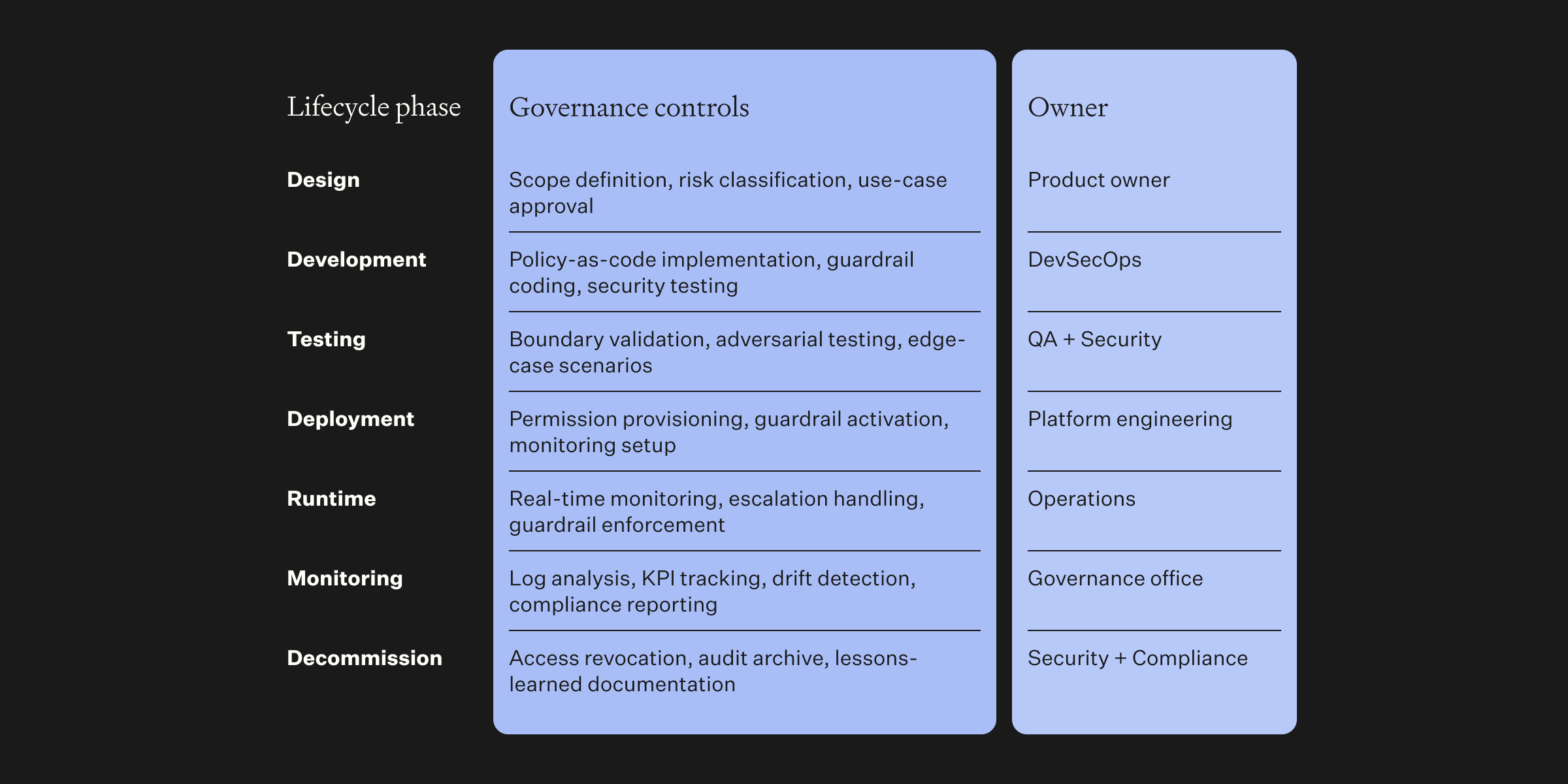
Each phase has a single accountable owner. Accountability ambiguity between phases is where governance gaps most commonly form.
Mapping governance pillars to global standards ensures regulatory readiness across jurisdictions.
The NIST AI RMF "Measure" function maps to the monitoring and traceability pillar: continuous measurement of AI system behavior against defined metrics, with findings that feed back into governance improvements.
ISO/IEC 42001 Clause 8 (Operation) maps to the runtime controls and human oversight pillars: operational controls that ensure AI systems perform within defined parameters, with human intervention mechanisms documented and tested.
The EU AI Act's high-risk requirements map to three pillars across three separate articles: Article 12 (Record-Keeping) requires mandatory logging for high-risk systems, Article 14 (Human Oversight) requires oversight measures proportional to risk level, and Article 20 (Corrective Actions and Duty of Information) requires documented procedures for handling system failures.
Organizations operating across jurisdictions benefit from building governance against the most stringent applicable standard (EU AI Act for most global enterprises) and mapping those controls across to other frameworks, rather than maintaining separate compliance programs for each.
Four KPIs measure whether an agentic AI governance framework is operating effectively.
Mean time to intervene: This measures the minutes from anomaly detection to human action. Establish a baseline during the pilot, then track improvement over time.
Percentage of actions within scope: This is the ratio of in-scope to out-of-scope attempted actions. The target is above 99% for production agents. Any sustained drop signals scope drift or inadequate boundary definitions.
Audit log completeness: This is the percentage of agent actions with a full traceability chain, covering action, authorization, data source, and outcome. The target is 100% for high-risk agents.
Quarterly permission drift: This is the percentage growth in agent access beyond its initial scope. Any growth requires documented justification and approval.
Report these KPIs quarterly alongside business performance metrics to maintain executive visibility and accountability.
The seven-pillar framework is a repeatable governance playbook. Start with the highest-risk agent in production, apply all seven pillars, measure against the four KPIs, and use the results as the template for onboarding additional agents.
Dataiku combines Dataiku Govern and Dataiku Agent Management to give enterprises audit trails, approval workflows, and business-level agent oversight in one environment. Governance controls and agent performance measurement operate from the same platform where agents are built and deployed.
Govern AI everywhere
Govern AI everywhere
Yes. Any agent operating in your enterprise environment, whether built internally, provided by a vendor, or accessed through a third-party platform, must operate within your governance framework. Vendor-built agents require the same scope documentation, access controls, monitoring, and audit logging as internally built ones. The accountability for an agent's behavior in your environment rests with your organization regardless of who built it
The response depends on the severity and the governance maturity. In a well-governed environment, the runtime control layer blocks the out-of-scope action, the monitoring system logs the attempt, an alert is sent to the governance team, and the incident is reviewed to determine whether the boundary definition needs updating or the agent needs correction. In an ungoverned environment, nobody knows until the consequences surface, which is the scenario governance frameworks are designed to prevent.
Costs depend on scope. For a single high-risk agent, implementing the seven pillars on a governed platform typically requires four to eight weeks of engineering and governance team effort. Enterprise-wide implementation across multiple agents and business units takes six to 12 months. The cost of not implementing governance, measured in regulatory penalties, incident remediation, and delayed AI scaling, consistently exceeds the implementation investment.
Partially. Runtime controls (guardrails, rate limits, output validation), monitoring (anomaly detection, drift alerts), and audit logging can and should be automated. Human judgment elements (scope approval, escalation decisions, quarterly reviews, risk classification) cannot be fully automated and should not be. The goal is to automate the enforcement and detection layers so human oversight focuses on judgment calls rather than manual monitoring.
Quarterly at minimum. Permission audits, KPI reviews, and scope assessments should run every quarter. The full framework should be reviewed annually or whenever a significant change occurs: new agent deployment, new regulatory requirement, organizational restructuring, or a governance incident. Agent capabilities evolve rapidly, and governance frameworks that do not evolve with them create gaps that widen with every new deployment.