

Unifying Analytics, Machine Learning, and Agents in One Platform
Why Enterprises Need a Unified AI Platform
For two decades, organizations have invested heavily in analytics platforms to move beyond spreadsheets and manual reporting. These platforms brought visibility through dashboards and trend analysis. But today, executives no longer just want to know what happened, they expect platforms that can predict, prescribe, and act.
To help enterprises understand what it truly takes to achieve a unified AI platform, this guide outlines the five key areas of consideration for building one connected, governed environment:
- Modern Analytics Foundations: Moving from descriptive dashboards to predictive and prescriptive insight.
- Low-Code and No-Code Participation: Expanding who can build and operationalize AI.
- Integrated AI Lifecycle: Connecting data prep, modeling, deployment, and monitoring in one place.
- Flexible Data Architecture: Ensuring interoperability across cloud and on-prem environments.
- Responsible Agent Governance: Scaling AI agents safely and compliantly.
Each section builds on the last, showing how unifying analytics, ML, and AI agents creates a foundation for scalable, governed innovation.
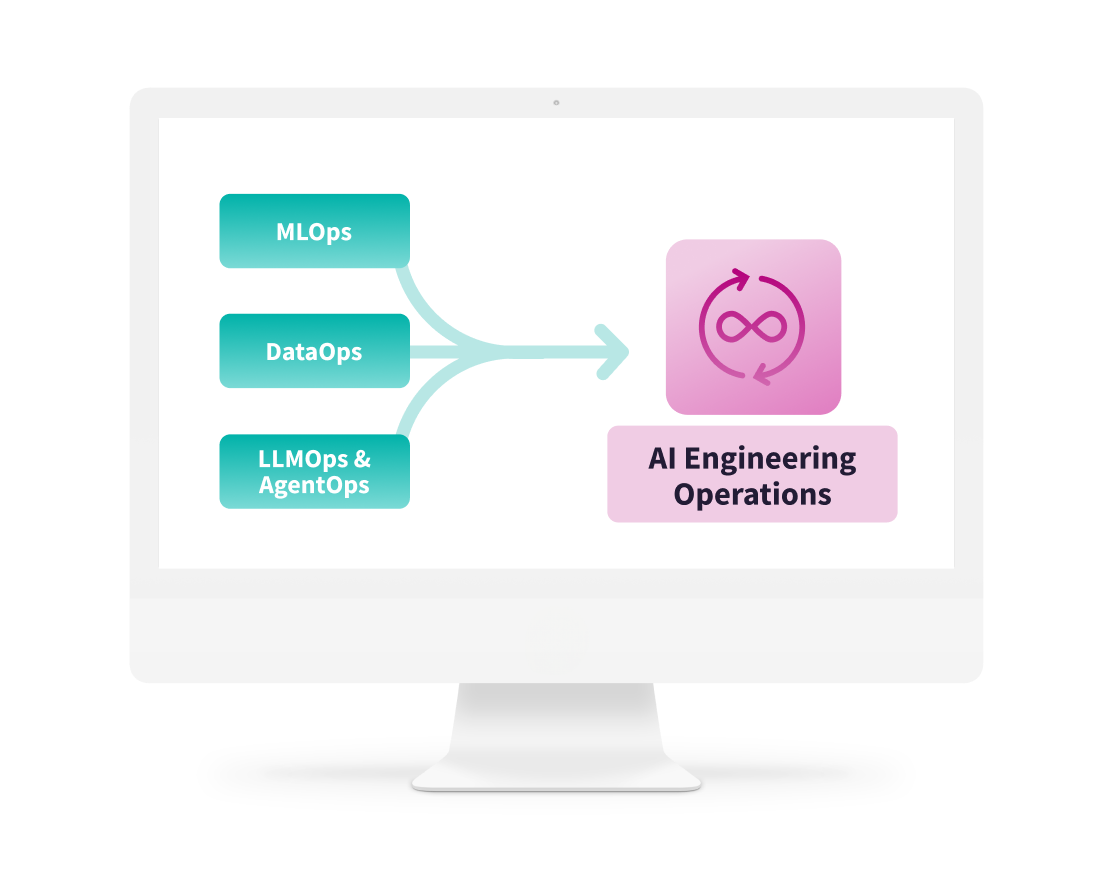
Despite years of investment, most analytics tools remain fragmented and siloed. They deliver static insights but fail to bridge analytics with machine learning (ML), generative AI (GenAI), and AI agents, the very capabilities enterprises now see as mission-critical. The result is inefficiencies, escalating costs, hidden technical debt, and governance blind spots.
Enterprises today need an AI platform that unites people, data, governance, and technology in a single environment. Dataiku is The Universal AI Platform™, providing organizations with the tools to work with data, transform data, and build analytics models at scale while embedding governance and managing cost and risk.
Why a Modern Analytics Platform Is Necessary, but Not Enough
Modern analytics platforms helped enterprises move beyond legacy systems. They democratized dashboards, enabled self-service, and improved decision-making. Yet they remain confined to descriptive analytics, telling enterprises what happened but not helping them act on it.
The next leap requires integrating analytics with data modeling, ML, GenAI, and AI agents. Enterprises must evolve from reporting to operationalization, with systems that can generate insights and execute them responsibly at scale. This shift demands:
- Broader participation across roles, not just technical teams
- Integrated governance that prevents risk creep
- Ecosystem flexibility to integrate seamlessly and evolve without lock-in
As organizations take this next step, many face a strategic decision: how to scale GenAI and AI agents effectively across the business. Without a unified platform, most fall into fragmented approaches that increase cost, complexity, and risk.
4 Pathways to Scaling GenAI and AI Agents
Enterprises typically pursue one of four approaches when scaling GenAI and agentic AI capabilities:
- Services: Outsourcing to consulting or systems integration partners provides scarce expertise and speed, but creates long-term dependency and high costs.
- Point Solutions: Dedicated analytics tools for specific processes (like contract review or sales enablement) can deliver fast results, but they don’t scale across the enterprise and quickly introduce technical debt.
- Do-It-Yourself (DIY): Building entirely in-house preserves IP and ensures tight integration, but requires scarce, expensive skills like advanced programming languages expertise and often overwhelms teams with maintenance.
- Platform: An AI platform lowers barriers to entry, fosters reuse of assets, and embeds governance. It combines the strengths of the other three paths while avoiding their pitfalls, enabling enterprises to scale GenAI and agentic AI responsibly.
This is why the platform path is emerging as the most sustainable. Dataiku bridges this gap by combining the strengths of a modern analytics platform with the breadth of an enterprise-wide AI platform, moving organizations from dashboards to real outcomes.
Expanding Participation With a Low-Code and No-Code AI Platform
A persistent bottleneck in AI is that too few people can meaningfully participate. Analysts rely on IT, business leaders wait on specialists, and data scientists spend their time serving requests instead of innovating.
A no-code, low-code AI platform solves this bottleneck. By spanning the full spectrum of skills, Dataiku makes AI creation inclusive and governed, enabling broad participation without compromising sophistication:
- No-code AI platform capabilities include drag-and-drop pipelines, visual ML, and even embedded GenAI assistants. Business users can now describe transformations in plain language and see results instantly, without writing code.
- Low-code AI platform features include formula-based transformations, customizable AutoML, and plug-ins for accelerated experimentation. Analysts and citizen developers can extend workflows flexibly using open source data and familiar programming languages.
- Full code options like Python, R, notebooks, APIs, and software development kits (SDK) give data scientists and engineers advanced control to handle large amounts of data and complex data processes.
All profiles work in one governed space, eliminating the sprawl of disconnected data analytics tools across departments. Unlike external services that keep expertise outside or point solutions that solve narrow tasks, an AI platform empowers employees directly. By spanning no-code, low-code, and full-code, it scales GenAI and AI agents across roles while avoiding silos and dependencies.
Take Toyota: Through an AI democratization program powered by Dataiku, Toyota Motor Europe trained over 270 employees and ran hackathons where 90% of participants uncovered new AI applications. Using Dataiku’s no-code and low-code features, non-technical business users built models in just hours, while executives gained a clearer view of AI’s potential. The program has already identified 50+ use cases for production, representing millions of euros in benefit, showing how expanding participation directly drives innovation at scale.
Capabilities of an AI Platform for the Full AI Lifecycle
AI initiatives often fail because tools are fragmented. Data preparation happens in one application, modeling in another, deployment in a third, and monitoring in yet another. This fragmentation creates waste, undermines governance, and accumulates technical debt, making it harder for enterprises to scale GenAI and AI agents responsibly across the AI lifecycle. Beyond inefficiency, stitching tools together introduces integration overhead and glue code that slows delivery and raises risk.
With Dataiku, enterprises eliminate tool sprawl by bringing the full AI lifecycle into a single environment:
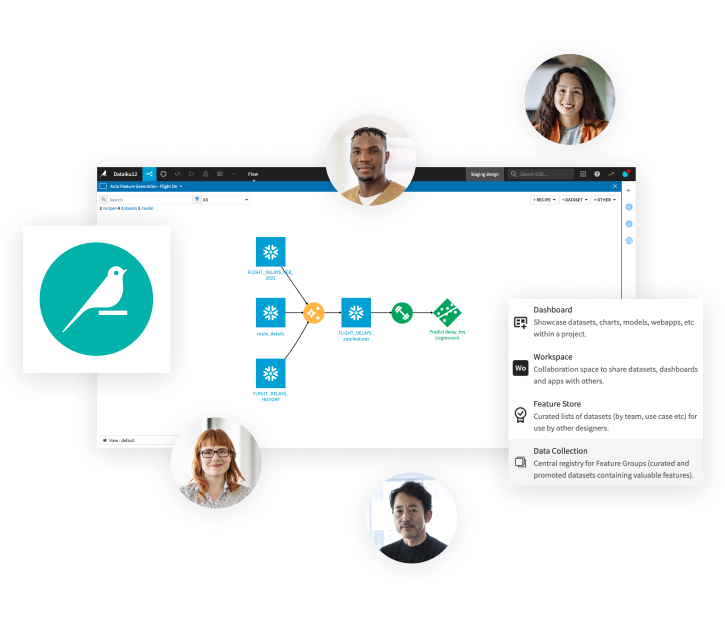
- The Dataiku Flow visually links data processes, recipes, models, and agents into coherent pipelines.
- Dataiku Visual ML combines AutoML with explainability, feature engineering, and deployment.
- Dataiku Deployer manages packaging, versioning, and promotion across development, test, and production.
- Dataiku Unified Monitoring oversees analytics, ML, APIs, and agents.
- Dataiku Govern centralizes oversight across workflows for accountability and compliance.
This unified approach also solves the lineage challenge. Instead of losing track of which data sources feed into which models across disconnected tools, enterprises gain a governed view of projects and approval chains, which is critical for compliance with regulations such as the EU AI Act. The ability to reuse data artifacts and automate workflows compounds ROI, turning one project’s work into accelerators for dozens more.
This closed loop makes enterprise AI sustainable. Convex, a specialty insurer, cut its reserving process from five months to one week and now refreshes data in hours instead of days. With Dataiku at the core of its workflow and a Center of Excellence enforcing governance, Convex demonstrates how integrated lifecycle tools enable faster delivery, stronger oversight, and scalable impact without increasing headcount.
By consolidating the full AI lifecycle, enterprises can move beyond experimentation to operational AI, scaling GenAI and AI agents responsibly, without the burden of fragmented tools, glue code, or mounting technical debt.
Built for Enterprise Data Architecture
Today’s enterprises cannot afford vendor lock-in or duplicative infrastructure. With the rapid pace of GenAI innovation, any platform that limits technology choice risks irrelevance.
Dataiku’s architecture-first approach means:
- Direct integration with major cloud-based warehouses like Snowflake, BigQuery, Databricks, and Redshift.
- Hybrid and on-premises compatibility to preserve existing investments.
- Pushdown execution that processes large amounts of data inside current infrastructure, avoiding duplication.
Emirates Global Aluminium (EGA) shows how this approach works in practice. With Dataiku on Databricks, EGA broke down silos and gave teams across functions access to trusted data sources. Process control engineers, project managers, and citizen data scientists now work with data in a shared environment to solve high-value problems in safety, supply chain, and operations. By enabling both experts and business users to contribute, EGA proves that modern data architecture drives faster solutions while maintaining governance.
The Dataiku LLM Mesh extends this flexibility to GenAI, connecting securely to providers such as OpenAI, Anthropic, Mistral, and Google. Dataiku LLM Guard Services (Cost Guard, Safe Guard, and Quality Guard), maintain compliance, security, and efficiency while experimenting with models, ensuring that enterprises can safely transform data into GenAI-powered applications.
LG Chem proves the value of this adaptability. Faced with complex safety regulations, the company built a RAG-powered chatbot in just one day using Dataiku, LangChain, and Azure OpenAI, a process that previously took weeks. The project shows how flexible cloud-based architecture turns compliance-heavy challenges into scalable, high-value services, proving that adaptability is a competitive advantage.
Point solutions and services may deliver quick results, but they fragment infrastructure and create duplication. A modern AI platform avoids these pitfalls, ensuring architecture remains interoperable, governed, and adaptable as GenAI and AI agents evolve.
From Analytics to AI Agents
Today, AI agents are moving from hype to enterprise reality. Agents can search, summarize, interact with systems, and execute tasks autonomously. But unmanaged adoption leads to analytics tool sprawl, compliance gaps, and hidden costs.
Dataiku introduces AgentOps, the framework for governing agents at enterprise scale. Key capabilities include:
- Prompt Studios to design, test, and deploy prompts.
- Dataiku Answers for safe, enterprise-wide conversational AI.
- Trace Explorer for visibility into agent decision-making.
- Dataiku Guard Services for safety, cost, and performance oversight.
- LLM Registry to track and approve models for compliance.
This makes agent adoption disciplined, auditable, and enterprise-ready. Novartis proved the impact by using the Dataiku LLM Mesh and Dataiku Answers to build a GenAI-powered chatbot that cut time to insights in healthcare market research by 90%. By governing models and prompts through Dataiku, Novartis scaled agents safely, delivered results faster, and unlocked new agility in a regulated industry.

Governance as a Competitive Advantage
Many organizations treat governance as a brake on innovation. In reality, governance is the foundation for speed, trust, and long-term value. Dataiku embeds governance across the platform:
- Dataiku Govern enforces oversight of projects, models, and workflows.
- Dataiku Unified Monitoring ensures transparency across deployed models
- Dataiku Guard Services provide safeguards for GenAI adoption.
This transforms governance from constraint into competitive advantage. Organizations can innovate at speed while remaining aligned with frameworks like the EU AI Act and GxP.
From Tools to Strategy With Dataiku, The Universal AI Platform™
Enterprises evaluating a no-code and low-code AI platform, or a data analytics platform must ask: Do these solutions prepare the business for agents, governance, and future-proof data architecture?
Point solutions may solve short-term needs. But only Dataiku unites analytics, ML, GenAI, and agents in a single governed environment. Dataiku delivers:
- A no-code and low-code AI platform in one.
- A future-ready alternative to fragmented data analytics tools.
- Seamless integration across diverse data architecture.
- Tools for the entire AI lifecycle, from analytics to agents.
- Governance and optionality to ensure resilience and trust.
Dataiku is The Universal AI Platform™ that expands participation, provides control, and positions enterprises to thrive in the new age of AI.