AI agent memory: types, architectures, and enterprise considerations
August 18, 2026/9 min read/Team Dataiku
AI agents are expected to remember users, conversations, and past decisions. A support agent that asks a customer to re-explain their issue for the third time is frustrating and a productivity failure. It erodes the value proposition of deploying the agent in the first place.
But not all memory works the same way. The memory architecture determines whether an agent carries context within a session, across sessions, or across its entire operational history, and each approach brings different trade-offs in performance, cost, governance, and data privacy.
This guide explains the major AI agent memory types, common architectures, enterprise implementation patterns, and the governance considerations needed to deploy memory-enabled agents at scale.
AI agent memory is the mechanism that allows agents to retain and retrieve information from past interactions, enabling continuity, personalization, and context-aware decision-making.
Two primary types exist: short-term agent memory (session-scoped context windows) and long-term agent memory (persistent stores that survive across sessions and workflows).
Episodic memory records sequences of past events. Semantic memory stores factual knowledge. Both serve different purposes in enterprise agent design.
Memory architecture choices directly affect cost (larger context windows consume more tokens), governance (persistent memory creates data retention obligations), and performance (retrieval latency affects agent response time).
Enterprise memory design must balance personalization with privacy: What agents remember is as important as how they forget.

AI agent memory matters because stateless agents cannot meet the continuity expectations that enterprise users and customers have.
Without memory, every agent interaction starts from zero. A customer support agent re-asks diagnostic questions the customer already answered in a previous session. A procurement agent re-evaluates supplier criteria it already assessed last week. An internal assistant re-requests context that the user provided yesterday. Each restart wastes time, degrades user experience, and reduces the operational value that justified deploying the agent.
According to LangChain's 2026 "State of Agent Engineering" report, based on a survey of over 1,300 professionals, a third of respondents cited quality as their top production blocker, with large enterprises specifically flagging context management as a leading cause of unreliable agent output.
Memory-enabled agents close that gap in three ways.
Personalization: The agent adapts responses based on the user's history, preferences, and prior interactions.
Operational efficiency: Fewer repeated prompts and shorter context-gathering cycles mean faster resolution and lower cost per interaction.
Compliance and auditability: Persistent memory creates a documented record of what the agent knew, when it knew it, and how it used that information in its decisions.
The cost benefit is often overlooked. Well-designed memory reduces context window consumption by retrieving only the relevant prior context rather than passing the entire conversation history. For agents processing thousands of interactions daily, that reduction translates directly to lower token costs. Understanding these benefits starts with distinguishing short-term memory from long-term memory.
AI agent memory operates on a spectrum from transient session buffers to persistent knowledge stores. Understanding where on that spectrum each use case falls determines the architecture.
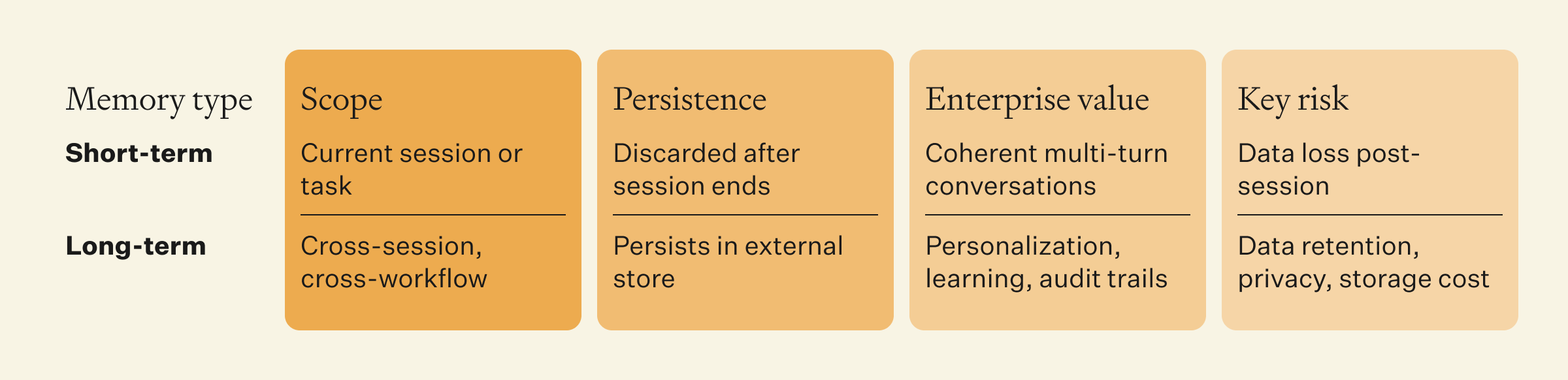
Short-term memory holds context within a single session or task execution. It operates through the LLM's context window: the conversation history, retrieved documents, and system instructions that are passed to the model with each request.
The benefit is simplicity.The model can access the current working context directly, often without a separate long-term retrieval step.The agent maintains coherence throughout a conversation because the full context is available in the prompt. For example, a chatbot can understand that “it” in a follow-up question refers to the product discussed two messages earlier, allowing the conversation to continue without the user repeating the product name.
The limitation is scope. When the session ends, the memory is gone. The agent starts fresh on the next interaction with no knowledge of what came before. For agents handling one-off queries (a search assistant, a code generation tool), this is sufficient. For agents that need to remember users, track ongoing cases, or learn from experience, it is not.
Long-term agent memory persists information across sessions, workflows, and time. It requires external storage: vector databases for semantic retrieval, knowledge graphs for structured relationships, or relational databases for transactional records.
Three capabilities distinguish long-term memory.
Persistence: The agent retrieves prior interactions, decisions, and context from previous sessions.
Personalization: User preferences, communication patterns, and historical context accumulate over time, improving the agent's relevance.
Episodic recall: The agent can reference specific past events ("the last time this supplier raised prices, you approved a 5% increase").
The hybrid pattern combines both: Short-term memory handles the current session's context, while long-term memory retrieves relevant prior context to augment it. This is the architecture behind most production RAG systems with memory, where retrieved documents provide factual grounding and memory provides user and session history.
Enterprise agents typically draw on two distinct types of memory, and confusing the two leads to poor architecture decisions. The table below breaks down how episodic and semantic memory differ across storage, retrieval, and use case.
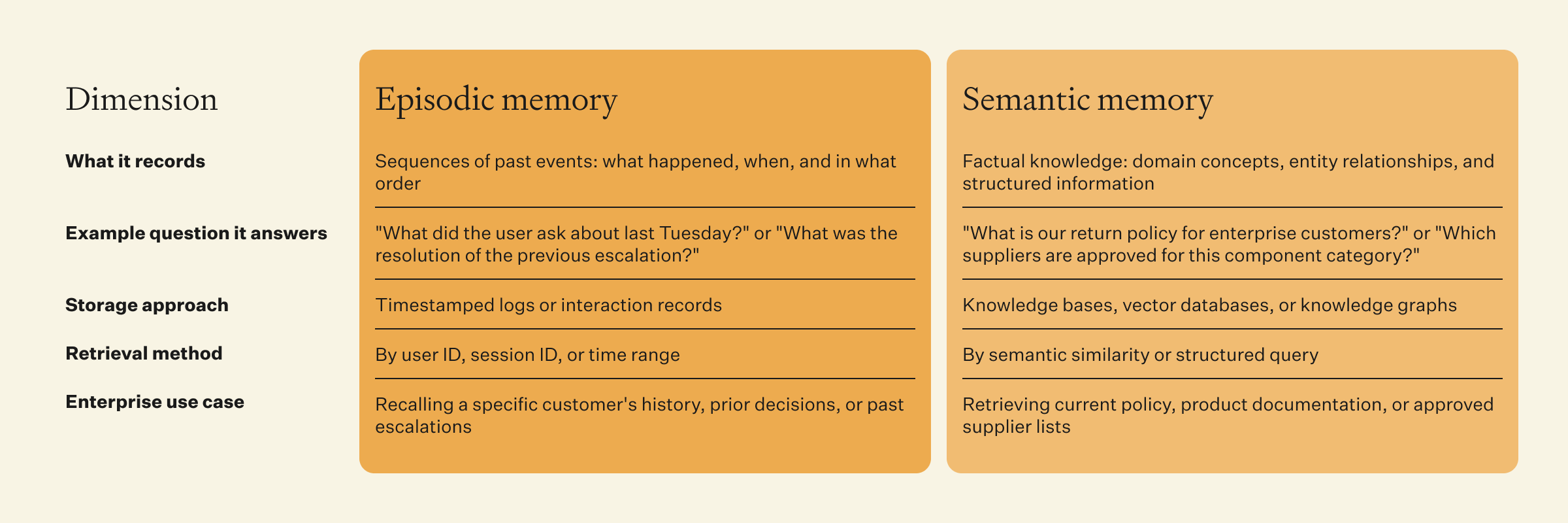
Both types serve enterprise agents, but for different purposes. A customer support agent uses episodic memory to recall the customer's previous issues and resolutions, and semantic memory to retrieve current product documentation and policy information. The most effective agents combine both rather than relying on just one.
Three architectural approaches store and retrieve agent memory, each with different trade-offs.
Token-level (in-context) memory passes prior interactions directly in the LLM's context window. This is the simplest architecture: no external storage, no retrieval system, and no latency overhead.
The constraint is the context window limit. As conversation history grows, either the context fills up (consuming tokens and increasing cost) or older context must be summarized or truncated, losing detail.
Parametric memory embeds knowledge directly into the model's weights through fine-tuning. The agent "remembers" because the information is part of the model itself. This approach works for stable domain knowledge that changes infrequently.
The limitation isupdating parametric memory requires retraining, which is expensive and introduces the risk of catastrophic forgetting (losing previously learned information).
External (retrieval-based) memory stores information in external systems (vector databases, knowledge graphs, relational databases) and retrieves it at inference time. This is the most flexible architecture: Memory is updatable without retraining, scales independently of the model, and is governable through standard data management practices.
The trade-off is retrieval latency and the engineering complexity of maintaining the storage and retrieval pipeline.
Most production enterprise agents use external memory combined with token-level context management.
Implementing AI agent memory is less about the storage technology and more about the design decisions made before a single vector database gets provisioned. Teams that skip straight to tooling tend to end up with memory stores that grow unbounded, retrieval that surfaces the wrong context, and no clear answer for how a deletion request gets fulfilled.
The steps below outline the design choices that determine whether memory improves an agent's performance or just adds cost and risk.
Not everything should be remembered. Define what information the agent needs to persist (user preferences, case history, decision outcomes) and what should be discarded after the session (intermediate reasoning steps, tool call responses that have no future value).
Every stored memory should include user_id, session_id, timestamp, and relevance tags. Metadata enables filtered retrieval: The agent retrieves only memories relevant to the current user, task, and time window rather than searching the entire memory store.
Storing raw interactions preserves detail but consumes storage and increases retrieval noise. Summarizing interactions before storage reduces both but loses nuance. The right choice depends on whether downstream use cases need exact recall (compliance, audit) or approximate context (personalization, continuity).
Memory retrieval should be scoped: by user, by time window, by relevance threshold, and by task type. Unfiltered retrieval that returns everything the agent has ever stored creates noise, increases latency, and risks surfacing irrelevant or stale context.
Memory that grows without bounds creates storage costs, retrieval latency, and governance liability. Define retention periods based on business requirements and regulatory obligations. User preference data may persist indefinitely. Session interaction logs may expire after 90 days. The retention policy should align with the organization's data governance framework.
Three metrics matter:
Recall:Is the memory system retrieving the information the agent needs?
Relevance:Is the retrieved information actually useful for the current task?
Staleness:Is the retrieved information still current, or has the underlying fact changed?
Start with a semantic memory MVP: a vector store containing the agent's domain knowledge, retrievable by similarity search. Add episodic memory (user interaction history) once the semantic layer is stable and the governance framework for persistent user data is in place.
Gartner® states, "Over 40% of agentic AI projects will be canceled by the end of 2027, due to escalating costs, unclear business value or inadequate risk controls, according to Gartner, Inc."* Memory-enabled agents create governance obligations that stateless agents do not.
Persistent memory that stores user interactions will inevitably contain personal information. The governance framework must define what PII can be stored, how it is encrypted, who can access it, and how deletion requests (GDPR Article 17, CCPA) are fulfilled. Deleting a user's data from a vector database is technically more complex than deleting a row from a relational table, and the governance plan must account for that.
Memory stores must comply with jurisdictional data residency requirements. An agent serving European customers must store European user memories in compliant infrastructure, regardless of where the agent itself runs.
Two cost categories compete. Storage costs grow with the volume of stored memories. Token costs grow with the volume of retrieved context passed to the LLM. Well-designed retrieval filters and summarization strategies optimize the balance: Store enough to be useful, retrieve only what is relevant, and avoid passing unnecessary context that inflates token consumption.
Memory that grows indefinitely degrades retrieval quality (more noise, slower search) and increases governance liability (more data to protect, audit, and potentially delete). Implement decay strategies: time-based expiry, relevance-weighted pruning, and periodic consolidation that summarizes older memories into compact representations.
Benchmark memory retrieval under realistic production load, not just against test queries. Retrieval latency that is acceptable at 100 queries per minute may be unacceptable at 10,000. Storage systems that perform well at 1M vectors may degrade at 100M.
Dataiku, the Platform for AI Success, addresses this through Dataiku Agent Management, which provides enterprise-wide agent oversight, connecting to agents across any platform and tracking business performance, behavioral drift, and governance status from a single view. For memory-enabled agents, this includes visibility into whether memory is improving agent performance or introducing retrieval quality degradation over time.
AI agent memory transforms agents from stateless tools into persistent, context-aware systems that improve with every interaction. The business impact is measurable: fewer repeated interactions, faster resolution, lower token costs, and the personalization that enterprise users increasingly expect.
The path forward:
Pilot with one workflow.
Implement semantic memory first (domain knowledge retrieval).
Add episodic memory (user interaction history) once the governance framework for persistent data is in place.
Measure recall, relevance, and staleness.
Iterate based on observed production behavior.
Dataiku provides governed agent workflows with built-in oversight, lineage, and monitoring across any infrastructure, ensuring that what agents remember is as well-governed as what they decide.
Deliver AI agents
Deliver AI agents
AI agent memory is the mechanism that allows an AI agent to retain, store, and retrieve information from past interactions. It enables agents to maintain context across conversations, personalize responses based on user history, and learn from prior decisions. Without memory, every agent interaction starts from zero regardless of what came before.
It can, if the memory contains inaccurate, outdated, unauthorized, or contradictory information. An agent that retrieves a stale memory and treats it as current fact will produce a confidently wrong response. Mitigation requires memory hygiene: expiry rules for time-sensitive information, staleness checks during retrieval, and relevance scoring that deprioritizes low-confidence memories.
Costs depend on two variables: storage (how much is persisted) and retrieval (how much context passes to the LLM per interaction). Token consumption is usually the larger driver, scaling with volume. Well-designed retrieval filters that return only relevant memories control cost.
No. Fine-tuning changes the model's weights through retraining and risks catastrophic forgetting. Agent memory stores information externally and retrieves it at inference time, updatable in real time without retraining. Most enterprise agents use external memory rather than fine-tuning for ongoing knowledge management.
Deletion depends on storage architecture. Relational databases require deleting records by user ID. Vector databases require removing the vectors generated from that data. Summarized memories require regenerating without the deleted user's contribution. Plan for deletion from the start by maintaining provenance, identifiers, data maps, and links between source records and derived memory artifacts.
Tags