Why secure agentic applications require a new approach
July 16, 2025/2 min read/Kurt Muehmel
Agentic applications, those built with large language models (LLMs) and dynamic workflows, aren’t your typical software. They’re complex, interconnected systems made up of agents, tools, services, and models, all operating across multiple boundaries.
And while their modularity brings flexibility and innovation, it also expands the security surface in ways traditional architectures weren’t designed to handle. So, how do IT leaders secure these systems without slowing innovation?
The answer lies in an architectural approach known as an LLM Mesh. In Chapter 6 of the “The LLM Mesh: An Architecture for Building Agentic Applications in the Enterprise" co-developed with O’Reilly, we unpack why an LLM Mesh architecture is critical for enterprise-scale agentic applications and how it enables consistent, system-wide security.

In legacy, monolithic applications, security measures like access control and audit logging are often bolted on in app-specific ways. This leads to various risks, such as:
Hardcoded permissions that are brittle and hard to maintain.
Inconsistent logging that makes tracing actions across systems nearly impossible.
Embedded secrets like API keys directly in code, creating obvious attack vectors.
Agentic applications amplify these weaknesses. With multiple agents invoking external services, shared data sources, and distributed workflows, perimeter-based security simply can’t keep up.

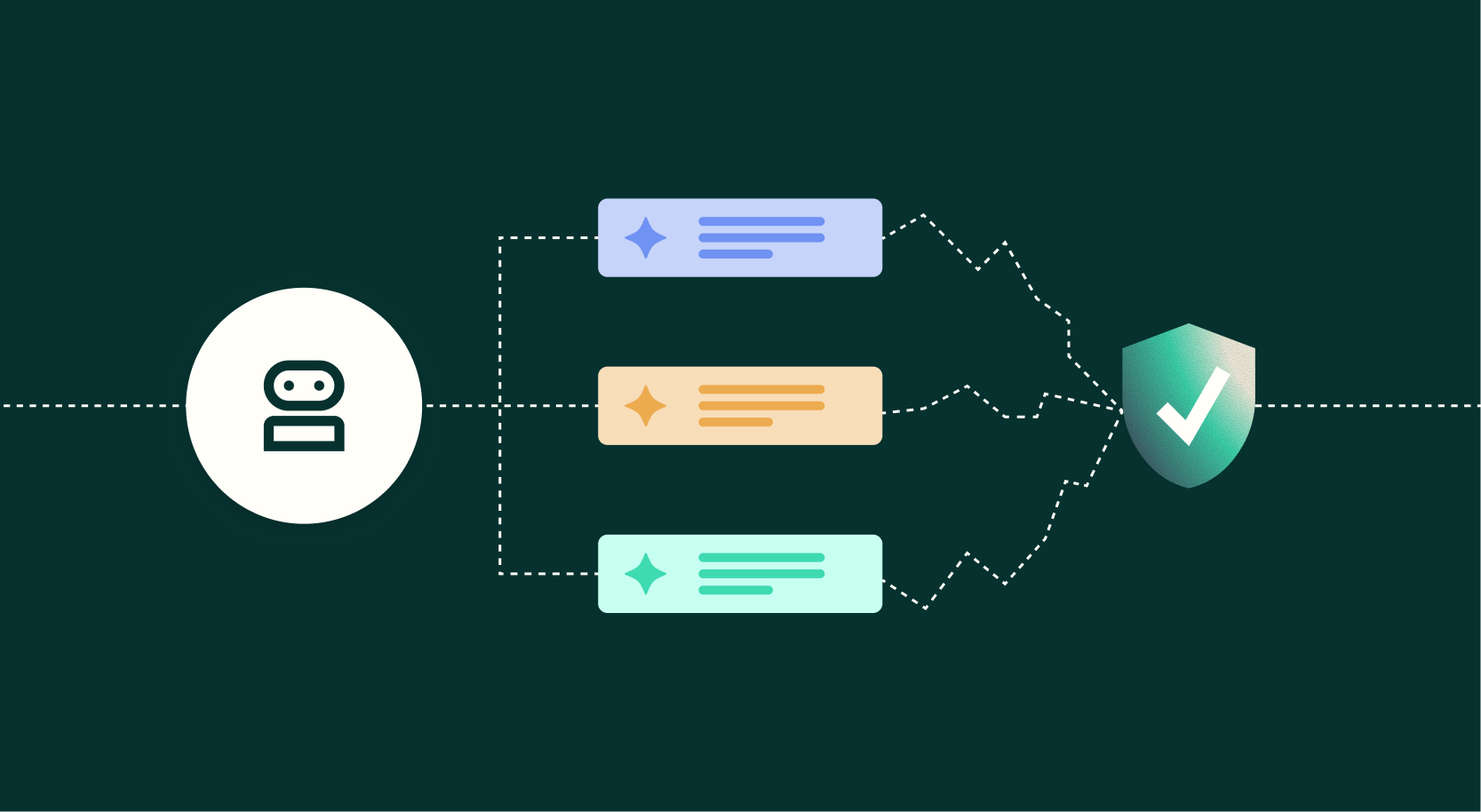
An LLM Mesh flips the paradigm. Instead of relying on scattered, app-specific defenses, it enforces security uniformly across all components: agents, tools, retrievers, and LLMs.
Here’s how:
Move beyond Role-Based Access Control (RBAC) to Attribute-Based Access Control (ABAC). In an LLM Mesh, permissions are context-aware and object-specific, applying to not just users but also agents, tools, and services. Example: An analytics agent can’t access HR datasets, even if invoked by an authorized user.
In distributed, multi-agent environments, consistent authentication is a must. Federated identity ensures credentials propagate securely across all agents, tools, and APIs, integrating seamlessly with enterprise SSO and Identity and Access Management (IAM) systems.
Every interaction in an LLM Mesh is mediated by an LLM-aware gateway. It inspects prompts, validates metadata, and enforces routing rules, preventing misuse like prompt injection or data leakage.
Permissions adapt in real time based on attributes like time, location, or data sensitivity. Secrets are managed centrally with automated rotation, so no more hardcoded API keys.
Structured, tamper-resistant logs capture every action with rich metadata. This isn’t just for troubleshooting; it’s essential for forensics, compliance (ISO 27001, GDPR), and regulatory audits.
Traditional rule-based monitoring doesn’t cut it for autonomous agents. An LLM Mesh enables context-aware detection of misuse, privilege escalation, or agent chaining abuse, feeding alerts directly into SIEM tools for rapid response.
Whether deploying in the cloud, on-premises, or hybrid, an LLM Mesh enforces strict resource and network isolation to prevent cross-tenant data leakage or unauthorized lateral movement.
From NIST’s AI Risk Management Framework to ISO/IEC 42001, enterprises face growing pressure to operationalize secure AI practices. An LLM Mesh supports this by making policies enforceable at the infrastructure level, turning governance from a static checklist into a live, active system.
This blog just scratches the surface. In the full chapter, you’ll get:
✅ Detailed comparisons of monolithic vs. LLM Mesh security postures.
✅ Concrete examples of LLM Mesh-native controls for agentic applications.
✅ Best practices for aligning with regulatory and governance frameworks.
✅ Insights into how an LLM Mesh enables safe, scalable, and governed AI deployment.
If you’re serious about scaling agentic applications securely, this is essential reading.