Decision 6 of 7: When AI sprawl becomes enterprise risk
May 20, 2026/4 min read/Julia Berman
This is the sixth installment in our seven-part breakdown of insights from the report, "7 career-making AI decisions for CIOs in 2026." Read the full report here.
In Decision #1, we explored how AI has become a leadership referendum. In Decision #2, we examined why explainability is becoming the gatekeeper for AI reaching production. For Decision #3, we discussed the accountability gap behind AI agents embedded in critical workflows. In Decision #4, we addressed the growing cost of vendor regret. Recently, in Decision #5, we explored why multi-model flexibility has become an architectural requirement.
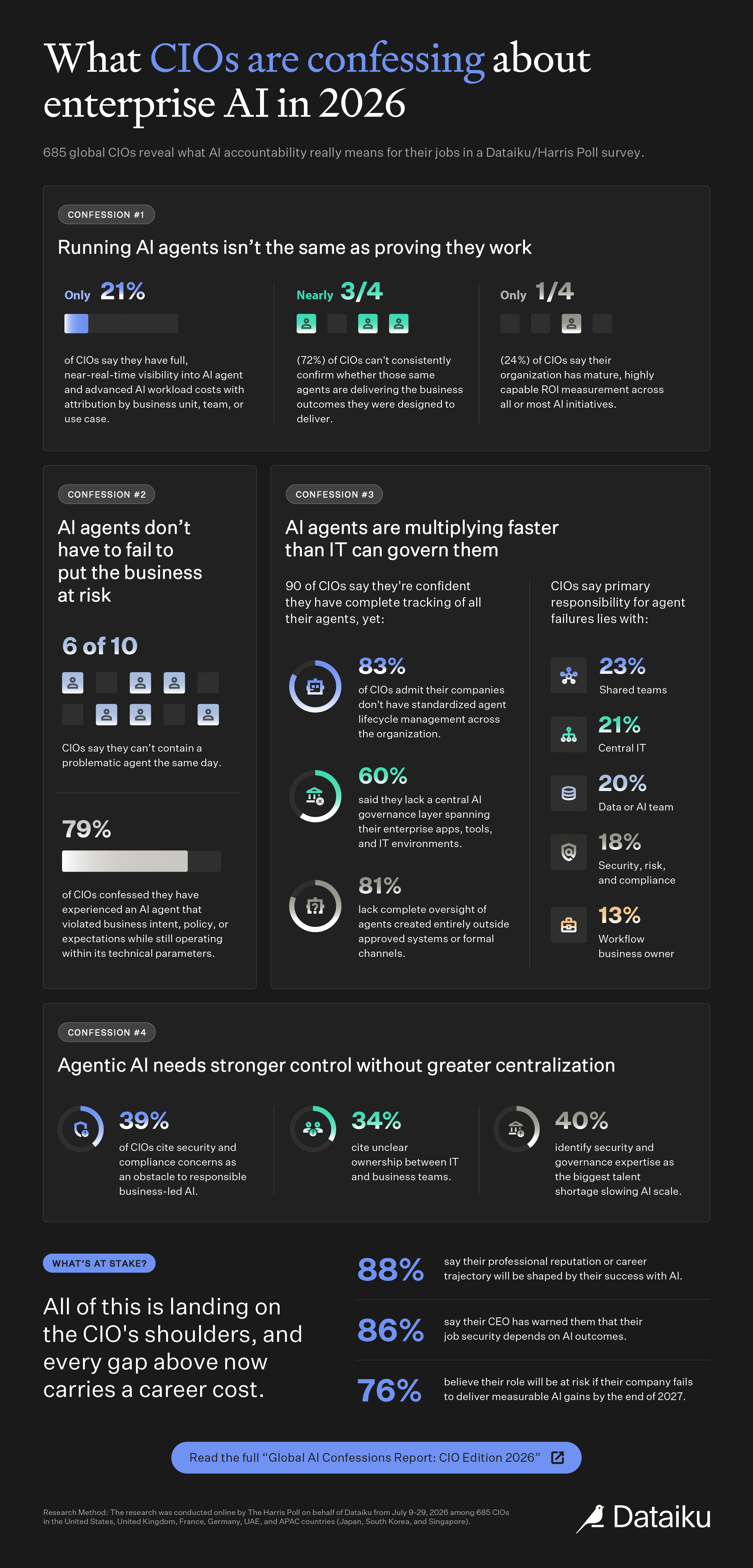
Now, with this sixth decision, we address what happens when AI creation itself moves faster than IT’s ability to govern it.
As low-code, no-code, GenAI, and agent-building capabilities spread across the enterprise, more employees can create AI-powered apps, workflows, and automations without waiting on centralized technical teams. That is exactly what many enterprises want: broader innovation, faster experimentation, and more business users turning AI into productivity gains.
But the same capabilities that make AI easier to scale also make it easier to lose control.
According to the recently released report, based on a Dataiku/Harris Poll survey of 600 enterprise CIOs worldwide, 82% of CIOs agree employees are creating AI agents and apps faster than IT’s ability to govern them. More than half (54%) have already discovered unsanctioned AI use for work tasks or projects. And 89% agree that broader employee access to AI tools without strong governance will create significant technical debt from shadow AI.
That makes the next career-defining decision clear. How can CIOs scale AI creation beyond IT without creating shadow AI, data exposure, and runaway sprawl?

For years, enterprise AI was largely concentrated among data science, IT, analytics, and engineering teams. These teams had the technical skills to build, deploy, and manage AI systems, which meant governance could be enforced through centralized processes. However, that model is changing quickly.
AI creation is becoming more distributed across the business. Teams across marketing, finance, operations, HR, and customer-facing are experimenting with GenAI tools, building workflows, and using AI to accelerate daily work. In many ways, this is the promise of enterprise AI: More people can solve more business problems without waiting months for technical delivery.
CIOs recognize that reality too. A strong majority view low- and no-code capabilities as essential to scaling AI creation across the enterprise, with 94% rating them at least critical. The central problem is that many teams are building outside the structures required to govern AI responsibly.
When AI creation expands without a governed pathway, enterprises don’t get democratized innovation. Instead, they find fragmentation — different tools, disconnected workflows, unapproved data use, inconsistent controls, and AI systems that no one can fully see.
Shadow AI is already in the enterprise.
More than half of CIOs say they have discovered unsanctioned AI use for work tasks or projects. Plus, unlike traditional shadow IT, shadow AI carries a different kind of exposure. An unsanctioned app or workflow may summarize sensitive data, generate customer-facing content, make recommendations, trigger business actions, or connect to systems that were never designed for that level of automated influence. That changes the risk profile.
CIOs are especially concerned about data exposure. In the report, 81% say they are concerned citizen-built AI could expose sensitive company data. The concern is not only that employees will build the wrong thing. It is that they will build the right thing in the wrong place, with the wrong data, under the wrong controls.
On a small scale, these issues may look like isolated productivity hacks. At enterprise scale, they become operational debt.
The data shows CIOs understand the longer-term risk clearly, as 89% agree that broader employee access to AI tools without strong governance will create significant technical debt from shadow AI.
That technical debt can accumulate in several ways.
Teams may build AI workflows that cannot be monitored or audited. Different departments may use different tools to solve similar problems, duplicating effort and creating inconsistent standards. Sensitive data may move through unapproved environments. AI outputs may influence business decisions without traceability. Agents may be created without clear ownership, escalation paths, or lifecycle management.
Over time, the enterprise inherits an AI estate it cannot fully inventory, assess, or defend.
That’s the core risk of AI sprawl. At first, it may not look like failure. In many cases, shadow AI can actually appear productive. For instance, employees may move faster or teams may automate repetitive work. Still, without governance, that speed creates systems the enterprise cannot explain, secure, or scale with confidence.
Enterprises that scale AI creation responsibly tend to share three structural characteristics:
Rather than forcing employees into unsanctioned tools, they give teams governed access to AI capabilities, approved data, reusable components, and standardized deployment patterns.
Dataiku E2A takes this exact approach. Experts build the logic, IT governs the components.
CIOs need a portfolio-level view of what is being built, who owns it, what data it uses, where it runs, and how it performs. Without that visibility, governance becomes reactive.
Access management, data permissions, monitoring, evaluation, approval workflows, and audit trails are built into the environment where employees create, not applied manually after the fact.
This is where architecture becomes strategic. If employees have to choose between speed and governance, many will choose speed. But when governance is embedded into the tools and workflows they already use, responsible AI creation becomes the default path rather than a separate compliance burden.
AI creation will continue moving beyond IT. That’s unavoidable, and in many ways, necessary. Enterprises will fail to capture the full value of AI if every use case has to move through a narrow centralized bottleneck, but CIOs cannot allow democratized AI to become unmanaged AI.
The enterprises that win in 2026 will be the ones that give employees room to build while maintaining control over data, deployment, monitoring, and accountability. They will enable broad AI creation without surrendering enterprise governance.
Those that do not will inherit the worst version of scale: AI everywhere, visibility nowhere.
In the accountability era, the riskiest AI in the enterprise may be the AI they did not know existed until it created real exposure. So then, the CIO’s decision is whether to make that expansion governable before shadow AI becomes irreversible debt.