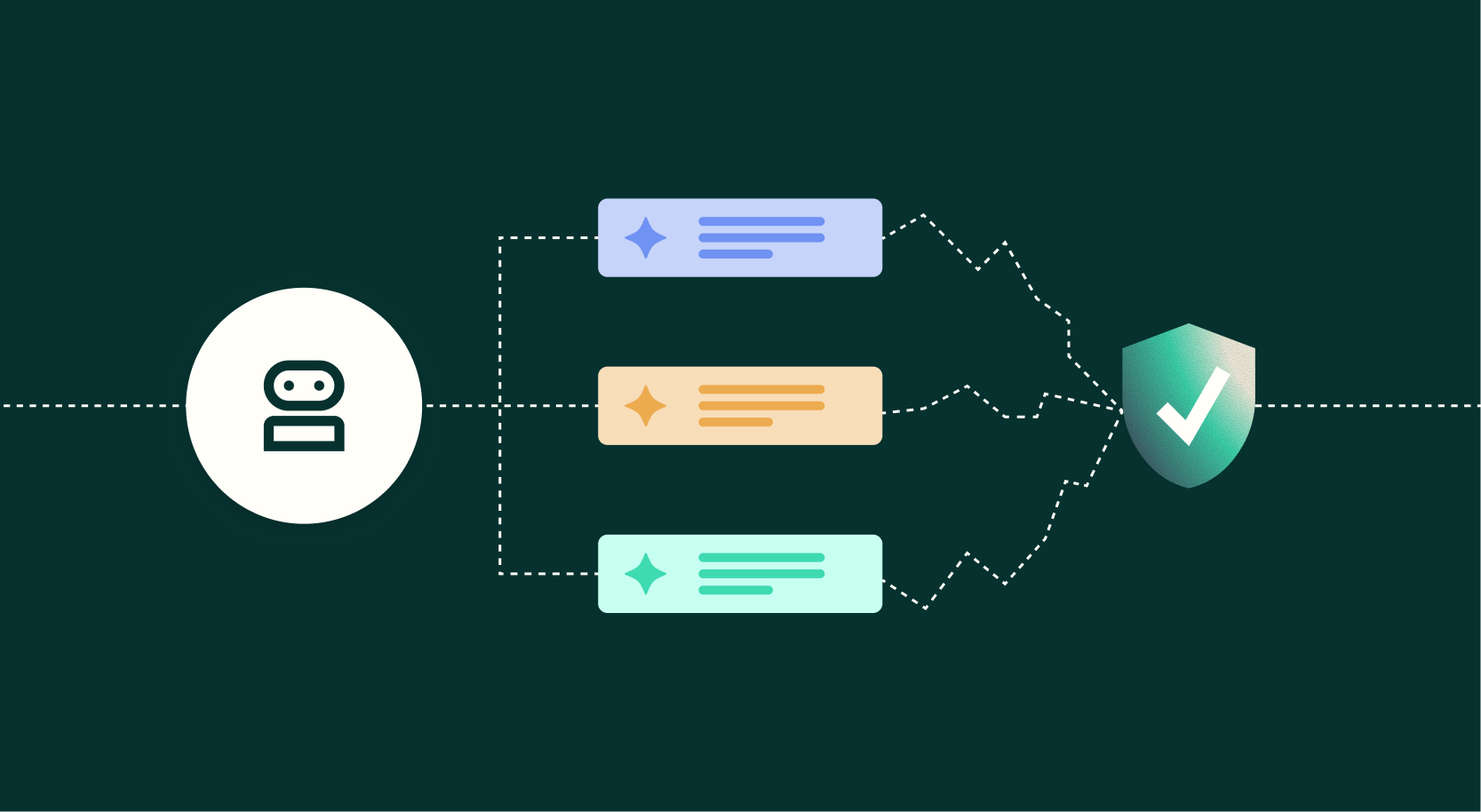
Why shadow AI agents are accumulating automation debt
January 20, 2026/4 min read/Julia Berman
For many enterprises, AI risk still centers on unsanctioned prompts and shadow tools. But the next wave of risk is already emerging, driven by autonomous agents that can take action across systems with limited human oversight.
When connected to enterprise tools and systems, AI agents can monitor signals, trigger workflows, update records, and send messages, sometimes with minimal human input. This means the risk is no longer “shadow AI” in the traditional sense (i.e., GenAI use outside of sanctioned tools). The distinction is that AI agents can act with little or no human input. The bigger risk, then, is what these agents are doing and whether anyone has visibility into it.

Shadow AI is usually framed as a usage problem that emerges with unsanctioned tools, untracked prompts, and one-off experiments. But shadow AI agents are different for a more specific reason: Not because they’re inherently autonomous, but because they’re unregistered, unmanaged, or unobservable inside the organization’s governance model. The “agent” part describes actuation (the ability to take steps and use tools). The “shadow” part describes the visibility gap. They represent a shift from assistance to autonomy — from systems that respond to systems that act.
A shadow agent might start as a small helper. For instance, it might follow a script that auto-triages support tickets, or act as an internal agent that monitors data and triggers actions when thresholds are met. Often, these systems are created with the best intentions of moving quicker, reducing manual work, and removing team blockers.
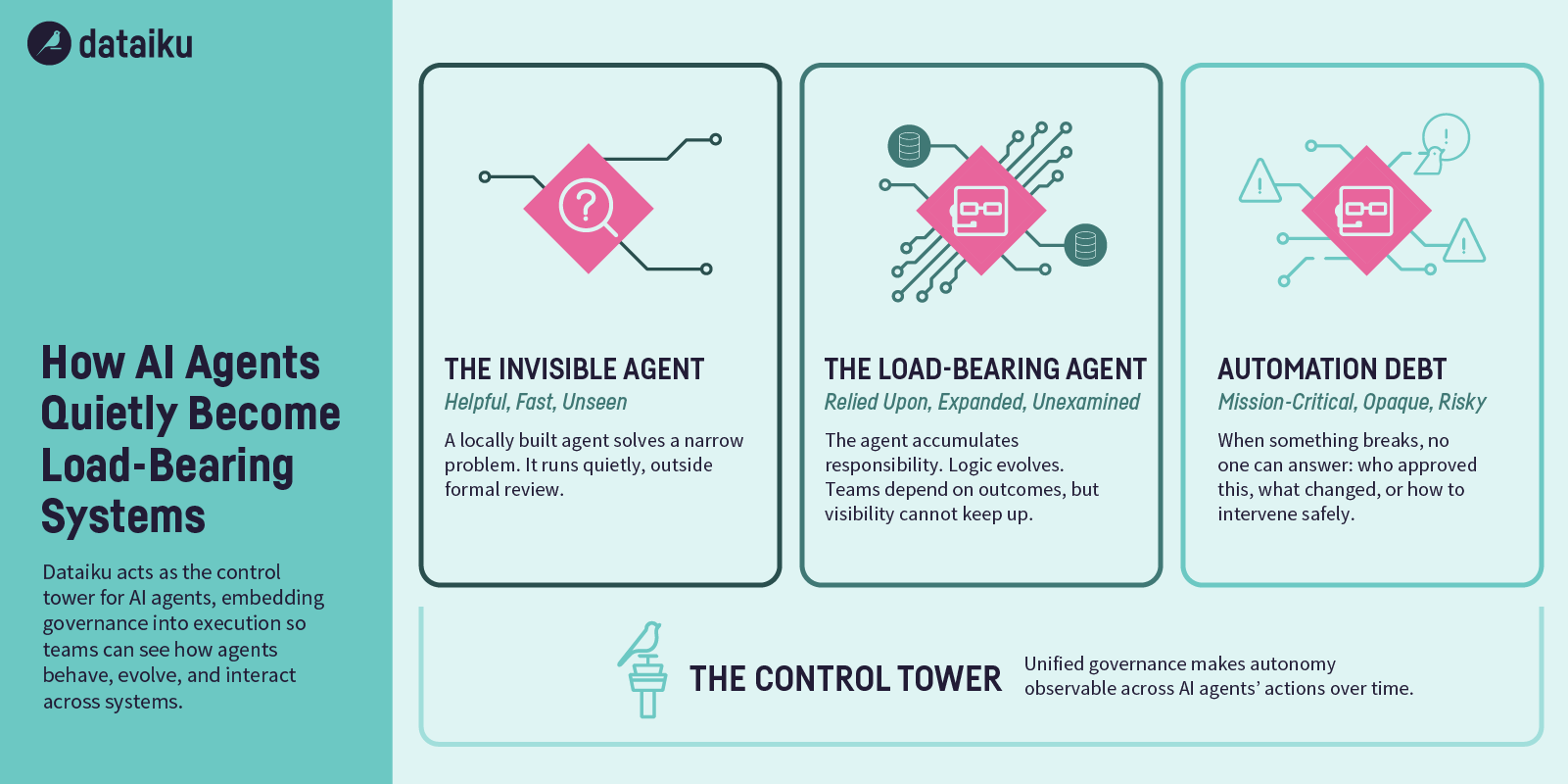
Although, over time, these agents can accrete responsibility. A triage rule can quietly become a decision heuristic while a threshold can become a de facto policy, especially when scope expands, ownership is unclear, or changes aren’t tested or documented. Each incremental change feels harmless, maybe even sensible, until the agent is effectively load-bearing, but no longer fully understood by the teams relying on it.
Once agents quietly become part of the organization’s operational fabric even without being formally reviewed, monitored, or governed, the risk equation changes. Shadow agents turn experiments into unofficial operations.
Much like technical debt, what you might call automation debt accumulates quietly. It builds every time an agent’s logic changes without traceability, and each time a prompt is updated without review. Basically every time an agent leverages data, triggers an action, or interacts with a system and no one can later explain why. In practice, automation debt isn’t about brittle logic but broken lineage.
Initially, the AI agent feels helpful, then it becomes relied upon. Eventually it’s mission-critical. Yet, when something finally goes wrong, leaders are left asking questions that governance was meant to answer all along:
Who approved this agent?
What model was it using at the time?
What data did it access?
Was a human ever involved?
Without oversight, these questions materialize as consequences instead of answers. Like technical debt, automation debt becomes harder and more expensive to unwind the longer it remains invisible.
Most governance frameworks were designed for a different era of AI development. One where models and systems were relatively static, deployments were deliberate, and behavior was predictable.
AI agents have shaken up the status quo though. They evolve continuously and chain actions together across systems. That doesn’t fit neatly into approval-once, deploy-once governance models most enterprises have grown to depend on. Rather, risks emerge from how systems are behaving over time. That’s why governance must extend into execution, monitoring, and ongoing evaluation.
In other words, governing agents starts with making autonomy observable across their entire lifecycle.
When organizations struggle to govern AI agents, the instinct is often to add more rules. More approvals. More documentation. But those rules fail to address the core problem of visibility. Without the ability to trace agent decisions, inspect intermediate steps, and understand model-tool-data interactions over time, autonomy starts outpacing accountability.
In aviation, control towers don’t fly planes or decide where they go. Their job is situational awareness, i.e., knowing what’s in the air, what’s changing, and when intervention is required. The same principle applies to AI agents.
As agents proliferate across teams, tools, and vendors, leaders need a central, enterprise-wide view into which agents exist, what they’re connected to, what data they touch, and how they behave over time.
That’s why AI governance today increasingly needs a control-tower-like capability, not instead of policy, but in addition to it.
Human-in-the-loop is often misunderstood as a way to slow systems down. In reality, it’s how organizations decide where accountability lives.
Certainly, not every agent action needs human review. But every agent needs clear escalation paths with defined evaluation points, along with the ability for humans to step in when behavior drifts, risks change, or context shifts.
Well-designed human-in-the-loop models are geared towards making autonomy sustainable. Oversight becomes a feature of the system versus an afterthought, ensuring that when agents act, responsibility is traceable within the system.
The future of enterprise AI is a move towards more visible AI agents as they operate.
Shadow AI agents have emerged because organizations are moving fast, and because governance often lacks the pace needed to match where AI is actually built and deployed. Momentum can be preserved, so long as the control tower view is established.
This is where platforms like Dataiku matter. By embedding orchestration, traceability, evaluation, and human-in-the-loop controls directly into how agents are built and run, governance becomes part of execution rather than an afterthought. This enables continuous visibility across agent logic, model behavior, and downstream actions so autonomy can scale without losing accountability as agents become operationally load-bearing.
One quiet indicator that automation debt has already formed is dependency asymmetry: Teams are unable to clearly articulate how long the business could function if a given agent stopped working. When that question can’t be answered confidently, risk has already shifted from theoretical to operational.
When AI is built everywhere, governance must weave into the foundation of agentic AI. It has to live everywhere too — quietly, continuously, and in service of trust.