The CEO trust paradox: AI confidence vs. control
May 19, 2026/3 min read/Julia Berman
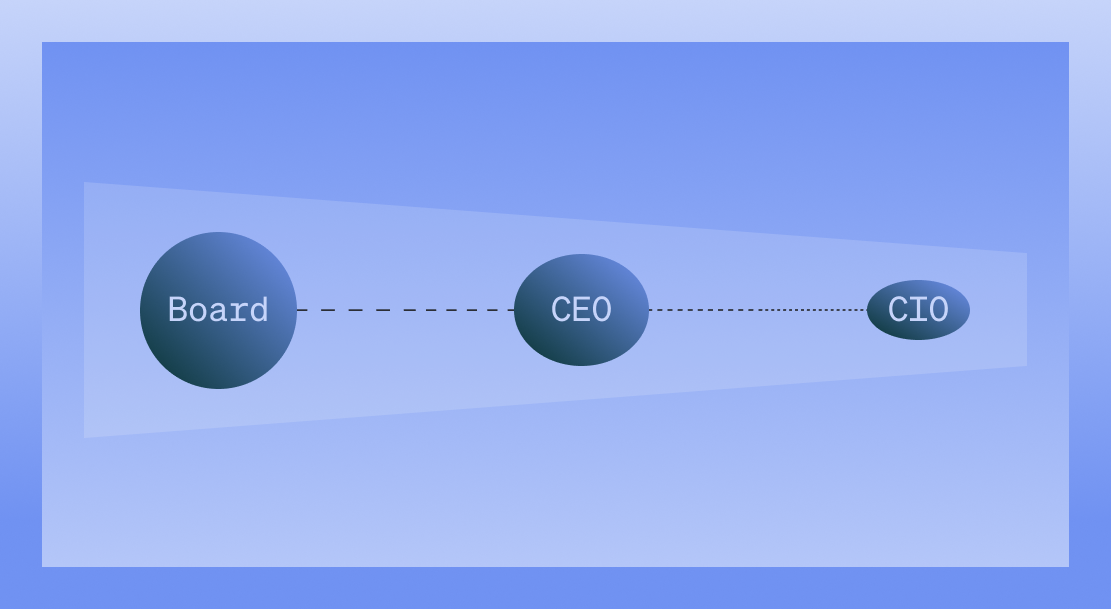
CEOs are increasingly willing to credit AI publicly. According to Dataiku's "Global AI confessions report: CEO edition 2026," based on a Dataiku/Harris Poll survey of 900 enterprise CEOs worldwide, nearly all (94%) say they would feel comfortable telling their board that AI tools influenced a strategic recommendation.
In private, however, the picture is very different. Only four percent never ask to justify AI-driven recommendations, indicating near-universal scrutiny of AI decisions. More than half (51%) keep humans in the loop when it comes to making business-critical decisions, and over one-third (34%) operate under a model where AI recommends, but humans approve.
That is the trust paradox sitting at the center of enterprise AI right now. CEOs are confident enough to attribute influence to AI in front of their boards, but not confident enough to let it act on its own without a human stepping in to vouch for it.
This is the second installment in our series on the "Global AI confessions report: CEO edition 2026." The first piece looked at the accountability gap between CEOs who own AI strategy and the CIOs making most of the decisions. Here we’ll be looking at another gap: the one that exists between the AI a CEO is willing to be seen using and the AI they actually trust to act.
The instinct to keep a human in the loop is not a failure of conviction. It’s actually the appropriate response when an executive cannot fully see how a recommendation was produced.
CEOs are accountable for outcomes. When an AI system surfaces a recommendation about a market entry, a portfolio reallocation, or a major operational shift, the CEO is the one who has to defend the call. If they’re unable to trace where the recommendation came from, what data shaped it, what assumptions it carried, or how it was tested, asking for human justification is the only sensible move.
That’s not a failure of confidence in AI, but a failure of visibility into AI.
Further, the report shows this caution is hardening. Belief that an AI agent could provide equal or better counsel than a board member has dropped from 94% in 2025 to 83% in 2026. Belief that AI could develop a better strategic plan than an executive has dropped from 89% to 76%. That means CEOs still have faith in AI, but they’re getting more realistic about what it takes to trust it at the executive layer.
This trust paradox is what happens when ambition outpaces infrastructure.
Manual verification works at low volume. It doesn’t work at the volume CEOs are already operating at.
CEOs report AI influencing or informing, at some level, up to an average of 40 business decisions per year. That is the executive workflow today, and the trajectory is steeper. Eighty-three percent of CEOs say they are confident their organization will deploy AI agents in full production in 2026.
When AI touches 40 decisions a year and agents are moving into production, every recommendation won’t route through a human checkpoint without consequence. Speed gets sacrificed for certainty. Autonomy gets constrained by oversight. At the same time, the people doing the manual verifying become the bottleneck on the strategy the CEO is publicly defending.
That isn’t a governance problem in the compliance sense. It’s a velocity problem — and CEOs already know it. When asked what matters most for AI success, CEOs rank governance (39%) ahead of people (34%) and orchestration (28%). Control, not capability, is the limiting factor.
The version of AI governance most executives have been sold is defensive: controls that slow things down, policies that limit what teams can do, oversight that adds drag. That framing is part of why governance gets deprioritized in favor of speed.
But the trust paradox reveals the opposite. The absence of trustworthy infrastructure is what’s forcing manual oversight on every decision. CEOs are slow because the system outputs remain untrustworthy without a human re-deriving it.
Strong governance flips that equation. When a CEO can see, on any AI-driven recommendation, what data was used, which model produced it, what guardrails were applied, who approved its deployment, and how it has performed historically, justification stops being a manual exercise. It becomes a property of the system.
This is what governance done well actually delivers. Recommendations become auditable on their own, without a human re-deriving them. Only sanctioned data and models reach high-stakes decisions, because access and approval structures are built in. Drift, bias, and performance issues surface before they reach an executive. Documentation lives with the output, not in a separate compliance system somewhere downstream.
The conviction is already there. Eighty percent of CEOs say they would trust their company's AI governance frameworks, even if their job were on the line. The work now is making sure those frameworks can actually carry that weight.
The CEOs surveyed in this report are correct in requiring human validation. Yet, they’re asking the right question of the wrong system.
The next phase of enterprise AI leadership will separate the enterprises that treat governance as a slowdown from the ones that treat it as the foundation that makes speed possible. The first group will keep running into the trust paradox — confident in front of the board, cautious in practice, and capped by how many recommendations a human can manually validate. The second group will build the infrastructure that lets AI move at the pace their strategy requires, with the traceability that makes every output defensible by design.
That is the unlock. It’s the work that determines whether the AI a CEO is willing to talk about on stage is the same AI they’re actually willing to run their business on.