Decision 5 of 7: When AI model choices become a switching problem
April 16, 2026/3 min read/Julia Berman
This is the fifth installment in our seven-part breakdown of insights from the report, "7 career-making AI decisions for CIOs in 2026." Read the full report here.
In Decision #1, we explored how AI has become a leadership referendum. In Decision #2, we examined why explainability is becoming the gatekeeper for AI reaching production. For Decision #3, we discussed the accountability gap behind AI agents embedded in critical workflows. Most recently, in Decision #4, we addressed the growing cost of vendor regret — and why AI stack flexibility has become a career calculation.
Now, with this fifth decision, we address what happens when the model layer itself becomes the constraint.
AI will either be built on an architecture that can evolve as model capabilities shift, or it will be locked into assumptions that were accurate for a few months in 2024. The difference comes down to whether LLM flexibility was designed in from the start or treated as a problem to solve later.

For much of early enterprise AI adoption, organizations chose a primary LLM provider and built around it. The logic was reasonable: Standardizing on one model simplified integration, reduced governance complexity, and kept vendor relationships manageable.
But now, that logic no longer holds.
According to the recently-released report, based on a Dataiku/Harris Poll survey of 600 enterprise CIOs worldwide, 81% of CIOs expect to rely on two or more LLM providers in 2026 just to stay competitive. Why? Different models are genuinely better at different things.
In fact, 93% of CIOs say different LLMs perform better for different use cases, and that this requires continual evaluation and switching. That's not a theoretical concern about future model releases. It's an operational reality in production environments today, where code generation, summarization, structured reasoning, and customer-facing interactions may each demand a different model to deliver reliable results.
Beyond evaluation, enterprises are actively moving between providers. Fifty-five percent of CIOs say they have already switched LLMs at least once, with cost reduction as the primary driver.
That figure matters for two reasons. First, it confirms that LLM switching is not a hypothetical planning exercise. It's a live operational event that a majority of enterprises have already navigated. Second, it reveals that switching decisions are often financially motivated, which means they will keep happening as pricing environments shift and new model releases change the cost-performance calculus.
The problem is that most enterprise AI architectures weren't designed with switching in mind. When models are deeply embedded in application logic, data pipelines, and prompt structures, replacing one provider with another requires significant rework. What should be a configuration decision becomes a reengineering project — with cost, delay, and risk attached.
Model-layer flexibility is about preserving the ability to choose differently tomorrow without rebuilding the systems those models sit inside.
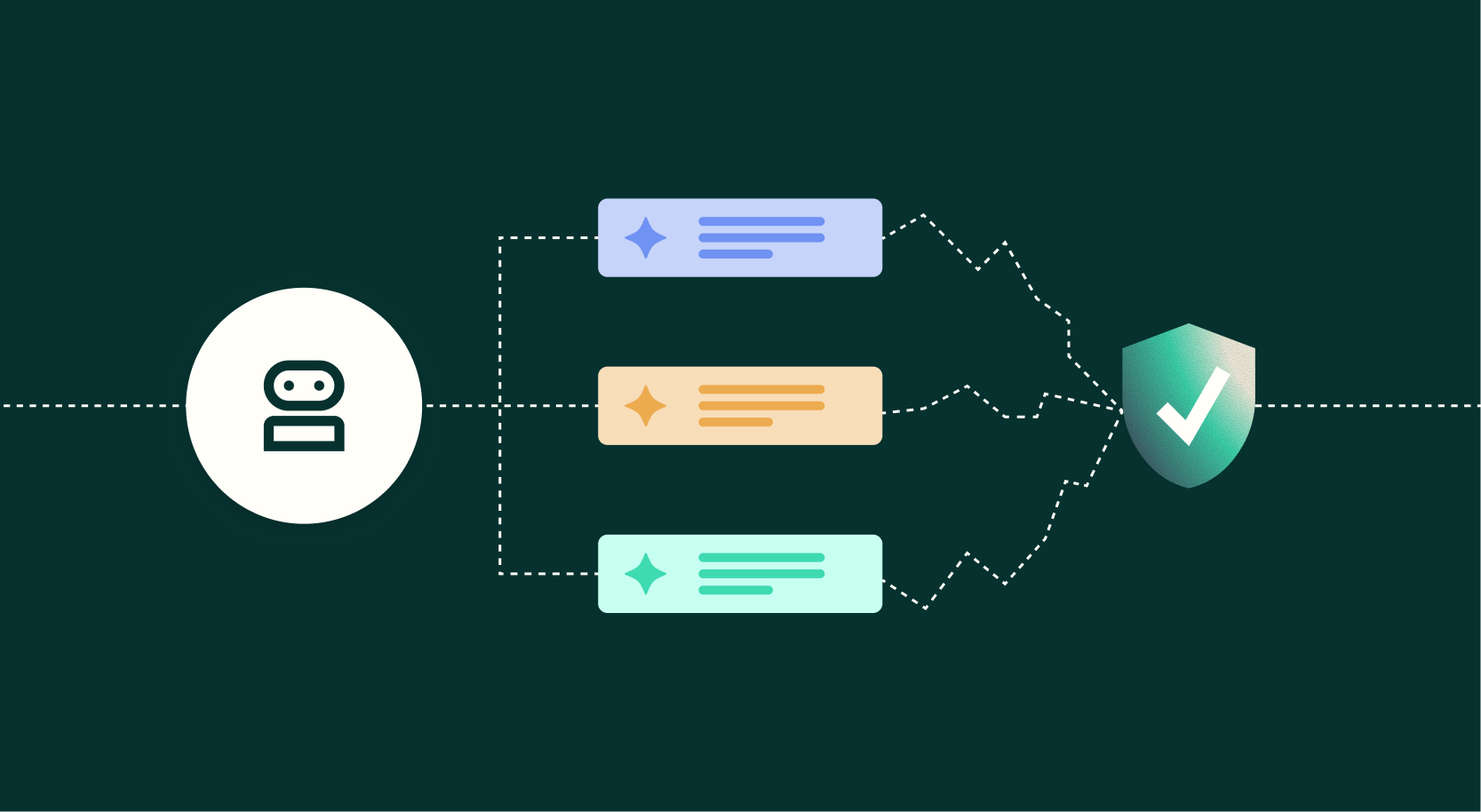
That requires a specific kind of architecture, one where:
Models are treated as interchangeable components rather than foundational dependencies
Evaluation, routing, and deployment are managed at the platform level rather than embedded in individual applications
Governance and traceability follow the model, regardless of which provider it came from
Enterprises that build this way gain the ability to respond to market shifts, pricing changes, and capability improvements without compounding technical debt at each transition.
Enterprises that manage model diversity successfully tend to share three structural characteristics:
1. They abstract the model layer from application logic. Prompts, orchestration, and business logic are decoupled from any specific LLM provider so that switching or adding models won’t require rewriting downstream systems.
2. They manage evaluation as a continuous operation. Model performance is monitored and compared across providers on an ongoing basis. That creates the evidence base needed to justify switching decisions internally and defend them externally.
3. They apply consistent governance across providers. Logging, traceability, and usage controls operate at the platform level (versus the model level). This ensures that as providers change, oversight remains intact.
This is where architecture becomes strategic. When LLM dependencies are buried inside application code, every model transition creates new exposure. When they're managed at the platform level, provider flexibility becomes a durable operational capability.
The pressure on CIOs to deliver competitive AI performance will certainly persist. As model capabilities continue to advance unevenly across providers, the ability to evaluate, switch, and route intelligently will directly affect the quality and cost of AI outcomes at scale.
The enterprises that treat multi-LLM as an architectural design principle — rather than a problem to solve reactively — will absorb those transitions smoothly. Otherwise, they’ll end up negotiating expensive migrations every time the model landscape shifts.
In 2026, LLM flexibility is no longer a technical preference. It's a performance and cost variable that boards are already asking about. The CIOs who have built for optionality will have defensible answers. Those locked into single-model dependencies will be explaining why they don't.