Normalize data: Scenarios, risks, and trade-offs
May 7, 2026/6 min read/Team Dataiku
Two teams pull the same revenue data. One normalizes it to compare growth rates across regions. The other reports raw totals to show absolute contribution. Both are correct, but they tell different stories. When they land on the same executive dashboard, the result is confusion. That tension sits at the center of every normalization decision. It is an analytical choice that shapes what your data says and how stakeholders interpret it — and as enterprises feed those same datasets into generative AI (GenAI) applications and AI agents, an undocumented normalization decision in the BI layer quietly becomes a governance problem in the AI layer.
Normalizing data means transforming values to a common scale so that differences in magnitude do not distort analysis, reporting, or model behavior.
The decision to normalize depends on the use case: blending cross-source data, running distance-based analytics, and training ML models all benefit from normalization, while absolute-value reporting and tree-based models often do not.
Inconsistent normalization across teams quietly kills dashboard trust.
Enterprises that treat normalization as a governed, documented decision rather than a default step produce more reliable analytics and more auditable outputs.
Data normalization is the process of transforming numerical values so they can be compared on a common scale without distorting their underlying meaning. In its simplest form, this might mean converting raw revenue figures across currencies into a single base, or adjusting survey scores collected on different scales to make them comparable. The term gets used in two contexts that are worth distinguishing. In database design, normalization refers to structuring tables to reduce redundancy. In analytics and data science, it refers to transforming feature values so they sit on a comparable scale. This article focuses on the second meaning.
Normalization is no longer just a preprocessing step handled inside a single model. It now sits upstream of dashboards, machine learning systems, and generative AI applications that all rely on the same underlying data. As enterprises consolidate data from more sources into shared platforms, the same metrics are reused across teams, models, and decision systems. Differences in scale that once stayed contained within a single analysis now propagate across dashboards, automated decisions, and AI-generated outputs. This raises the stakes. A metric that looks flat in one region might actually be growing faster than any other, just on a smaller absolute base. In a modern data stack, that misinterpretation doesn’t stay local but influences forecasts, triggers downstream decisions, and can even shape how AI systems summarize or prioritize information. Normalization, in this context, is not just about analytical correctness. It is about ensuring that every system built on top of the data — reports, models, and AI applications — operates on a consistent and reliable foundation.
Normalizing data matters because it ensures that metrics can be compared fairly across sources, so decisions are based on real differences in performance rather than differences in scale. When teams blend data from multiple systems into shared dashboards, scale differences can quietly distort every metric on the page. Consider a common scenario: A global company tracks customer acquisition cost (CAC) across five regions. One region operates in a market where costs are structurally lower. Without normalizing for local baselines, that region always looks like the top performer, even when its efficiency is actually declining quarter over quarter. This is how trust in KPIs erodes across an organization. Executives stop trusting dashboards, teams retreat to their own spreadsheets, and finance ends up running manual reconciliation just to get numbers that agree.
Unnormalized inputs produce unreliable analytical models, and the failure is usually invisible until a clustering output shifts or a similarity score stops making sense. Many common techniques, including k-means clustering, principal component analysis, and distance-based scoring, weight variables by their magnitude. If one variable ranges from 0 to 1 and another from 0 to 1,000,000, the larger variable will dominate the result regardless of its actual predictive value. The consequences are practical: unstable clustering outputs, misleading similarity scores, and derived metrics that shift unpredictably when new data arrives. For teams running advanced analytics or ML workflows, unnormalized inputs are where unreproducible results usually start.
Not every dataset benefits from normalization, but several common situations make a strong case for it.
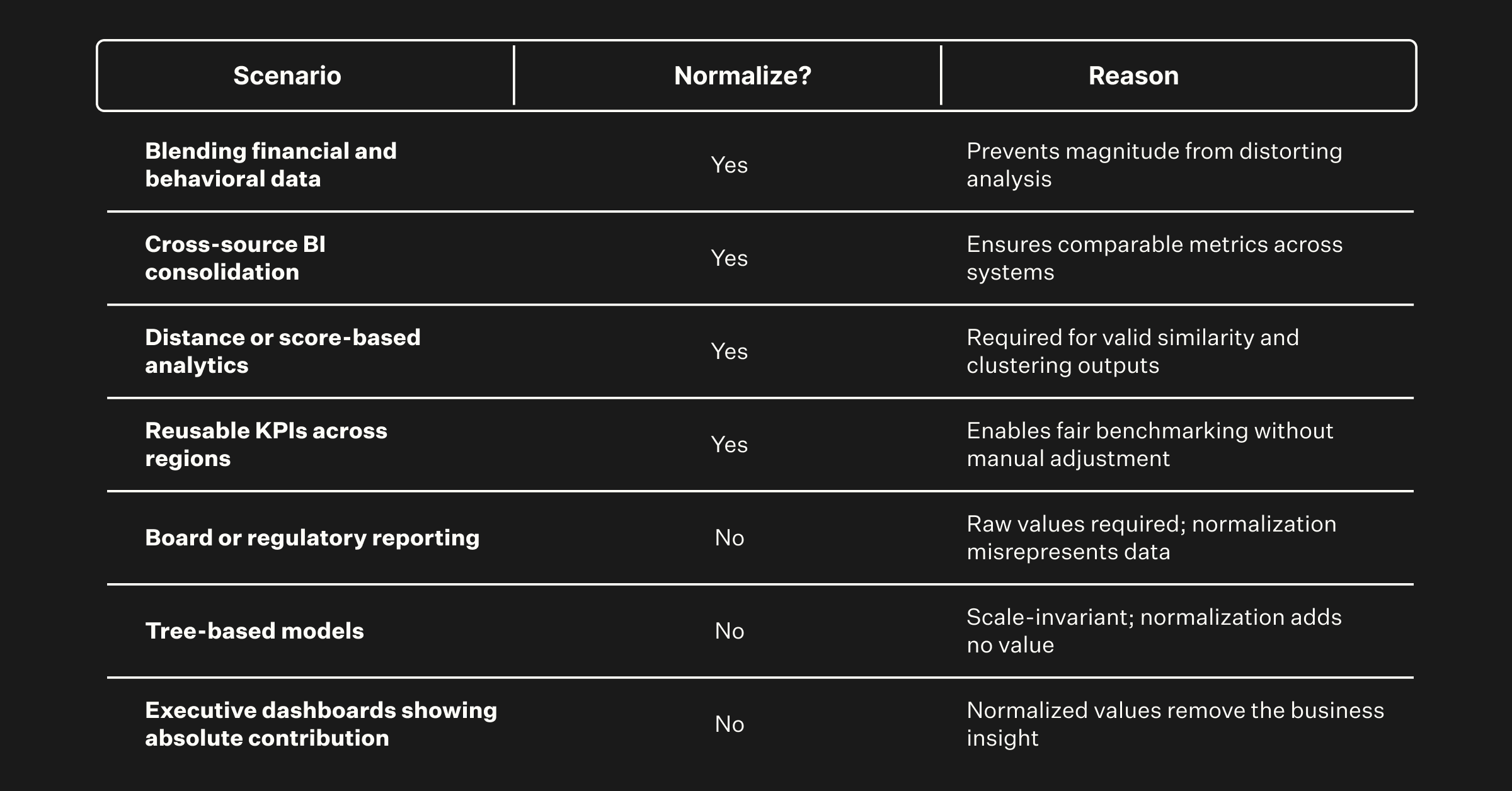
When combining transaction values (often in thousands or millions) with engagement metrics like click rates or NPS scores (typically single or double digits), normalization prevents the financial data from overwhelming every analysis.
Merging data from CRM, ERP, and marketing platforms into unified dashboards requires a consistent scale. Without it, cross-source comparisons are unreliable.
Any analysis that calculates distance, similarity, or composite scores (customer segmentation, risk scoring, anomaly detection) needs normalized inputs to produce valid results.
When the same KPI is consumed by multiple business units operating in different markets, normalization enables fair benchmarking without requiring each team to manually adjust for local context.
Most regression, neural network, and gradient-based algorithms converge faster and perform better on normalized features. Platforms like Dataiku, the Platform for AI Success, apply rescaling automatically during model training, but understanding when and why it happens is still essential.
Normalization is not always appropriate. Applying it by default can obscure the exact information stakeholders need.
If the goal is to show that Region A contributes $50M in revenue and Region B contributes $5M, normalizing those values removes the very insight the report exists to deliver.
Board reports, financial statements, and regulatory filings often require actual figures. Normalizing them would misrepresent the data.
Decision trees, random forests, and gradient-boosted models split data based on thresholds, not distances. They are inherently scale-invariant, and normalizing inputs adds processing overhead without improving results.
Presenting everything as indexed or percentage-based can strip context. Executives often need to see both the rate of change and the absolute numbers to make informed decisions. The table below maps common enterprise scenarios to a normalization decision with the reasoning behind each call.
Click on the image above to zoom into full PDF
Enterprises that govern normalization decisions consistently produce analytics that hold up across teams, tools, and audits. Across a large organization, normalization needs to be embedded into data workflows and pipelines, not left as a one-off preprocessing step. This means establishing standard definitions that apply across both the reporting layer and the modeling layer, so a "normalized revenue index" means the same thing whether it appears in a BI dashboard or feeds into a predictive model. Data catalogs and semantic layers earn their keep here, a capability covered in depth in how Dataiku governs AI across the analytics lifecycle. When normalization logic is documented alongside the dataset it transforms, every downstream consumer (analyst, data scientist, executive) can trace how a number was derived and whether it is appropriate for their use case. Most enterprises already live with the fallout: undocumented transformations buried in notebooks and SQL scripts, producing conflicting numbers across dashboards with no clear way to reconcile them. According to the "Global AI Confessions Report: Data Leaders Edition," based on a Dataiku/Harris Poll survey of 800+ senior data executives, 95% admit they lack full visibility into AI decision-making. Undocumented normalization logic buried in notebooks and SQL scripts is one of the most common sources of that gap.
Three factors should drive the decision.
Use case: Is the goal comparison, modeling, or reporting? Comparison and modeling typically benefit from normalization. Reporting often requires raw values or both raw and normalized views.
Audience: Technical teams can work with standardized scores. Executive stakeholders usually need interpretable numbers. Match the transformation to the consumer.
Risk tolerance: In regulated contexts, any transformation applied to reported data needs to be documented and auditable. The simpler the normalization method, the easier it is to explain during an audit.
As a general principle: normalize deliberately, document the method, and make the original values recoverable. Standardization policies (which method, applied where, documented how) matter more across teams than any individual technique choice.
Normalization should not be treated like a step to check off during data preparation. It is, in fact, a decision that shapes what your analytics reveal and what they obscure. What separates reliable analytics from a dashboard graveyard is treating normalization as a governed choice: documenting the method, standardizing it across teams, and revisiting it as use cases evolve. The result is analytics that stakeholders actually trust, because the numbers are accurate and any analyst can trace exactly where they came from. Whether you are consolidating BI across departments or building ML models that feed into production decisions, the question is not whether to normalize. It is whether you have made that choice deliberately and documented it well enough that the next person down the line can understand why.
Normalization choices only hold up when they are consistent across every team that touches the data. Dataiku integrates data preparation, machine learning, generative AI, agents, and governance in one environment where transformation logic is documented, reusable, and traceable from raw input to final output.
Normalization is necessary when dashboards blend data from multiple sources with different scales, when KPIs are compared across regions or business units with different baselines, or when composite scores are calculated from variables measured in different units.
Yes. Normalizing revenue data can shift which region appears to be growing fastest. Normalizing survey data can change which product scores highest. The method and context determine whether the normalized or raw view tells the more accurate story.
When different teams apply different normalization methods to the same underlying data, dashboards produce conflicting numbers. This erodes trust in reporting and forces manual reconciliation, which slows decision-making.
In most enterprise environments, yes. Standardized normalization policies ensure that metrics are comparable across teams and that KPIs mean the same thing regardless of who built the report or model.
It can. If normalization methods are undocumented, it becomes difficult to trace how a reported number was derived from raw data. For regulated industries, this creates compliance risk. Documenting normalization logic in a data catalog or governance framework addresses this gap.