How data transformation can break analytics, ML, and GenAI
April 29, 2026/6 min read/Team Dataiku
Ask who owns data quality in an enterprise, and most teams will point to someone. Ask who owns the transformation logic between the source system and the model, and the room goes quiet.
The most damaging data transformation challenges rarely live in raw data or the algorithm. They live in the chain of extraction, cleansing, mapping, conversion, and loading steps that sit between them.
A schema change that silently propagates through the system. A deduplication rule that handles 95% of records but lets the remaining five percent corrupt every downstream result. A normalization step is applied in the analytics pipeline but is missing from the ML pipeline, causing two teams analyzing the same data to reach opposite conclusions.
None of these are edge cases.
According to "7 career-making AI decisions for CIOs in 2026," based on a Dataiku/Harris Poll survey of 600 enterprise CIOs, 85% say gaps in traceability or explainability have already delayed or stopped AI projects from reaching production.
Transformation failures are a primary driver of these gaps, and the stakes keep rising. A single failure can generate a wrong report in analytics, corrupt the feature space in ML, and feed generative AI applications and autonomous agents with data that was silently broken before it ever reached them.
This article maps the seven ways data transformation breaks across analytics, ML, generative AI, and agentic systems, and outlines the fixes enterprises use to catch these failures before they compound.
Data transformation failures are the most common silent cause of inconsistent analytics, unreliable ML models, and hallucinating generative AI systems.
Seven failure modes span technical, organizational, and architectural dimensions, from data retrieval gaps to tooling mismatch and technical debt.
The same transformation defect ripples differently depending on what consumes it: a wrong number on a dashboard, a model trained on corrupted patterns, or an agent executing decisions on data that was already broken.
Fixing transformation failures requires designing pipelines with downstream AI use cases in mind, not just the immediate reporting need.
Data transformation is the process of converting raw data into standardized, usable formats for analytics, ML, and AI systems. It spans extraction, cleansing, mapping, conversion, and loading, and it happens at every stage of the data lifecycle.
The challenge is that transformation is not a single step but a chain. Errors at any point cascade downstream: A mapping mistake during extraction can cause a schema mismatch during loading, which leads to feature inconsistencies in model training and ultimately results in prediction errors in production. The further downstream a transformation defect travels before detection, the more expensive it is to diagnose and fix.
Data transformation failures are especially dangerous in the AI era because systems consuming flawed data act autonomously, allowing errors to compound before anyone notices.
In traditional analytics, a transformation failure produced a wrong number on a dashboard. Someone eventually noticed, and the damage was contained to a bad report and a correction cycle.
With ML, the blast radius expands.
A model trained on incorrectly transformed features does not flag the problem. It learns the wrong patterns and produces predictions that look statistically valid but are built on a faulty foundation. Drift detection may not catch it because the model's performance metrics remain stable against an equally flawed validation set.
With generative AI and agentic systems, the blast radius expands further.
A retrieval-augmented generation (RAG) system that pulls from a knowledge base with inconsistent transformations will synthesize contradictory information into confident, fluent, wrong answers. An autonomous agent acting on stale or incorrectly mapped data will execute decisions that compound with every step before a human intervenes.
Transformation failures have grown into a business risk that affects prediction accuracy, customer trust, regulatory compliance, and the credibility of every AI initiative they touch.
Data transformation breaks in seven distinct ways, each producing different downstream failures across analytics, ML, and GenAI systems. The table below provides an overview of each failure mode before we explore them in detail.
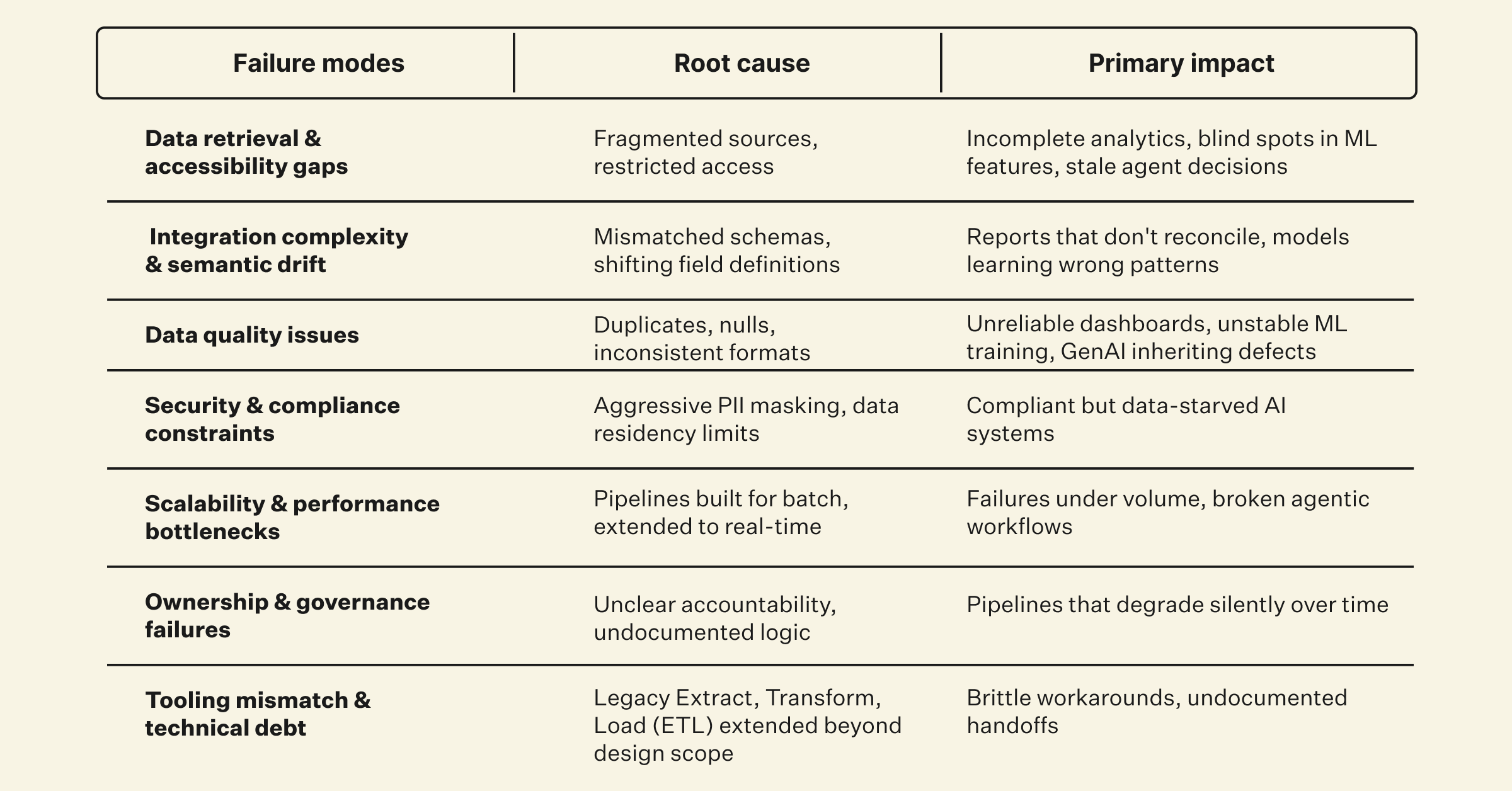
Fragmented sources and restricted access create blind spots. An analytics dashboard missing data from one regional system understates revenue. An ML model missing a feature because the source requires access approvals it never received learns an incomplete picture of customer behavior. An agent operating without access to real-time inventory data makes procurement decisions on stale information.
When data from different systems uses different schemas, formats, or definitions for the same concept, consistency breaks silently. "Revenue," which means gross in one system and net in another, produces reports that do not reconcile.
Semantic drift, where field meanings shift over time without documentation, is one of the hardest data governance failures to detect because the data still looks structurally valid.
Duplicates inflate counts. Missing values force imputation that may introduce bias. Inconsistent formats (dates stored as strings in one source and timestamps in another) produce join failures or silent mismatches.
These are the most common data transformation challenges, and they affect every downstream system. Dashboards show unreliable metrics, ML training becomes unstable, and generative AI responses inherit whatever defects exist in their source material.
Privacy regulations and access controls are necessary, but they can unintentionally limit the data available for transformation. PII masking that is too aggressive strips features that models need. Data residency requirements that prevent cross-region joins create incomplete datasets. The result is AI systems that are compliant but starved of the data they need to perform.
Pipelines built for batch processing at a moderate scale break when volume, velocity, or concurrency increases. A transformation pipeline that processes overnight batch loads reliably may fail when extended to real-time analytics, continuous ML retraining, or agentic workflows that require current-state data.
Faster hardware rarely solves the problem. The underlying issue is usually a pipeline architecture that was never designed for the throughput it now needs to handle.
When no one owns a transformation pipeline end-to-end, degradation is inevitable. Upstream schema changes happen without notification. Downstream consumers build dependencies on undocumented logic.
Data literacy gaps mean that business users consuming transformed data cannot distinguish a valid output from a corrupted one. When the pipeline finally breaks, accountability is unclear, and the investigation starts from scratch.
Legacy ETL tools that served well for structured reporting were not designed for the variety of data that ML and generative AI consume.
Teams working around tool limitations create custom scripts, manual handoffs, and undocumented workarounds that become technical debt. Each workaround adds fragility. Over time, the transformation layer becomes the least understood and most brittle part of the data infrastructure.
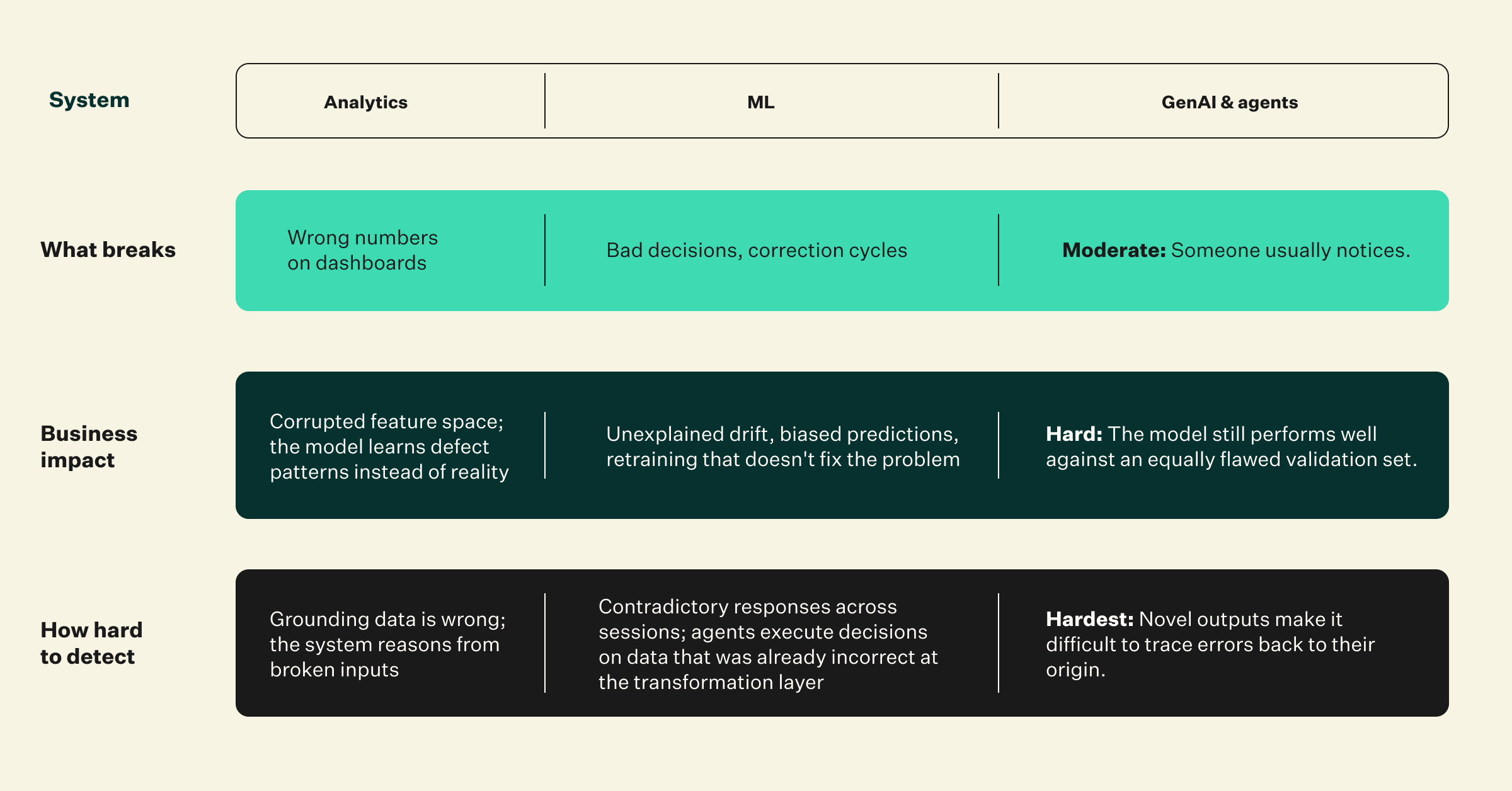
Data transformation defects produce different failure modes depending on which system consumes the broken data, and detection gets harder as you move from analytics to ML to GenAI.
A wrong number on a dashboard is visible and correctable. A corrupted feature space in an ML model is harder to spot and costlier to fix. Broken grounding data in a GenAI system or autonomous agent can compound silently across every decision it makes.
The table below breaks down how each system fails, what the business impact looks like, and critically, how difficult the problem is to detect.
The following principles address the failure modes that surface most often in production pipelines:
Design transformation with downstream use cases in mind. A pipeline built only for reporting will break when ML or generative AI systems consume the same data with different requirements. Transformation logic should account for every downstream consumer at design time.
Embed quality checks at every stage. Validation should not happen only at the end of the pipeline. Profile data at ingestion, validate after every transformation step, and alert on anomalies before they propagate.
Plan for scale and change from the start. Pipelines should handle both batch and real-time processing without architectural rework. Schema evolution, source changes, and volume growth should be anticipated in the design, not treated as exceptions.
Align governance across analytics and AI teams. When the analytics team and the ML team apply different transformation logic to the same source data, inconsistencies are guaranteed. Shared transformation definitions, maintained in a governed catalog, prevent divergence.
Document everything. Every transformation step, its logic, its parameters, and its owner should be traceable. When an output looks wrong, the team investigating it should be able to walk backward through the pipeline without guesswork.
Modern data transformation platforms reduce these failure modes by connecting transformation logic, quality checks, and governance in one environment, so defects are caught before they reach downstream systems.
Automation reduces manual handoffs and the undocumented workarounds that create technical debt. Built-in data quality checks catch defects at the transformation layer before they reach models or agents.
Architecture designed for both batch and real-time processing eliminates the scalability failures that surface when pipelines are extended to new use cases. And governance support, including lineage tracking, access controls, and audit trails, ensures that transformation logic is visible and auditable across teams.
What matters most is not the data transformation tool itself, but whether it ensures every downstream system receives accurate, updated data. A transformation layer that operates in isolation from the analytics, ML, and generative AI systems it feeds will always produce the kinds of failures this article describes.
Every failure mode in this article traces back to the same root cause: transformation pipelines designed for one use case that were extended to others without the governance, quality controls, or architecture to support them.
Dataiku, the Platform for AI Success, connects data preparation, transformation, quality monitoring, and AI development in a single governed platform, so the transformation logic that feeds a dashboard is the same logic that feeds an ML model, a generative AI application, or an agentic workflow.
The most common way data transformation breaks AI initiatives is when inconsistencies or errors in the transformed data propagate to downstream systems. This leads to faulty model training, incorrect predictions, and unreliable AI-driven decisions.
Organizations can detect data transformation failures early by implementing automated validation checks and monitoring at each stage of the data pipeline. Consistently comparing transformed data against source data and tracking key metrics helps catch anomalies before they impact downstream systems.
Generative AI systems amplify data transformation issues because they autonomously consume and act on flawed data, propagating errors across outputs without human intervention. Small inconsistencies in the input can compound, producing biased, inaccurate, or misleading results at scale.