How data normalization affects machine learning performance
May 6, 2026/7 min read/Team Dataiku
A model performs well in testing, clears review, and ships to production, only for predictions to start drifting within weeks. The culprit is usually not the algorithm or the training data but a normalization step applied during development and handled differently in the inference pipeline. The failure is common and avoidable. Data normalization in machine learning is a design decision that directly affects whether a model trains efficiently, generalizes reliably, and holds up in production. As enterprises extend ML pipelines to support generative AI (GenAI) applications and AI agents operating across those same data flows, normalization inconsistencies compound faster and degrade outputs across more systems at once. In this article, we break down how data normalization shapes machine learning performance, the risks of inconsistency across pipelines, and how to standardize it for reliable, production-grade AI.
Data normalization rescales features to a common numeric range so that no single variable dominates model training due to its magnitude alone.
Normalization directly affects training stability, convergence speed, and the reliability of predictions across common ML algorithms.
Inconsistent normalization between training and production quietly degrades model performance in ways that are hard to catch until the damage is done.
Choosing and standardizing a normalization approach is a model governance decision, not just a technical one.
Data normalization in modern machine learning is the controlled transformation of numeric features into a consistent scale so models learn from signal, not magnitude. It ensures that differences in units, ranges, or distributions do not distort how features influence training or predictions. Without normalization, a feature measured in millions (annual revenue) will mathematically overwhelm a feature measured in decimals (click-through rate), regardless of which one is actually more predictive. Models do not recognize unit context. They optimize based on raw numbers, which introduces unintended bias. A related concept, standardization, rescales features to a mean of zero and a standard deviation of one. Both approaches aim to create comparability across features, but they behave differently depending on the data distribution and the algorithm. The distinction matters when choosing a technique, but the underlying principle is the same: fair feature contribution starts with consistent scaling.
Modern ML systems no longer operate as isolated models trained once and deployed statically. They are part of continuously evolving pipelines that power real-time decisions, generative AI applications, and cross-functional data products. The same features are reused across models, retrained frequently, and served in production environments where even small inconsistencies propagate quickly. In this context, normalization is not just about improving model training — it is about ensuring consistency, reproducibility, and reliability across the entire AI lifecycle. Both techniques, along with other common scaling methods, are implemented in standard libraries like scikit-learn's preprocessing module. But implementation alone is not enough. Treat normalization as a foundational ML design decision, not something you configure once and never revisit. The method you choose, the parameters you persist, and how consistently they are applied across training, retraining, and inference all shape model behavior downstream.
Data normalization affects machine learning performance in three critical ways: It stabilizes training, removes scale-driven bias, and ensures consistent behavior between development and production. These effects show up across the model lifecycle, from initial training runs to live predictions.
1. It directly impacts how models learn
Algorithms that rely on gradient descent (such as linear regression, logistic regression, and neural networks) update weights based on the scale of input features. When feature ranges vary widely, the loss surface becomes skewed, slowing convergence or preventing it altogether. Normalized inputs create a more balanced optimization landscape, leading to faster and more stable training.
2. It prevents scale from distorting importance
Without normalization, features with larger numeric ranges dominate the model purely because of their magnitude, not their predictive value. This introduces hidden bias into the model, where predictions skew toward variables measured in larger units rather than those that actually carry signal.
3. It determines whether models behave reliably in production
A model trained on normalized data expects the same transformation at inference time. If production pipelines apply different scaling methods, use different parameters, or skip normalization, prediction quality degrades silently. This is one of the most common starting points for model drift in enterprise systems.
4. It underpins fair model comparison
When models are trained on differently normalized data, performance differences often reflect preprocessing choices rather than true algorithmic improvements. Standardizing normalization across experiments is essential for reproducible benchmarking and trustworthy evaluation.
Inconsistent normalization produces different failure modes depending on the algorithm, and all of them are expensive to catch after deployment. These issues typically show up in a few recognizable patterns:
Degraded training behavior
When feature scales are misaligned, gradient-based algorithms struggle to optimize effectively. Training takes longer, loss curves become unstable, and models converge to weaker solutions even when runs appear successful.
Distorted model logic
Without consistent scaling, features with larger numeric ranges dominate model behavior regardless of their true importance. In distance-based algorithms, this can completely override smaller-scale but meaningful signals, skewing outputs in ways that are hard to trace.
Broken assumptions at inference time
Models learn from normalized data and expect inputs in the same form. When production pipelines apply different transformations or skip them entirely, the model receives data it was never trained to interpret, leading to silent prediction errors.
Compounding impact in real-world systems
In enterprise use cases like fraud detection, even a single mismatched feature (such as transaction amount) can shift model sensitivity enough to miss patterns it previously detected. Because these systems operate continuously, small inconsistencies scale into material performance gaps.
False confidence from clean test results
The most misleading failure mode is when everything looks correct in development. Consistent normalization in training and validation produces strong metrics, masking the fact that production pipelines handle data differently. By the time degradation is noticed, it has already compounded over time.
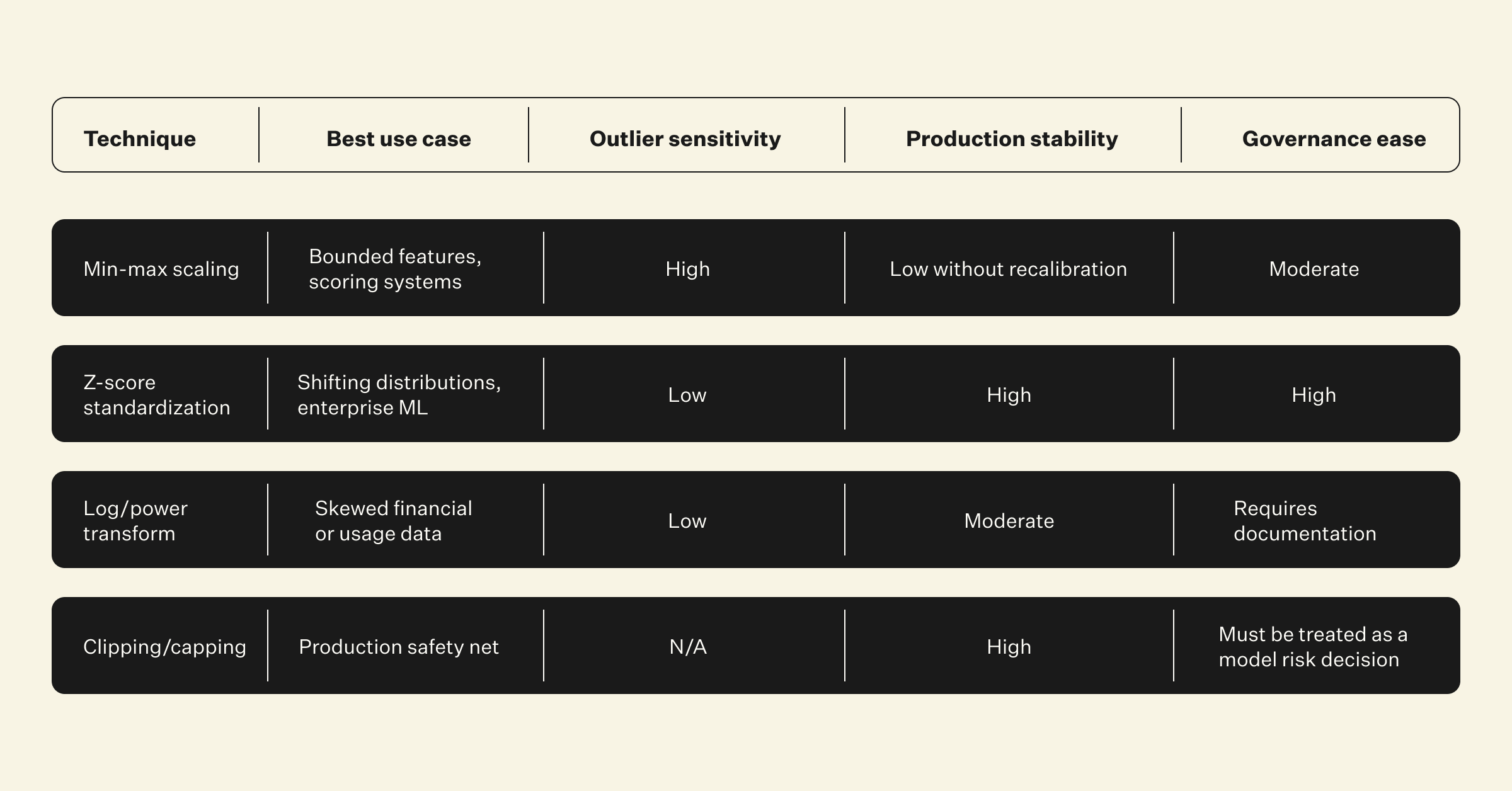
Each technique makes trade-offs between simplicity, robustness, and interpretability.
Click on the image above to zoom into full PDF
Min-max scaling compresses values into a fixed range, typically 0 to 1, based on the observed minimum and maximum in the training data. It works well for features with known, stable bounds (scores out of 100, percentages, sensor readings within calibrated ranges). The risk is sensitivity to outliers. A single extreme value stretches the range and compresses everything else toward zero. In production, if new data exceeds the training range, values fall outside the expected bounds and model behavior becomes unpredictable. This makes min-max scaling a poor fit for features with long tails or evolving distributions without regular recalibration.
Z-score standardization centers each feature around a mean of zero with a standard deviation of one. It is the most widely used technique in enterprise ML because it handles evolving distributions more gracefully than min-max scaling. Because z-score standardization does not impose a fixed range, new data that falls outside the training distribution still maps to a meaningful position on the scale. Z-score standardization holds up better in production environments where data distributions shift over time. The assumption is that features are roughly normally distributed, which does not always hold, but the technique remains robust enough for most practical applications. For teams working across departments, z-score standardization is also easier to govern. The parameters (mean and standard deviation) are intuitive to document and compare across pipelines.
Financial data, usage metrics, and operational measurements often follow heavily skewed distributions where a small number of extreme values dominate. Log and power transformations compress the upper tail and spread out the lower range, reducing the influence of outliers without removing them. These transformations are common in revenue modeling, user engagement analysis, and operational analytics, where extreme values carry real meaning. The risk is inconsistent application: when one team applies a log transform and another does not, metrics derived from the same underlying data will not align.
Clipping sets hard boundaries on feature values, replacing anything above or below a threshold with the threshold value itself. It is a blunt tool, but in production ML, it serves as a safety net against extreme inputs that could destabilize model predictions. The trade-off is information loss. Clipping a transaction amount at $100,000 means the model cannot distinguish between a $100,000 transaction and a $10M one. When the goal is prediction stability, that tradeoff is reasonable, but it should be documented as a model risk decision rather than applied quietly as a preprocessing default.
The right normalization technique depends on three factors.
Data characteristics: Bounded features with stable distributions suit min-max scaling. Unbounded or shifting distributions favor z-score standardization. Heavily skewed data benefits from log or power transformations applied before either scaling method.
Algorithm sensitivity: Gradient-based and distance-based algorithms require normalization. Tree-based models (random forests, XGBoost) split on thresholds and are inherently scale-invariant, making normalization unnecessary and sometimes counterproductive.
Enterprise context: Across a large organization, simplicity and consistency matter more than statistical precision. A z-score standardization applied uniformly across all numeric features and documented in the feature store will outperform a patchwork of technique-specific choices that no one can reproduce six months later.
Most teams get the technique right and still run into problems because they apply it inconsistently across training, retraining, and inference pipelines.
In practice, normalization breaks down not in the data science notebook but in the handoff to production. To operationalize normalization reliably, enterprises need to get four things right:
1. Shared preprocessing pipelines
Normalization logic should live in the same pipeline that serves both training and inference. When training applies normalization inside a notebook and production applies it inside a separate microservice, parameter mismatches are inevitable.
2. Consistency across the ML lifecycle
The parameters used to normalize training data (the min, max, mean, and standard deviation of each feature) must persist and be applied identically during retraining and inference. If these values are recalculated on new data without versioning, model behavior shifts with every retraining cycle.
3. Feature stores and MLOps infrastructure
A feature store centralizes feature definitions, transformations, and normalization logic so that every model consuming a feature applies the same preprocessing. The result is consistent preprocessing across every model that touches a given feature, without teams reimplementing the same transformation in different ways.
4. Documentation and auditability
Undocumented normalization choices create audit risk. In regulated industries, a model's preprocessing steps are part of its risk profile. If a reviewer cannot trace how raw inputs were transformed into model features, the model fails the governance test regardless of its predictive accuracy. According to the "Global AI Confessions Report: Data Leaders Edition", based on a Dataiku/Harris Poll survey of 800+ senior data executives, 95% admit they lack full visibility into AI decision-making. Undocumented normalization choices are one of the quieter contributors: When preprocessing logic lives in a notebook rather than a governed pipeline, no audit trail exists to trace how raw inputs became model features.
Normalization inconsistencies between training and production quietly erode model reliability and team trust. Dataiku, the Platform for AI Success, keeps data preparation, model training, and deployment in a single governed environment so normalization logic is defined once and applied consistently wherever the model runs.
Enterprise models typically consume features from multiple sources, measured on different scales. Without normalization, large-scale features dominate model training regardless of their actual predictive value. This produces biased predictions, slower convergence, and models that are harder to interpret and audit.
Yes. The same dataset normalized with min-max scaling versus z-score standardization can produce meaningfully different model weights, convergence behavior, and prediction distributions. This is why normalization technique selection should be documented and standardized across model development workflows.
When training and inference pipelines apply different normalization methods or parameters, the model receives inputs that do not match what it learned from. Model outputs start drifting without triggering obvious errors. By the time anyone notices, the degradation has been compounding for weeks.
In most enterprise environments, yes. Standardized normalization policies ensure that features consumed by multiple models are preprocessed identically, that model comparisons are valid, and that audit and compliance reviews can trace how raw data was transformed into model inputs.