




The myth of architectural completion
Data platforms are rarely finished: They evolve. Phased data migrations can take years. But that timeline rarely accounts for the full reality: New systems get introduced before legacy ones are fully retired, business priorities shift mid-project, regulatory requirements change, budgets tighten, teams reorganize.
Whether in a mid-sized organization or a global enterprise, the data landscape typically includes core operational systems (ERP, CRM), finance platforms, cloud analytics workloads, department-level datasets, legacy databases, spreadsheets that support critical processes, and unstructured data across file systems.
If AI required a perfectly unified lake house before delivering value, most organizations would never get started.
The more useful question is not "Is our data architecture complete?" It's "Do we have enough governed, accessible data to solve a specific business problem?" In many cases, the answer is yes.
The real cost of waiting
Forty-two percent of companies now abandon the majority of their AI initiatives before reaching production; a dramatic surge from just 17% the previous year. But here's what's even more troubling: the gap isn't closing. Approximately 80% of AI projects never reach production, almost double the failure rate of traditional IT projects.
The companies succeeding aren't the ones with perfect data architecture. McKinsey’s 2025 State of AI found that high-performing organizations are three times more likely to have scaled AI than their peers. The key difference in these high-performing organisations is that their systems are built to work within messy, real-world data environments rather than waiting for perfect conditions.
Consider what happened at Zillow. The company’s AI-powered home-buying program collapsed after its pricing models failed to keep pace with rapidly shifting housing market conditions, leading to more than $500 million in losses and a workforce reduction of roughly 25%.
As highlighted in post-mortem analyses and industry commentary, the system struggled to account for the complexity and volatility of real-world housing dynamics. The case illustrates a broader risk in AI deployment: when models trained primarily on historical data encounter conditions that exceed their assumptions, they can generate confident predictions that scale errors just as efficiently as insights.
The lesson isn't to wait for perfect data; it’s to start with scoped problems where data completeness can be verified. By doing so, organizations can align teams with key business KPIs, move the needle on measurable outcomes, and foster a cultural shift where a diverse team embraces innovation and delivers tangible value.
Infrastructure modernization and AI are different initiatives
A lakehouse migration is fundamentally an infrastructure program. Its goals are scalability, cost optimization, consolidation, and long-term simplification. AI adoption is a capability program. Its goals are identifying high-value use cases, developing models, embedding them into workflows, and managing risk.
These efforts should inform one another. But they should not be strictly sequential.
In fact, early AI initiatives often sharpen infrastructure decisions. Once organizations start building real use cases, they quickly discover where data quality truly impacts outcomes, where lineage and traceability need to improve, where latency becomes critical, where governance controls require strengthening, and where consolidation actually creates value versus merely looking tidy on an architecture diagram.
Modernization driven by real workloads tends to be more effective than modernization driven purely by architectural ambition. This is not an argument for bypassing governance or ignoring data quality. It is a recognition that “good enough” governed data for a high-impact use case often creates more value than “perfect” data delivered too late.
The real constraint is often organizational
When AI programs stall, it’s rarely because data migration or the lakehouse is incomplete. Data foundations matter, but they’re only one part of success. MIT research shows that older organizations often saw declines in structured management after adopting AI, driving significant productivity losses. The lesson is clear: companies can’t just layer AI onto existing structures, they must rethink how they operate.
Beyond this, the real barriers are organizational: weak collaboration between business and technical teams, unclear governance, poor model lifecycle management, and difficulty moving models into production.
These issues don’t disappear with better architecture. Making AI work requires deliberate capability building across culture, processes, and governance. That’s why the platform layer matters, not just to unify data, but to scale production-grade AI and embed it responsibly across the business.
What modern AI platforms must enable
Traditional AI platforms were designed for environments where data was already centralized and standardized. That assumption no longer reflects enterprise reality.
Modern AI platforms must operate across heterogeneous environments and support AI development within them. That means they must:
- Connect natively to mixed environments (legacy systems, cloud warehouses, operational databases) without requiring wholesale migration.
- Enable governed collaboration from day one, so data scientists, analysts, and business stakeholders work within guardrails.
- Manage the full model lifecycle with traceability and accountability.
- Support infrastructure evolution in parallel, allowing data estates to modernize while AI capability scales.
This shift reflects a broader evolution in the market.
The 5% of AI projects that do succeed share common characteristics: They “adapt, remember, and evolve”, are customized and specialized for critical tasks, focus on one valuable problem, embed directly into user workflows, and learn from real-time feedback.
How Dataiku addresses these challenges
Dataiku is designed to precisely solve these problems: enabling enterprises to build production-grade AI without waiting for perfect infrastructure.
Connect to your existing environment
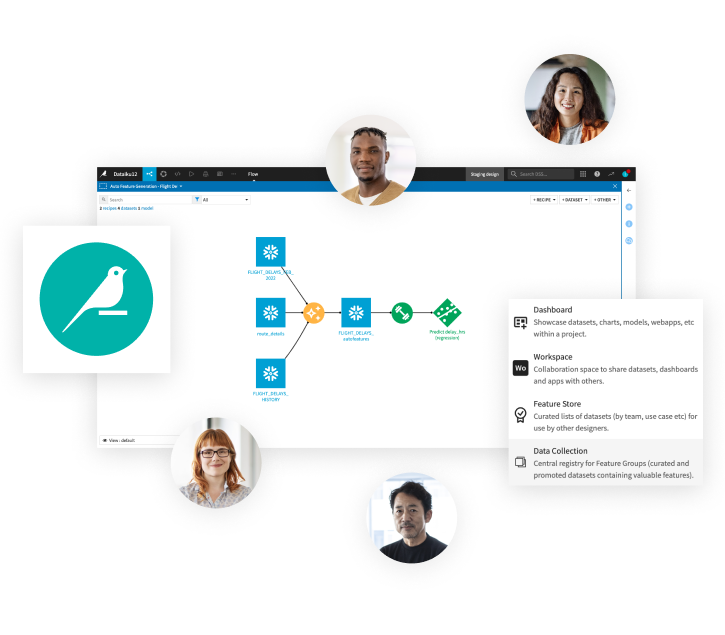
Rather than forcing wholesale migration, Dataiku connects natively to your mixed data landscape: legacy databases, cloud warehouses (Snowflake, Databricks, BigQuery), operational systems, and unstructured data sources. This means you can start building AI with the 60%-70% of data you already have access to, while your broader lakehouse strategy evolves in parallel.
Governed collaboration from day one
The organizational constraint (teams not collaborating, unclear governance, shadow experimentation) gets addressed through Dataiku's unified platform.
Data scientists, analysts, and business stakeholders work together within guardrails, with built-in governance, auditability, and role-based access controls. This prevents the “shadow AI economy” problem while enabling rapid, responsible experimentation.
Full model lifecycle management
Dataiku manages the complete AI lifecycle with traceability and accountability, from data preparation through model deployment, monitoring, and iteration. This addresses the 80% failure-to-production rate by providing the infrastructure needed to operationalize models reliably, not just build them.
Adaptive systems that learn
Unlike generic LLM chatbots that users abandon for mission-critical work, Dataiku enables the creation of adaptive AI systems through features like Agent Hub and the Dataiku LLM Mesh. These systems can remember context, evolve based on feedback, and be customised for specific enterprise workflows; the exact characteristics MIT identifies in the 5% of AI projects that succeed.
Unified AI operations
Dataiku's unified Ops approach consolidates MLOps, LLMOps, DataOps, and AgentOps into a cohesive operational model. This addresses the organizational readiness gap, giving teams the structure to move from pilot to production in 90 days rather than getting stuck in perpetual experimentation.
The result: Organizations can build and deploy high-impact use cases now, while their broader data strategy continues to mature. Real customers are already seeing this in practice.
Mitsubishi Electric used Dataiku to consolidate data ingestion, preparation, modeling, visualization, and reporting in one unified platform.
This led to a 60% reduction in time required to produce analysis outputs and an 80% reduction in time needed for data visualization compared to using Python, with thermal energy analysis and reporting for a full year of data now completed in 20 days.
Standard Chartered used Dataiku in FP&A to move beyond spreadsheet-based processes and leverage its existing ecosystem, including compute warehousing that had been underused. This means that now two people are doing the work of about 70 people limited to spreadsheets, with analyst productivity increasing by a factor of 30.
Momentum is strategic
AI maturity is not achieved through a single successful deployment. It develops through iteration, through solving real problems, embedding models into workflows, and refining governance processes over time.
Organizations that delay AI until infrastructure is “ready” postpone more than technology implementation. They also postpone organizational learning. Every month of delay means:
- Competitors build experience with model iteration and deployment.
- Internal teams miss opportunities to understand what actually works.
- The organization fails to develop the muscle memory needed for scaled AI adoption.
- “Shadow AI” usage grows unchecked, creating governance and security risks. Dataiku’s CIO survey showed that a majority of CIOs (82%) agree employees are creating AI agents and apps faster than IT’s ability to govern them.
Those that begin building capability within their current architecture generate momentum, demonstrate measurable value, strengthen executive sponsorship, and make more informed infrastructure investments.
MIT's data shows that top performers reported average timelines of 90 days from pilot to full implementation, while enterprises stuck in analysis paralysis report the lowest rates of pilot-to-scale conversion.
Start with what you have
A more productive framing is this: Don't ask whether your lakehouse is complete enough for AI. Ask what responsible, governed AI use cases you can deploy today within your existing environment.
The companies succeeding aren't waiting for perfection. They're following a disciplined approach:
Identify scoped problems. Find one business problem where you have 60%-70% of the required data. This does not need to be perfectly consolidated, but sufficiently accessible and governed. Focus on workflows where data completeness can be verified and outcomes clearly measured.
Dataiku customers have successfully applied this approach across industries: LG Chem built a RAG-powered health and safety support app that serves as the first line of support for employees, cutting manual search time without requiring complete data consolidation.
A fashion enterprise deployed an internal process support agent giving employees instant access to corporate policies and operations manuals, solving a real problem with existing, accessible data.
Evaluate along two dimensions. Assess potential use cases through business impact and data availability. The highest-value opportunities often do not require the most sophisticated infrastructure. They require clarity of purpose and disciplined execution.
Build adaptive systems. Generic LLM chatbots appear to show high pilot-to-implementation rates (~83%), but this masks a deeper split in perceived value.
Users trust them for simple tasks but abandon them for mission-critical work due to lack of memory and customization. What's missing is systems that adapt, remember, and evolve.
This is where platforms like Dataiku differ from point solutions. With features like modular Knowledge Banks, document-level security, Agent Hub for orchestration, and continuous feedback loops, organizations can build AI systems that actually improve over time based on real-world usage, thereby turning that 95% failure rate into sustainable success.
Measure and iterate. Sixty-six percent of companies struggle to establish ROI metrics for AI initiatives. Define clear success metrics from day one: cost reduction, query performance improvements, faster time-to-insight, increased data accessibility, or enablement of new analytics capabilities.
Dataiku's built-in monitoring and evaluation frameworks make this practical rather than aspirational. Teams can track model performance, measure business impact, and iterate based on real feedback; closing the loop that most AI initiatives leave open.
AI readiness is not binary, it's a spectrum. Organizations that wait for 100% readiness rarely begin. Those that act at 70% build experience, improve governance, and accelerate over time.
The window is closing
The competitive dynamic is shifting. While 42% of companies abandon AI initiatives and others wait for architectural perfection, early adopters are accumulating advantages that compound over time: trained models improving with feedback loops, organizational muscle memory for deployment, governance frameworks tested in production, and executive teams comfortable making AI-informed decisions.
Infrastructure will continue to evolve. The organizations that move ahead are those that build AI capability and modernize architecture in parallel, allowing each to inform the other.
.png?width=928&height=620&name=Thumbnail%20link%20(2).png)
.png)

.png)