Business analytics vs. data analytics: Key differences
April 26, 2026/6 min read/Mark Abramowitz
Your team keeps asking for “better insights,” but what they actually need depends on a more specific question. Are you trying to understand what the data says, or decide what the business should do next? That distinction sits at the center of the data analytics vs. business analytics conversation and it explains why many organizations struggle to turn analytical work into measurable outcomes. Most enterprises today are not short on data, tools, or technical expertise. What they lack is clarity on how different types of analytics contribute to decisions. Without that clarity, even strong analysis can fail to influence what actually happens in the business. Understanding how data analytics and business analytics differ is the first step toward making analytics work in practice. In this article, we’ll break down the key differences between data analytics and business analytics, how they operate in enterprise environments, and what organizations need to do to connect analytical insight to decision-making.
Data analytics generates insights, while business analytics turns those insights into decisions.
The core challenge for organizations is alignment, not the lack of analysis.
Analytics delivers value when it operates as a connected system with clear ownership and feedback.
Platforms and governance are essential to scale analytics with consistency and traceability.
Data analytics focuses on extracting insights from data, while business analytics focuses on using those insights to guide decisions. Data analytics involves collecting, preparing, and analyzing data to identify patterns, trends, and relationships. Its outputs typically answer questions such as what happened, why it happened, or what is likely to happen next. Business analytics takes those outputs and applies them in context. It connects analytical findings to business priorities, helping teams choose between alternatives and define measurable outcomes. In simple terms, data analytics produces evidence, while business analytics turns that evidence into direction.
Although the two disciplines overlap, they operate differently across the analytics lifecycle.
Click on the image above to zoom into full PDF
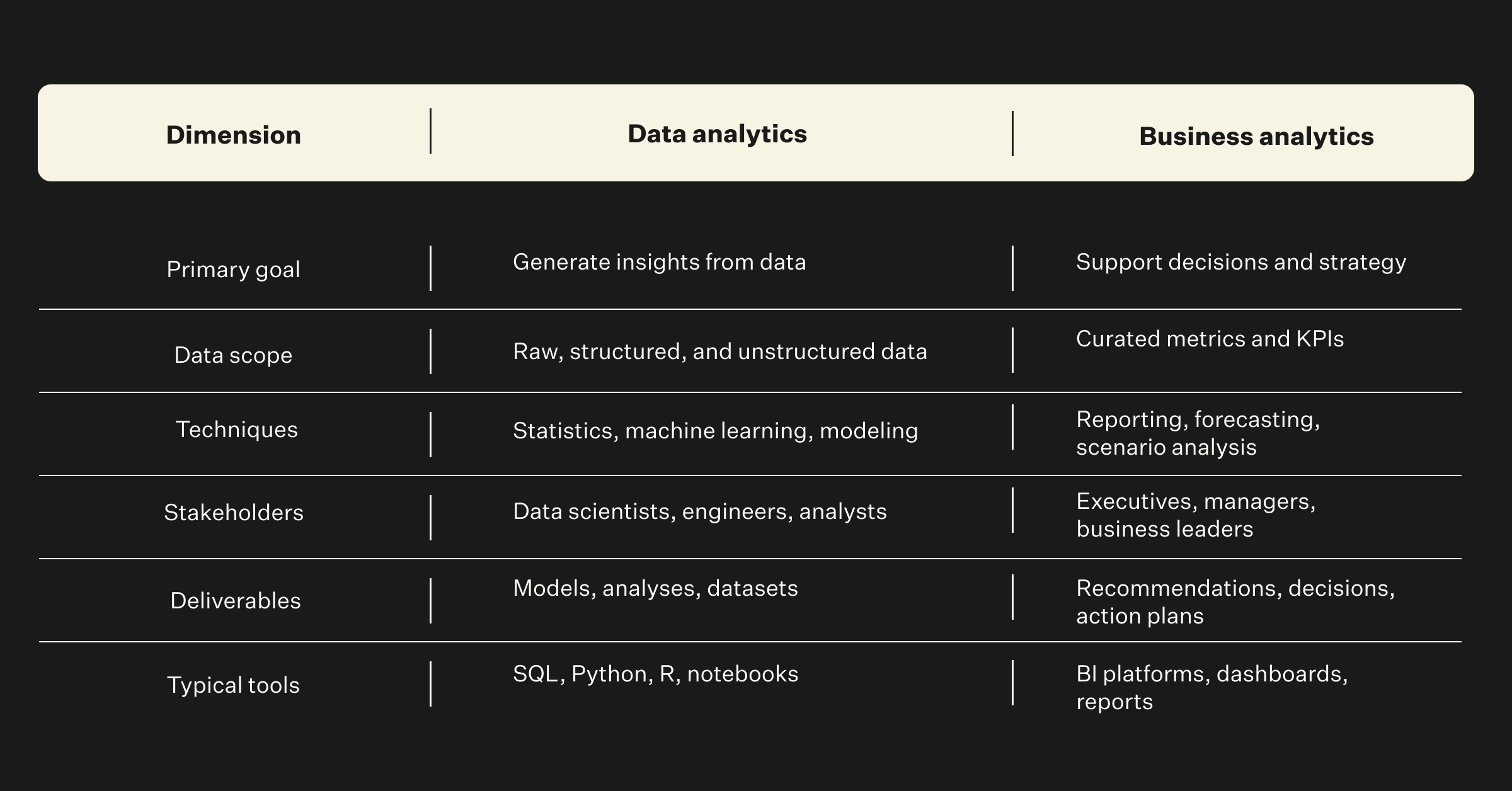
In practice, data analytics provides depth and rigor, while business analytics provides context and direction. The distinction becomes meaningful when organizations move from analysis to action.
Looking at both disciplines in the same business context makes the contrast clearer. In marketing, a data analytics team might build a segmentation model based on customer behavior. That model identifies patterns and groups but it does not decide how budgets should shift. Business analytics takes the next step, translating those segments into campaign priorities and spend allocation. A similar pattern appears in finance. An anomaly detection model can flag unusual expense patterns, but decisions about approval thresholds or vendor strategy depend on broader constraints such as risk tolerance and operational needs. Across functions, the pattern remains consistent:
Data analytics explains the situation.
Business analytics determines the response.
Both are necessary, but they solve different parts of the problem.
In enterprise settings, the difference between data analytics and business analytics is shaped by how teams and responsibilities are structured. Most organizations follow a hybrid model. Data analytics capabilities are centralized to maintain consistency and reuse, while business analytics is embedded within functions to stay close to operational decisions. This structure works in principle, but it introduces coordination challenges. When alignment is weak, the impact becomes visible. Teams begin to question which numbers to trust, analytical work is repeated in different formats, and decisions rely on offline spreadsheets rather than shared systems. The issue becomes more visible as AI adoption grows. According to the Dataiku "Global AI Confessions Report: Data Leaders Edition," 95% of data leaders say they cannot fully trace how AI systems arrive at decisions. This lack of traceability reflects a deeper problem: analytical logic and decision ownership remain disconnected, which reduces confidence even when models perform well. These issues are not caused by poor analysis. They arise when the connection between analytical work and decision-making is not clearly defined.
A common assumption is that better tools or more advanced models will resolve these challenges. But the difficulty lies elsewhere. Data analytics and business analytics operate under different constraints. Data teams often prioritize accuracy, scalability, and reuse, while business teams prioritize speed, relevance, and accountability. Without coordination, these priorities can conflict.
Three challenges tend to surface repeatedly:
Analysis does not align with decision timelines.
Outputs lack sufficient business context.
Ownership of decisions is not clearly defined.
When these issues persist, analytics remains informative rather than actionable.
Improving outcomes requires connecting analytical work more directly to how decisions are made. This helps ensure that analysis fits into the rhythm of the business. Three elements consistently make the difference:
Clear decision ownership: Every significant analytical output should be tied to a defined decision and a responsible stakeholder. Without ownership, insights remain open to interpretation.
Alignment with decision timing: Analytical rigor loses value if it does not match when decisions are made. In many cases, a timely, directional input is more useful than a delayed, highly precise one.
Feedback loops into future decisions: Decisions should not be treated as endpoints. Tracking outcomes and comparing them to expectations helps refine both analytical models and business judgment over time.
When these elements are in place, data analytics and business analytics operate as a coordinated system rather than separate efforts.
As analytics expands into AI and automated workflows, governance becomes essential to maintaining trust and consistency. Governance provides visibility into how data is used, how models are built, and how decisions are made. It ensures that assumptions are documented and outcomes can be reviewed. This visibility is critical in complex environments where decisions need to be explained and refined over time. At the same time, governance must be balanced. Too little structure reduces trust, while too much can slow down execution. The goal is to support decisions that are both traceable and timely.
For CIOs and CDOs, the distinction between data analytics and business analytics directly informs where to focus effort. The right priorities depend on the organization’s level of maturity, but the progression tends to follow a clear pattern.
Early-stage focus: establish consistency
Align on definitions, metrics, and core data foundations. Without this baseline, both data analytics and business analytics operate on unstable ground.
Mid-stage focus: improve coordination
Reduce duplication across teams, clarify decision ownership, and ensure that analytical work aligns with business priorities and timelines.
Advanced-stage focus: drive integration
Embed analytics into business processes so that decisions are consistently supported by models that can be trusted, monitored, and improved. Across all stages, one principle holds: if decisions are not improving, adding more analysis is unlikely to solve the problem. The priority should shift to how analytical work connects to the way the business operates.
Technology plays a key role in enabling alignment, but only when it supports the full lifecycle of analytical work. Organizations should look for platforms that allow technical and business users to work within a shared environment, where context is preserved from data preparation to decision-making. Key capabilities include:
Consistent metric definitions across teams
Visibility into assumptions and changes
Built-in deployment and monitoring
Traceability from insight to outcome
These capabilities reduce fragmentation and help ensure that analytical work remains connected to decisions.
In many organizations, fragmentation across tools creates barriers between analysis and decision-making. Data may sit in one system, models in another, and decisions in separate reporting layers. This makes it difficult to maintain continuity as work moves from insight to action. Dataiku, the Platform for AI Success, addresses this by bringing data analytics and business analytics into a unified environment where both technical and business teams can operate with shared context. Technical and business teams work in the Dataiku Flow, share context through Dataiku Stories, and apply governance with Dataiku Govern, reducing friction between insight and action across the analytics lifecycle. Together, these capabilities reduce the friction that typically exists between analysis and decision-making. Instead of moving across disconnected tools, teams can collaborate within a single system where insights remain linked to outcomes.
As AI adoption grows, the relationship between data analytics and business analytics continues to evolve. Business users are engaging more directly with predictive models, while data teams are increasingly involved in deployment and monitoring. The boundary between the two disciplines is becoming less rigid, but their roles remain distinct. Data analytics continues to provide the foundation of reliable insight. Business analytics ensures that those insights translate into decisions that reflect real-world constraints. Organizations that succeed will focus on integrating these capabilities, ensuring that analytical work fits naturally into decision-making processes rather than existing alongside them.
Both disciplines serve different functions within the same analytical workflow. Business analytics drives decisions; data analytics generates the evidence behind them. Organizations get the most value when both are aligned with shared governance and clear ownership.
Common examples include annual budget allocation based on scenario modeling, marketing campaign prioritization using projected ROI comparisons, and supply chain restructuring decisions informed by capacity analysis. Each involves choosing between alternatives under resource constraints.
Typical applications include customer segmentation using clustering algorithms, predictive churn modeling, A/B testing for product feature validation, and demand forecasting with time-series analysis. Each produces an analytical output that informs a downstream business decision.