Governance as acceleration: data proves it’s not a speed bump
June 16, 2026/4 min read/Julia Berman
For years, the enterprise AI governance conversation has been shaped by a quiet assumption: Governance is the thing that slows AI down. This may look like the review cycle that delays the launch, committee that questions the model, or even documentation requirement that sits between a working prototype and a deployed system.
That assumption has driven a lot of behavior. Teams route around governance to keep velocity up. Leaders defer governance investments until "after we've proven value." Vendors pitch governance as a compliance line item, separate from the platform doing the actual work.
In 2026, data tells a different story though. Enterprises with robust AI governance frameworks aren't moving slower — they're moving roughly an order of magnitude faster than the ones without.
Three data points from independent 2026 research make the case. For one, Databricks' 2026 State of AI Agents report, drawn from telemetry across more than 20,000 organizations including over 60% of the Fortune 500, found that companies actively using AI governance tools put 12x more AI projects into production than companies that don't. The same report links the use of evaluation/monitoring practices with higher production rates (nearly 6x) which aligns with what many teams see: you scale faster when you can measure behavior continuously.
Meanwhile, The Larridin State of Enterprise AI Q1 2026 report, an independent survey of 364 enterprise leaders, found that organizations with formalized AI risk and compliance policies are 2.2x more likely to demonstrate ROI than those without (84.5% vs. 37.9%).
Finally, Gartner® research on AI governance platforms sets out the following Strategic Planning Assumption: “By 2028, governance technologies will decrease regulatory compliance costs by 20%, enabling 10% more investment in strategic growth initiatives.”
None of these are rounding errors, nor do any of them describe organizations being held back by their guardrails. They describe getting more done because of them.

The intuition that governance slows things down comes from a specific image: governance as a review gate that sits between development and deployment. Build the thing, then submit it for approval, then wait, then maybe ship.
That image describes one kind of governance that's bolted on after the fact, which does slow things down. It's also, increasingly, separate from what high-performing enterprises are doing.
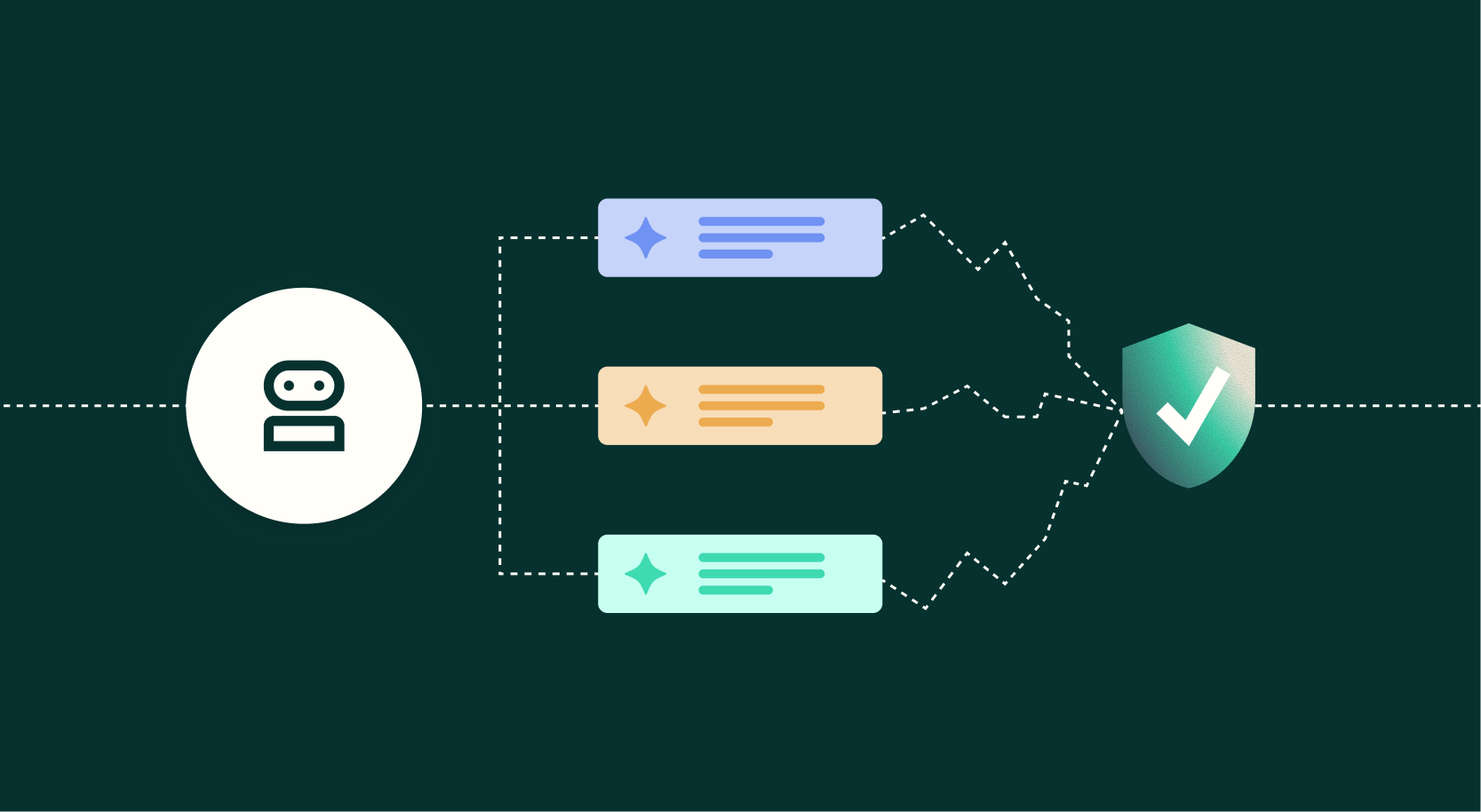
The governance that produces the 12x multiplier is the kind that's built into how AI projects are constructed from the start. It's documented lineage that's captured at the moment of creation versus reconstructed later. It's an evaluation that runs continuously alongside the agent, not as a one-time audit and approval workflows that are part of the build process.
When governance is structural, it actually removes steps. The questions that would have surfaced as deployment-blocking surprises — Who owns this? What data does it touch? Has anyone tested it for bias? — have already been answered by the time the project reaches production review.
The Larridin report captures this dynamic clearly: 58.2% of organizations cite structural issues like unclear responsibility and fragmented ownership as their primary barrier to measuring AI impact, while only 15.1% cite inadequate data infrastructure. The technology exists. What slows AI down isn't the technology itself or governance, it's the absence of the organizational architecture that governance provides.
It's worth being precise about what governance is doing in these numbers, because the mechanism matters.
In the Databricks data, "companies actively using AI governance" means companies running their AI deployments through a unified layer that defines how data is used, sets guardrails and rate limits, and establishes structured accountability. This isn't a policy document on SharePoint, but an operational layer that the AI runs through.
In the Larridin data, "formalized AI risk and compliance policies" describes organizations that have moved past the 69.2% who say they have a policy and into the smaller group that has actually defined what their policy enforces. The gap between those two groups is large: 81% of leaders report satisfaction with their AI guardrails, while 37.1% admit their governance is inconsistent and risk visibility is unknown. Having a policy is not the same as executing oversight, and only the latter produces the multiplier.
As the Market Guide states verbatim: “Traditional assurance processes rely on point-in-time audits or periodic testing to validate whether the aforementioned governance frameworks are effective. However, those processes are ineffective as AI is continuously accessing information and making decisions.”
The report further notes that “[c]ontinuous monitoring and enforcement at runtime is necessary to help identify errors, biases or secondary security threats, allowing timely intervention and reporting to other stakeholders in the organization to mitigate the risk.”
The common thread is that governance, in all three datasets, serves as continuous infrastructure.
If governance is producing a 12x multiplier on AI projects in production, it's worth understanding exactly how.
First, governance compresses the review cycle. When lineage is captured at the moment of creation and evaluation runs continuously, the question "Is this safe to deploy?" doesn't require a forensic reconstruction. The answer is already documented. Projects that would have spent weeks in review move through in hours.
Second, governance removes the rebuild tax. AI projects that ship without proper governance often have to be rebuilt later when a compliance audit surfaces a gap, regulator asks a question no one can answer, model drifts and no one notices until something breaks. Governed projects avoid that latent rework. They ship once and stay shipped.
Third, governance unlocks scale. The Databricks data shows multi-agent systems growing 327% in four months and database operations increasingly augmented by AI agents. That kind of growth is only possible when each new project doesn't multiply the governance burden. A unified governance layer means the tenth agent costs roughly the same to govern as the first.
Fourth, governance creates the conditions for trust. The teams that get to deploy AI in critical workflows are the ones whose AI can be explained, audited, and accounted for. Governance is what makes those workflows accessible. Without it, the most valuable use cases stay off the table.
The implication for enterprise AI leaders in 2026 is structural instead of tactical.
If governance is the variable that separates the 84.5% of organizations demonstrating ROI from the 37.9% that aren't, then the conversation about whether to invest in governance is the wrong conversation. The conversation worth having is about how to make governance continuous, embedded, and inseparable from the build process.
That's the bet Dataiku, the Platform for AI Success, has been making for years, and the 2026 data validates the framing. Governance that sits next to development — embedded lineage, defined human-in-the-loop checkpoints, signoff workflows that are part of construction rather than added afterward, unified visibility across models, agents, and workflows — is the structural feature that produces velocity.
Enterprises that figure that out first are the ones already pulling ahead. The 12x gap between governed and ungoverned AI deployment demonstrates what happens when governance stops being treated as a tax and starts being treated as infrastructure.
For three years, the AI governance conversation has been shaped by the assumption that careful equals slow. The 2026 data refutes that assumption directly.
Governed organizations move 12x more AI projects into production. They demonstrate ROI at 2.2x the rate of ungoverned peers.
The speed bump framing was always backwards. Governance was never what slowed AI down, the absence of it was.
Gartner®, Market Guide for AI Governance Platforms, Lauren Kornutick, Sumit Agarwal, Avivah Litan, Svetlana Sicular, Priya Sundararaman, Souparna Palit, 4 November 2025.
GARTNER is a trademark of Gartner, Inc. and/or its affiliates.