AI vs. machine learning: real-world business applications
March 19, 2026/5 min read/Kurt Muehmel
If you've been a business leader in the last couple of years, you've likely felt pressure to introduce artificial intelligence (AI) into your operations. Or to put the tag "AI-powered" somewhere in your marketing briefs. In the last year, there have been a lot of discussions about AI agents in enterprise applications. But despite years of hype, many organizations still struggle to implement AI in a way that delivers real, measurable impact.
A big reason is confusion. Marketing narratives have blurred the lines between what AI actually is and what it can realistically do. Even among leadership teams driving AI strategy, the distinction between artificial intelligence and machine learning (ML) is often unclear.
That distinction matters. Understanding how AI and ML differ is important for choosing the right use cases and platforms. Before looking at real-world applications or technology decisions, it’s worth getting clear on what these terms actually mean.
Machine learning is a core approach to building AI systems, but there are also other approaches to artificial intelligence, such as rules, Good Old-Fashioned AI (GOFAI), or even just hard-coding responses for specific scenarios.
AI and machine learning create value when applied to specific, well-defined business problems backed by quality data.
Most real-world AI solutions combine multiple models and techniques into a single operational system.
Platform choice matters, as scalability, governance, and integration directly impact long-term ROI.

Machine learning is an approach to building AI systems. All machine learning is AI, but not all AI systems use machine learning.
There are many approaches to AI, and machine learning is one of the most common today. Other approaches include GOFAI, which relies on symbolic rules and explicit logic, as well as rule-based systems that manually code responses to common inputs, such as early chatbots.
If we define AI as a system capable of making intelligent decisions, machine learning is an approach that uses a lot of examples to teach a machine to make those decisions.
Here are some of the major differences between AI and machine learning:
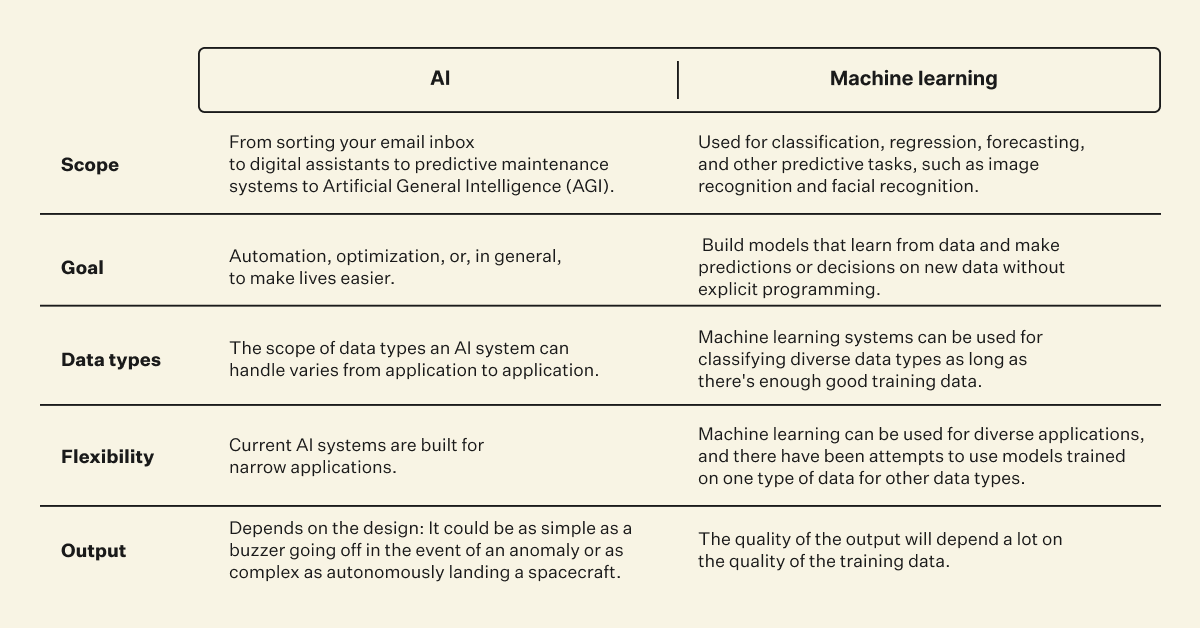
As you can see, machine learning is an approach to AI, and the latter is much broader.
Multiple ML systems are often used to build a single AI solution or system. In these applications, the separate models process different sets of inputs and produce separate outputs. These outputs may serve as inputs for more models to get the final output(s). The complete system is often deployed as an AI application or decision system.
For instance, when using AI systems on an assembly line, there would be a machine learning model(s) analyzing camera footage to identify different components, another model(s) analyzing equipment performance, and others controlling the different robots. The output from these models may, in turn, be monitored by a deep learning model to raise alerts in case of safety risks, inventory shortage, or a maintenance requirement.
In enterprise settings, this orchestration role is often handled by an AI agents platform, which coordinates models, rules, and workflows into a single operational system.
AI delivers value when applied as a system, not a standalone model. ML generates predictions, but AI orchestrates those predictions with rules, integrations, and workflows to drive business outcomes.
Across industries, this combination streamlines operations and speeds decisions.
Application: clinical diagnostics Hospitals and diagnostic centers use AI systems to support clinical decisions. ML models analyze X-rays and MRI scans to identify conditions like pneumonia, fractures, or tumors, while the AI system integrates results into workflows, prioritizing urgent cases and alerting specialists. During COVID-19, radiology teams explored ML models trained on confirmed positive imaging data to assist with infection detection and case prioritization.
How AI supports clinical diagnostics ML handles image analysis, but AI coordinates the full process: rules flag high-risk findings, results feed into electronic health records, and workflows route critical cases. This combination ensures timely, reliable, and governed clinical action.
Application: fraud detection Banks and payment processors deploy AI to detect fraud and money laundering across millions of transactions daily. Machine learning identifies anomalous activity, such as unusual transfers or patterns from inactive accounts, while the AI system integrates these insights into operational decision-making.
How AI supports fraud detection ML surfaces subtle risks, but AI determines the response: enforcing rules on transaction limits, applying geographic or velocity restrictions, and escalating alerts when needed. By orchestrating ML predictions with rules and workflows, AI systems prevent losses and adapt as threats evolve.
Application: predictive maintenance Manufacturers use AI systems for predictive maintenance. Machine learning models analyze sensor data, such as vibration, temperature, and acoustic signals, to predict equipment failures. The AI system coordinates maintenance actions and supply chain responses.
How AI supports predictive maintenance ML provides the predictions, but AI operationalizes them: creating work orders, scheduling technicians, and ordering replacement parts automatically. This integration ensures downtime is minimized, assets are better managed, and production stays on track.
Application: demand forecasting Retailers use AI across loss prevention, demand forecasting, and personalization. ML models detect theft in surveillance feeds, forecast demand, and recommend products, while the AI system connects these insights to operational decisions and customer experiences.
How AI supports demand forecasting ML produces predictions, but AI integrates them with business rules and workflows: inventory is adjusted automatically, alerts trigger in loss prevention systems, and recommendations account for stock, margins, and lead times. AI turns ML insights into measurable operational and commercial results.
Choosing between AI approaches and the platform that supports them will shape everything from adoption to ROI. Before you build anything, get clear on the problem you’re solving and the constraints you’re working within.
This is why choosing the right machine learning platforms is critical: They determine how easily analytics, models, LLMs, and agents move from experimentation into governed, scalable AI systems. Start by grounding your decision in data readiness and business impact, then evaluate platforms based on how well they scale, integrate, and stay governable over time.
Focus on the problem first
Define one specific business pain point to solve.
Decide whether the problem requires prediction, automation, or decision support.
Validate that you have enough high-quality data to support the use case.
Assess your data and modeling needs
Check whether historical data exists and is reliable.
Understand how often models need to retrain or adapt.
Plan for explainability and monitoring from day one.
Plan for scale and adaptability
Choose a platform that supports ML, LLMs, and agents together.
Avoid point solutions that lock you into one model or vendor.
Make sure new use cases can build on existing work, not start from scratch.
Embed governance early
Ensure you can control access to data, models, and agents.
Put review, approval, and monitoring workflows in place.
Align AI usage with regulatory and internal compliance requirements.
Enable end users without losing control
Support AI agents that automate real workflows.
Let business teams interact with AI safely and transparently.
Maintain centralized oversight as adoption grows.
Besides adoption, the next major problem with any digital transformation initiative is that they're not often aligned with organizational goals. An MIT study showed that almost 95% of GenAI investments reported no measurable ROI.
Organizations that succeed take a different approach. They focus on one high-impact problem, solve it well, and then scale responsibly. That requires more than models. It requires coordination between people, systems, and governance.
This is where Dataiku fits in. As the Platform for AI Success, Dataiku connects data, machine learning, GenAI, and AI agents in one environment, with governance built into every step. Business teams and technical teams work in shared workflows, models move into production faster, and AI scales without increasing risk.
Instead of experimenting in silos, you build AI capabilities that compound over time.
Not exactly. Machine learning is one approach to building AI systems. While all machine learning models are AI, not all AI systems rely on machine learning.
AI is commonly used for predictive maintenance in manufacturing, fraud detection in finance, inventory optimization in retail, workflow automation across industries, and process automation in transportation and logistics.
Rule-based systems, such as early search algorithms or basic access-control fingerprint scanners, are examples of narrow AI that operate without machine learning models.
AI is the broad concept of intelligent systems. Machine learning is one approach to AI that learns from data. Large language models (LLMs) are an advanced form of machine learning using deep neural networks and transformers to generate and understand human language from vast, unstructured datasets.
Tags