Roche: Transforming patent workflows with agentic AI
November 5, 2024/3 min read
Hours saved
in attorney time
Days
to build new GenAI projects — took months before Dataiku
Increased quality
in insights to enhance case law analysis completeness
For Roche, the patent process has always been a high-stakes, labor-intensive endeavor. European patents often lead to oppositions and appeals, requiring exhaustive legal research across roughly 50,000 cases from the European Patent Office (EPO) Board of Appeals. Attorneys traditionally spent many hours combing through reference books and running keyword-based searches, a slow, costly process that often produced incomplete insights.
With mounting case volumes and pressure to respond faster, Roche needed a more modern way to operationalize knowledge, reduce manual work, and empower attorneys to focus on higher-value analysis.
That inflection point marked the beginning of the AI journey for the Basel patent team at Roche. In 2021, the company adopted Dataiku, The Universal AI Platform™, to bring GenAI into patent law analysis. Starting with early pilots, Roche’s patent attorneys began experimenting with semantic search, full-text analysis, and deep search flows.
Over time, these efforts evolved into Themis PatAI, an agentic AI interface that unifies multiple specialized GenAI projects into a single workspace, streamlining case law and internal knowledge research and shaping the future of how attorneys work. For the full details of the project Lex use case, finalist of the Dataiku Frontrunner Award for Best Agentic AI Use Case, check out this blog.
Protecting its innovation is critical to Roche’s business but demands deep, time-consuming legal research. Attorneys invest hours searching through thousands of pages, while keyword-based methods often miss important context. The result is:
Manual, repetitive work that consumes valuable patent attorney resources.
Incomplete insights, risking overlooked precedents.
Slow responses, making it difficult to keep pace with fast-evolving legal landscapes.
Without automation or advanced analytics, the team faced rising costs and limited scalability in its legal operations.
Roche turned to Dataiku because it offered both the power of GenAI and the accessibility of citizen development for non-technical users:
The Dataiku LLM Mesh enabled testing prompts across different models while estimating token costs.
The Knowledge Bank and Prompt Studios helped structure complex search and retrieval flows.
Visual recipes and low/no-code tools allowed attorneys to build workflows without IT bottlenecks.
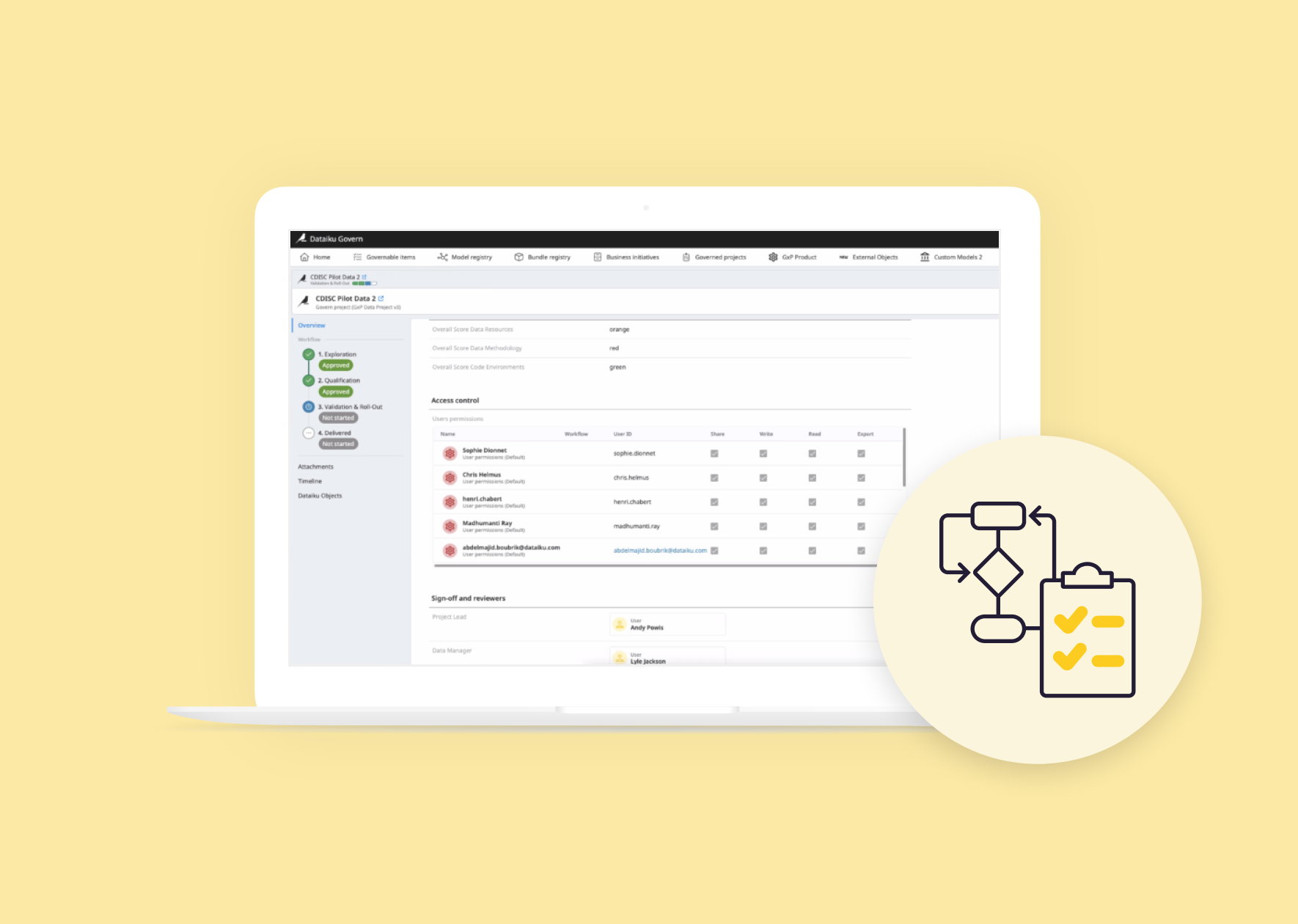
Governance and security ensured sensitive legal data was handled responsibly.
"Evaluating different prompts and estimating token costs using and comparing different LLMs was easy on the Dataiku platform. We also liked the variety of LLMs available through the LLM Mesh."
Andres Buser, Chapter Lead New Modality IP, Roche
The journey began with AskWhitebook, a pilot project that used Dataiku to deliver semantic search, full-text analysis, and even deep search of EPO appeal cases. Patent attorneys can now query case law more intuitively, surfacing richer insights in less time.
Building on this success, Roche developed Themis PatAI, an agentic AI interface that unifies multiple specialized tools in one chat-based workspace. AskWhitebook is one such example of an underlying project, as well as "TheLake," which answers natural language questions on the basis of documents stored in the department’s Google Drive folders and is used by 30 attorneys every month. The challenge was that attorneys had access to multiple Dataiku-built GenAI projects (e.g., RAG searches using various internal and external knowledge bases), but switching between them was confusing and fragmented.
Using Dataiku Agent Connect, Themis PatAI acts as an orchestrator, routing queries to the right sub-agent (knowledge management, deep search, dataset lookups) and returning results in one interface to the end user. It was initially built for 80 European patent attorneys and paralegals, with potential expansion to up to 250 globally. Users can stay within one environment, relying on the agent to answer follow-ups, summarize documents, and confirm statements, all without needing to learn or navigate each individual Dataiku project.
"The entry barrier to starting with AI and data analytics tools is remarkably low when using the Dataiku platform, making it a great choice even for non-technical users."
Andres Buser, Chapter Lead New Modality IP, Roche
The impact of Dataiku at Roche is already clear:
From months to days: Time to build new GenAI projects collapsed.
$100K–$250K annual savings: Primarily from reduced attorney hours per case.
$375K–$475K saved by avoiding consultancy costs thanks to in-house citizen development.
Improved quality of insights: More complete insight generation, improving confidence in strategies and decisions and potentially increasing success rate in patent proceedings
Enhanced productivity: Patent attorneys can now dedicate more time to high-value legal strategy instead of manual data processing.
"With Dataiku, we've demonstrated that citizen development can rapidly build complex AI solutions. This approach has allowed IP attorneys to have more comprehensive case law analysis at their fingertips."
Andres Buser, Chapter Lead New Modality IP, Roche
Roche’s patents department sees agentic AI as a “no-brainer use case” for knowledge management, with the potential to transform how attorneys work:
Expand Themis PatAI from 80 attorneys in Europe to up to 250 globally.
Integrate deeper with R&D, using AI to map patent landscapes and help inform development decisions earlier.
Advance knowledge management with RAG, full-text and deep search analysis, and visual embeddings for faster, more intuitive access to legal and technical documents.
Explore digital twins of experts, teams, and departments to enable access to insights with unprecedented speed.
Within the next few years, Roche expects Themis PatAI and its ecosystem of agents to reduce legal research time dramatically and extend AI-powered insights to R&D and beyond. By consolidating projects, agents, and governance on Dataiku, Roche is not just streamlining today’s case law analysis, it’s building a future where patent attorneys and their stakeholders collaborate seamlessly with AI.