AI governance for enterprises: Frameworks and best practices
April 19, 2026/8 min read/Jacob Beswick
Every enterprise, in some form, is becoming an AI-driven organization. Models score credit applications, flag fraud, generate customer communications, and recommend treatments. But the people building those models, the teams securing them, and the leaders accountable for their outputs typically work on disconnected tools with no shared governance layer. That gap is where risk accumulates.
In this article, we break down what AI governance is, why it matters, the leading frameworks shaping it, and a practical roadmap to implement it effectively.
AI governance unifies data, models, and business accountability into a single system to manage risk across the AI lifecycle.
Leading frameworks like ISO 42001, NIST AI RMF, and the EU AI Act are most effective when investigated as a layered set rather than treated as independent options.
Strong data governance and clearly defined ownership are critical foundations for scalable and compliant AI systems.
A structured roadmap and continuous monitoring enable organizations to operationalize governance and adapt as regulations evolve.

AI governance is the system of policies, roles, processes, and controls that guide how AI systems are designed, developed, deployed, and monitored across the full lifecycle and across portfolios of models, teams, and regions. AI governance differs from related disciplines in scope. Data governance focuses on data quality, access, and privacy. ML model governance focuses on individual model performance and validation. IT governance focuses on securing infrastructure, hardware, and data access. AI governance spans two dimensions: operational governance, covering the processes, roles, and oversight structures that manage AI responsibly across an organization, and technical governance, covering the controls applied to models, data pipelines, and AI systems throughout their lifecycle. Both are necessary for a functioning program.
Organizations invest in AI governance for several interconnected reasons. Three that consistently surface in enterprise evaluations are visibility, financial risk, and regulatory pressure. Some examples of each are provided below. Visibility into what AI is actually running across the business is critically low. According to IBM's 2025 Cost of Data Breach Report, shadow AI incidents account for 20% of all enterprise breaches, adding $670K to the average breach cost. When organizations do not know what AI systems are deployed, who owns them, or whether they are still performing as intended, that gap is not just an operational problem. It is where financial and reputational exposure accumulates before anyone notices. Second, shadow AI creates real financial exposure. As per the 2025 Gartner® survey, "69% of organizations suspect or have evidence that employees are using prohibited public GenAI." Financial exposure comes from two directions: penalties associated with noncompliant systems, and the cost of running low-value AI without management or guardrails in place. Third, regulation is accelerating. "A May through June 2025 Gartner survey of 360 IT leaders involved in the rollout of generative AI (GenAI) tools found that over 70% indicated that regulatory compliance is within their top three challenges for their organization’s widespread GenAI productivity assistants deployment." The EU AI Act, sector-specific mandates like SR 11-7, and emerging state-level rules are creating overlapping obligations that only structured governance can address.
Seven principles form the responsible AI foundation of any governance program, each translating into specific controls. The examples below are illustrative, not exhaustive.
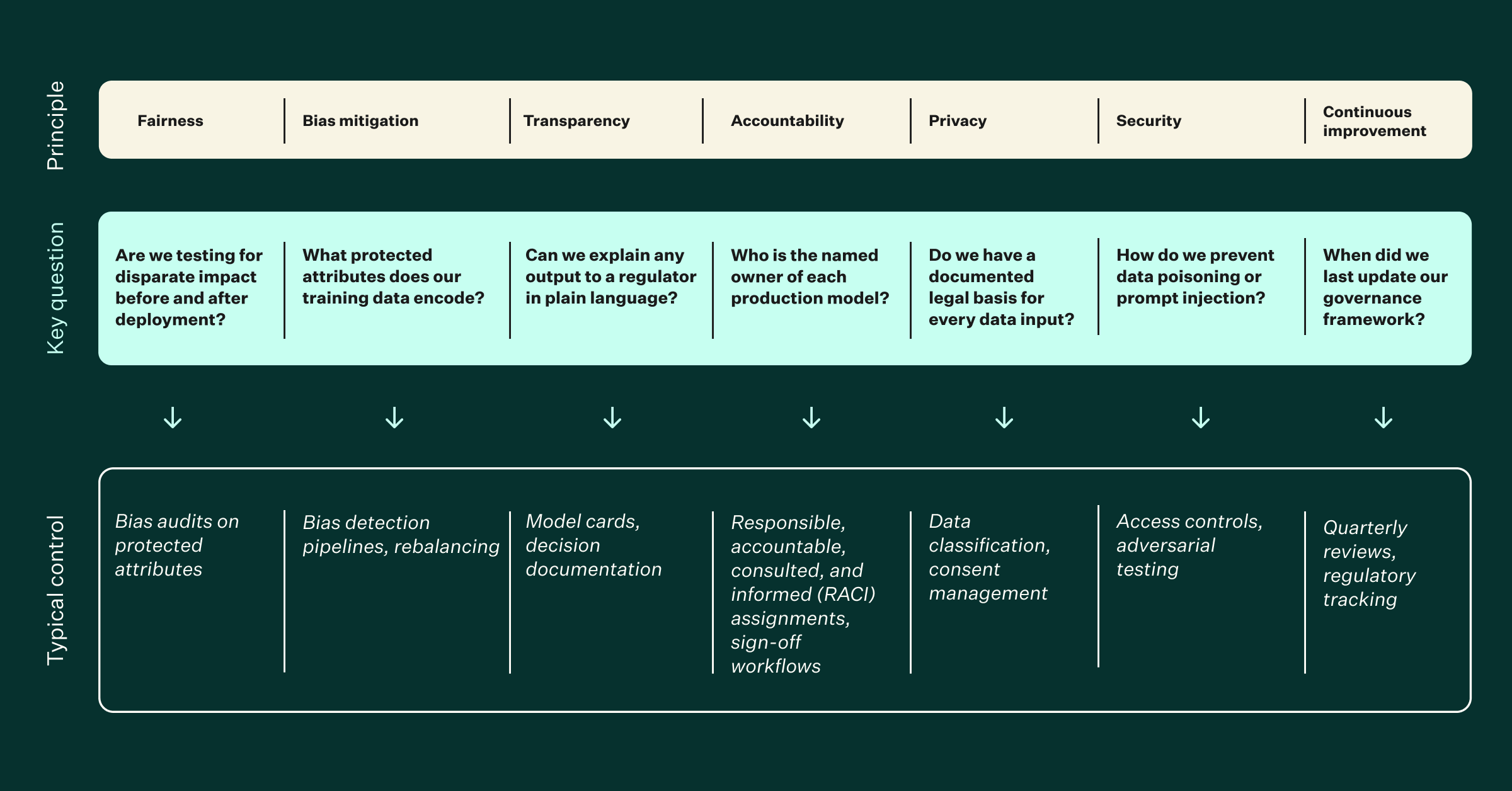
Click on the image above to zoom into full PDF
Three frameworks define the governance landscape in 2026 for organizations operating in the U.S. and EMEA. Consider investigating how these frameworks interact and can be layered to secure your AI governance implementation.
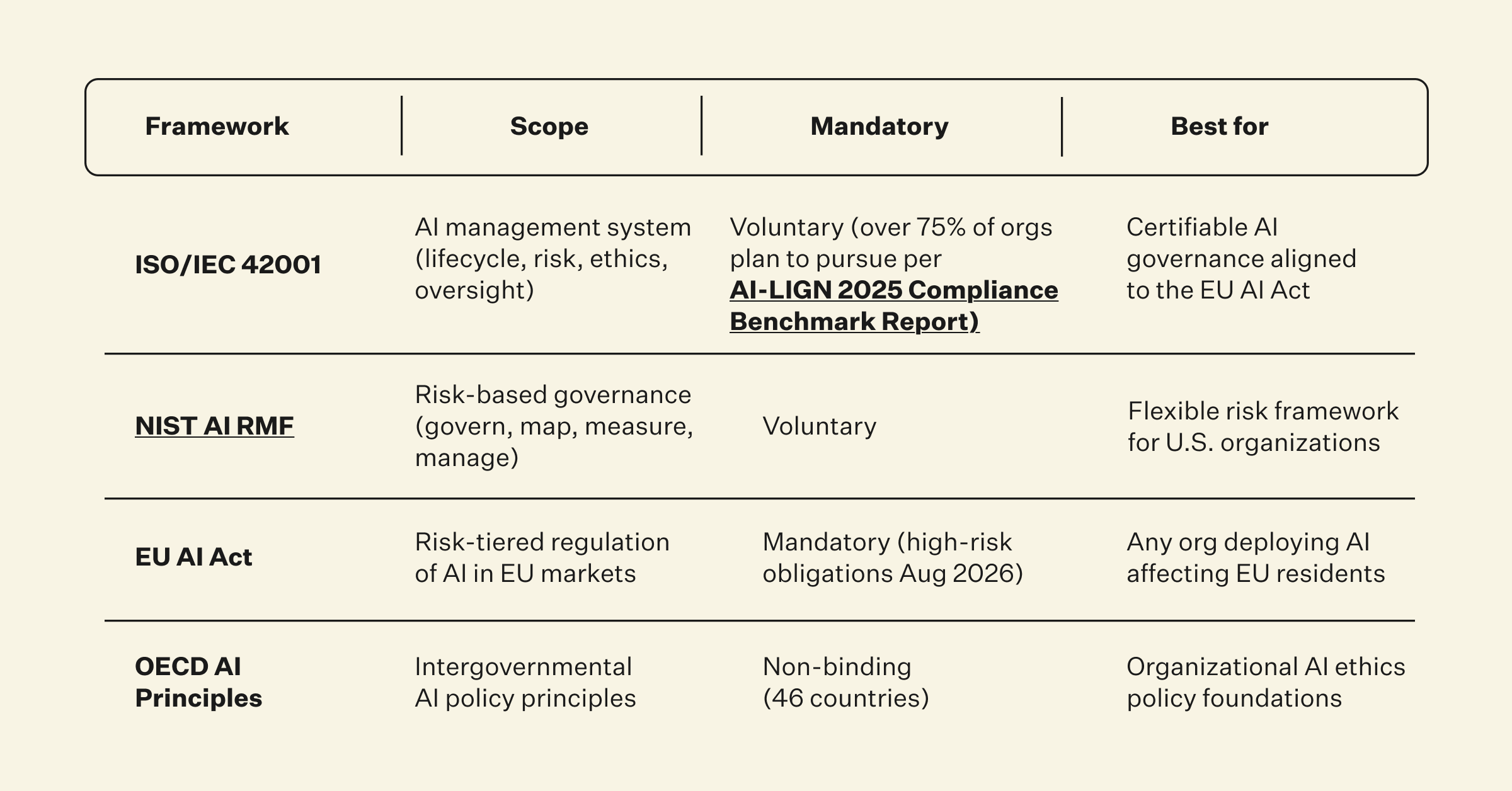
Click on the image above to zoom into full PDF
ISO 42001 and NIST AI RMF can be complementary: ISO 42001 provides the building blocks for a certifiable management system and NIST provides the risk methodology. Both can be viewed as servicing EU AI Act requirements.
AI governance cannot function without strong data governance. Every model inherits the quality, biases, and compliance posture of its training data. A data governance framework ensures five pillars are applied consistently across every data source feeding your models:
Data cataloging
Lineage tracking
Privacy controls
Metadata standards
Retention policies
This foundation matters equally for traditional ML governance and for governing agentic AI. Where agents are in scope, they inherit the data quality and bias profile of every model they call. Governance requirements for agentic AI are still evolving, but the same lineage and monitoring principles apply.
AI governance is a cross-functional mandate that fails when left solely to IT or legal departments. Establishing a clear RACI matrix ensures that model owners, data scientists, and executive stakeholders remain aligned on risk and performance. The following is an example of how this can be distributed across an organization.
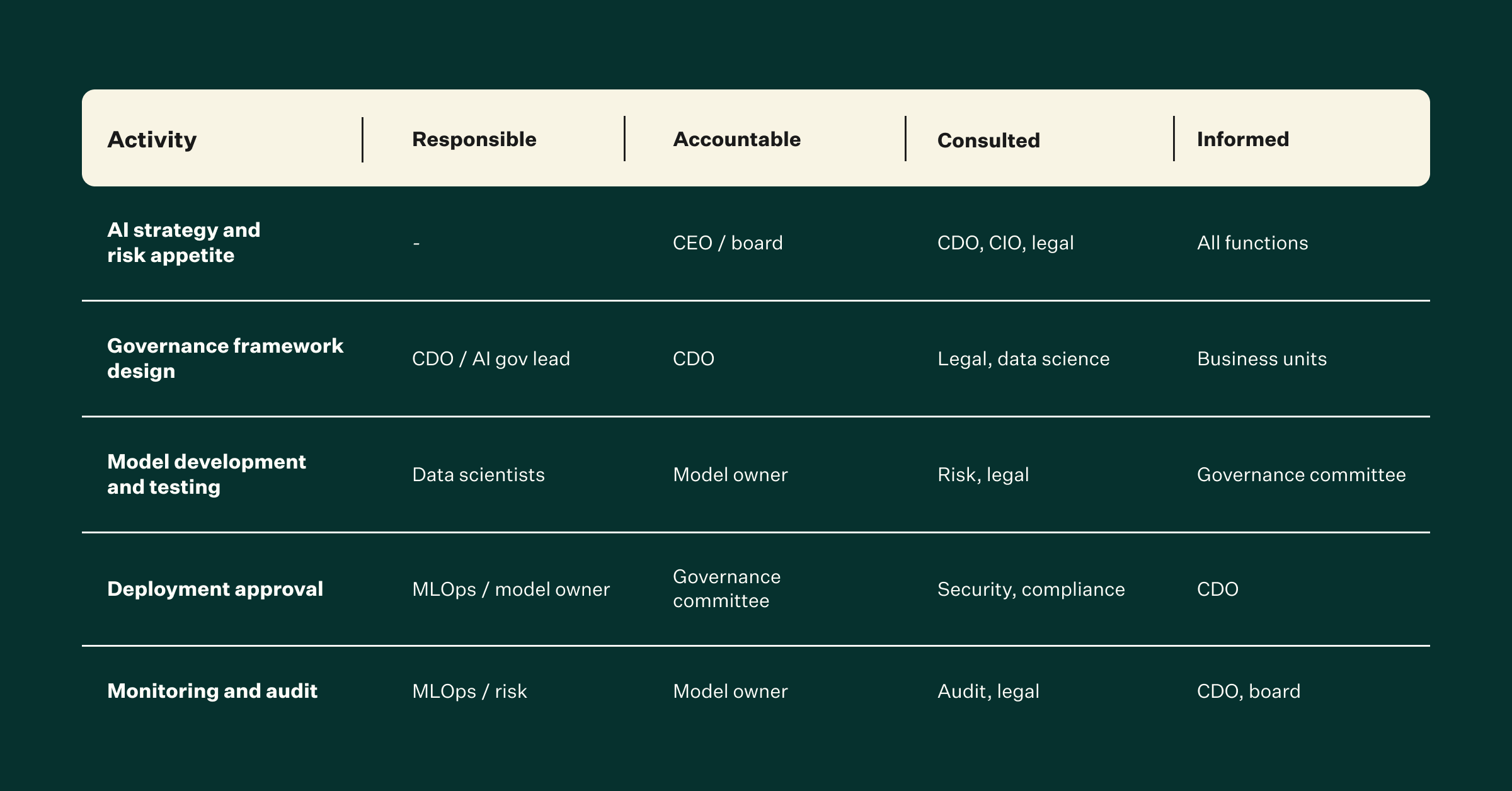
Click on the image above to zoom into full PDF
Across organizations of any size, every production model should have a named owner responsible for its compliance, performance, and documentation.
Transitioning to a governed AI environment requires a structured journey from initial inventory to continuous, automated monitoring. This roadmap outlines the key steps to build a governed AI environment. Implementation timelines vary based on organization size, departmental structure, AI scaling maturity, resource allocation, and whether governance is being driven by internal strategy or external regulatory pressure.
Translate organizational values into actionable AI policies covering acceptable use, risk thresholds, and prohibited applications.
Deliverable: Governance policy document
Choose and adapt frameworks based on regulatory requirements and maturity. Use the frameworks section above to identify which standards apply to your jurisdictions and sectors.
Deliverable: Framework alignment matrix
Establish a cross-functional body with authority to approve, escalate, and block deployments.
Deliverable: Committee charter and RACI
With the committee in place, inventory all AI systems, models, and data pipelines. Identify gaps in documentation, ownership, and monitoring against the policies and framework already defined.
Deliverable: AI asset inventory with risk classification
Implement tooling for drift detection, bias monitoring, and approval workflows. Connect monitoring to governance so alerts trigger reviews.
Deliverable: Monitoring dashboards with thresholds
Schedule regular reviews and update policies as regulations evolve.
Deliverable: Committee record of governance implementation updates, policy decisions, and open actions
Tooling accelerates governance by automating documentation, monitoring, and compliance workflows.
Key capabilities service AI governance across the AI lifecycle. These can include:
Pre-development qualification against, at a minimum, risk, feasibility, cost, and compliance requirements
Model and data checks pre-deployment
Post-deployment model evaluation
Post-deployment monitoring dashboards
Documentation centralization and registries
Workflow orchestration platforms with governance integrated into the development lifecycle through approval gates and role-based access
The most effective approach combines these in a single platform, securing governance alignment with the AI lifecycle while accommodating different stakeholders' needs. Integration with the AI lifecycle is essential for efficaciousness.
Organizations across financial services, healthcare, and retail are operationalizing structured AI governance to scale innovation while maintaining regulatory and ethical oversight.
JPMorgan Chase operates one of the largest model risk management (MRM) programs in the banking sector, aligned with Federal Reserve SR 11-7 guidance. The bank maintains centralized model inventories, independent validation teams, and board-level risk reporting for high-impact models.
Governance in action: Tiered risk classification enables rigorous oversight for credit and fraud models while streamlining review for lower-risk use cases, balancing compliance with scalability.
Mayo Clinic has documented a formal internal governance structure for evaluating and deploying AI-enabled digital health technologies. In a peer-reviewed case study, Mayo describes establishing a centralized review process, multidisciplinary oversight committee, and embedded accountability mechanisms to assess safety, effectiveness, and ethical risk before clinical deployment.
Governance in action: AI tools undergo structured review aligned with regulatory expectations, including clinical validation, risk assessment, and defined ownership prior to integration into care workflows. This enables innovation while maintaining patient safety and compliance.
Unilever has implemented a structured AI assurance process to evaluate and mitigate risks associated with AI use across its global operations. As part of its preparation for the EU AI Act, the company reviews proposed AI use cases through cross-functional subject matter experts who assess ethical, legal, and operational risk before deployment.
Governance in action: AI initiatives undergo structured risk assessment and oversight aligned with emerging regulatory requirements, embedding governance earlier in the development lifecycle to enable responsible scaling of AI across brands and regions.
Dataiku is the Platform for AI Success, a single platform where business and technical teams collaborate on data, ML, generative AI (GenAI), and agents with governance embedded at every layer.
Dataiku provides Dataiku Govern, a centralized governance node designed to oversee AI and analytics initiatives across the organization. The platform enables teams to register AI projects, apply risk-based qualification, and enforce customizable governance workflows with required review and sign-off steps before deployment.
Governance in action: AI initiatives are tracked in a shared registry with structured approval processes, helping organizations formalize oversight, maintain documentation, and align AI development with internal policies and regulatory requirements.
Measuring AI governance success means understanding where you are now and where you need to get to. The maturity model below maps governance development across policy, process, technology, and culture dimensions. Maturity develops from Level 1 (ad hoc, no inventory) through Level 3 (automated monitoring) to Level 5 (continuous governance adapting as regulations change). An example of a potential AI governance implementation journey can be seen below.
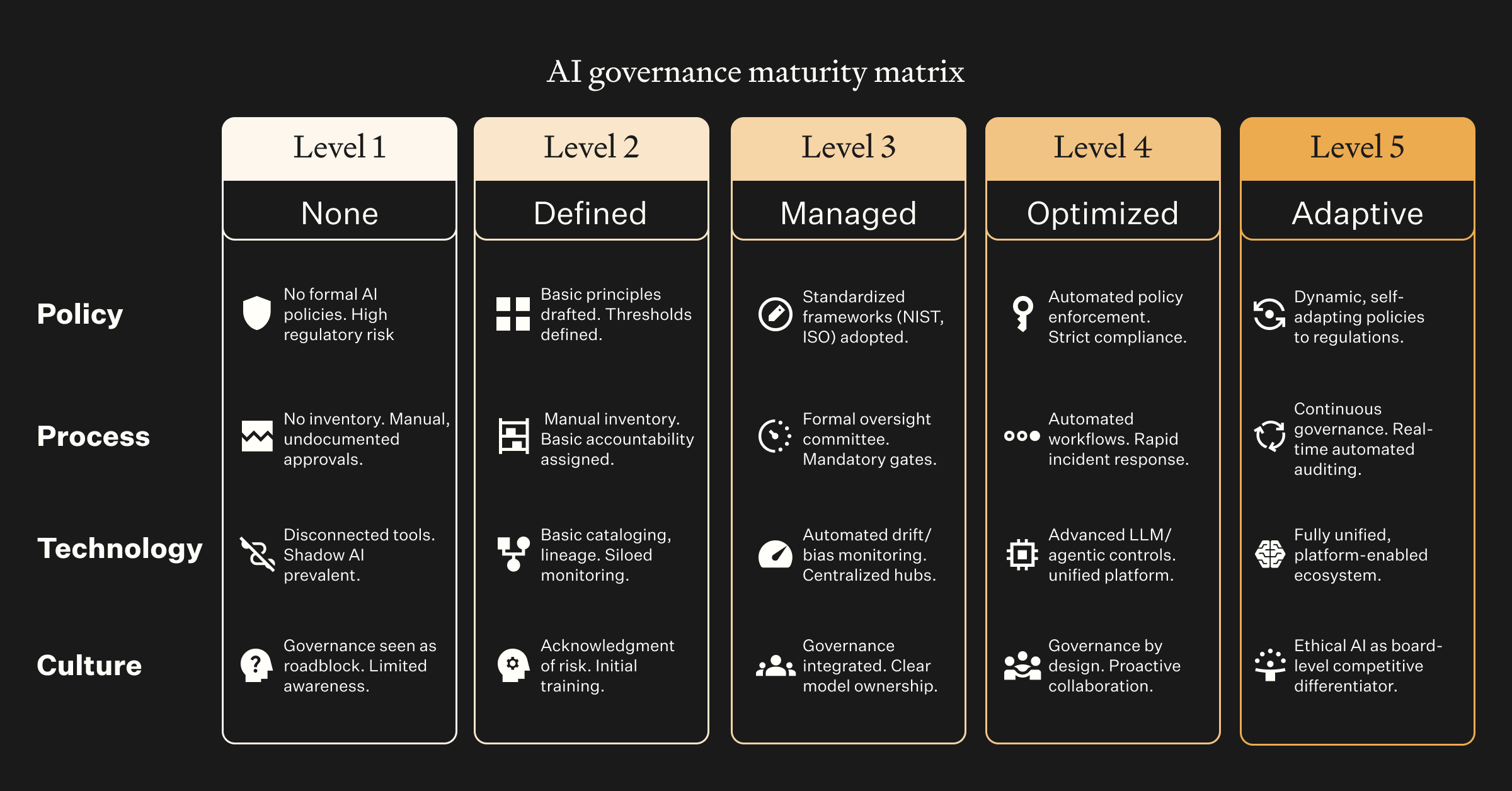
Click on the image above to zoom into full PDF
Governance implementations encounter predictable obstacles. The table below pairs each challenge with a practical mitigation.
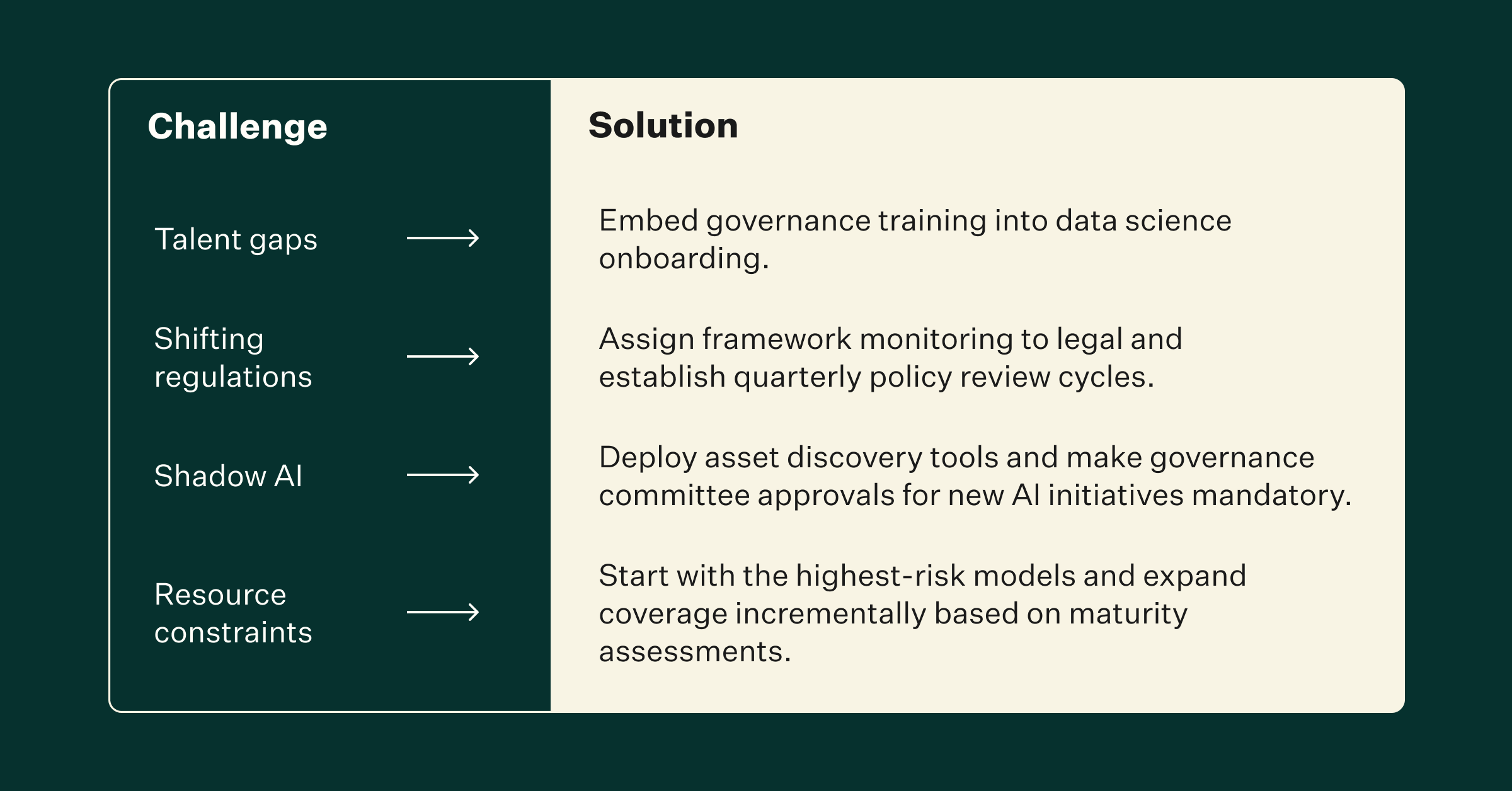
Click on the image above to zoom into full PDF
These mitigations connect directly to the implementation roadmap above.
Four developments will shape governance through 2027. 1. EU AI Act enforcement is operational: Prohibited practices have been banned since February 2025, penalties have been active since August 2025, high-risk obligations will take effect in August 2026. 2. The governance of foundation models and the proliferation of organization-level agents are becoming a distinct discipline, particularly relevant in the context of the EU AI Act and sovereign AI requirements. 3. Automated policy enforcement is evolving toward policy-as-code and continuous compliance monitoring as portfolios scale. The tension between this shift and core governance principles like accountability and transparency remains an active area of debate in regulatory circles. 4. Sovereign AI requirements are fragmenting the compliance landscape. Organizations deploying AI across jurisdictions will need governance frameworks flexible enough to accommodate regional variations without rebuilding from scratch.
The pattern across every governance challenge in this article is the same: disconnected teams, fragmented tooling, and oversight applied after the fact. Dataiku provides a governed AI platform where data science, IT, legal, and business collaborate with governance embedded from day one. Dataiku Govern delivers centralized project oversight, risk assessment workflows, a model registry with full lineage, and continuous monitoring.
AI governance is the system of policies, roles, processes, and controls that guide how AI systems are designed, developed, deployed, and monitored across the full lifecycle and across portfolios of models, teams, and regions.
In practice, this translates into governance committee structures, risk classification frameworks, approval workflows before production, continuous monitoring after deployment, and audit-ready documentation across every AI system an organization operates.
An example of AI governance is a financial institution implementing a tiered risk system under SR 11-7 guidelines to manage its diverse model portfolio. In this scenario, high-risk models like credit scoring undergo independent validation and board-level reporting while lower-risk models follow streamlined controls to satisfy regulatory expectations without creating operational bottlenecks.
AI governance is fundamentally a risk management discipline. Its purpose is to ensure that AI systems deployed across the business, whether traditional ML or agentic, do not introduce unacceptable risk and are safe to operate at scale. That means defining what responsible AI use looks like for the organization, enforcing those standards across the teams building and deploying AI, and maintaining visibility over every system in production.
Unlike IT governance, which typically sits within a single function, AI governance is a cross-business mandate — owners in legal, compliance, product, and operations all have a stake in how AI systems behave.
Building an AI governance framework starts with the organization's own values, objectives, and risk appetite. The first question is what matters to the business: which AI systems carry the most exposure, what outcomes are unacceptable, and where accountability currently sits.
Answering those questions shapes the rules of the road. From there, the practical elements follow: a governance committee with authority to approve and block deployments, roles and responsibilities assigned across data science, IT, legal, and business, qualification processes before models reach production, and monitoring after deployment.
Standards like ISO 42001 and the NIST AI RMF provide useful structural reference points, but the framework's foundation is the organization's own definition of responsible AI use.
Gartner Press Release, Gartner Identifies Critical GenAI Blind Spots That CIOs Must Urgently Address, November 19, 2025. GARTNER is a trademark of Gartner, Inc. and its affiliates.
GARTNER is a trademark of Gartner, Inc. and its affiliates.