AI compliance roadmap: build responsible, trustworthy AI
April 22, 2026/5 min read/Team Dataiku
AI adoption is moving faster than the controls around it. Models now influence who gets credit, which resumes get shortlisted, how fraud is flagged, and how clinical decisions are supported. Yet the teams involved rarely operate on the same system.
Data scientists build and deploy models in one environment. Security and risk teams monitor issues elsewhere. Executives are left accountable without a clear view of what is live in production. Compliance failures usually start there. The rules exist. The gap is visibility. AI compliance closes that gap by giving every stakeholder a shared, operational view of how models behave once they are deployed.
AI compliance is essential because AI systems influence critical decisions, and failures can result in legal penalties, reputational damage, and operational harm.
Effective AI compliance relies on five pillars: data privacy, data security, transparency, fairness, and governance, applied across the AI lifecycle.
Organizations must align with global and regional frameworks, including the EU AI Act and ISO 42001, alongside sector-specific rules, to manage risk consistently.
Operationalizing AI compliance requires tools, cross-functional collaboration, and continuous monitoring to embed governance into daily workflows and prevent failures.

AI compliance refers to the practices that ensure AI systems meet legal, organizational, and technical standards throughout their lifecycle.
Sustaining compliance is challenging because most organizations approach it the way they approach software compliance. But AI systems behave differently. They produce probabilistic outputs, develop biases nobody programmed, and may drift from intended behavior over time.
Governing this across the full lifecycle, from training data selection through production monitoring, cannot fall on one team. Artificial intelligence regulatory compliance requires shared ownership between data science, IT, legal, and business. Typical AI compliance examples include bias audits on training data, documenting decision logic for regulators, and flagging model degradation post-deployment.
AI compliance matters because AI systems directly influence critical decisions that can impact people, operations, and business outcomes. Three developments have moved it from a legal team agenda item to a board conversation.
Regulations now have enforcement mechanisms. The EU AI Act began enforcing penalties in August 2025. California and Colorado have state AI laws taking effect in 2026 with new transparency and governance requirements. Prohibited practices under the EU AI Act can trigger fines of nearly €15 million or 3% of global turnover, with a ceiling of €35 million or 7% for the most serious violations. GDPR actions against AI systems already top nine figures in total fines across Europe.
The reputational damage outlasts the fine. When a hiring algorithm discriminates or a fraud system profiles communities by ethnicity, customers leave, talent walks, and the brand carries that damage for years.
Boards are asking questions that organizations cannot answer. According to "7 career-making AI decisions for CIOs in 2026", based on a Dataiku/Harris Poll survey of 600 enterprise CIOs, 92% have been asked at least once to defend AI outcomes they could not fully explain.
Effective AI compliance programs organize controls around five interconnected pillars. Each maps to specific lifecycle stages.
AI systems consume datasets full of personal, sensitive, and regulated information. The challenge is visibility. Frameworks like GDPR establish expectations around clear data lineage, documented processing bases, data minimization, and strict access controls. Under many of these frameworks, individuals can request information about how AI processes their data and challenge automated decisions.
A model is only as reliable as the data it was trained on. Security controls must protect data at rest, in transit, and during processing through encryption, access management, and audit trails. Organizations also need defenses against data poisoning and adversarial attacks designed to compromise model behavior from the inside.
"The model decided" is no longer a sufficient answer. The EU AI Act requires transparency for high-risk systems, including human-readable documentation and user-facing disclosures. According to the same "7 career-making AI decisions for CIOs in 2026" survey, 85% of CIOs report that explainability gaps have already delayed or stopped AI projects from reaching production.
Biased training data produces biased outcomes. AI compliance requires proactive bias testing across protected characteristics, continuous monitoring for disparate impact, and documented remediation. Pre-deployment audits are necessary but insufficient. Bias detection needs to run continuously because data distributions shift as business conditions change.
None of the above holds without clear ownership. Organizations need defined roles, model owners, risk reviewers, compliance leads, structured approval workflows, and audit-ready documentation. Compliance gaps appear between teams. When data science, IT, legal, and business run on disconnected tools, the gaps between those tools are where failures occur.
This overview focuses on the U.S. and EMEA regulatory landscape. Organizations in other jurisdictions should assess applicable local requirements with qualified legal counsel.
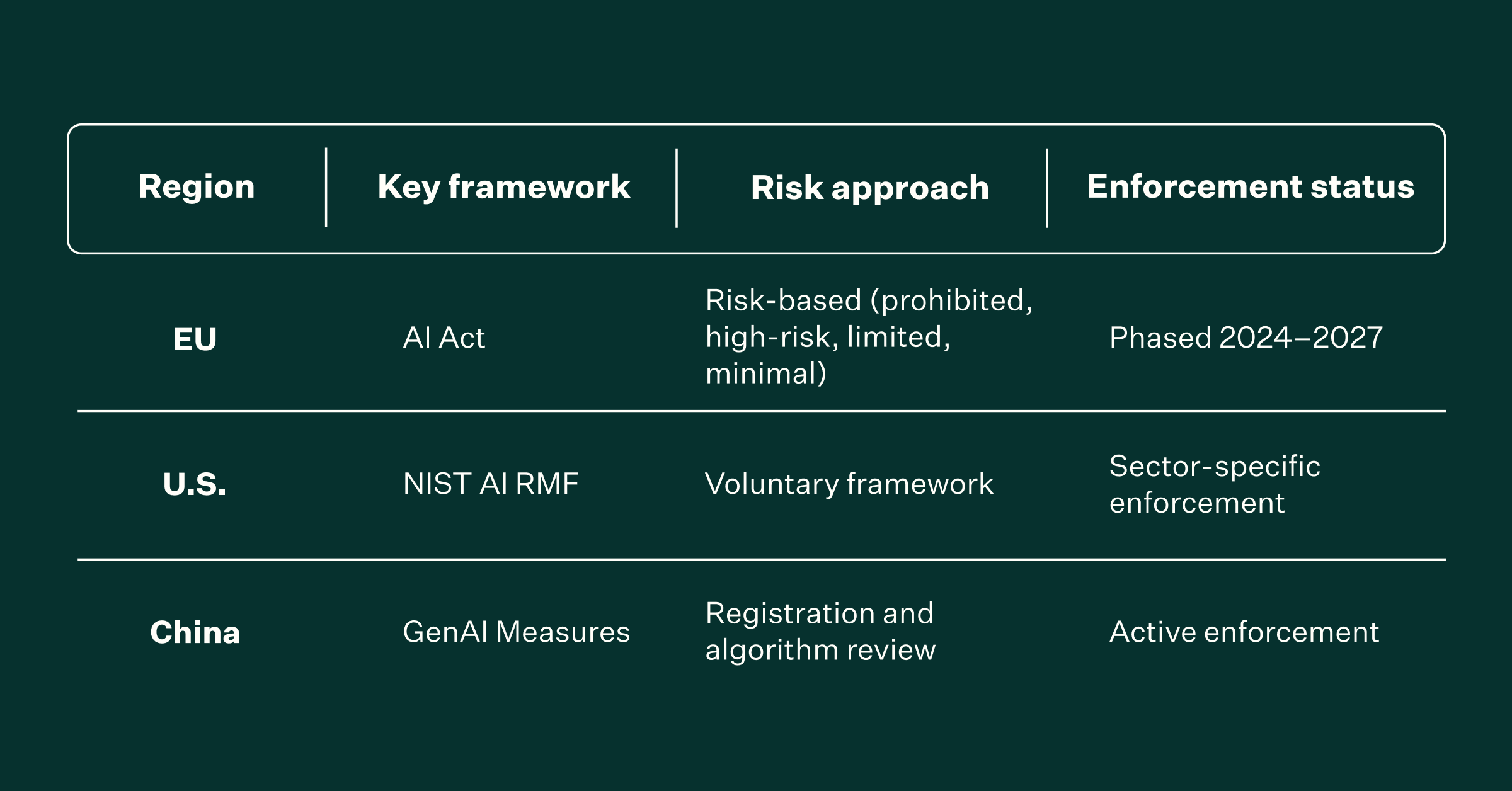
Click on the image above to zoom into full PDF
Regional frameworks set baseline expectations. Vertical regulations add sector-specific layers.
AI systems affecting patient diagnosis, treatment, or clinical decision support face scrutiny from FDA oversight of AI/ML-enabled medical devices, HIPAA data handling requirements, and emerging algorithmic accountability standards.
Credit scoring, fraud detection, and automated lending decisions fall under fair lending laws, including ECOA and the Fair Housing Act, model risk management guidance SR 11-7, and increasingly under AI-specific regulations. Regulators consistently expect explainability and auditability for models influencing credit, insurance, or investment decisions.
Government use of AI in benefits administration, law enforcement, and public services carries heightened accountability standards. The Dutch childcare benefits scandal demonstrated the consequences of algorithmic decision-making without transparency or human oversight.
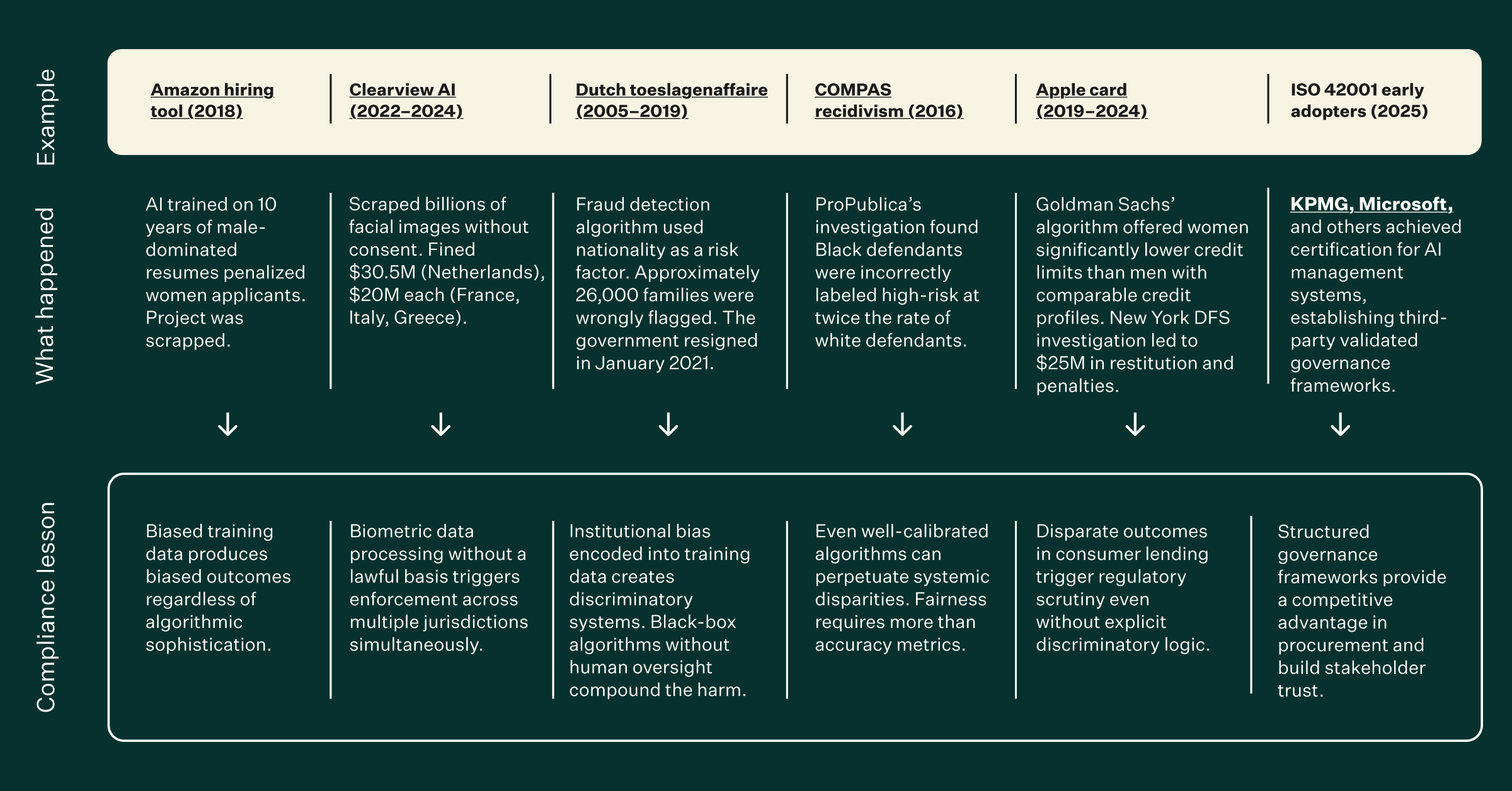
Click on the image above to zoom into full PDF
The steps below reflect what consistently compliant organizations have in common. Specific regulatory obligations vary by organization, jurisdiction, and use case.
1. A complete inventory of all AI systems in production, development, and planning, with named owners assigned to each
2. Risk classification for each system based on applicable regulatory frameworks and industry requirements
3. Regulatory obligations mapped to each system based on jurisdiction, industry, and use case
4. Data governance covering lineage, consent management, retention policies, and access controls
5. Bias testing across protected characteristics before deployment and on an ongoing basis after deployment
6. Explainability built into model architecture rather than added after the fact
7. Approval workflows with defined roles for model owners, risk reviewers, and compliance leads before any model reaches production
8. Documentation covering training data provenance, model decisions, testing results, and approval records
9. Continuous monitoring for drift, performance degradation, and emerging bias in production models
10. Regular audit schedules with compliance processes updated as regulations evolve
Compliance programs fail when they exist only in policy documents. Sustainable AI compliance requires cross-functional ownership, regular training on evolving regulations, and governance embedded into daily AI workflows rather than applied as a periodic audit.
The pattern across every failure in this article is the same: disconnected teams, fragmented tooling, and governance applied after the fact. Solving that requires a platform where data science, IT, legal, and business collaborate on a shared, governed surface.
Dataiku, the Platform for AI Success, supports this through centralized visibility across ML and GenAI projects. Dataiku Govern provides automated risk management, bias detection, and explainability tools, letting organizations operationalize compliance rather than managing it through spreadsheets and manual reviews. Dataiku is recognized in the IDC MarketScape 2025-2026 for unified AI governance as a leader for its approach to embedding governance throughout the AI lifecycle.
Key standards include NIST AI RMF (voluntary U.S. risk management framework, not itself a compliance standard), ISO 42001 (certifiable management system), and the EU AI Act (binding regulation with risk-based requirements). Sector-specific standards like SR 11-7 in financial services and HIPAA in healthcare add additional layers depending on the organization's industry and jurisdiction.
AI can support compliance operations through automated monitoring of model drift and bias, anomaly detection in audit trails, automated documentation generation, and regulatory change tracking.
This article is intended for informational and educational purposes only and does not constitute legal advice. Organizations should consult qualified legal counsel regarding their specific regulatory obligations.