AI governance for risk, audit, and regulatory readiness
May 5, 2026/7 min read/Team Dataiku
Most enterprises have an AI governance policy but struggle to answer the follow-up questions a regulator would actually ask.
The gap is about operational depth rather than intent. Policies exist, but model inventories are incomplete. Risk assessments are conducted, but not connected to enterprise risk registers. Audit trails cover training data but miss what happens after deployment.
According to "7 career-making AI decisions for CIOs" based on a Dataiku/Harris Poll survey of 600 enterprise CIOs, 92% have been asked at least once to defend AI outcomes they could not fully explain. That statistic reflects the real state of AI governance risk and compliance in most organizations: The intent exists, but the operational infrastructure to support it usually does not.
AI governance risk and compliance connects governance structures, risk controls, and regulatory alignment into a unified operational discipline.
Enforcement is accelerating: EU AI Act penalties took effect in August 2025, with high-risk system requirements following in 2026.
Effective AI governance integrates AI-specific risks into existing enterprise risk management rather than running a parallel process.
Audit readiness requires continuous monitoring, documented decision trails, and AI model governance tools that enforce standards across the full lifecycle.

AI governance, risk, and compliance (AI GRC) is the enterprise discipline that combines governance structures, risk assessment frameworks, and regulatory compliance controls to ensure AI systems are developed, deployed, and monitored responsibly, safely, and within legal requirements.
These three functions overlap but serve distinct purposes:
Without risk management, governance produces policies that nobody operationalizes.
Without compliance alignment, risk management misses regulatory obligations.
Compliance alone, without governance backing it, collapses into checkbox exercises the moment a regulator looks closely.
The NIST AI Risk Management Framework provides a useful reference point: it organizes AI risk management into four functions (Govern, Map, Measure, Manage) that together form the operational backbone of an effective program.
When these three elements work together, organizations gain
Faster audit cycles
Defensible decision trails
Stakeholder trust
Ability to scale AI adoption without scaling risk proportionally
AI governance, risk, and compliance has shifted from a strategic aspiration to an operational priority, driven by regulatory enforcement, board-level accountability, and compounding risk exposure.
Enforcement now has teeth. The EU AI Act prohibited certain AI practices as of February 2025, and the penalty regime — including fines of nearly EUR 15 million or 3% of global annual turnover, with a ceiling of EUR 35 million or 7% for the most serious violations — came into effect in August 2025. High-risk AI system requirements enter their next compliance phase in August 2026, with obligations continuing to roll out across system categories through 2027. In the U.S., state-level AI legislation is advancing at different speeds. California and Colorado have introduced broader AI transparency and governance obligations. Texas passed HB 149, though its scope and applicability are more limited and targeted than broader state frameworks.
Boards expect real-time visibility. Executive accountability for AI outcomes is no longer theoretical. The same "7 Career-Making AI Decisions for CIOs in 2026" survey found that 85% of CIOs report explainability gaps have already delayed or stopped AI projects from reaching production. Once AI governance failures surface at the board level, they shift from an engineering concern to a leadership accountability issue.
Ungoverned AI creates compounding risk. Each AI system deployed without proper risk assessment, documentation, or monitoring adds to an organization's cumulative exposure. In enterprise risk management terms, ungoverned AI compounds existing operational, reputational, and cyber risks across the portfolio rather than introducing isolated new ones.
Liability exposure is also expanding. As AI systems make or influence decisions that affect customers, employees, and partners, the legal surface area grows. Insurers are beginning to assess AI governance maturity when pricing technology liability coverage, and regulators across sectors are signaling that inadequate AI oversight will be treated as a board-level failure, not a technical one.
Achieving true regulatory readiness requires operational systems that can demonstrate control, traceability, and compliance on demand.
If any answer below is no, the sections that follow map the path from gap to readiness.
Can you produce a complete inventory of every AI system in production, development, and planning?
Can you classify each system by risk level under applicable regulations?
Can you show documented approval workflows and audit trails for every deployed model?
Can you demonstrate continuous monitoring for drift, bias, and performance degradation?
An effective AI governance framework rests on four pillars: governance structures and roles, risk assessment methodologies, compliance alignment with key regulations, and continuous monitoring and audit.
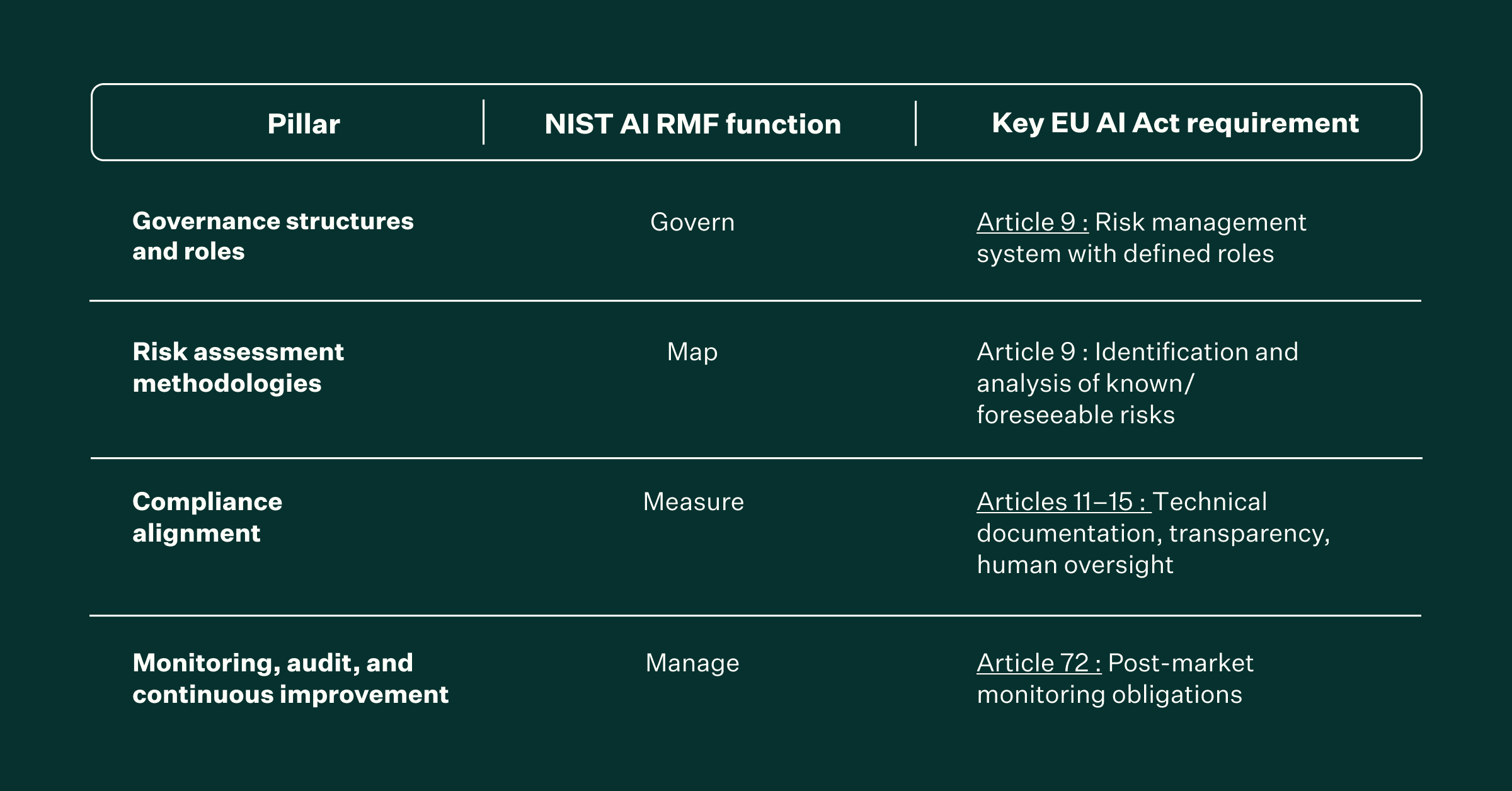
Click on the image above to zoom into full PDF
AI governance requires cross-functional ownership. A dedicated AI governance committee with representation from data science, legal, risk, audit, and business leadership ensures that no single function makes decisions in isolation.
Clear role definitions matter: who owns each model in production, who reviews risk assessments before deployment, who approves changes to production systems, and who is accountable when something fails. Without a documented RACI (Responsible, Accountable, Consulted, Informed) framework, accountability defaults to whoever happens to be in the room when the question is asked.
AI risk assessment adapts familiar risk management approaches to AI-specific failure modes. A likelihood-impact matrix remains the right tool, but the categories need updating: bias and fairness failures, model drift, data poisoning, hallucination in generative AI systems, and unauthorized access to model outputs.
The NIST AI RMF's Map function provides a useful structure for identifying these risks systematically. For a generative AI chatbot, that assessment might include: likelihood of hallucinated outputs reaching customers (high), impact of reputational damage from inaccurate responses (high), and adequacy of human-in-the-loop controls (variable).
Continuous monitoring transforms risk assessment from a point-in-time exercise into an ongoing operational discipline.
The regulatory environment for AI is fragmented but converging. Organizations operating across jurisdictions need to map obligations to evidence artifacts.
Here’s a simple breakdown of what each regulation requires and the evidence you’ll need to stay compliant:
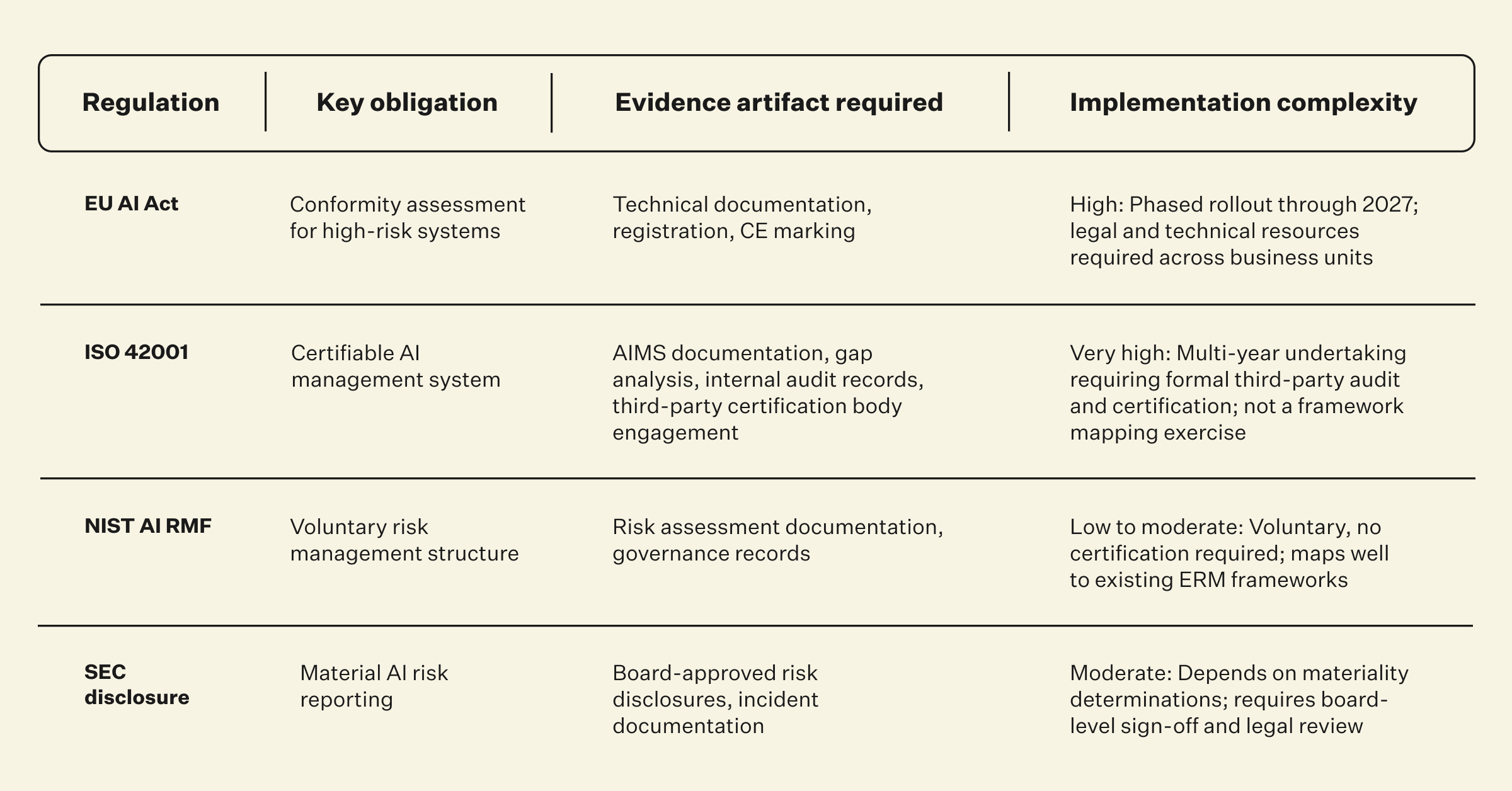
Click on the image above to zoom into full PDF
The practical approach is to build compliance controls against the most stringent applicable standard and map them across to other frameworks rather than maintaining separate compliance programs for each regulation.
Annual reviews alone cannot produce audit readiness. It requires continuous monitoring: automated drift detection, performance degradation alerts, bias checks on production outputs, and versioned audit trails for every model decision.
Log retention policies must cover the full lifecycle, from training data provenance through production inference logs. Model versioning must track not just the model itself but the preprocessing logic, feature definitions, and governance approvals associated with each version.
Quarterly retrospectives, with findings reported to the board, close the feedback loop between monitoring insights and governance improvements.
Integrating AI into enterprise risk management means mapping AI-specific risk categories into existing ERM registers, assigning ownership through the same cross-functional oversight that governs operational, financial, and cyber risk, and treating AI risk as an enterprise concern rather than a data science silo.
A practical risk statement might read: "Automated credit decisioning model produces systematically biased outcomes against protected classes, resulting in regulatory enforcement action and reputational damage." Mitigations would include pre-deployment bias testing, continuous fairness monitoring, and documented human override procedures.
The cross-dependency analysis matters. AI risks rarely exist in isolation. A model that fails in production can cascade into supply chain disruptions, customer service failures, or data privacy violations. Mapping these dependencies in the ERM framework ensures that AI risk is assessed in the context of the enterprise, not in a silo.
AI model governance tools automate the enforcement of governance policies across the AI lifecycle, from data and analytics workflows to models and autonomous agents. Without them, governance relies on manual processes that do not scale.
The evaluation criteria that actually determine long-term fit are:
Security and access controls
Integration with existing data infrastructure
Audit log completeness
Scalability across analytics workflows, models, and agents
Explainability and documentation capabilities
Total cost of ownership, including implementation
The tool categories that matter for governance programs include:
Data lineage tracking across analytics pipelines
Bias testing and fairness monitoring for models, explainability dashboards, model registries with approval workflows
Governance controls for AI agents (including prompt management and action tracing)
Continuous performance monitoring
For pilot rollouts, start with the highest-risk AI system in production, whether that is a predictive model, a business-critical analytics workflow, or an AI agent interacting with users. Instrument it fully, document the governance workflow end to end, and use it as the reference implementation for onboarding additional systems. Change management matters here: governance tools only work if the teams building analytics, deploying models, and operating agents actually use them.
The five most common AI governance challenges are data silos that prevent unified risk visibility, bias in training data, shadow AI deployed outside governed processes, skills gaps between data science and legal teams, and budget constraints that delay governance investment. Each has a specific mitigation path.
These challenges are already showing up at scale. In the 2026 Dataiku/Harris Poll survey, more than 50% of CIOs reported discovering employees using unsanctioned shadow AI tools, and 82% said AI is being built faster than it can be governed — highlighting how quickly risk can expand beyond formal oversight.
1. Data silos prevent unified risk visibility. When training data, model artifacts, and production logs live in disconnected systems, no single team can assess the full risk profile of an AI system.
*Mitigation: A centralized platform that connects data, models, and governance in a single environment
2. Bias in training data produces discriminatory outcomes that trigger regulatory and reputational risk.
*Mitigation: Automated bias testing across protected characteristics, applied before deployment and continuously in production.
3. Shadow AI (models deployed outside governed processes) creates unmonitored exposure.
*Mitigation: A model registry that provides visibility into every AI system in development, staging, and production, combined with organizational policies that make ungoverned deployment unacceptable
4. Skills gaps between data science, legal, and risk teams create communication failures.
*Mitigation: Cross-functional training and shared tooling that gives each function visibility into the others' work
5. Budget constraints tempt organizations to defer governance investment.
*Mitigation: Demonstrating ROI through audit efficiency gains, faster regulatory response times, and reduced remediation costs from governance failures
The thread across every gap in this article is the same: risk assessments that exist but are not connected to enterprise registers, audit trails that cover training but miss production, and explainability questions that 92% of CIOs cannot fully answer. These are symptoms of the same underlying failure: governance that lives in policy documents instead of operational workflows.
Fixing that requires a single environment where the credit decisioning model that needs bias testing, the generative AI chatbot that needs hallucination controls, and the shadow AI system that needs to be discovered in the first place are all visible, governed, and auditable from the same surface. That is what separates organizations that can answer a regulator's follow-up questions from those that cannot.
Dataiku, the Platform for AI Success, brings AI governance, model management, agents, and compliance controls into that single environment, so data science, risk, legal, and business teams work from the same governed foundation.
A foundational AI governance framework typically takes three to six months to establish. Full operationalization, including tooling, continuous monitoring, and cross-functional workflows, typically takes 12 to 18 months.
Regulatory readiness comes down to a complete AI system inventory classified by risk level, evidence artifacts mapped to applicable regulations, and continuous monitoring that generates audit-ready logs. Organizations that build against the most stringent applicable standard and map controls across frameworks are better positioned to adapt as new regulations emerge.
Internal audit provides independent assurance that governance controls are operating as designed. In practice, that means reviewing model risk assessments, testing the completeness of audit trails, validating bias testing methodologies, and checking whether production monitoring catches the risks it was designed to detect. Risk teams own the ongoing risk assessment process and escalation protocols when monitoring identifies issues.
AI model governance tools monitor production models by comparing current outputs against baseline performance metrics established during training and validation. Drift detection identifies when input data distributions or model predictions shift beyond acceptable thresholds. Bias monitoring evaluates outputs across protected characteristics to flag disparate impact. Performance monitoring tracks accuracy, precision, and other metrics over time to catch gradual degradation before it affects business outcomes.