AI ethics and governance: Operationalizing responsible AI at enterprise scale
May 3, 2026/6 min read/Team Dataiku
AI is no longer a future investment. It is an active operational reality. GenAI and autonomous agents are accelerating deployment timelines, expanding decision-making across business functions, and introducing risks that traditional governance models were never designed to handle. In this environment, AI ethics and governance are not a compliance checkbox. They are the operational foundation that determines whether enterprise AI scales responsibly or becomes a source of institutional, regulatory, and reputational harm.
The stakes are especially high right now. GenAI models hallucinate, agents act autonomously across systems, and neither behaves like the deterministic ML pipelines that earlier governance frameworks assumed. Principles written for a simpler AI era are no longer sufficient.
That means translating ethical principles into operational controls that travel with every model, agent, and decision, from design through deployment through continuous monitoring. For CDAOs and AI transformation leaders, this is the core challenge: closing the gap between what an organization says about responsible AI and what its systems actually enforce. This article provides the operational playbook for doing exactly that.
Effective AI governance means embedding enforceable controls (bias testing, approval gates, and audit trails) directly into development and deployment workflows, not adding them after the fact.
GenAI and agentic systems introduce new risks like hallucination, prompt injection, and autonomous decision-making that demand governance protocols beyond traditional ML frameworks.
Regulatory frameworks like the EU AI Act and NIST AI RMF translate into concrete enterprise actions: risk-tiered model inventories, approval workflows, and post-market monitoring.
Organizations that integrate governance into MLOps, LLMOps, and AgentOps pipelines turn compliance evidence into a byproduct of building, making responsible AI scalable and auditable by default.

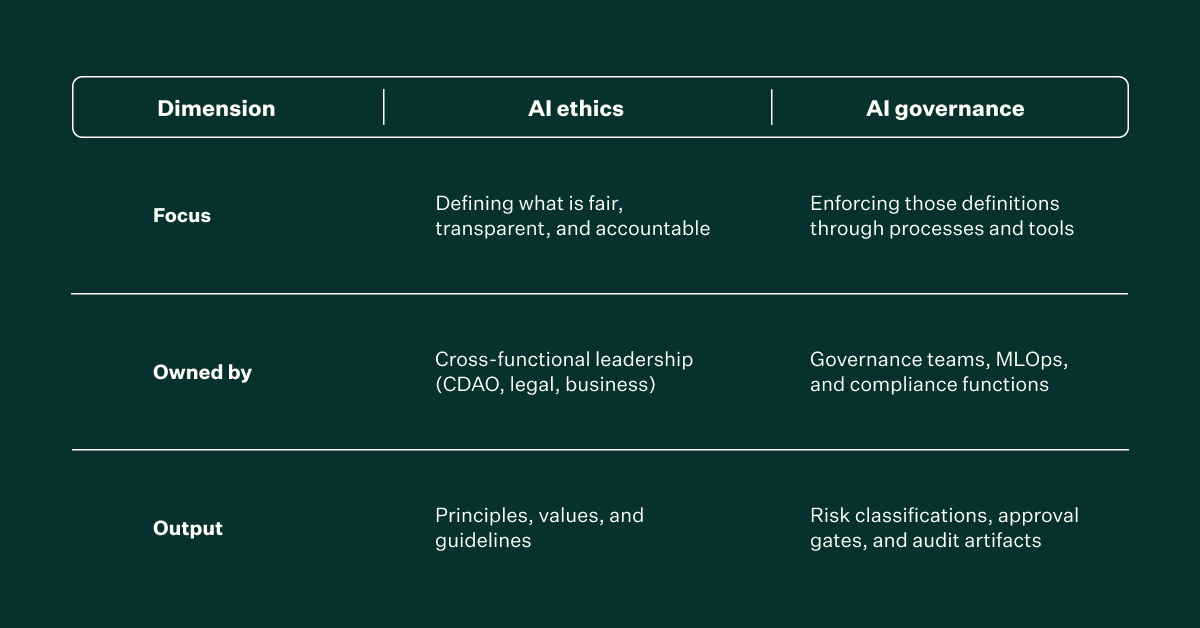
Every enterprise has AI principles posted somewhere. Few have translated those principles into enforceable controls that travel with a model from development through production. That gap, between defining values and enforcing them, is precisely where ethics ends and governance begins.
Click on the image above to zoom into full PDF
At enterprise scale, the real work is operationalizing ethics across systems, teams, and models simultaneously. This is where platforms matter. Dataiku, the Platform for AI Success, embeds governance into every step of the AI lifecycle, from data preparation through deployment and monitoring.
Business, regulatory, and reputational risks compound as AI expands across an organization. As per McKinsey's 2025 report, 88% of organizations report regular AI use in at least one business function. So, the blast radius of a single governance failure widens considerably.
Amazon's experimental AI recruiting tool, for instance, systematically downgraded applications from women because it had been trained on historically male-dominated hiring data. The company scrapped the system only after an internal audit surfaced the bias.
Distributed model ownership amplifies this problem. Different teams build models on different data with different assumptions, and GenAI capabilities introduce novel risk vectors like hallucination and data leakage.
These challenges are especially pronounced for CDAOs managing cross-functional AI portfolios, where AI ethics and governance are the mechanisms that prevent scale from becoming a source of institutional risk.
Four principles anchor responsible enterprise AI, and each requires specific operational controls to function at scale:
1. Fairness: Bias testing and mitigation workflows run at each stage of model development. Teams define fairness metrics during design and validate them before any model reaches production.
2. Transparency: Documentation standards and explainability tools give stakeholders clear visibility into how models make decisions, including model cards and feature importance reports.
3. Accountability: Model approval checkpoints and defined oversight roles ensure every AI system has a named owner responsible for its performance and compliance posture.
4. Privacy and security: Data access controls, encryption, and audit trails protect sensitive information throughout the AI lifecycle while addressing both regulatory requirements and internal risk policies.
These principles deliver value only when systems enforce them automatically within production workflows.
Organizations find the leap from responsible AI ambition to execution overwhelming. But there are responsible AI frameworks that can bring benefits. These frameworks enable enterprises to articulate the responsible AI principles they need to follow to meet their business goals. It helps them curate governance, define key processes, introduce technology and tools and create a culture of responsible AI among the employees.
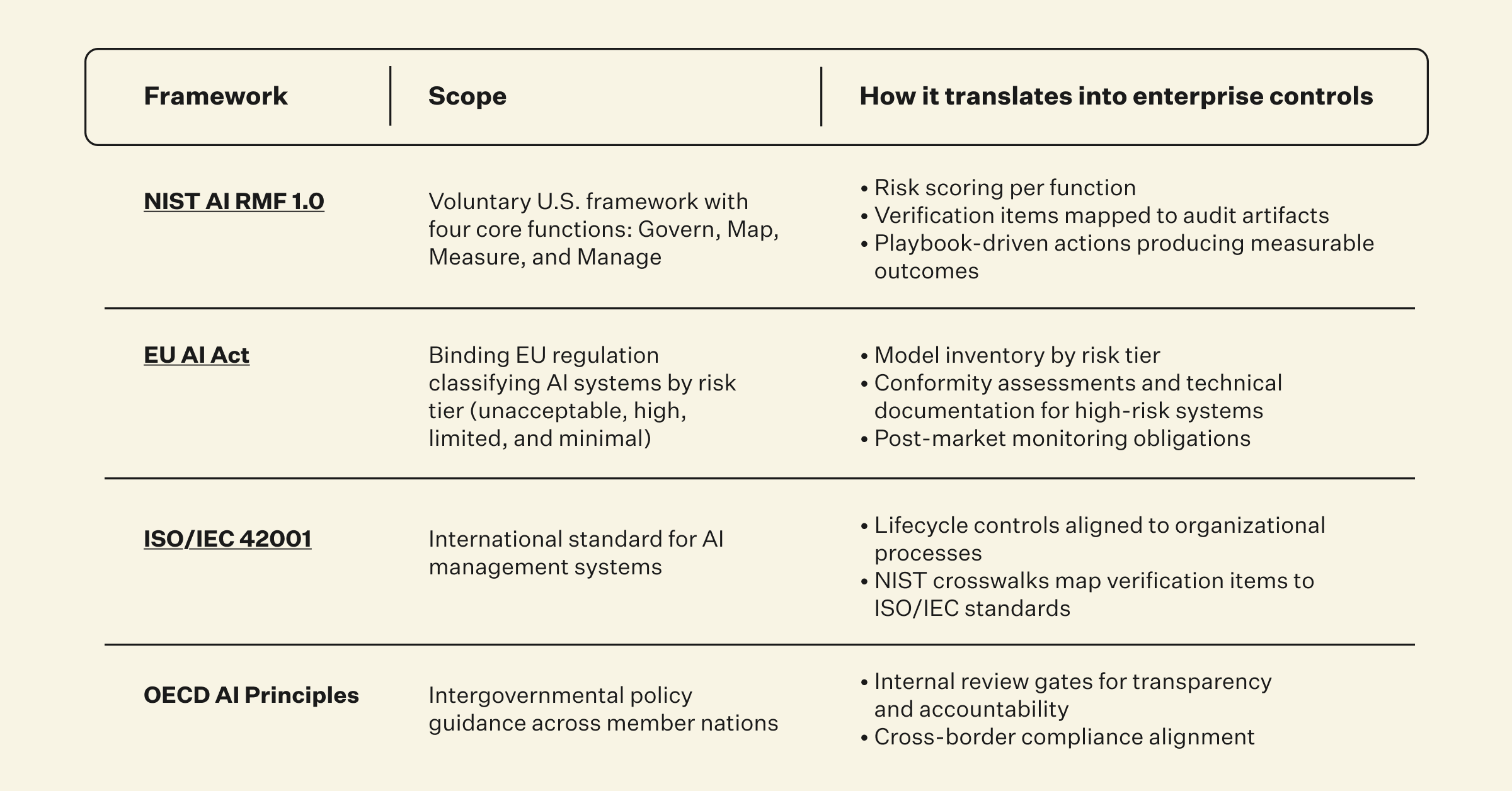
The four most referenced frameworks for enterprise AI governance and ethics teams translate into specific operational actions.
Click on the image above to zoom into full PDF
The practical value of these frameworks increases when organizations apply them through a single governance layer with shared risk taxonomies and audit formats.
Binding regulations carry consequences that voluntary frameworks do not, and CDAOs need to prepare for enforcement timelines already underway.
The EU AI Act (Regulation (EU) 2024/1689), published in the Official Journal on 12 July 2024, creates obligations organized by risk tier. High-risk AI systems require conformity assessments, technical documentation, data governance protocols, and post-market monitoring. For CDAOs, this means maintaining a complete model inventory with risk classifications, audit-ready documentation, and defined human oversight roles.
In the U.S., the NIST AI RMF 1.0 provides a voluntary framework that has become a de facto reference point. Its four core functions (Govern, Map, Measure, and Manage) give enterprises a structured risk management approach, supported by companion playbooks with verification items published through the NIST AI Resource Center.
Across jurisdictions, regulatory fragmentation means enterprises operating globally need governance structures that satisfy overlapping requirements through shared audit artifacts and risk classification schemes. A unified governance layer with region-specific configurations reduces the duplication and cost of meeting multiple regulatory regimes simultaneously.
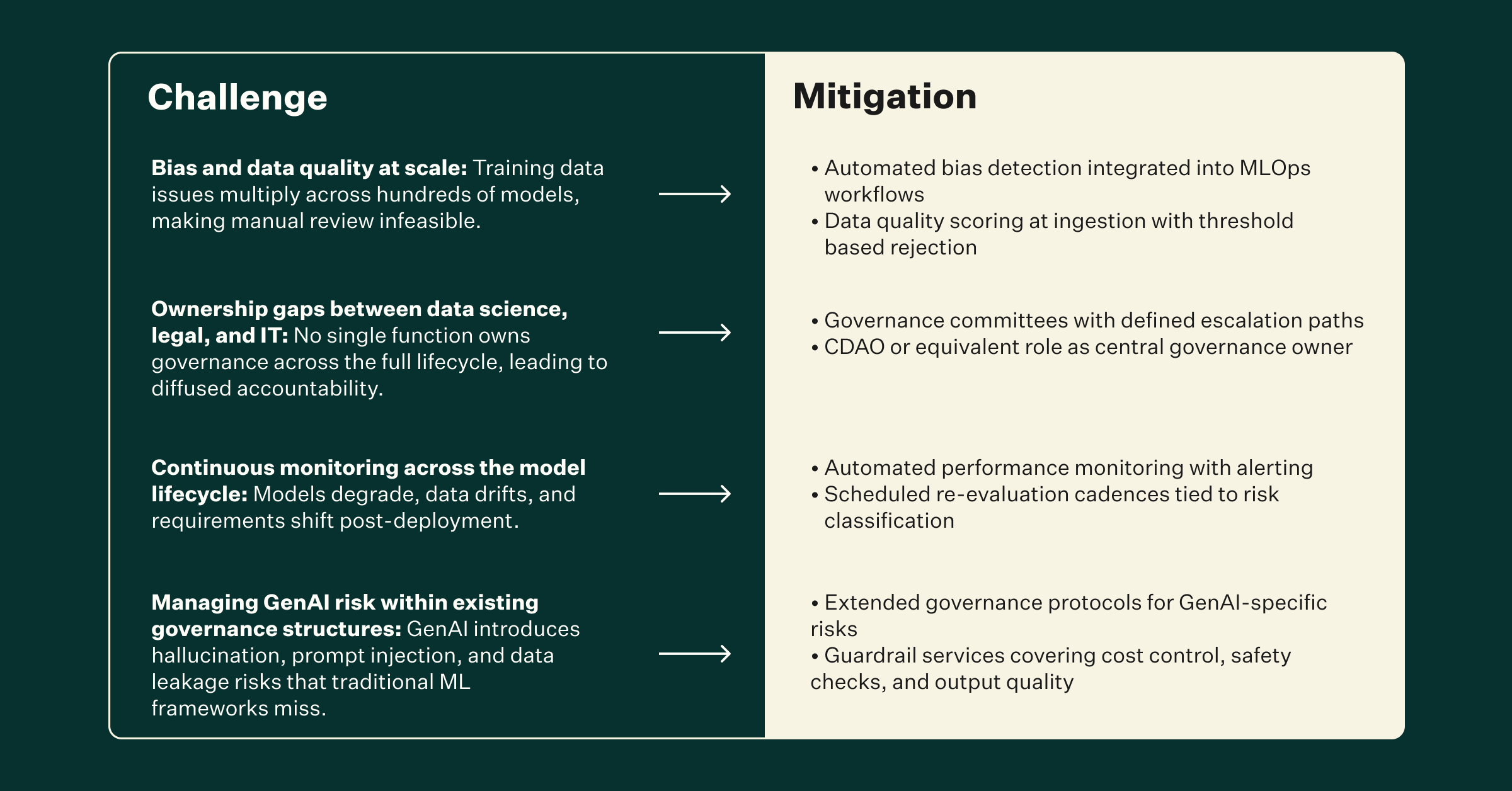
Compliance readiness looks different in a boardroom presentation than it does inside a production ML pipeline. Several execution barriers consistently stall AI enterprise governance programs as organizations move from pilot to enterprise scale.
Click on the image above to zoom into full PDF
These gaps compound with scale, making automated controls and clear ownership the decisive factors in any governance program.
Governance programs that succeed at scale share a common architecture. The following four-step playbook gives CDAOs a repeatable path from policy to enforcement.
1. Define governance ownership and escalation paths. Assign a central governance owner, typically the CDAO or a dedicated AI governance committee. Map escalation paths so ownership is clear at every level, from model developer to executive sponsor.
2. Establish model risk classification and approval workflows. Classify every AI system by risk tier, following frameworks like the NIST AI RMF or the EU AI Act's categories. High-risk systems require formal review and signoff before deployment. Dataiku Govern embeds these approval workflows directly into the development lifecycle, so the correct reviews trigger automatically based on risk classification.
3. Embed lifecycle controls into MLOps, LLMOps, and AgentOps pipelines. Documentation, lineage tracking, and review gates become part of the standard development workflow. When controls live inside the pipeline, compliance evidence is a byproduct of building. A strong AI ethics and governance program makes this the default operating mode for every team.
4. Implement monitoring, metrics, and audit reporting. Track model performance, fairness metrics, and inference costs in production. The Stanford AI Index found that inference costs for GPT-3.5-equivalent performance dropped from $20 to $0.07 per million tokens in roughly 18 months, making continuous monitoring economically practical at scale.
This playbook works best when supported by a platform that enforces controls programmatically at every step.
Governance programs produce measurable outcomes when they shift from policy documents into production workflows. Three hypothetical enterprise examples illustrate what this looks like in practice.
A financial services organization implemented risk classification for all AI models aligned with the EU AI Act's tiering structure. High-risk models required formal conformity assessments and CDAO signoff before production deployment. Regulatory exposure decreased because every model in production carried documented risk rationale and approval artifacts.
A healthcare organization embedded automated fairness checks into its model training pipelines. Every model was tested against predefined fairness thresholds before promotion to staging. Compliance readiness improved because audit evidence was generated during development, with no separate manual review cycle.
A supply chain enterprise deployed a centralized registry tracking every model's lineage, owner, risk classification, and deployment status. Any auditor could trace a production model back to its training data, approval chain, and performance history.
Each pattern demonstrates a consistent principle: Governance actions embedded into workflows produce measurable compliance outcomes.
AI ethics and governance matures through a clear progression: Principles define intent, controls enforce it, and continuous monitoring proves it. Organizations that treat governance as an operating model (with defined ownership, risk classification, lifecycle controls, and production monitoring) close the gap between policy and practice.
Dataiku embeds these controls into every stage of the AI lifecycle through capabilities like Dataiku Govern, which ties approval workflows and audit trails directly to the development process. For CDAOs managing AI at enterprise scale, the path forward depends on operational discipline. Governance that travels with every model, agent, and decision is how responsible AI becomes real.
AI ethics defines what fair, transparent, and accountable AI looks like. AI governance enforces those definitions through operational controls, approval workflows, risk classifications, and audit trails within production systems.
Scale amplifies risk. Hundreds of models across teams and geographies mean a single governance gap can affect thousands of decisions. Automated controls, centralized registries, and defined ownership become necessary to maintain accountability.
Many governance tasks benefit from automation: Bias detection, performance monitoring, documentation generation, and risk scoring. High-stakes decisions still require human oversight and signoff checkpoints at defined approval gates.
Enterprises embed ethics through lifecycle controls: Bias testing during development, explainability tools in production, approval gates before deployment, and continuous monitoring post-launch. Platforms like Dataiku enforce these controls within standard AI development workflows.