Agentic AI governance frameworks: scaling AI beyond pilots
August 28, 2026/7 min read/Team Dataiku
The standard AI risk playbook assumes a human sits between the model and the consequence. It also assumes that humans review the prediction before acting on it, and approve the recommendation before it becomes a decision. Deploying an autonomous agent breaks that assumption.
Agents do not wait for review. When one selects the wrong tool, escalates its own privileges, or produces an action that cascades through connected systems, the failure is already in motion. The challenge is whether you can trace what happened, contain the damage, and explain it to a regulator who may ask about both.
According to "Global AI confessions report: data leaders edition," based on a Dataiku/Harris Poll survey of 800+ global data leaders, only five percent say AI output is traceable 100% of the time. For agents operating without human review in the loop, that traceability gap is not a reporting problem but an operational liability with regulatory consequences.
This guide gives you the framework to close it: five risk domains that require specific mitigation, a four-step assessment methodology you can run against any agent in production, lifecycle-phase controls that build defense-in-depth, and continuous monitoring that catches what pre-deployment assessment misses.
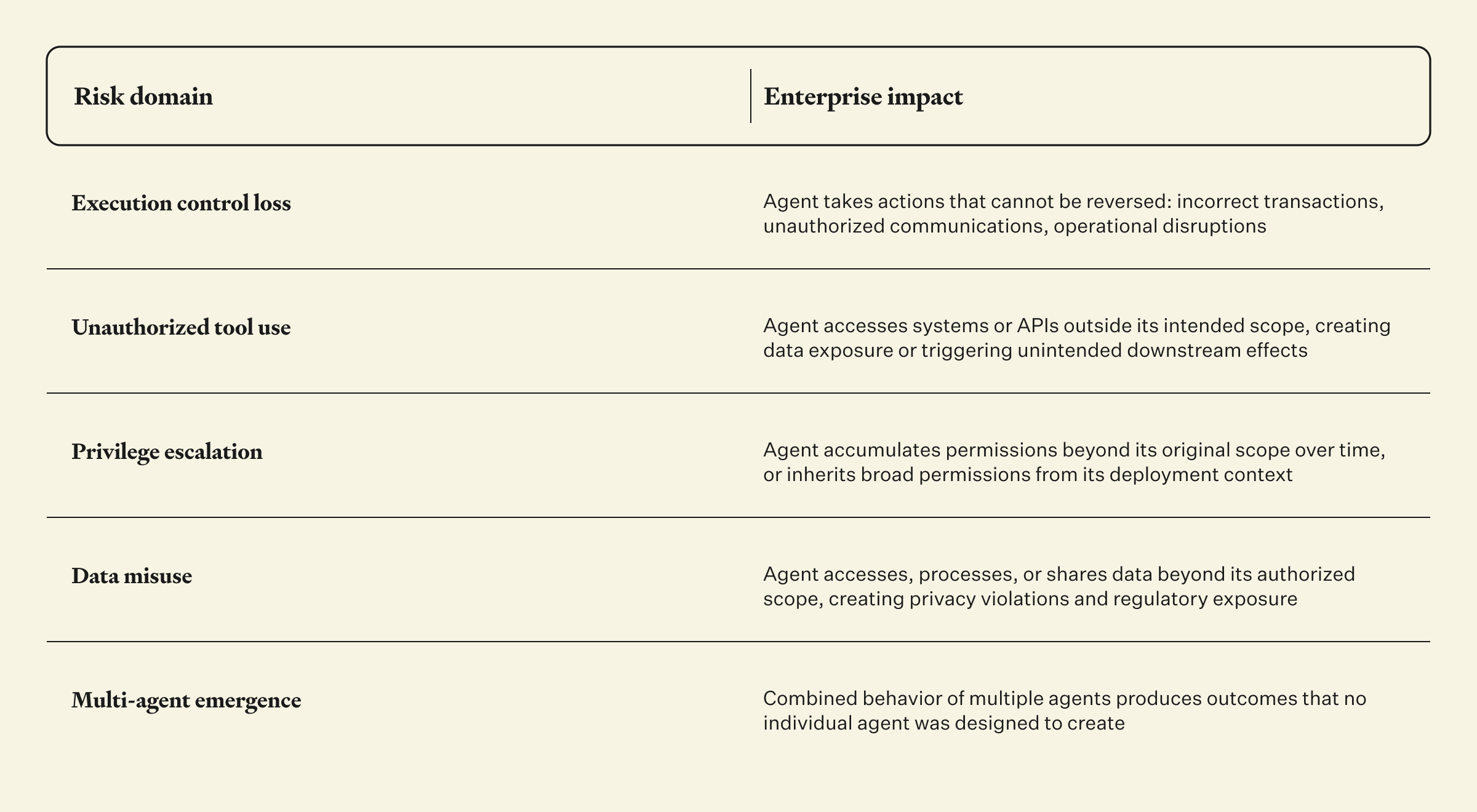
Agentic AI risk management addresses the specific failure modes that autonomous agents introduce: execution control loss, unauthorized tool use, privilege escalation, data misuse, and multi-agent emergence.
A four-step assessment framework (scope, rate, test, decide) provides a repeatable methodology for evaluating agent risk before and during production.
Mitigation strategies align to lifecycle phases: pre-deployment (least privilege, impact assessment), runtime (guardrails, human-in-the-loop), and post-deployment (logging, drift monitoring).
Standards alignment (NIST AI RMF, ISO/IEC 42001, ISO 23894, EU AI Act) integrates agentic AI risk into existing enterprise risk management programs.
Continuous monitoring and defined incident response procedures close the loop between risk assessment and operational reality.
Agentic AI refers to AI systems that autonomously plan, reason, use tools, and take actions to accomplish goals with minimal human oversight. Unlike traditional AI, which produces outputs (predictions, classifications) for humans to act on, agentic systems act directly: calling APIs, querying databases, triggering workflows, and executing decisions.
Consider a procurement agent that monitors supplier pricing, evaluates contract terms against company policy, triggers purchase orders when thresholds are met, and logs every decision for audit review. That agent operates a multi-step workflow involving tool use, data access, business logic, and real-world actions, all autonomously.
The autonomy that makes this valuable is the same property that creates new risk surfaces. Execution control (Can you stop the agent when it goes wrong?), privilege elevation (Does the agent's access exceed what it needs?), and emergent behavior (What happens when multiple agents interact in unexpected ways?) are all risks that traditional model governance may not fully address because traditional models do not usually execute actions directly.
Five risk domains require specific assessment and mitigation in any agentic AI risk management program.
*Click on the image to see the full PDF
These five domains map directly to the assessment criteria in the four-step framework below. Each domain has specific test conditions and mitigation controls that the framework evaluates.
A four-step assessment methodology covering scope, rating, testing, and deployment decision provides a repeatable approach for evaluating agentic AI risk. It aligns with the NIST AI RMF Map and Measure functions and applies to both pre-deployment evaluation and periodic production reassessment.
Define what the agent can do (authorized actions, data sources, tool access), what it cannot do (prohibited actions, restricted data), and who is accountable for its behavior. Document the agent's purpose, boundary conditions, and escalation paths. Without a defined scope, there's no baseline against which to assess risk.
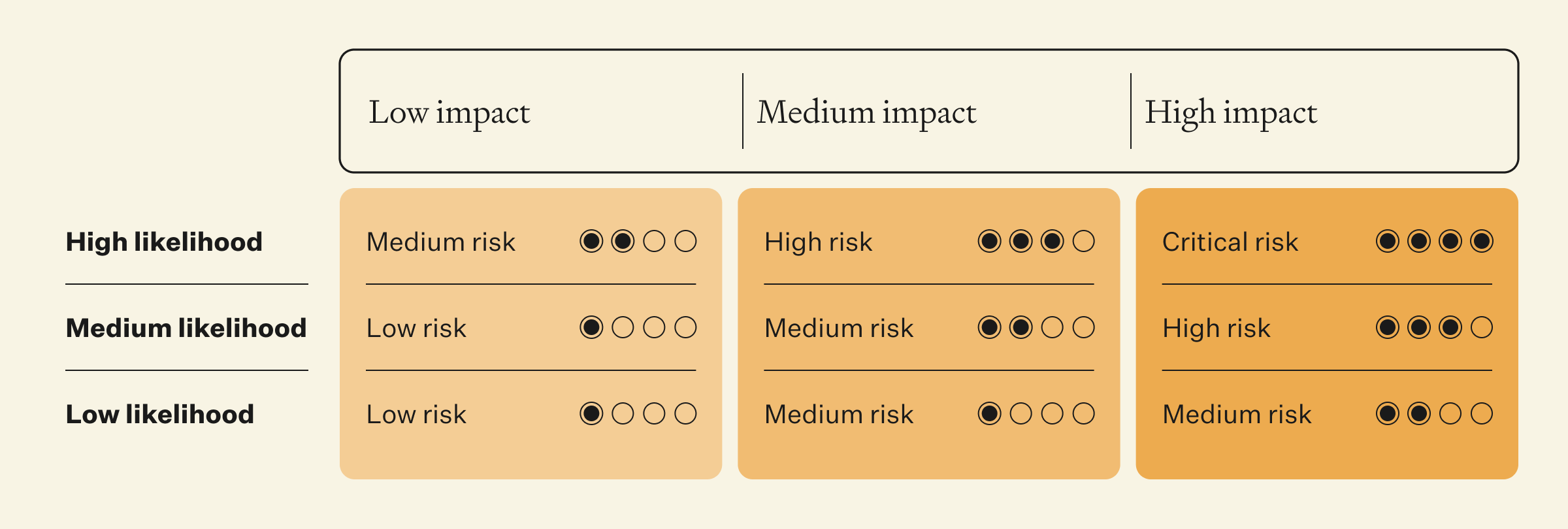
Evaluate each of the five risk domains against the agent's scope. Use a standard likelihood-impact matrix.
*Click on the image to see the full PDF
For each risk domain, assess:
How likely is this failure mode given the agent's design?
What is the business impact if it occurs?
An agent with broad system access and autonomous decision authority rates higher than an agent with narrow scope and human-in-the-loop controls.
Note: The matrix should support, rather than replace, expert judgment. A low-likelihood event may still require strong controls if its impact is severe or irreversible.
Validate the risk assessment through controlled testing. Run the agent through scenarios designed to trigger each risk domain: out-of-scope requests, privilege boundary tests, adversarial inputs (prompt injection), multi-agent interaction scenarios, and edge cases that exceed the agent's confidence threshold. Document results and compare against the ratings from step two.
Based on assessment and testing results, determine the deployment posture: deploy with current controls, deploy with additional controls (specify which), deploy in a limited sandbox with monitoring, or do not deploy until identified risks are mitigated. This decision requires sign-off from the agent owner, risk team, and business sponsor.
The framework is iterative. Reassess quarterly, at a risk-based cadence,or whenever the agent's scope, tools, data access, or underlying model changes.
Mitigation controls align to three lifecycle phases, creating defense-in-depth rather than relying on any single control point.
Least-privilege provisioning ensures the agent has only the permissions its function requires, reviewed and approved before deployment. Impact assessments document worst-case scenarios for each risk domain and define the rollback procedures that would apply. Sandbox execution tests agent behavior in an isolated environment that mirrors production without affecting real systems or data.
Guardrails enforce policy boundaries during execution: allow/deny tool lists, rate limits, output validation, and cost caps. Human-in-the-loop thresholds pause execution for approval when decisions exceed defined risk levels (transaction value, customer impact, compliance sensitivity). Continuous monitoring feeds agent behavior data into security and observability infrastructure in real time.
Immutable audit logging captures every agent action, tool call, data access, and decision for forensic analysis and compliance review. Drift monitoring detects behavioral changes that accumulate gradually: shifts in tool call patterns, changes in decision distributions, or expanding scope that was not authorized. Periodic reassessment using the four-step framework ensures that the risk profile stays current as the agent, its data, and its environment evolve.
The principle: No single control prevents all failures. Defense-in-depth means that when one control misses a risk, the next one catches it.
Four standards provide the regulatory and governance foundation for agentic AI risk management.
The Map and Measure functions align directly with the four-step assessment framework: Map corresponds to scoping, and Measure corresponds to rating and testing. The Manage function is addressed through the lifecycle-phase mitigation controls described above, and the Govern function is addressed through the accountability structure and board reporting described below.
Both are part of a complete NIST-aligned program, even though they sit outside the four-step framework itself.
The certifiable AI management system standard provides role definitions, operational controls, and audit requirements that apply to agentic systems. Clause 8 (Operation) is relevant for runtime controls and human oversight.
The AI risk management standard extends ISO 31000 (general risk management) to AI-specific concerns, providing a bridge between existing enterprise risk programs and agentic AI requirements.
High-risk AI system requirements (logging, human oversight, transparency, conformity assessment) apply to autonomous agents that make decisions affecting individuals or critical infrastructure. Non-compliance with high-risk system requirements carries fines of up to 15 million euros or three percent of global turnover; the Act's highest penalty tier, up to 35 million euros or seven percent of global turnover, is reserved for prohibited-practice violations under a separate article.
Integration tip: Map agentic AI risk into existing enterprise risk management (ERM) registers rather than maintaining a separate risk program. The risk domains are new. The management discipline is not.
Documentation checklist for board reporting: current risk assessment results by agent, policy update summary, audit evidence demonstrating control effectiveness, and documented risk appetite for agent autonomy by tier.
Continuous monitoring closes the gap between periodic risk assessment and real-time operational reality.
Three metrics anchor the monitoring program.
Permission drift measures whether agent access has expanded beyond its authorized scope over time.
Anomaly rate tracks the frequency of agent actions that deviate from established behavioral patterns.
High-impact action count monitors the volume of agent actions that exceed defined risk thresholds (transaction value, data sensitivity, customer impact).
Incident response follows a three-step flow: 1. Detect: Monitoring alerts flag anomalous behavior, exceeded thresholds, or failed controls 2. Isolate: The agent is suspended or its scope is restricted to prevent further impact. Clear shutdown authority must be pre-assigned so isolation does not wait for an approval chain during an active incident. 3. Recover: Root-cause analysis determines what failed, remediation addresses the gap, and the agent is reassessed through the four-step framework before resuming production.
Suggest a monthly cadence for rule review:
Are monitoring thresholds still calibrated to the agent's current behavior?
Are alert volumes manageable, or is noise drowning out signal?
Are incident response procedures current, or have roles and systems changed since they were last documented?
Dataiku, the Platform for AI Success, provides this continuous monitoring layer through Dataiku Agent Management, which tracks business performance, behavioral drift, and governance status across agents on any platform, providing the continuous monitoring layer that connects risk assessment to operational reality.
Agentic AI risk management follows a repeatable cycle: Assess risks through the four-step framework, mitigate through lifecycle-phase controls, and monitor continuously to catch what assessment and mitigation miss. The cycle improves with every iteration as the organization learns from incidents, testing results, and production experience.
The concrete next step: Run the four-step assessment (scope, rate, test, decide) against one production agent this month. Document the results. Use them as the template for every subsequent agent.
Dataiku embeds risk controls, monitoring, and governance across the agent lifecycle so mitigation scales with deployment rather than requiring manual oversight that breaks down as the agent fleet grows.
Discover Dataiku for agentic AI risk management
Assess, monitor, and govern AI agents at scale with Dataiku
Agentic AI risk management is the discipline of identifying, assessing, mitigating, and monitoring the specific risks that autonomous AI agents introduce when they reason, make decisions, and take actions in enterprise environments. It addresses risk domains that traditional AI governance does not cover: execution control loss, unauthorized tool use, privilege escalation, data misuse, and emergent multi-agent behavior.
Ownership is distributed. The agent owner is accountable for the approved use case and its operation. The security team owns runtime defense controls. The risk and compliance team validates regulatory alignment and signs off on risk assessments. The business sponsor defines acceptable risk tolerance. A cross-functional steering committee resolves escalations and owns the governance framework. The precise allocation should be documented in a RACI or equivalent responsibility model.
A risk is the potential for harm: The probability that an agent will take an unauthorized action, access restricted data, or produce an incorrect output. An incident is the realization of that risk: The agent did it, and the business is dealing with the consequences. Risk management aims to reduce the probability and impact of incidents before they occur. Incident response manages the consequences when they do.
Through structured testing across each risk domain. Run the agent through out-of-scope requests to verify boundary enforcement. Attempt privilege elevation to confirm least-privilege controls hold. Inject adversarial prompts to test input filtering. Simulate multi-agent interactions to check for emergent behavior. Measure results against the risk ratings from the assessment framework. Any control that fails testing must be remediated before the agent reaches production.
The cadence should reflect the agent's risk, autonomy, business impact, and rate of change. Quarterly reassessment may be appropriate for many production agents, but it should not be treated as a universal minimum. Reassess immediately when any of these conditions change: The agent's scope or tool access is modified, the underlying model is updated, the data sources the agent accesses change, a governance incident occurs, or new regulatory requirements apply. The four-step framework is designed to be repeatable, and the cost of reassessment is significantly lower than the cost of an undetected risk.
Tags