Single-agent vs. multi-agent systems: Enterprise AI tradeoffs
March 17, 2026/6 min read/Clément Stenac
In many organizations, AI pilots start with a single agent. It’s faster to build and easier to test. But as use cases expand into multi-step workflows (fraud investigations, claims processing, supply chain coordination), the limits of a single-agent setup become clear.
A recent Cornell University study found that coordinated multi-agent systems achieved a 42.68% success rate on complex planning tasks, whereas a single-agent GPT-4 setup scored just 2.92% on the same benchmark. For enterprise teams, that difference raises a practical question: When does one agent stop being enough?
The issue lies with architectural fit. Choosing between single-agent and multi-agent systems affects scalability, governance, cost, and operational risk. This article outlines the tradeoffs and provides a framework for deciding which approach aligns with your production goals.
Single-agent systems are simpler to govern and cost-effective for well-defined, sequential tasks, but they struggle with cross-functional complexity.
Multi-agent systems distribute work across specialized agents, improving scalability, fault tolerance, and parallel execution in process-driven environments.
The architectural choice directly impacts governance, cost control, coordination design, and production risk from day one.
Successful multi-agent deployments require explicit role boundaries, communication protocols, continuous monitoring, and built-in oversight.
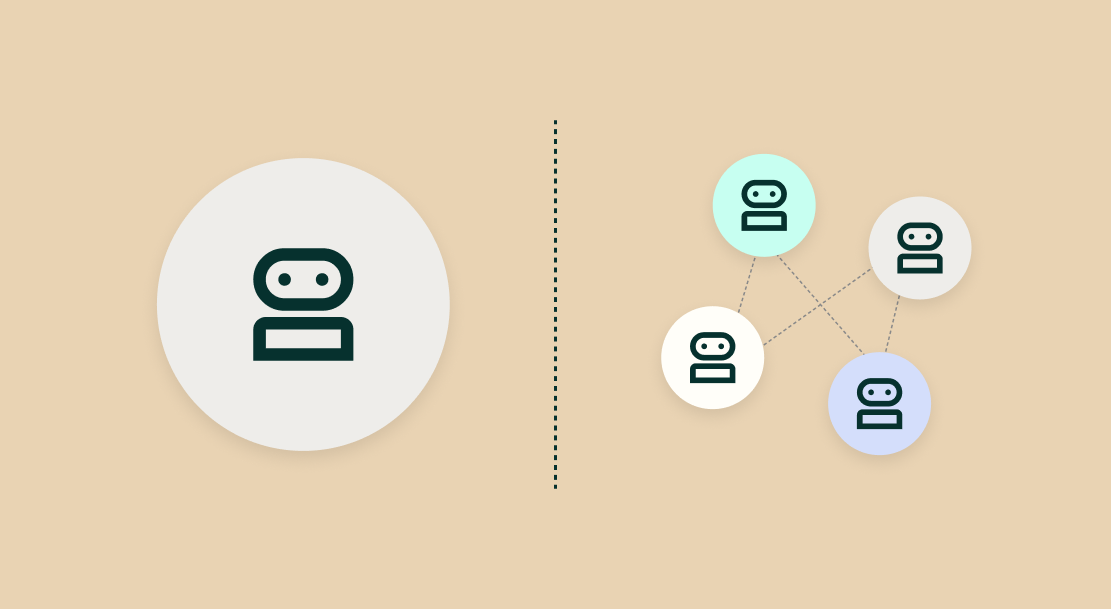
A single-agent system relies on one LLM to handle both planning and execution. It receives a prompt, reasons through the steps, and produces an output, like a customer service chatbot answering questions within a defined scope.
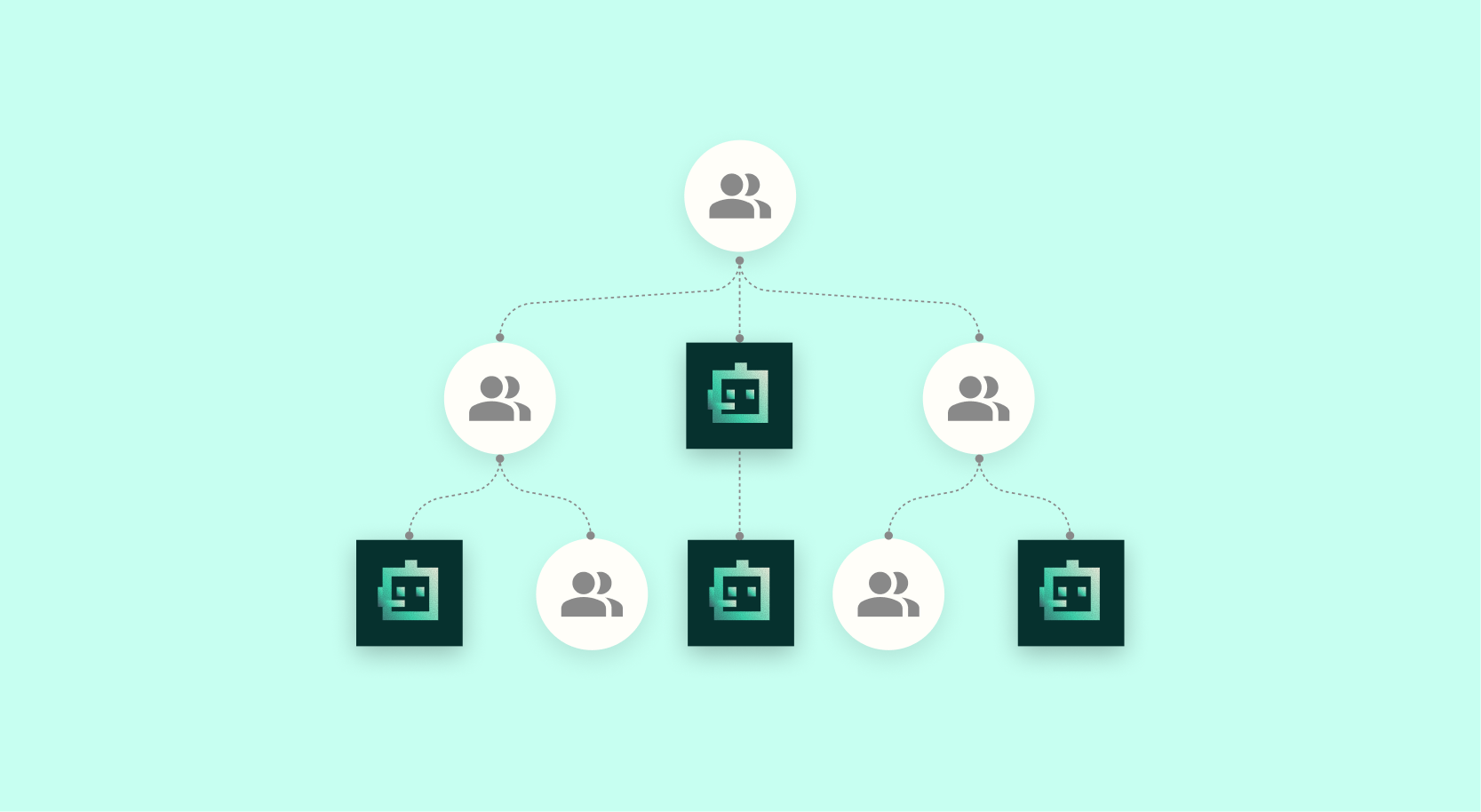
A multi-agent system works differently. Instead of one model doing everything, multiple autonomous agents take on specialized roles and coordinate to solve a problem collectively. In a fraud detection workflow, for example, one agent might analyze transactions, another reviews customer history, an aggregator synthesizes the findings, and a validator checks the results.
This distinction matters for enterprise AI architecture because governance and scalability requirements shift accordingly. A single agent is easier to monitor and audit. A multi-agent system requires explicit coordination, but it can manage levels of complexity that would overwhelm a single model.
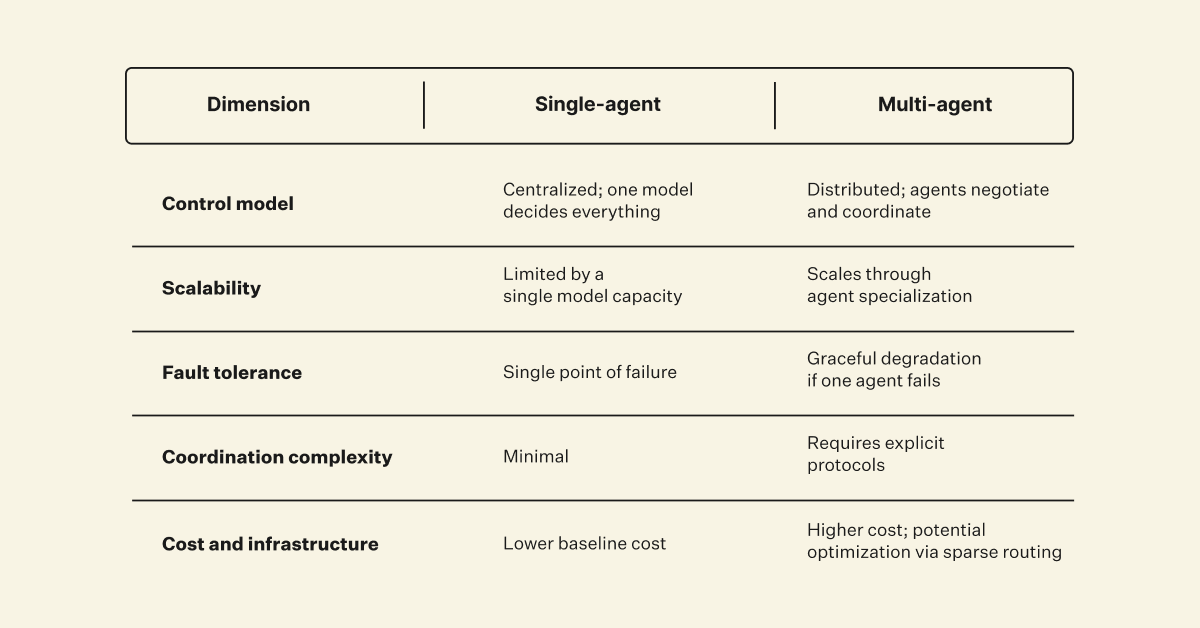
Understanding when each architecture fits means comparing them across the dimensions that matter in production. The differences affect control, cost, and risk from day one.
The table below highlights how the two approaches diverge operationally:
A chess AI illustrates single-agent design: One model evaluates positions and selects moves. By contrast, traffic optimization across a metropolitan area requires multiple agents, where each intersection coordinates with neighbors while responding to local conditions.
So how do you decide?
Decision checklist for architecture selection:
Choose a single-agent system when tasks are well-defined and sequential.
Choose a multi-agent system when tasks require parallel processing or domain expertise.
Consider hybrid models with a central orchestrator and specialist agents.
Evaluate governance readiness before committing to distributed architectures.
Hybrid approaches combine central oversight with distributed execution. They often deliver the governance clarity of single-agent systems with the capability of multi-agent systems.
Multi-agent systems rely on several foundational elements:
Agents: These vary in autonomy. Some operate independently, while others include human-in-the-loop checkpoints for high-stakes actions.
Environments: Agents may operate in physical settings, like warehouse robotics, or virtual ones, such as software agents processing claims.
Communication protocols: Structured exchanges via ACL, REST APIs, or messaging systems enable coordination and shared context.
When designed intentionally, multi-agent systems expand what AI can handle in production. The coordination overhead is real, but so is the payoff once your use cases move beyond simple, sequential tasks.
Key benefits of multi-agent systems include:
Scalability through specialization: Instead of retraining one large model to do everything, you can introduce a specialist agent for a new domain. That modularity makes expansion more manageable and often more cost-efficient over time.
Improved fault tolerance: A single-agent system has one decision engine. In a multi-agent setup, failure in one component doesn’t necessarily bring the entire workflow down. The system can degrade gracefully while maintaining core operations.
Deeper domain expertise: Agents can be optimized for specific responsibilities. In financial services, for example, one agent might focus on regulatory compliance while another handles market analysis, each operating within defined boundaries.
Faster execution through parallelism: Single agents process tasks step by step. Multi-agent systems distribute work across specialists simultaneously, reducing bottlenecks in complex workflows.
As AI initiatives shift from isolated assistants to process-oriented systems, these advantages become less about experimentation and more about operational capability.
The same coordination that makes multi-agent systems powerful also introduces new layers of complexity. As soon as you move from one agent to many, architecture decisions start affecting performance, cost, and governance in very visible ways.
The table below outlines the most common enterprise challenges and ways to mitigate them:
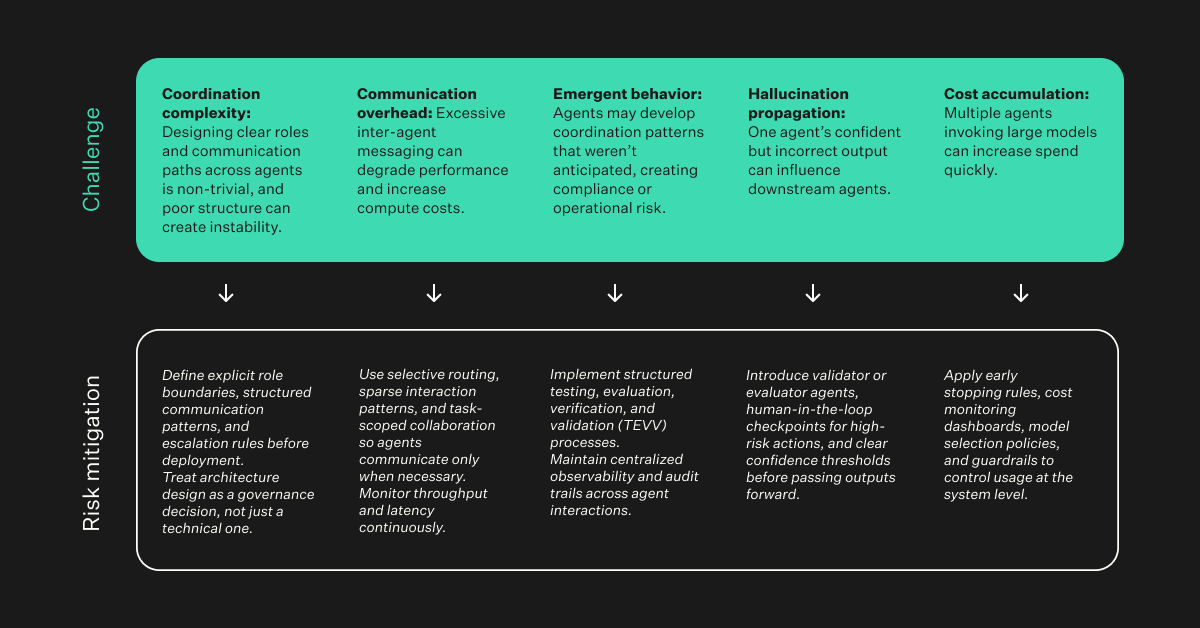
In practice, most failures in multi-agent deployments stem from insufficient coordination design and weak oversight. As your agent ecosystem grows, so does your governance surface, and that requires intentional controls from day one.
Enterprise adoption of agentic AI accelerates rapidly. Deloitte reports significant enterprise movement toward agentic AI, with companies progressing quickly from testing to deployment. At the same time, Dataiku’s survey report, "7 Career-Making Decisions for CIOs in 2026," found that 87% of global CIOs report AI agents are already embedded in their company’s workflows in some way, signaling a clear shift from isolated pilots to production-grade integration.
The examples below illustrate how multi-agent architectures show up differently across industries, depending on workflow complexity and regulatory pressure:
In financial services, multi-agent systems support fraud detection by combining transaction analysis agents with pattern-recognition specialists and validation layers. Credit risk workflows often pair document extraction agents with scoring models, creating structured pipelines instead of isolated model calls.
Retail demand forecasting improves when agents monitoring sales data coordinate with those tracking external signals like weather or promotions. Pricing optimization systems can assign agents to monitor competitor activity, while others adjust pricing based on inventory levels and margin targets.
Healthcare environments use multi-agent systems for clinical decision support, where symptom analysis agents collaborate with treatment recommendation specialists. In drug discovery, molecular screening tasks can be distributed across agent teams to accelerate experimentation without overwhelming a single model.
In manufacturing, predictive maintenance systems deploy sensor-monitoring agents that feed structured signals into failure prediction specialists. Quality control environments coordinate visual inspection agents with defect classification models, reducing production bottlenecks.
Across industries, the pattern is consistent. As workflows become more complex and process-driven, specialization and coordination shift from being architectural options to operational requirements.
Moving from concept to production requires disciplined architecture decisions. Most agent initiatives stall because coordination, governance, and observability were not designed upfront. These elements must be embedded into the system lifecycle, not retrofitted later.
A practical implementation typically unfolds in stages:
Before choosing tools or frameworks, clarify what success looks like:
Define business goals and measurable success criteria.
Identify constraints around governance, risk, and compliance.
Determine whether coordination complexity truly requires multiple agents.
Clear objectives prevent architectural overengineering.
With goals defined, translate them into system boundaries:
Model the operating environment.
Identify agent roles and responsibilities.
Choose coordination patterns (orchestrator–executor or peer-to-peer).
Select communication protocols aligned with your infrastructure.
This is where scalability and fault tolerance are decided.
Development should focus on both individual agent capability and collective behavior:
Integrate external systems through structured APIs.
Test agents independently for task accuracy.
Stress-test inter-agent coordination under load.
Many failure modes emerge only during collaboration, not isolated testing.
Production readiness depends on measurable performance and continuous oversight.
Key evaluation metrics include:
Throughput: Tasks completed per unit of time
Latency: Time from input to final output
Inter-agent reliability: Successful handoffs versus coordination failures
Cost per task: Total inference spend divided by completed workflows
Deployment is not the endpoint. Agent behavior can drift as models update or data distributions shift. Continuous monitoring ensures the system remains aligned with business objectives, performance thresholds, and governance requirements.
The single vs. multi-agent system choice shapes whether your AI investments deliver production value or remain stuck in pilots. Multi-agent architectures outperform single agents on complex tasks but demand governance infrastructure. Multi-agent systems require centralized oversight and audit trails built into the development workflow. Capabilities within Dataiku, including Agent Hub for orchestration and Dataiku Govern for lifecycle management, address these requirements directly. Start with clear goals. Match architecture to task complexity. Build governance in from day one.
A common example of a single-agent system is an enterprise chatbot powered by a centralized LLM. The system receives user input, processes it through a single reasoning pipeline, and generates a response or action. All decision-making is handled by that one agent, which makes the system easier to govern, test, and predict.
AI agents are often categorized into four broad types based on how they make decisions and interact with their environment. Reactive agents respond only to current inputs and hold no memory of past states. Model-based agents maintain an internal representation of the environment in which they operate, allowing them to reason about situations they can't directly observe. Goal-based agents evaluate possible actions based on how well they help achieve a specific goal. Finally, utility-based agents optimize outcomes by weighing tradeoffs such as cost, risk, or performance.
An example of a multi-agent system is an AI-driven supply chain optimization platform. In this setup, separate agents may independently handle demand forecasting, supplier risk analysis, inventory planning, and logistics routing. These agents communicate and coordinate with one another to produce a global outcome without relying on a single centralized decision-maker.
Tags