Enterprise AI agents: architecture, use cases, and ROI guide
April 23, 2026/6 min read/Mark Abramowitz
Your IT team spends 40% of its week on ticket triage, status updates, and routing. A chatbot handles the easy questions but stalls the moment a request needs judgment or context from multiple systems. Does this sound familiar? Enterprise AI agents close that gap. This guide covers architecture decisions, use cases with ROI evidence, and a deployment playbook built for CIO-level governance requirements.
Enterprise AI agents go beyond chatbots and copilots by autonomously reasoning through multi-step workflows, using tools, retaining memory, and adapting without constant human oversight.
The differentiator for enterprise deployments is the architecture: governance, memory, tool integration, and orchestration, connecting agents to existing systems.
Agent maturity follows a clear progression from assistive to multi-agent, so most organizations should start at the bottom rather than leap to full autonomy.
Measurable ROI depends on matching the right maturity level to the right process.
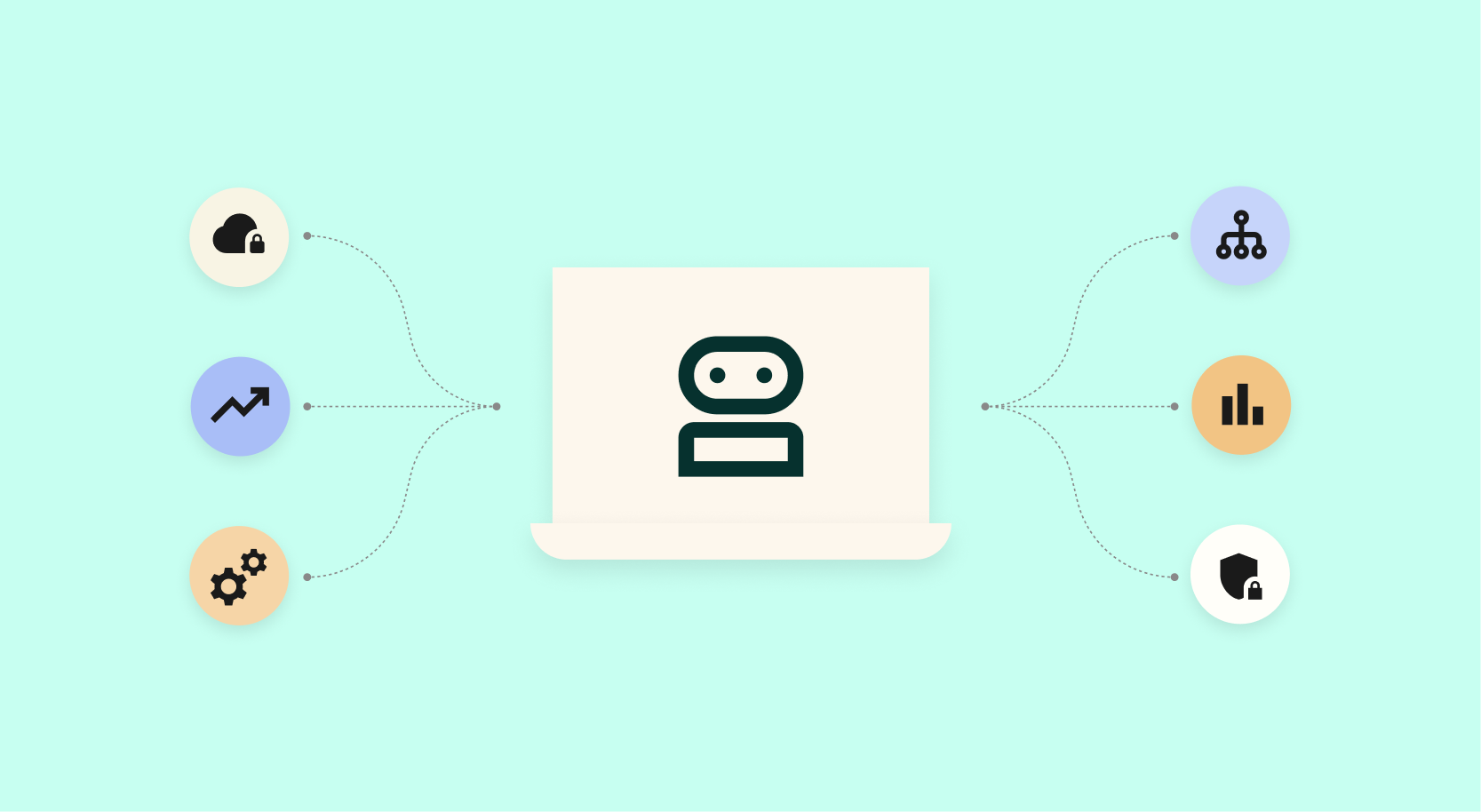
An enterprise AI agent is a software system that perceives its environment, reasons through multi-step plans, and executes tasks by calling external tools. Unlike static chatbots that respond to single prompts, agents operate in continuous loops. They observe context, decide on actions, execute those actions, and learn from results.
The core distinction from copilots lies in autonomy. Copilots suggest; agents act. A copilot might recommend a customer response. An agent drafts the response, checks it against compliance rules, sends it, and logs the interaction for audit.
Several capabilities define production-ready agents:
Memory persistence: Agents retain context across sessions and interactions.
Planning modules: Agents decompose complex tasks into sequenced steps before execution.
Tool integration: Agents access databases, APIs, and enterprise systems through controlled connections.
Governance hooks: Built-in checkpoints enable human review and audit trails at every stage.
These capabilities transform agents from demo-ready experiments into systems that handle real operational workloads.
Architecture decisions made early determine whether agents reach production or stall in pilot phases. Each block contributes a distinct capability to the agent's overall function:
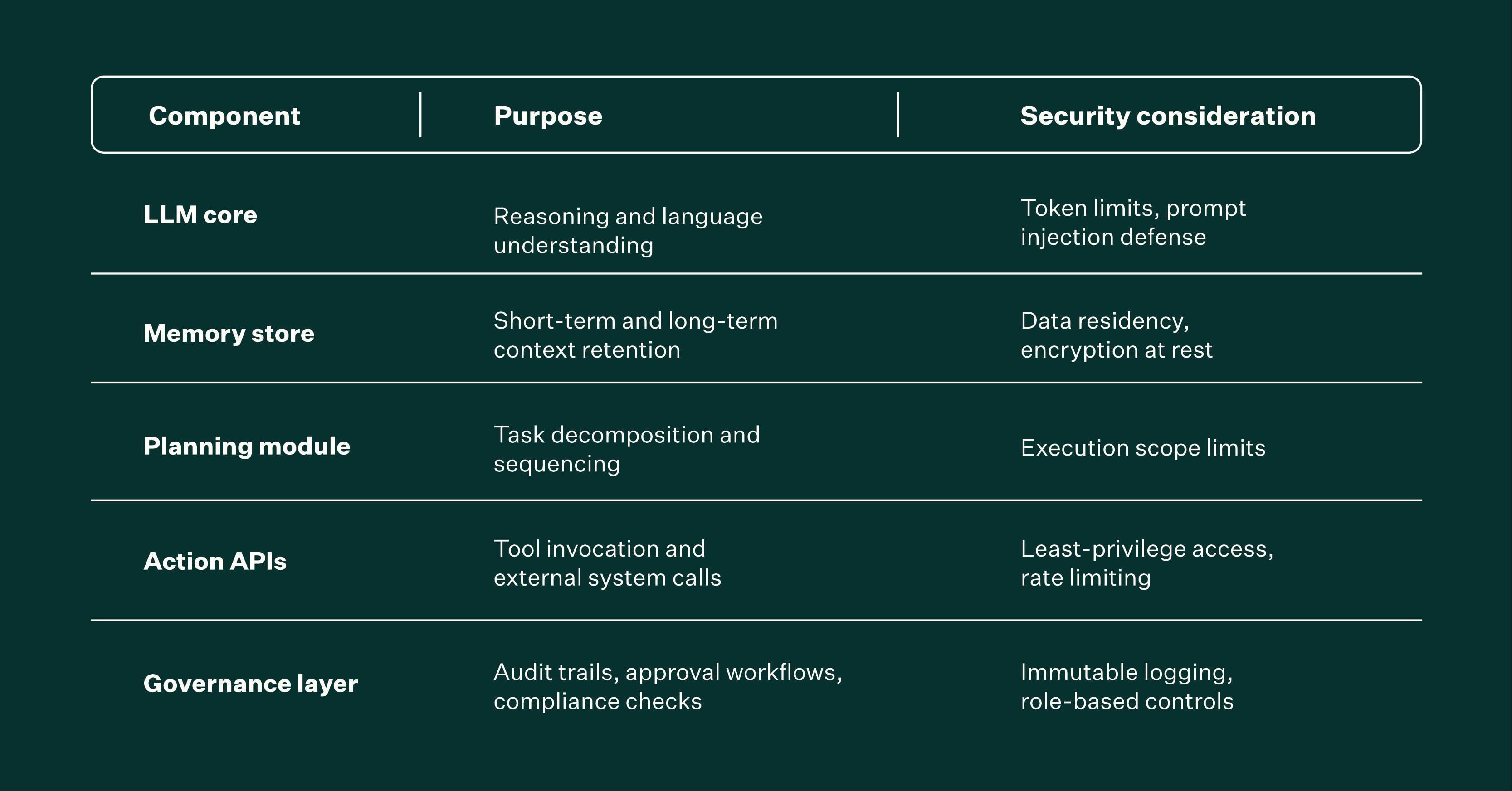
Click on the image above to zoom into full PDF
Open-source frameworks (LangChain, CrewAI, AutoGen) provide building blocks but leave security, governance, and scalability to your engineering team. Enterprise platforms add centralized oversight, role-based access, and production monitoring. For teams that need agents in production within weeks, a platform approach typically delivers faster, safer results.
Not every process needs full autonomy. Enterprise AI maturity follows four levels, and choosing the right one is critical to ROI:
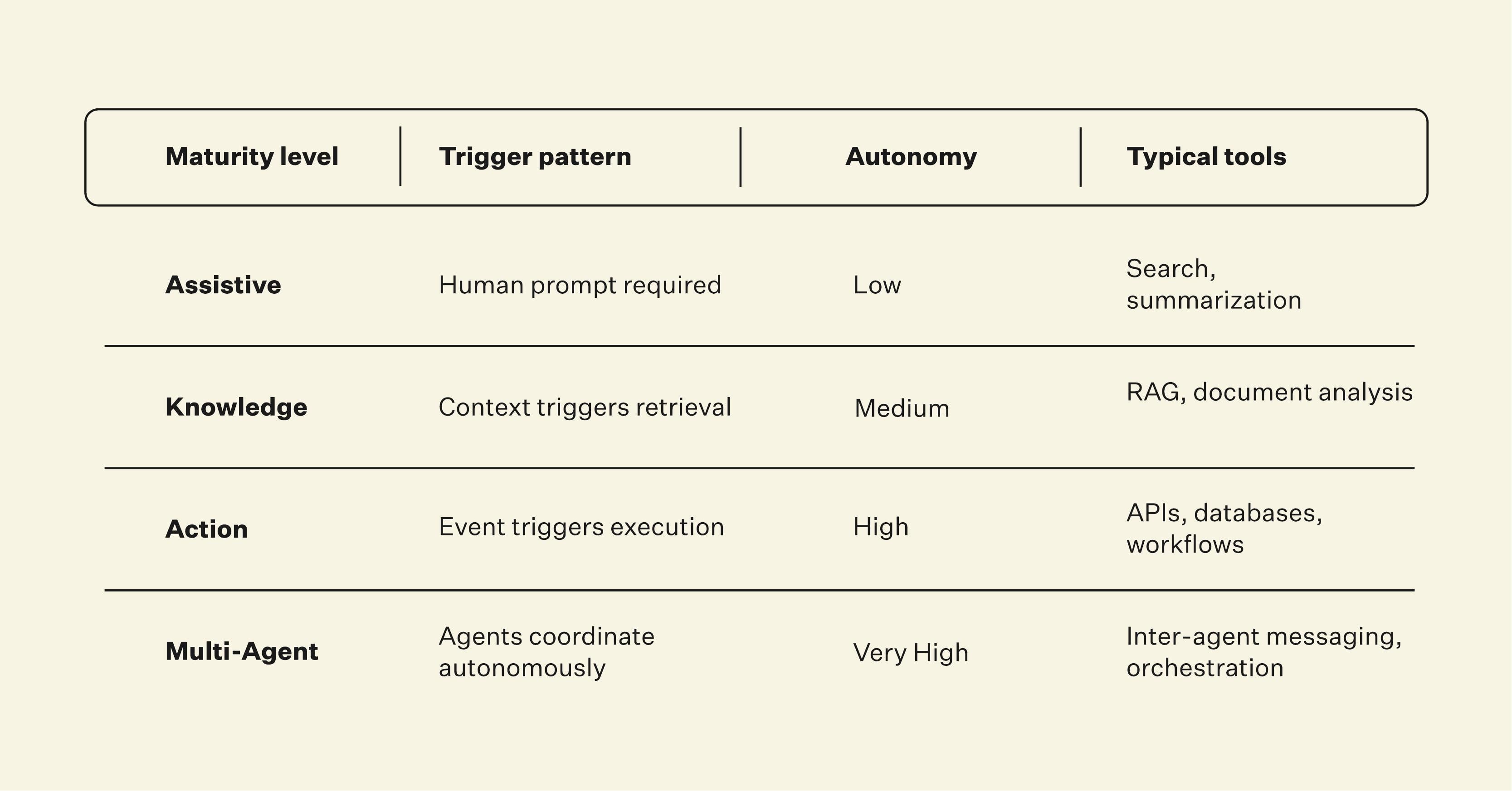
Click on the image above to zoom into full PDF
Start assistive. Graduate to knowledge and action agents as governance matures. Reserve multi-agent for workflows that genuinely require specialized coordination.
Dataiku is the Platform for AI Success, a single platform where business and technical teams collaborate on data, ML, generative AI (GenAI), and agents with governance embedded at every layer. Agent Hub in Dataiku supports all four maturity levels within a single governed environment, so you don't need to re-platform as your agents mature.
Enterprise AI agents operate through a continuous loop:
1. Observe: The agent ingests data from APIs, databases, user inputs, and event streams, detecting triggers that require action.
2. Plan: The agent reasons about the approach, decomposes goals into sub-tasks, selects tools, and sequences actions. Memory from previous cycles informs planning.
3. Act: The agent executes by calling APIs, generating content, updating records, or escalating to humans when confidence is low. Results feed back into observation, creating a self-improving loop.
Human-in-the-loop checkpoints fit naturally into this cycle. Organizations configure approval gates before high-stakes actions, enabling agents to prepare decisions while humans retain final authority.
Enterprise AI agents deliver measurable value when applied to well-scoped processes, combining automation with reasoning to reduce cost, increase speed, and improve operational consistency.
The business impact typically shows up across five dimensions:
1. Cost reduction: According to IBM, deploying agentic AI across 270,000 employees produced a $4.5 billion productivity impact.
2. Efficiency at scale: "By 2029, agentic AI will autonomously resolve 80% of common customer service issues without human intervention, leading to a 30% reduction in operational costs," according to Gartner®, Inc.*
3. Decision speed: Agents synthesize information from disparate sources in seconds rather than days, whether for fraud pattern detection, predictive maintenance scheduling, or campaign optimization.
4. Error reduction: Consistent rule application eliminates variability in compliance-sensitive workflows.
5. ROI formula: Compare current process cost (hours × headcount × loaded rate) against agent-assisted cost (platform + integration + oversight) over 12 months. Start with one workflow to build a credible business case.
AI agent examples span industries, with common patterns emerging in high-volume, rules-driven workflows:
Financial institutions deploy agents to evaluate transaction context in real time. A traditional fraud system flags transactions based on fixed rules. An agent evaluates transaction history, merchant patterns, and account behavior before deciding, reducing false positives while catching sophisticated fraud patterns.
Healthcare agents coordinate across electronic health record systems to surface relevant patient history during clinical encounters. They retrieve test results, flag drug interactions, and prepare summary views for physicians. The measurable outcome is faster clinical decisions with complete information.
Retail agents manage inventory replenishment by integrating demand forecasts with supplier lead times. They generate purchase orders within approved parameters and escalate exceptions for human review.
Manufacturing agents monitor equipment sensor data and correlate it with maintenance histories. They predict failures, schedule preventive maintenance, and order replacement parts before breakdowns occur.
"Over 40% of agentic AI projects will be canceled by the end of 2027, due to escalating costs, unclear business value or inadequate risk controls," according to Gartner, Inc.
Here are the primary challenges:
Data privacy: Agents accessing multiple systems expand the attack surface, requiring least-privilege access and continuous monitoring.
Bias: Agents inherit biases from training data. Regular output auditing is essential.
Talent gap: Agent development spans data engineering, ML operations, and business process design. Platform-level accessibility helps close this gap.
Cost and complexity: Start small, measure rigorously, and scale only what works.
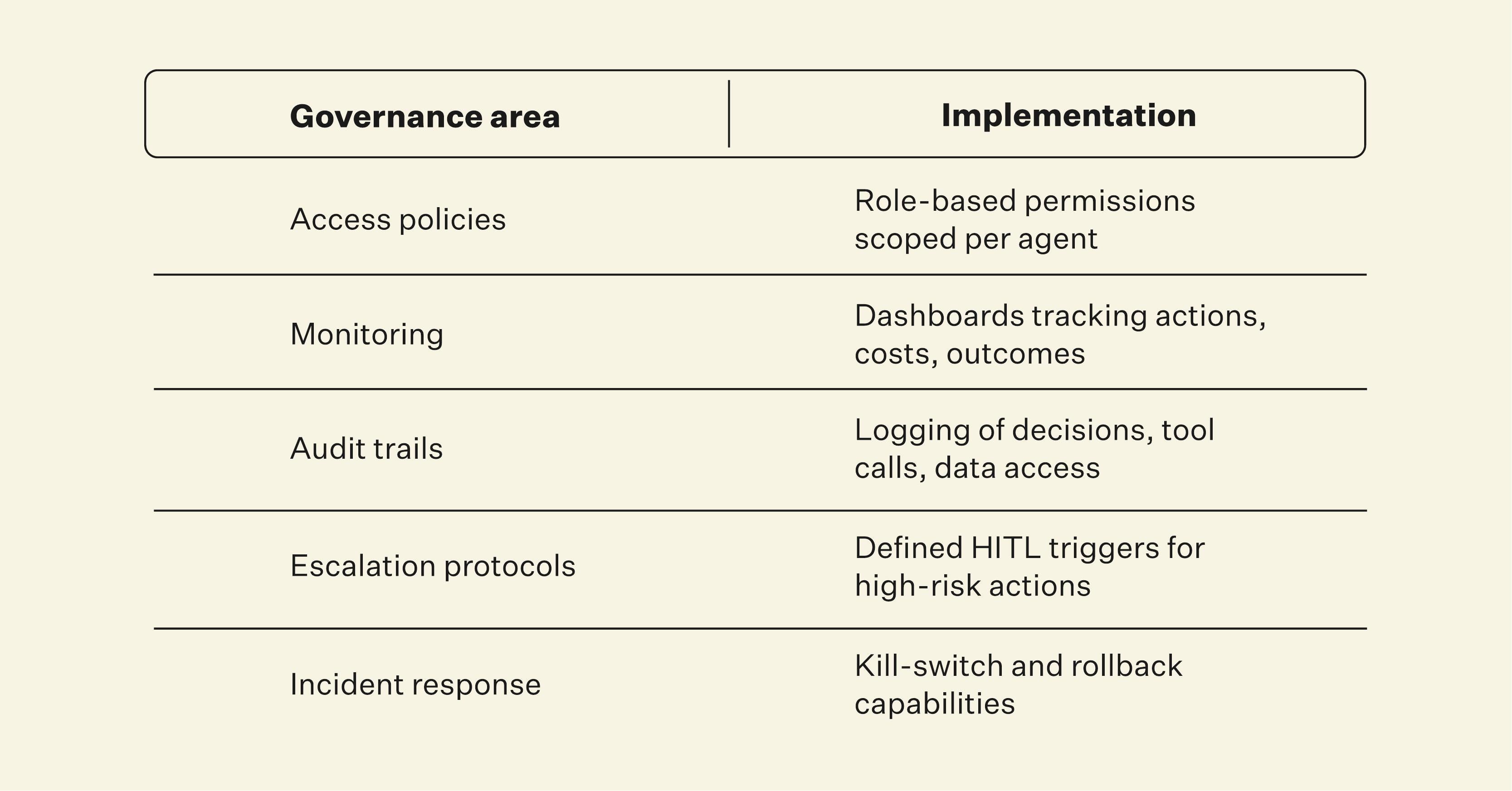
Enterprise AI agents introduce operational, regulatory, and financial risks that traditional automation frameworks were not designed to handle. To move from experimentation to production safely, organizations need explicit governance structures that define who agents can access, how their actions are monitored, and what safeguards activate when something goes wrong.
The table below outlines the core governance areas enterprises must formalize to reduce risk and operate AI agents safely at scale:
Click on the image above to zoom into full PDF
Failure scenario: An agent with broad API access updates pricing across 500 stores based on a misinterpreted demand signal.
Mitigation: Scope authority to a narrow range, require human approval above threshold, and maintain automated rollback.
A seven-step framework guides deployment from concept to scale:
1. Identify the right use case. Choose a high-volume, rule-heavy, well-documented process. Support triage, document processing, and compliance monitoring are proven starting points.
2. Assess data readiness. Audit quality, accessibility, and integration points. Agents need clean, connected data to reason effectively.
3. Decide build vs. buy. Open-source offers flexibility but requires engineering investment. Enterprise platforms deliver faster deployment with built-in governance. Factor in total cost: integration, governance overhead, and team ramp-up.
4. Pilot with human-in-the-loop. One team, one workflow, one measurable KPI. Keep human oversight tight.
5. Measure and iterate. Track business KPIs (cycle time, error rate, cost per resolution), not just technical metrics.
6. Scale with governance. Extend successful pilots with centralized oversight. Every new agent inherits the same framework.
7. Drive adoption. Train teams on working with agents. Supervising AI-driven processes requires new skills.
"Forty percent of enterprise applications will be integrated with task-specific AI agents by the end of 2026, up from less than 5% today," according to Gartner Inc.*
Strategic moves for CIOs in the next 12 months:
Establish an enterprise-wide AI governance council with clear escalation authority.
Pilot agents in one high-value process with full observability before expanding.
Build internal skills for agent oversight, including risk awareness and audit capabilities.
Enterprise AI agents shift organizations from productivity tools to systems that operate autonomously within business processes. The pattern among those capturing value: well-scoped pilots, rigorous governance, and methodical scaling.
Platforms like Dataiku operationalize this disciplined approach by embedding governance, oversight, and lifecycle management directly into how agents are designed and deployed.
Dataiku Govern embeds approval workflows and audit trails directly into the agent lifecycle, enabling scale without sacrificing control. The organizations capturing value today started with discipline.
The market spans cloud-native agent builders, CRM-embedded agents, and governed AI platforms. When evaluating, prioritize governance depth, multi-model flexibility, integration breadth, and whether both technical and business users can build agents without re-platforming. Agent Hub in Dataiku covers the full lifecycle, from data preparation through governed agent deployment.
A compliance monitoring agent that scans regulatory updates, cross-references them against current policies, identifies gaps, drafts remediation recommendations, and routes them for approval, completing in hours what previously took weeks is an example of an enterprise AI agent.
An AI agent perceives its environment, reasons about the best course of action, executes tasks by calling tools and APIs, and learns from results to improve over time.
Agentic AI is the broader category of AI systems capable of autonomous reasoning, planning, and action. Enterprise AI agents are agentic AI architected for business environments with added governance, security, compliance, and system integration. All enterprise AI agents are agentic AI, but not all agentic AI meet enterprise production requirements.
*Gartner Press Release, Gartner Predicts Agentic AI Will Autonomously Resolve 80% of Common Customer Service Issues Without Human Intervention by 2029, March 5, 2025.
GARTNER is a trademark of Gartner, Inc. and its affiliates.
Tags