AI decision automation: faster and more consistent decisions
May 25, 2026/7 min read/Jed Dougherty
The bottleneck in most enterprise AI programs is not model accuracy, and it is not the quality of GenAI outputs. It is the last mile: getting a prediction, a recommendation, or an agent's reasoning into an actual operational decision, at speed, with a clear accountability trail. Enterprises are building more AI than ever. ML models score risk. GenAI drafts responses, summarizes documents, and surfaces insights. Agents plan and execute multi-step workflows with minimal human intervention. Yet for many organizations, the outputs of all this AI activity still land in a dashboard or a review queue, waiting on a human to act. The intelligence exists. The decision infrastructure to operationalize it, at scale, does not. According to "Global AI confessions report: data leaders edition," based on a Dataiku/Harris Poll survey of 800 global data leaders, 64% say their AI agents are better at automating operational tasks than at making higher-order business judgments. That gap between operational automation and decision-quality AI is where most enterprises stall. Models generate signals. Agents take actions. But without a governed decision layer connecting the two to real business workflows, neither delivers consistent, auditable outcomes at the speed the business requires. This guide covers the components of AI decision automation, use cases across four industries, governance controls that keep AI-driven decision-making accountable, and a six-step roadmap for implementation.
AI decision automation moves AI outputs from dashboards and notebooks into operational decisions, executed at speed with governance controls.
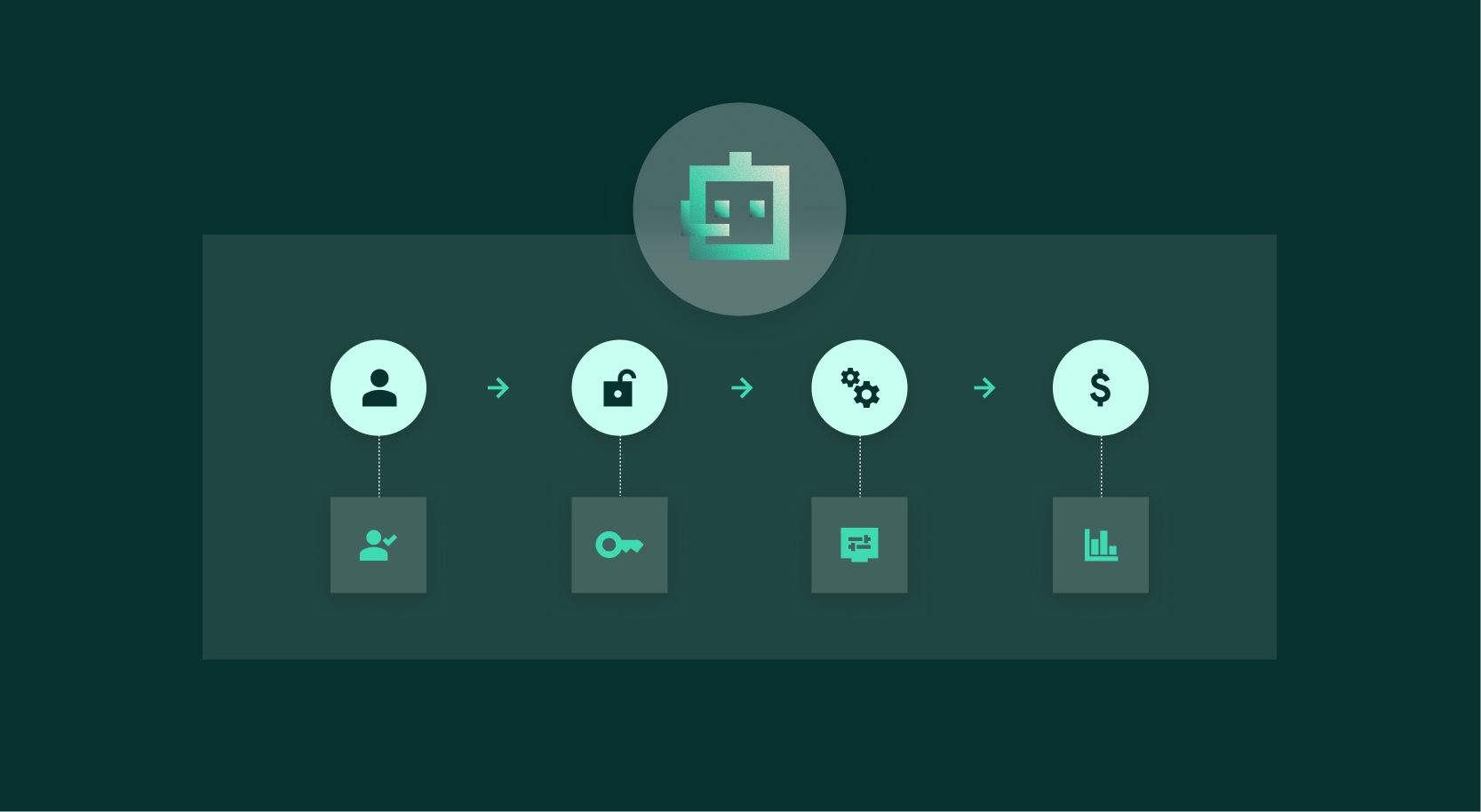
Four components drive it — data inputs, ML models, business rules engines, and workflow orchestration.
Enterprise use cases span domains including finance, supply chain, customer service, and compliance, each with different automation thresholds and oversight requirements.
Governance and human-in-the-loop controls are not optional. They are what make the difference between AI decisioning that scales and AI decisioning that creates liability.
AI decision automation is the use of machine learning models, business rules, and workflow orchestration to make or recommend decisions that previously required human judgment, at a speed and consistency that manual processes cannot match. It's not the same as traditional decision support (which presents data for humans to act on) or robotic process automation (RPA, which automates keystrokes and clicks without reasoning). AI decision automation sits between the two: The system reasons through data, applies learned patterns and business rules, and either executes the decision directly or presents a recommendation with a confidence score for human approval. The spectrum runs from fully rule-based (if revenue exceeds threshold, approve budget automatically) through ML-augmented (model scores risk, human reviews edge cases) to fully autonomous (agent evaluates, decides, and acts without human intervention). Most enterprise AI decisioning systems operate in the middle — the model handles the volume, and humans handle the ambiguity. Here's a practical example. A mid-market company processes 2,000 expense reports monthly. A rules engine auto-approves reports under $500 that match policy. An ML model flags anomalies in the rest. A human reviewer handles only the eight percent that the model cannot classify with high confidence. The result is the same quality with 90% less manual review time.
Four building blocks make AI process automation work at enterprise scale.
Every automated decision depends on the data feeding it. Structured data from enterprise resource planning (ERP), customer relationship management (CRM), and financial systems combines with unstructured inputs (documents, emails, sensor readings) to create the decision context. Data quality is the most common failure point: A decision model trained on incomplete or stale data produces confident, wrong outputs.
Models provide the predictive or classificatory intelligence: credit risk scores, demand forecasts, anomaly detection, and intent classification. The model does not make the decision alone. It provides the signal that the decision system acts on.
Rules encode organizational policy, regulatory requirements, and risk thresholds. They constrain what the model's output can trigger. A model might score a loan application as low-risk, but a business rule blocks approval if the applicant's jurisdiction has specific regulatory requirements. Rules and models work in tension, and that tension is a feature, not a bug.
The orchestration layer sequences the decision: which data to pull, which model to run, which rules to apply, what happens when confidence is low, and where human approval gates sit. Without orchestration, the other three components exist in isolation, producing insights that never become actions.
Decision intelligence AI delivers the most measurable impact in high-volume, rule-heavy decision environments where speed and consistency directly affect business outcomes.
Automated credit scoring and insurance underwriting are among the most mature AI decision automation use cases. Bestow's life insurance platform illustrates the pattern: A rules engine automates data calls and decision sequencing while ML models score risk in real time, moving applications from submission to policy issuance in minutes rather than days. Human underwriters handle edge cases and regulatory exceptions. The rules engine enforces compliance boundaries (GDPR, Fair Lending Act) automatically throughout.
Demand forecasting models connected to automated reorder systems reduce inventory carrying costs while preventing stockouts. The decision loop is tight: Sensor and IoT data feeds into ML predictions, which trigger procurement actions when inventory drops below dynamically adjusted thresholds. Enterprises implementing this pattern report meaningful inventory reductions while maintaining or improving fill rates, with outcomes varying by industry and implementation scope.
AI-driven decision making in customer service starts with triage: classifying incoming tickets by intent, urgency, and customer value. The system routes straightforward issues to automated resolution and complex ones to human agents with full context attached. The consistency benefit is as significant as the speed benefit: Every customer gets the same classification logic applied, 24/7, regardless of which shift is handling the queue.
Real-time anti-money laundering (AML) checks, policy enforcement, and anomaly detection are decision automation use cases where the cost of a missed decision is regulatory action. The system monitors transactions against risk models and regulatory rules continuously, flagging violations for human review and blocking prohibited transactions automatically. GDPR Article 22 requires that individuals have the right to contest automated decisions that significantly affect them, which means these systems must include documented human oversight and appeal mechanisms.
The benefits are measurable across four dimensions.
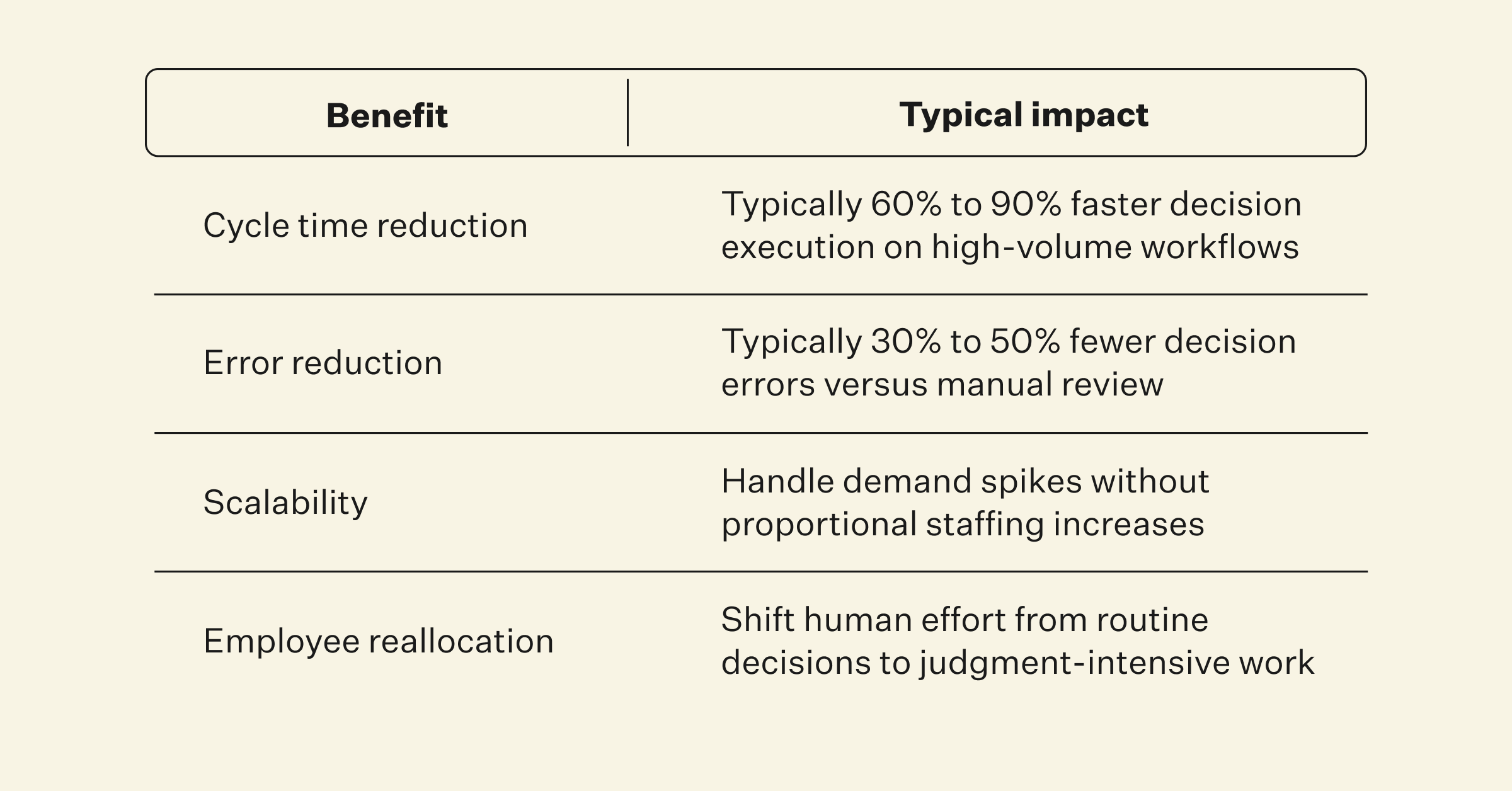
Note: Ranges reflect reported outcomes across enterprise implementations. Actual results vary by use case, data quality, and implementation scope.
The less visible benefit is consistency. Human decision-makers are subject to fatigue, recency bias, and inconsistent application of policy. AI decisioning systems apply the same logic to every input, every time. That consistency is particularly valuable in regulated environments where differential treatment creates compliance risk.
Full automation is not always feasible or advisable. High-stakes decisions (credit denials, medical recommendations, and compliance exceptions) require human oversight at defined thresholds. Three governance models work in practice:
1. Approval thresholds route decisions above a defined risk or value level to human reviewers.
2. Shadow mode runs the AI decision system in parallel with human decision-makers for a validation period, comparing outputs without acting on them.
3. Fallback workflows automatically escalate to human review when model confidence drops below a defined threshold or when the input falls outside the model's training distribution.
Bias monitoring, explainability, and audit trails are non-negotiable for any AI decisioning system operating in a regulated environment. Every automated decision must be traceable: what data went in, what model was applied, what rules constrained the output, and who or what approved the action. Dataiku, the Platform for AI Success, embeds human-in-the-loop checkpoints and approval gates directly into the Dataiku Flow, before any model or agent action reaches production. Dataiku Govern provides audit trails, sign-offs, and rollback capabilities. Dataiku Agent Management evaluates deployed agents against business KPIs, not just uptime, detecting behavioral drift and routing fixes through governance workflows before they affect production decisions.
Most AI decision automation programs fail not because the technology underperforms, but because teams automate the wrong decision first or skip the data readiness work that determines whether the system can deliver. This roadmap sequences the steps to avoid both. Step 1: Identify high-volume, rule-heavy decisions. Start where the math is clearest: processes with high decision volume, well-defined rules, and measurable outcomes. Expense approvals, ticket routing, and reorder triggers are common starting points. Step 2: Audit data quality and availability. Map every data source on which the decision depends. Assess completeness, accuracy, timeliness, and access controls. If the data is not ready, the decision system will not perform regardless of model quality. Step 3: Select or build the decision platform. Evaluate whether to wire together separate tools (data prep, model training, rules engine, orchestration) or use an end-to-end platform. Dataiku covers the full AI decision automation stack, including data preparation, ML model development, agent orchestration, and governance, in a single environment, eliminating the integration overhead of multi-tool architectures. Step 4: Prototype and validate with human oversight. Run the decision system in shadow mode alongside existing human processes. Compare outputs. Identify where the system agrees, where it disagrees, and why. Step 5: Measure KPIs. Track decision speed, error rate, cost per decision, and human override frequency. These metrics determine whether to expand automation scope or adjust the model and rules. Step 6: Scale and continuously improve. Extend the decision system to adjacent workflows. Retrain models as data evolves. Update rules as regulations change. AI decision automation is not a one-time deployment. It is a continuously governed operating discipline.
AI decision automation closes the gap between what models can predict and what organizations actually decide. The enterprises that succeed treat it as an operational discipline with clear governance, not as a technology project with a fixed end date. Start with one high-volume decision, run a time-boxed pilot in shadow mode with measurable KPIs, and scale from results rather than ambition. Dataiku provides the full stack for that journey: data preparation, ML model development, agent orchestration, embedded governance, and cross-platform visibility through Dataiku Agent Management. Organizations that want AI to move from signals to decisions, at scale and with accountability, have everything they need to start in one place.
AI decision changes human jobs. Routine, rule-heavy decisions shift to AI, freeing people for higher-value work: supervising the system, handling edge cases, and making judgment-intensive calls that automation cannot. The net effect in most implementations is reallocation, not reduction.
RPA automates actions (clicking, form-filling, file movement) without reasoning. AI decision automation reasons through data, applies learned patterns, and selects an action based on context. In practice, the two often combine: AI makes the decision, RPA executes it in enterprise systems.
There is no universal minimum. Classification tasks typically need a few thousand labeled examples for a baseline model. Quality matters more than volume: Complete records, consistent formatting, accurate labels, and representative coverage of edge cases are what determine production performance.
Three mechanisms work together: feature importance scores, decision audit trails logging every step from data input to final output, and counterfactual explanations. Build explainability into the architecture from the start; reverse-engineering it after deployment is significantly harder and often incomplete.
Well-scoped pilots with clean data and clear KPIs typically show measurable results within eight to twelve weeks. Cycle time moves first; error reduction and cost savings follow. Full ROI, including compliance risk reduction, typically materializes over six to twelve months as the system scales.