Agent orchestration explained: How enterprises manage multi-agent AI workflows
May 21, 2026/10 min read/Jed Dougherty
A single AI agent is easy to build. Running dozens of specialized agents in coordinated workflows and trusting the output is not. The discipline that makes the difference is agent orchestration.
According to "Global AI confessions report: data leaders edition," based on a Dataiku/Harris Poll survey of 800 global data leaders, 86% of organizations now rely on AI agents in daily operations. Yet most lack the orchestration and governance infrastructure to manage them at scale. Agents are deployed in isolation, operating on fragmented data, duplicating work across teams, and producing outputs that no one can audit end to end.
This guide covers the orchestration patterns that solve those problems, the architecture components that make them work, real-world use cases, and a seven-step implementation blueprint to move from standalone agents to governed multi-agent systems.
Agent orchestration is the discipline of coordinating multiple AI agents to execute complex workflows in a governed, observable, and reliable way.
Five core patterns (sequential, concurrent, group chat, handoff, and hierarchical) fit different workflow requirements. Choosing the wrong pattern is the most common architecture mistake.
Enterprise orchestration requires four technical components: a task routing engine, memory and state layers, conflict resolution and guardrails, and monitoring and observability.
Moving from single agents to multi-agent orchestration is a seven-step process that starts with assessment and ends with production governance, not a single deployment event.
Agent orchestration is the coordination of multiple autonomous AI agents to execute complex, multi-step workflows as a governed system. It determines which agent acts, when, on what data, and with what authority.
The distinction from single-agent systems is significant:
A single agent receives a prompt, reasons through a task, uses tools, and returns a result, operating without coordination or shared state.
A multi-agent orchestrated system assigns specialized agents to specific subtasks, routes work between them, manages shared state, resolves conflicts, and enforces governance controls across the entire workflow.
AI agent orchestration sits on a continuum.
At one end: Simple chatbots that follow scripted flows
In the middle: Single LLM agents that reason and use tools autonomously
At the far end: Multi-agent orchestration systems where specialized agents collaborate on complex workflows that no single agent could handle reliably
The further an enterprise moves along that continuum, the more orchestration matters, and the more the failure modes shift from "the agent got it wrong" to "the agents contradicted each other and no one noticed."
Enterprises need multi-agent orchestration because complex workflows require specialized capabilities that no single agent can deliver reliably at scale.
Efficiency and specialization: A supply chain workflow might require one agent to monitor supplier risk indicators, another to cross-reference inventory levels, and a third to generate procurement recommendations. Each agent operates within its domain expertise rather than attempting to handle everything.
Scalability: Single-agent systems hit throughput limits when processing volume increases. Multi-agent orchestration distributes work across parallel agents, scaling capacity without degrading quality.
Reliability through redundancy: When one agent in an orchestrated system fails, the workflow can reroute to an alternative agent or escalate to human review rather than producing a silent failure.
Governance and security boundaries: In enterprise environments, different agents need different access levels. An agent analyzing customer sentiment should not have access to payment processing systems. Orchestration enforces these boundaries.
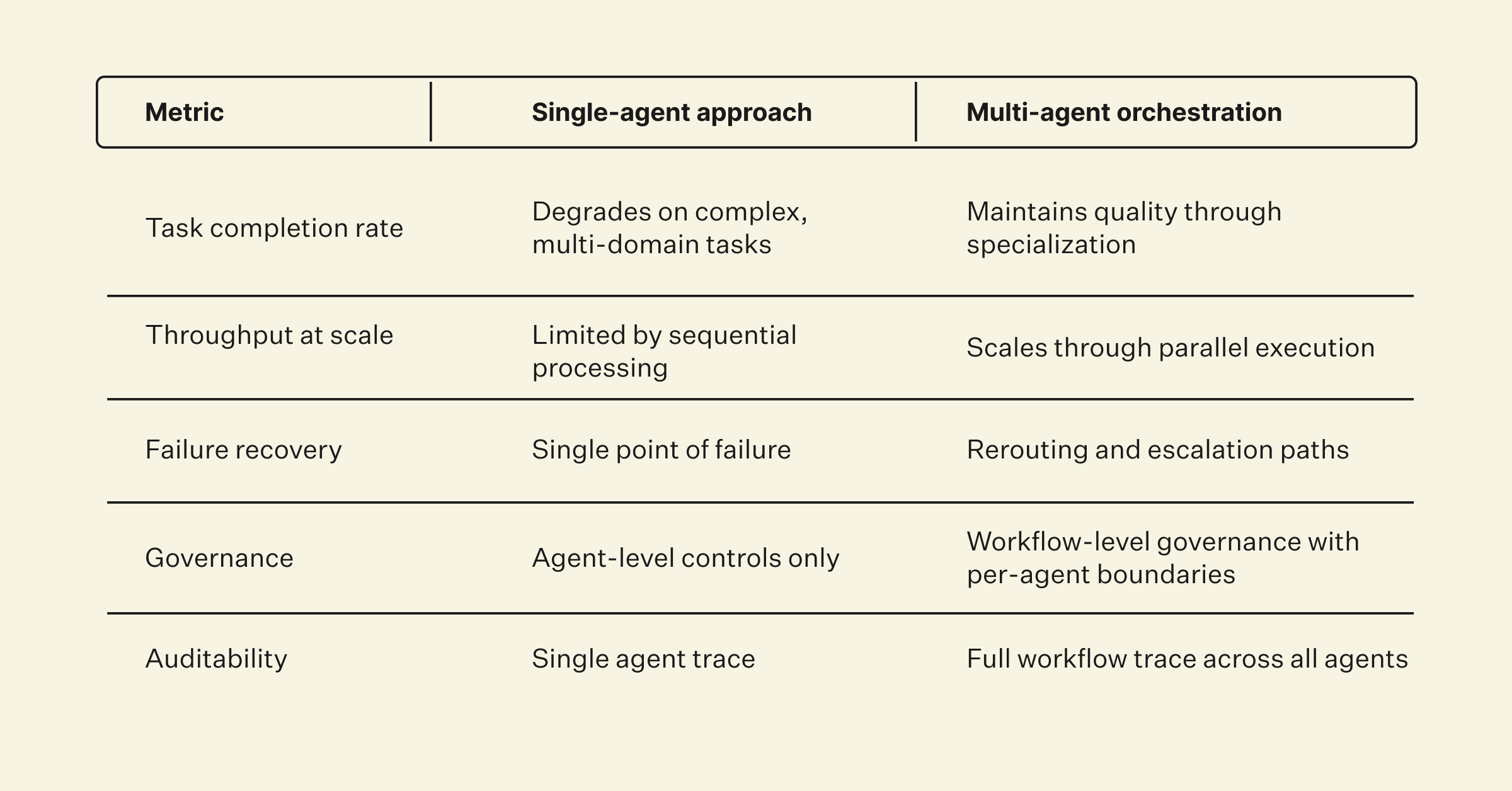
The differences between the two approaches compound at scale. A single agent managing a complex, multi-domain workflow will degrade in quality, hit throughput limits, and produce a single point of failure with no recovery path. Multi-agent orchestration addresses each of these gaps directly, and the gap widens as workflow complexity increases.
Click on the image above to zoom into full PDF
Orchestration patterns determine how agents interact. Choosing the right pattern is the most consequential architectural decision in a multi-agent system, because changing it after deployment is expensive.
The sequential pattern routes tasks through agents in a fixed order, where each agent's output becomes the next agent's input. This is the simplest and most predictable pattern.
When to use:
Workflows with clear, linear dependencies (document review, multi-stage approval, and content generation pipelines)
When to avoid:
Tasks that require parallel processing
Workflows where the step order may vary
Time-sensitive operations where sequential processing creates bottlenecks
Example: A law firm's contract review pipeline where Agent 1 extracts key terms, Agent 2 checks compliance against regulatory requirements, and Agent 3 generates a summary with flagged risks
Pitfall: A low-quality or incorrect output from one agent propagates silently through the rest of the chain. Because each agent trusts the previous agent's output, errors compound rather than surface.
Mitigation: Build output validation checks between steps, set confidence thresholds that trigger human review before the next agent proceeds, and log each agent's output independently so failures can be traced to their source.
The concurrent pattern executes multiple agents in parallel on independent subtasks, then aggregates their outputs. This maximizes throughput when tasks do not depend on each other.
When to use:
Independent analyses that can run simultaneously (multi-source market research, parallel data validation, and concurrent risk assessments)
When to avoid:
When agents need each other's outputs to operate
When the aggregation logic is more complex than the parallel work itself
Example: A stock analysis system where a financial analysis agent processes company filings, a sentiment agent monitors news and social signals, and a technical analysis agent evaluates price and volume indicators; results are aggregated into a single recommendation, with conflict resolution logic handling contradictions.
Pitfall: Concurrent agents may produce conflicting conclusions. Mitigation requires defined reconciliation rules (majority voting, confidence scoring, or escalation to human review).
Mitigation:
Define a reconciliation method before deployment (voting, confidence scoring, or rule-based override).
Set a clear escalation path for unresolvable conflicts.
Log all conflicting outputs for audit and model improvement.
The group chat pattern enables multiple agents to contribute to a shared thread, iterating collaboratively toward a solution. A maker-checker variant has one agent propose outputs while another validates them.
When to use: Complex problems that require multiple perspectives (product design review, policy analysis, and cross-functional planning)
When to avoid: Simple tasks where the overhead of multi-agent discussion exceeds the value, or time-sensitive workflows
Example: A municipal planning process where an urban planning agent proposes infrastructure changes, a budget analysis agent evaluates costs, and a regulatory compliance agent flags permit requirements; the threaded discussion format provides a natural audit trail.
Pitfall: Agents can loop indefinitely without converging on a resolution, particularly when two agents hold contradictory positions and no arbitration rule is defined.
Mitigation: Set a maximum number of discussion turns before a human reviewer or supervisor agent is brought in, define a default resolution rule (such as deferring to the agent with the highest confidence score), and log the full thread for audit.
The handoff pattern dynamically delegates tasks between agents based on the current context. Unlike sequential patterns, the routing is determined at runtime based on the task's characteristics.
When to use: Customer service workflows where the initial request type is unknown (triage agent routes to billing, technical support, or account management based on intent classification)
When to avoid: When routing logic is simple enough for static rules
Example: A telecom CRM system where a triage agent classifies incoming requests and hands them to specialized agents for billing disputes, technical troubleshooting, or plan upgrades; each specialist agent has access to different data sources and different authorization levels.
Pitfalls: It entails infinite routing loops (Agent A hands to Agent B, which hands back to Agent A) and misrouted requests.
Mitigation: Include guardrails like maximum handoff limits, timeout thresholds, and automatic escalation to human review after a defined number of transfers.
Hierarchical and federated patterns represent two approaches to managing agent coordination at the organizational level. Both suit enterprise environments where scale, privacy, or regulatory complexity make simpler patterns insufficient.
Click on the image above to zoom into full PDF
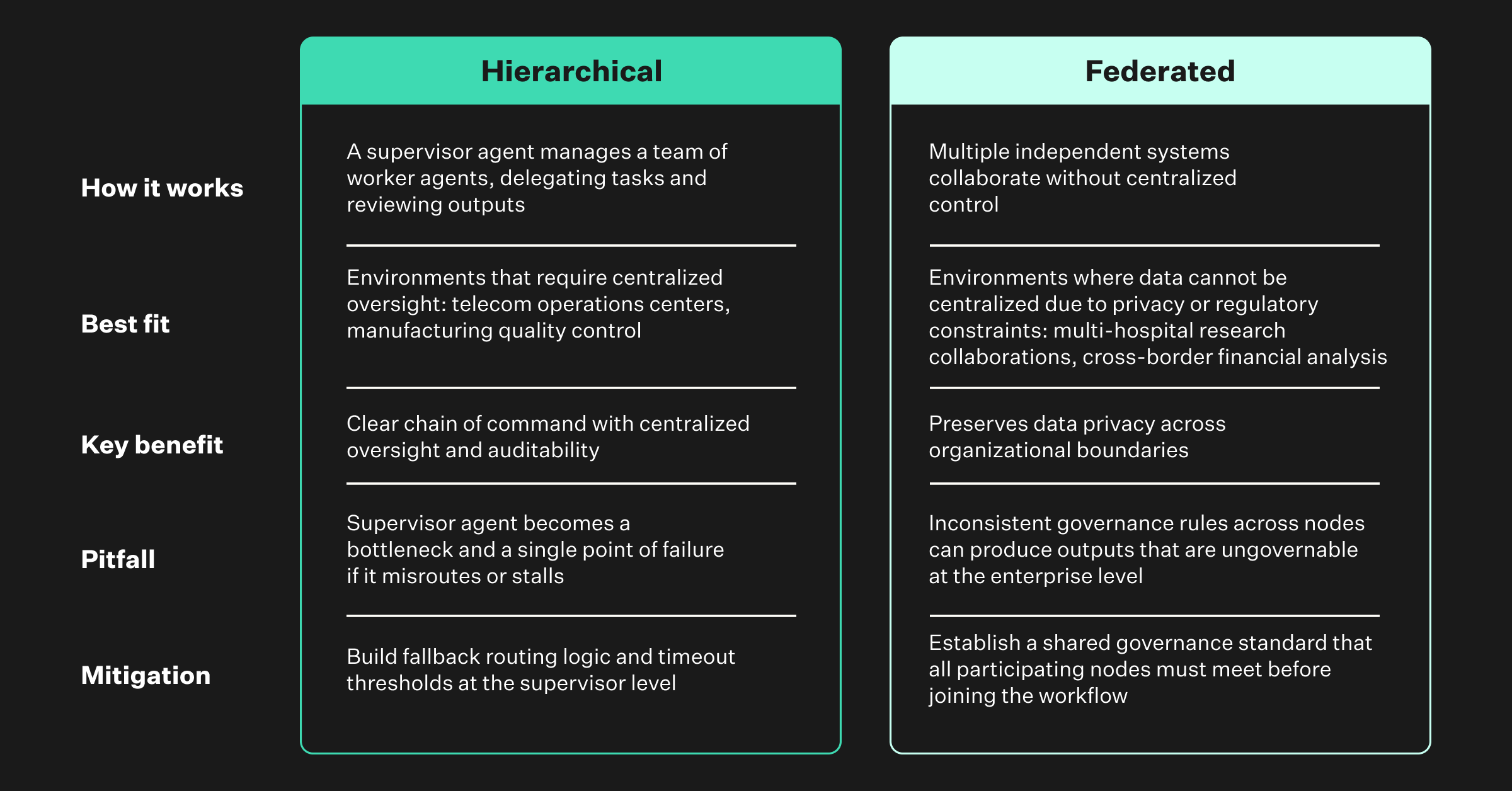
Patterns define how agents interact. Architecture components make those interactions reliable, observable, and governed.
The task routing engine is the dispatcher that decides which agent handles each task. Routing can be deterministic (rule-based: "billing requests always go to the billing agent") or dynamic (LLM-based: the orchestrator interprets the task and selects the best agent based on context).
A basic deterministic routing configuration:
routing_rules:
- intent: billing_dispute
      agent: billing_specialist
      priority: high
      fallback: human_review
- intent: technical_issue
agent: tech_support
priority: medium
fallback: senior_tech
- intent: unknown
agent: triage
escalation_after: 2_attemptsMulti-agent systems require three memory tiers:
Short-term memory holds context within a single task execution.
Long-term memory persists knowledge across sessions and agent runs.
Episodic memory records sequences of actions and outcomes for learning and debugging.
State management must support sub-millisecond reads for agents operating in real-time workflows. In-memory data stores with vector search capability handle both retrieval speed and semantic similarity matching for context-aware agent decisions.
When agents disagree or produce contradictory outputs, the system needs defined resolution mechanisms: voting (majority wins), quorum (minimum agreement threshold), confidence scoring (highest-confidence output wins), or rule-based overrides (predefined business rules take precedence).
Guardrails protect against unsafe agent behavior:
{
  "guardrails": {
    "security": "agents cannot access data outside their RBAC scope",
    "privacy": "PII is masked before passing between agents",
    "content_safety": "outputs are screened before delivery to users",
    "budget": "per-agent token limits enforced per execution"
  }
}Production multi-agent systems require distributed tracing across every agent interaction. Core metrics include token usage per agent, agent latency (time from task receipt to output), task success rate, error rate by agent and by workflow, and cost per execution.
Dashboards should surface both technical health (uptime, latency, and error rates) and business outcomes (task completion quality, decision accuracy, and cost per resolution). The gap between these two views is where most orchestration monitoring programs fail.
Moving from a single agent to a governed multi-agent system is not a single deployment event. It is a phased process that requires deliberate sequencing across assessment, design, integration, and ongoing governance.
Step 1: Assessment (two to three weeks): Inventory existing workflows, identify candidates for multi-agent orchestration, and document data dependencies, governance requirements, and success KPIs.
Step 2: Agent selection (one to two weeks): Define the specialized agents needed, their capabilities, data access requirements, and authorization boundaries. Map each agent to a specific role in the workflow.
Step 3: Framework setup (two to four weeks): Select and configure the orchestration framework. Evaluate the trade-off between open-source frameworks (maximum flexibility, full maintenance burden) and managed platforms (faster deployment, built-in governance, and vendor dependency).
Step 4: Routing design (one to two weeks): Define routing logic, handoff rules, and fallback paths. Test with edge cases: What happens when no agent matches the intent? What happens when two agents claim the same task?
Step 5: Memory integration (two to three weeks): Configure shared state management, memory tiers, and context persistence. Ensure that agents can access the context they need without accessing data outside their scope.
Step 6: Testing and optimization (two to four weeks): Run the orchestrated workflow against historical data and synthetic edge cases. Measure latency, accuracy, cost, and failure modes. Optimize agent prompts, routing logic, and guardrails based on results.
Step 7: Rollout and governance (ongoing): Deploy to production with monitoring dashboards, alerting, and escalation paths. Establish governance review cycles to audit agent behavior, update routing rules, and refine guardrails as the system evolves.
The patterns and architecture components described above translate directly into operational value across industries. The following examples show how enterprises are applying multi-agent orchestration to workflows that previously required significant manual coordination.
A triage agent classifies incoming tickets by intent, urgency, and customer tier. Based on classification, it hands off to a billing agent, technical support agent, or account management agent.
Each specialist agent pulls context from the relevant backend systems (billing history, support logs, and account details) and either resolves the issue or escalates with full context to a human agent.
Enterprises implementing this pattern report measurable improvements in first-contact resolution (FCR) rates and customer satisfaction (CSAT) scores because the specialist agent receives full context rather than starting from scratch after a transfer.
Concurrent agents analyze market data from different sources simultaneously: One agent processes financial filings, another analyzes social sentiment, and a third evaluates macroeconomic indicators.
Each agent produces an independent analysis in a standardized format. A synthesis agent reconciles the outputs, flags contradictions, and produces a unified report. The concurrent pattern reduces analysis time from hours to minutes compared to a single-agent baseline.
In CI/CD environments, multi-agent orchestration coordinates code review workflows. A code analysis agent scans for bugs and security vulnerabilities. A style compliance agent checks against coding standards. A documentation agent verifies that code changes are reflected in documentation.
If the code analysis agent flags a merge conflict, an auto-resolution agent attempts a fix and routes the result back for re-review. The sequential-plus-handoff hybrid pattern keeps the pipeline moving without manual intervention.
The framework market spans open-source developer tools and managed enterprise platforms. Selection depends on the trade-off between flexibility, governance, and operational overhead.
Click on the image above to zoom into full PDF
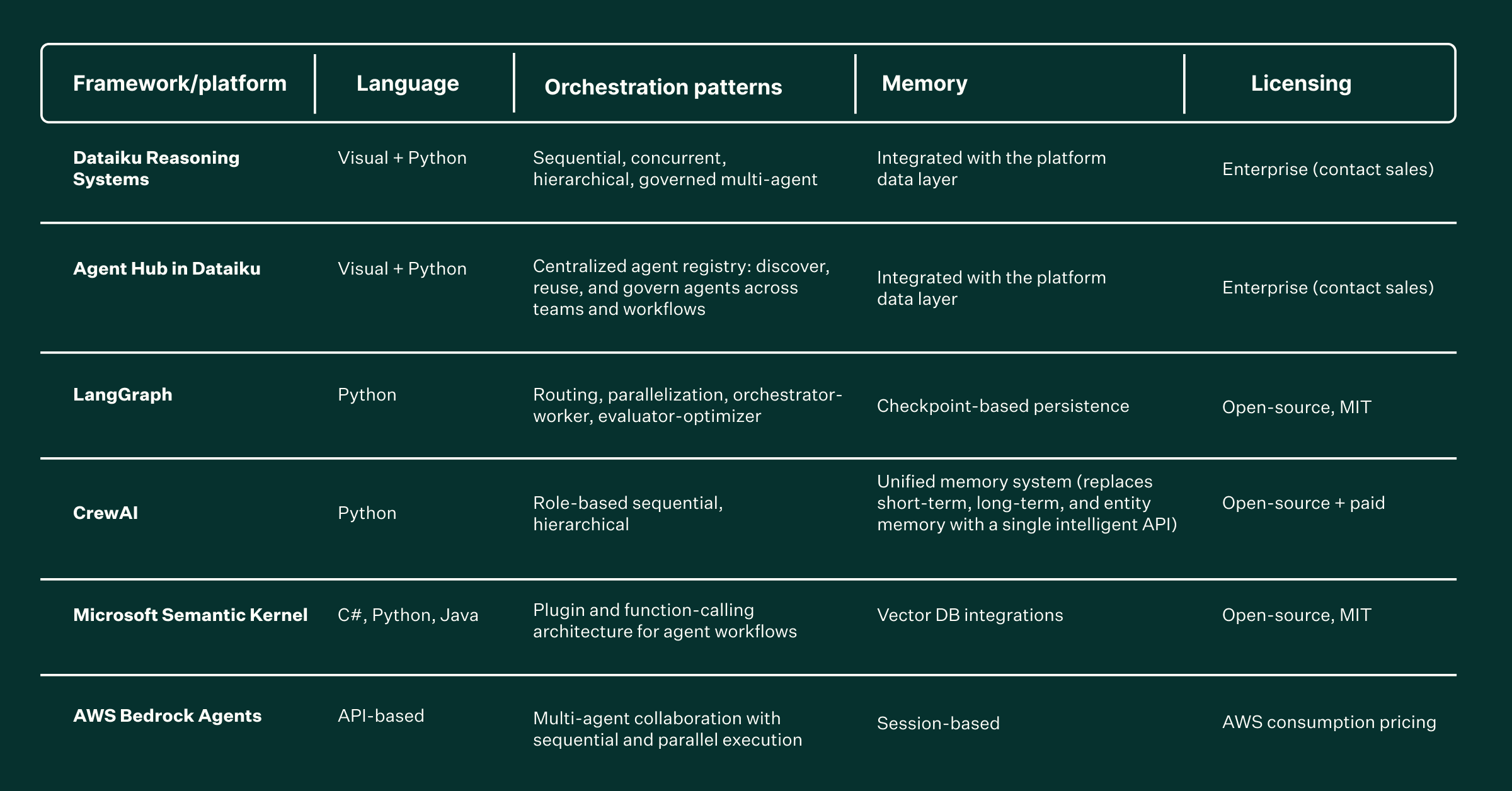
Dataiku, the Platform for AI Success, occupies a different position in this table. Where other frameworks provide orchestration primitives that developers assemble, Dataiku Reasoning Systems provides enterprise multi-agent orchestration with governance embedded.
The system unifies data, ML models, agents, business rules, and human-defined decision logic into a single governed environment. It is not just an orchestration framework but a governed reasoning layer that connects agent behavior to the data infrastructure, compliance controls, and business KPIs that enterprise deployments depend on.
Agent Hub in Dataiku extends this further by giving teams a centralized registry to discover, reuse, and govern agents across the organization. Rather than rebuilding agents from scratch for each new use case, teams can publish agents to the hub, share them across departments, and monitor their performance in production from a single interface.
For enterprises managing dozens of agents across multiple workflows, this is the difference between an agent inventory and an agent ecosystem.
Selection criteria:
Latency requirements (sub-second for customer-facing agents)
Governance maturity (audit trails, RBAC, and approval gates)
Cost model (open-source maintenance vs. managed platform fees)
Team skills (developer-first frameworks vs. visual orchestration environments)
Scaling multi-agent systems introduces a distinct set of operational risks. Understanding them before deployment is more effective than diagnosing them in production.
Click on the image above to zoom into full PDF
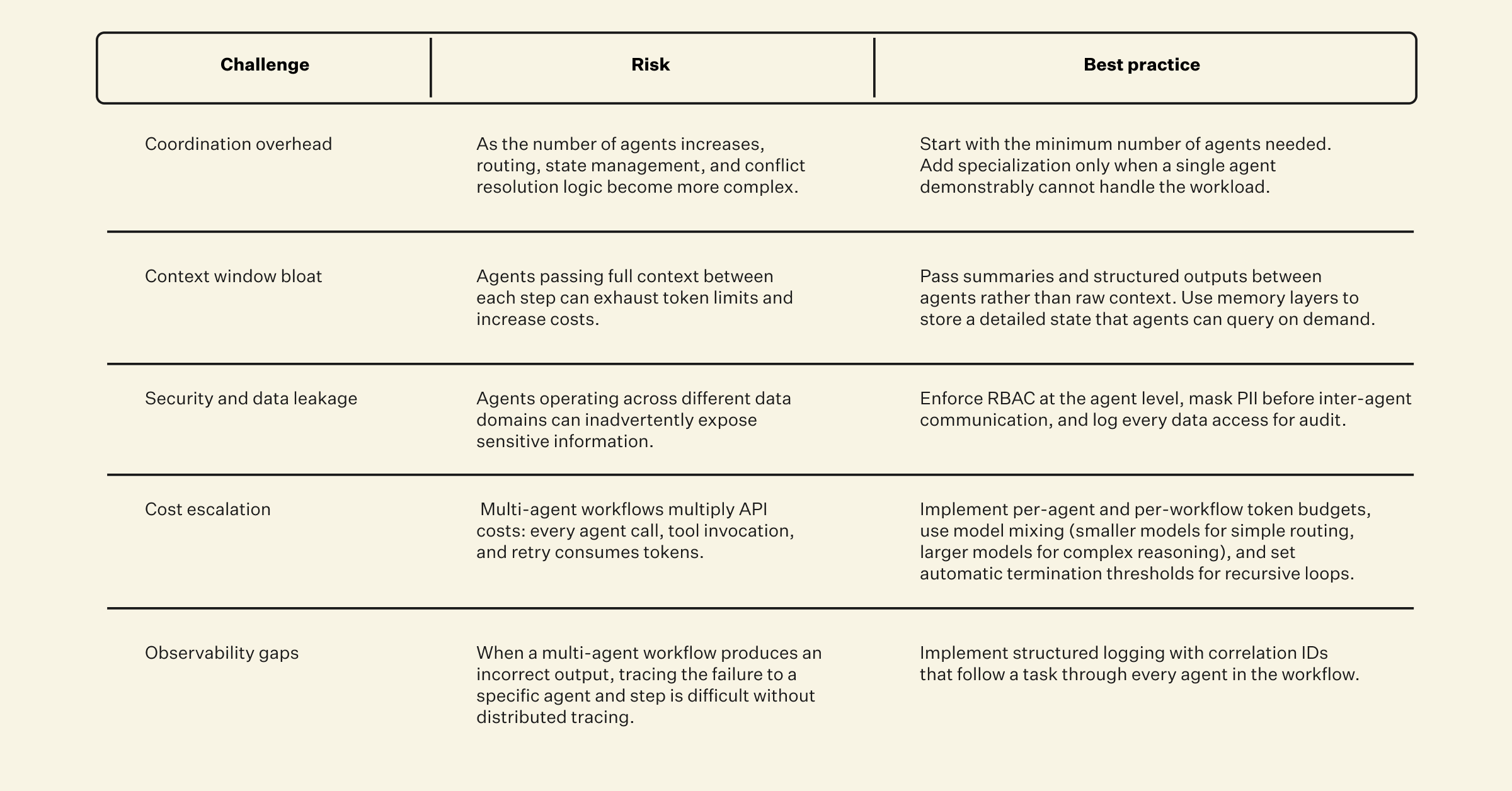
Agent orchestration is the infrastructure layer that determines whether an enterprise's AI agents operate as a coordinated system or as a collection of disconnected experiments. The right orchestration pattern, matched to the workflow's actual complexity, paired with architecture that handles memory, routing, conflict resolution, and monitoring, is what separates agents that deliver measurable business impact from agents that run but do not perform.
As standards like the Model Context Protocol (MCP) continue to mature, orchestration frameworks will converge around interoperable patterns that reduce vendor lock-in and simplify multi-platform agent management. The enterprises that invest in orchestration infrastructure now will be positioned to adopt those standards without rebuilding from scratch.
Dataiku is designed for exactly that transition: Reasoning Systems connect data, models, agents, and human decision logic into governed workflows today, while Agent Hub in Dataiku gives teams the centralized registry they need to manage, reuse, and scale agents as that landscape evolves.
LangGraph is a product of LangChain, Inc. Microsoft Semantic Kernel is a trademark of Microsoft Corporation. AWS Bedrock is a trademark of Amazon Web Services, Inc. CrewAI is a trademark of CrewAI Inc. Dataiku is not affiliated with or endorsed by any of the above companies. All product capabilities referenced in this article are sourced from publicly available information. Sources are dated April 2026.
At minimum: an LLM provider (or multiple, for model mixing), an orchestration framework or platform that handles routing and state management, a memory layer for context persistence, and a monitoring solution for observability. For enterprise deployments, add RBAC, audit logging, and a governance framework.
Without a centralized orchestration layer, agents operate in silos, duplicate work, and produce conflicting outputs with no audit trail. Centralized orchestration provides a single control point for routing tasks, enforcing access boundaries, managing shared state, and tracing every decision. For enterprise deployments, that visibility and control is what separates agents trusted in production from agents stuck in pilots.
Latency depends on the pattern. Sequential workflows add the latency of each agent in the chain. Concurrent workflows are bounded by the slowest parallel agent. In production, expect 2 to 15 seconds for a full multi-agent workflow with three to five agents, depending on LLM response times and tool call complexity. Customer-facing use cases typically require sub-five-second response times, which constrains pattern selection and model choices.
Implement RBAC scoped to each AI agent's data access and action permissions. Mask PII before passing data between agents. Log every agent action, tool call, and data access in an immutable audit trail. Use sandbox environments for testing new agents before production deployment. Align your governance controls with the NIST AI Risk Management Framework.
Start with a single workflow that currently involves multiple manual steps or handoffs between teams. Map the steps, identify where specialized agents would add value, and select the orchestration pattern that matches the workflow's complexity. Run a time-boxed pilot scoped to one team and one measurable KPI. Scale from there based on results, not ambition.
Tags