Dataiku named a Gartner Magic Quadrant Leader for 5th consecutive year
June 23, 2026/3 min read/Mark Abramowitz
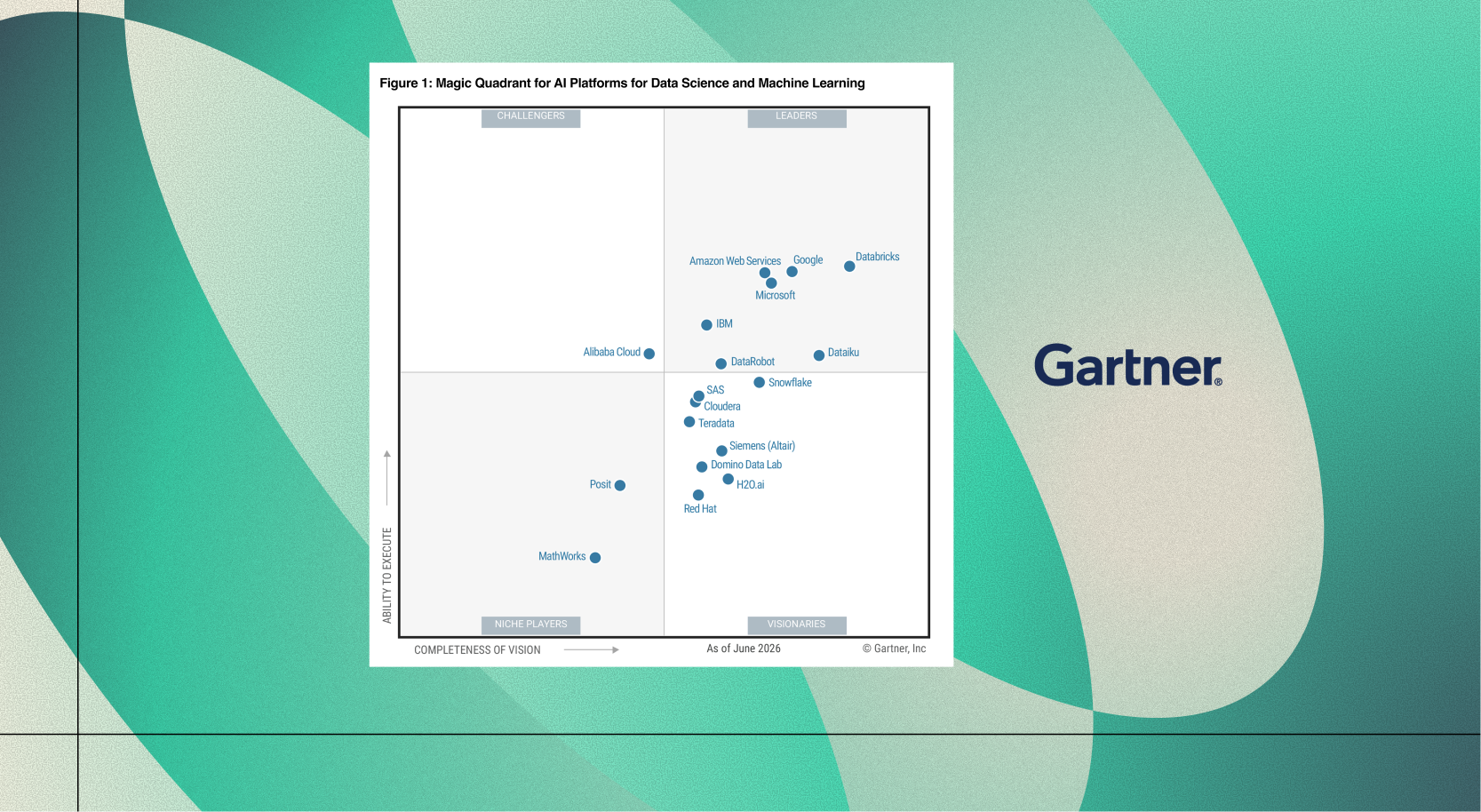
For the fifth consecutive year, Dataiku has been named a Leader in the 2026 Gartner® Magic Quadrant™ for AI Platforms for Data Science and Machine Learning, once again recognized in the Leader quadrant for both “Completeness of Vision” and “Ability to Execute.”
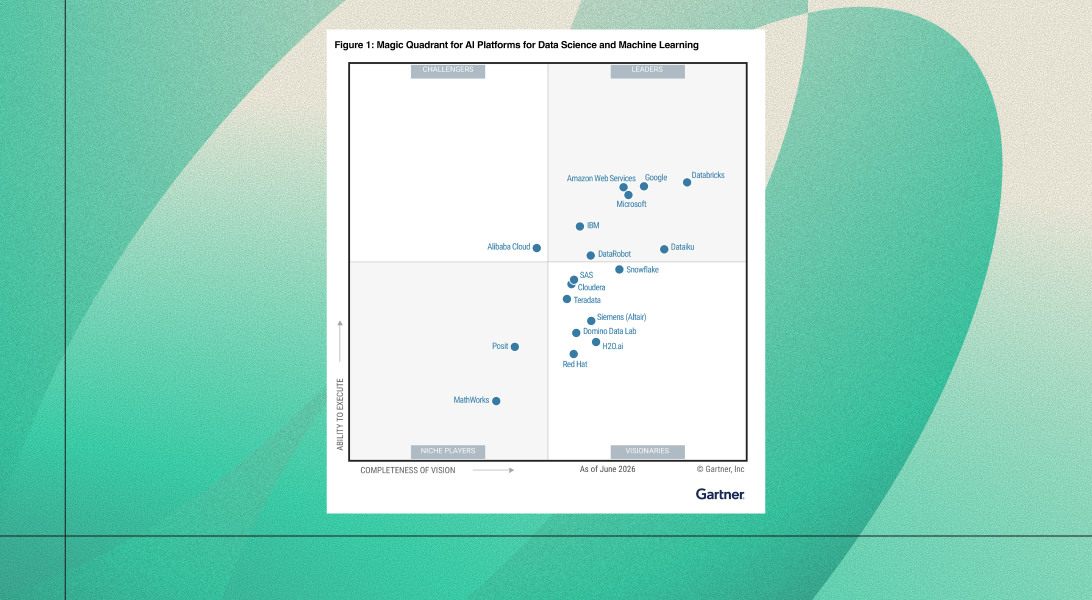
The Magic Quadrant for AI Platforms for Data Science and Machine Learning evaluates platforms based on their ability to execute today and their vision for where the market is going. We believe this recognition reflects how Dataiku supports enterprise AI in practice:
AI is developed and operationalized across multiple teams, with each group working in the tools and interfaces best suited to its role. This enables smoother handoffs, stronger alignment, and faster progress from experimentation to production.
Workflows span data, models, and agents instead of living in siloed tools. Teams can connect AI systems across existing infrastructure, applications, and business processes.
Governance is embedded throughout, not added after the fact. Organizations gain visibility into performance, cost, risk, and business impact as AI scales across the enterprise.
As AI expands across the enterprise, these capabilities become essential. Organizations need to understand what AI systems exist, how they behave, and whether they are delivering business value.
Enterprise AI is no longer a set of projects. It is a system that spans teams, tools, and decisions. Most organizations already have AI across their business. Models run in different environments. AI agents are being deployed across teams. Analytics, machine learning (ML), and generative AI are expanding in parallel. What’s missing is a system to orchestrate it. That’s the gap between AI adoption and AI success.
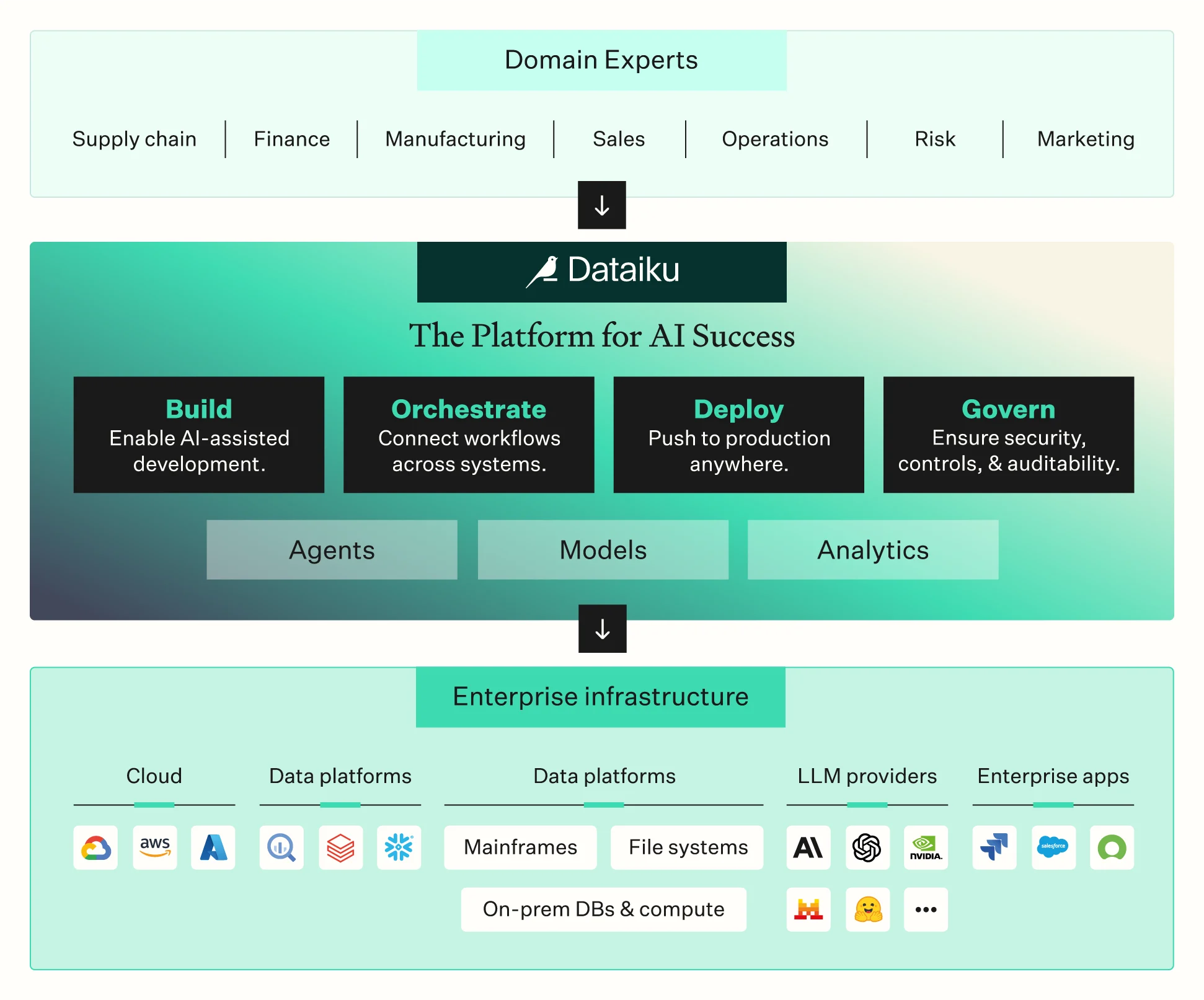
Dataiku was built to close that gap. As the Platform for AI Success, it provides the orchestration layer that connects AI across the enterprise so it operates as a system, not as isolated components. At the center is a simple idea: AI success requires three elements working together — people, orchestration, and governance.
Teams need to build AI together, using tools that match their expertise. Data, models, agents, and applications need to be connected into real workflows across existing systems. And performance, cost, and risk need to be visible and controlled across every AI initiative.
This is the AI Success Formula. It is why enterprises use Dataiku to move from experimentation to production, and from individual use cases to enterprise-scale outcomes. That foundation is already delivering measurable results across industries.
Organizations like Roche, Euronext, and Geodis are using Dataiku to reduce manual work and accelerate decision-making, while Michelin, Mitsubishi Electric, and European Air Transport (DHL) are using it to improve operational visibility, efficiency, and responsiveness at scale — spanning analytics, ML, generative AI, and agentic AI systems.
As enterprise AI expands from individual models to interconnected systems, organizations need a way to coordinate data, models, agents, and decisions across increasingly complex environments.
We believe this recognition reflects Dataiku’s ability to support that shift through architectural flexibility, integrated governance, and systems designed for operational AI at scale. Organizations can orchestrate AI across existing infrastructure and platforms without forcing consolidation or lock-in, all while maintaining the visibility and controls needed to manage performance, cost, and risk across enterprise AI initiatives.
AI itself is changing. Enterprises are moving beyond individual models and applications toward coordinated systems that combine agents, models, pipelines, and human input. This shift requires more than new tools. It requires a way to operate AI as a managed system across the business.To help enterprises operate as a coordinated system, Dataiku recently introduced several new capabilities:
Dataiku E2A (Expert-to-Agent) is the agent orchestration engine that uniquely turns domain expertise into production agents, with domain experts and AI experts building side by side on the same governed platform.
Dataiku Agent Management monitors agents across every platform they run on, tracking decision quality and business impact, not just technical health.
Dataiku Cobuild lets experts describe a business objective in natural language and generates a complete, inspectable AI project, not opaque scripts you have to trust on faith.
Dataiku Reasoning Systems coordinate industry-specific data, models, agents, and human judgment into governed decision systems for high-stakes processes.
The next phase of enterprise AI will be defined by execution. Organizations that succeed will know what AI systems exist across their business, understand how those systems are performing, and coordinate data, models, agents, and decisions into real workflows. They will operate AI as part of how the business runs.
Gartner, Magic Quadrant for AI Platforms for Data Science and Machine Learning, Yogesh Bhatt, Afraz Jaffri, Diarmuid Curran, 22 June 2026. Gartner does not endorse any vendor, product or service depicted in its research publications, and does not advise technology users to select only those vendors with the highest ratings. Gartner research publications consist of the opinions of Gartner's research organization and should not be construed as statements of fact. Gartner disclaims all warranties, expressed or implied, with respect to this research, including any warranties of merchantability or fitness for a particular purpose. GARTNER is a registered trademark and service mark, and MAGIC QUADRANT is a trademark and service mark of Gartner, Inc. and/or its affiliates in the U.S. and internationally and are used herein with permission. All rights reserved. This graphic was published by Gartner, Inc. as part of a larger research document and should be evaluated in the context of the entire document. The Gartner document is available upon request from Dataiku.