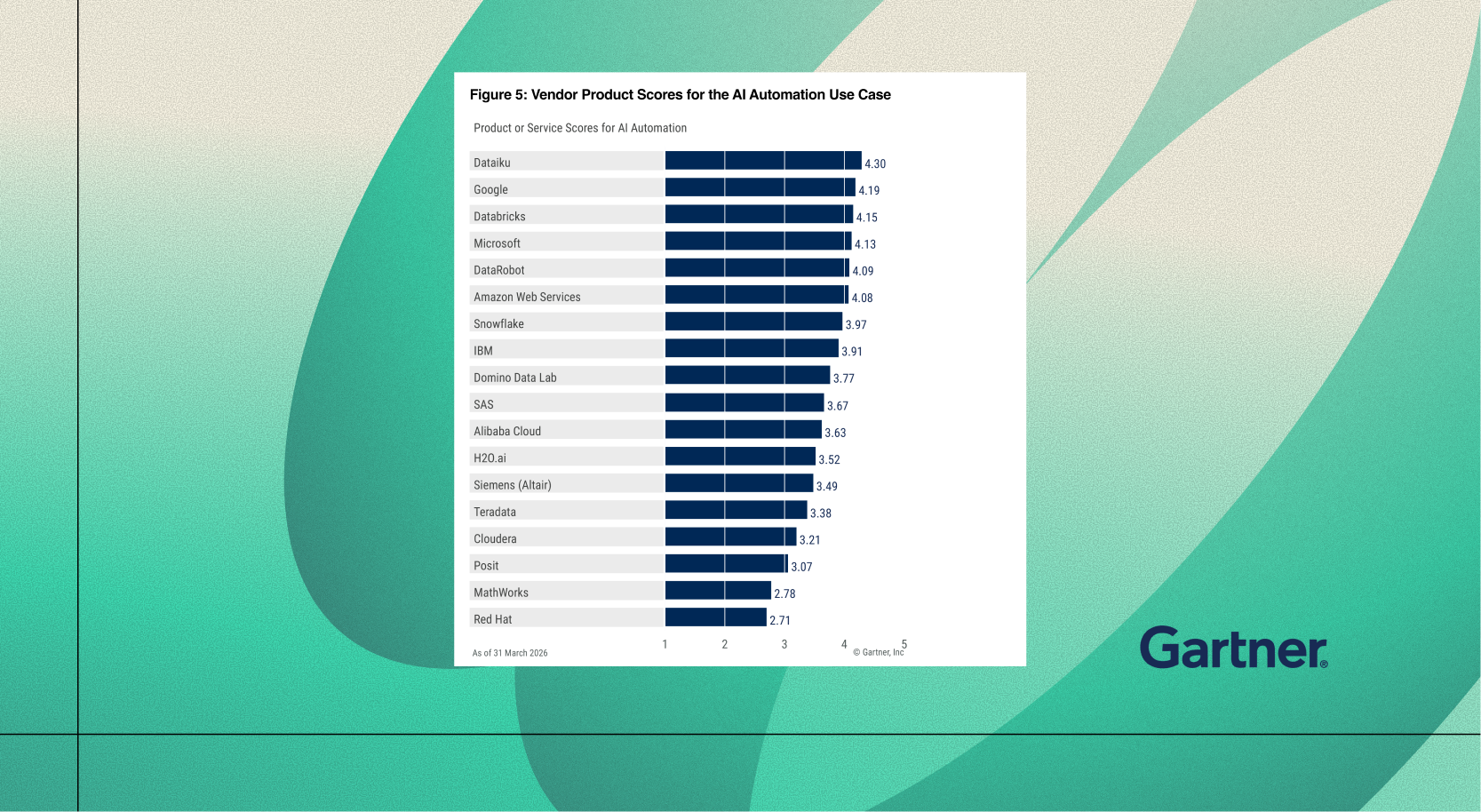
Dataiku ranked #1 for AI automation and insights generation
July 27, 2026/4 min read/Team Dataiku
Enterprise AI is expanding in every direction. Models run across every cloud, agents are deployed by internal teams and bundled into the software your organization already buys, and GenAI applications are built faster than governance teams can track them. The question facing leaders is no longer whether to invest in AI. It's whether they can operate it as a connected system that delivers measurable results.
That's the context in which we're proud to share our latest recognition. Dataiku ranked #1 for both the AI Automation and AI Insights Generation Use Cases in the Gartner® Critical Capabilities for AI Platforms for Data Science and ML. We believe this reflects our ability to help organizations operationalize AI across workflows, decisions, and business processes, from surfacing the insights that inform a decision to running the automated systems that act on it.
This recognition also follows Dataiku being named a Leader in the 2026 Gartner® Magic Quadrant™ for AI Platforms for Data Science and ML for the fifth consecutive time.
The companies that succeed with enterprise AI create strong connections between their teams, their AI systems, and the controls that make AI trustworthy at scale. We call this the AI Success Formula, and it rests on three pillars that have to work together:
People: Every builder type, from domain experts and analysts to data scientists and engineers, contributes safely with tools suited to their skill set in a shared space.
Orchestration: Machine learning models, LLMs, agents, business rules, and human judgment are coordinated into real operational workflows.
Governance: Visibility, validation, and performance measurement are embedded from design through production.
Dataiku, the Platform for AI Success brings these pillars together in a single environment where AI operates as part of the enterprise instead of as isolated experiments. We believe this is what the two Use Case results point to: insights generation and AI automation sit at opposite ends of the AI lifecycle, and we believe our scores across both reflect a platform built to carry a decision all the way from analysis to action.
Insights generation is about uncovering the actionable patterns, trends, and intelligence that inform enterprise decisions. AI automation is about orchestrating models, agents, and workflows to act on those decisions with the continuous optimization that autonomous operations require. One informs the decision while the other operationalizes it. Strength across both is what lets organizations close the distance between knowing and doing.
Four newer flagship offerings show how we're extending that strength as enterprise AI enters its next phase.
One of the biggest barriers to enterprise AI is translating business intent into working systems. Turning an idea into production AI has typically required weeks of coordination between stakeholders, data scientists, and engineers, with something lost in translation along the way.
Dataiku Cobuild removes that friction. Describe an objective in natural language, and it generates a structured AI project inside Dataiku's visual environment, including pipelines, models, agents, and approval workflows. Unlike coding assistants that generate opaque scripts and ask you to trust them, Dataiku Cobuild produces auditable systems that teams can inspect, modify, and govern before a single line reaches production. It pairs the speed of the most advanced AI building tools with the accountability enterprise environments demand.
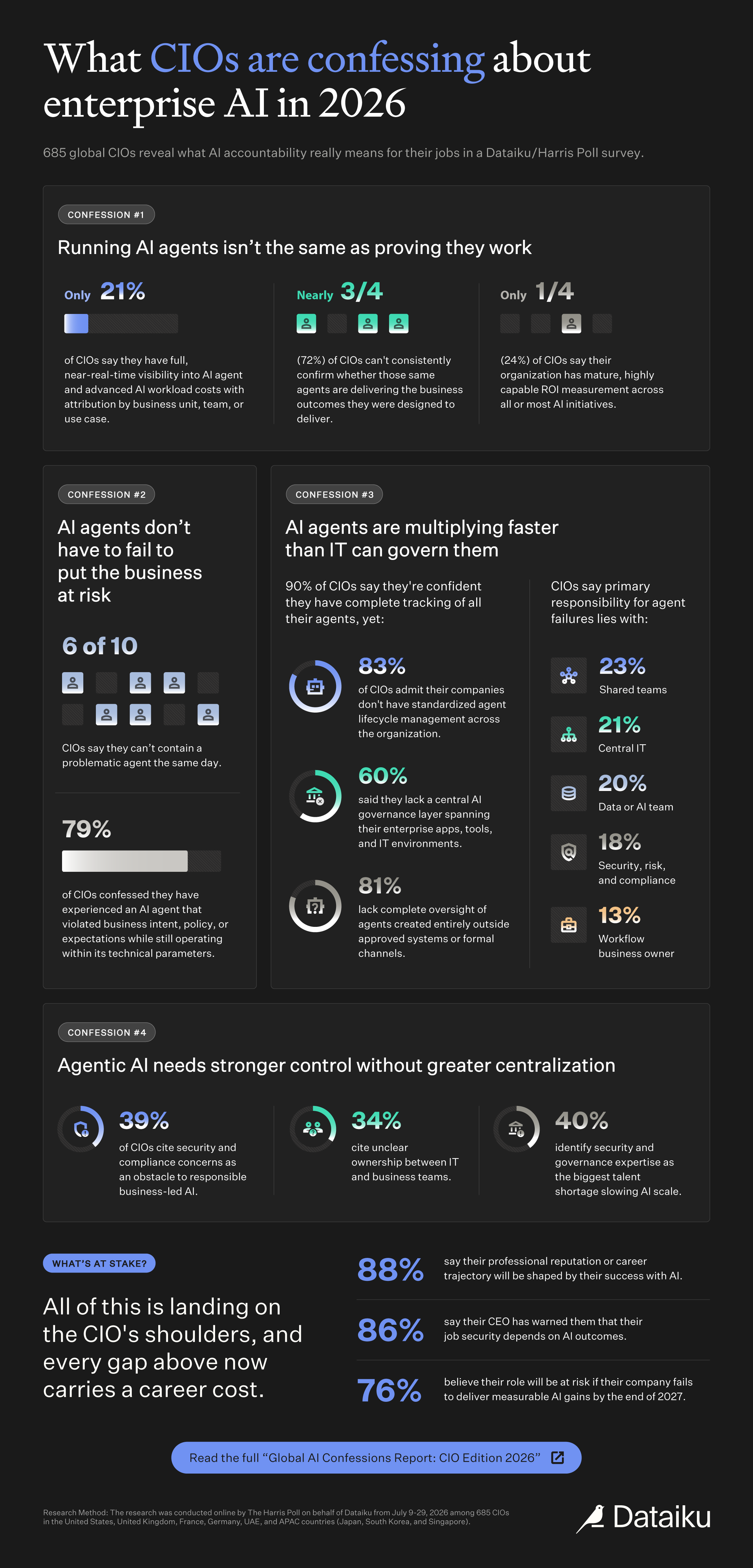
AI agents are proliferating faster than most organizations can track them, built across cloud platforms, enterprise applications, internal tools, and vendor ecosystems. In a recent Dataiku/Harris Poll survey of 600 enterprise CIOs, 82% said employees are creating AI agents and applications faster than IT's ability to govern them. Most companies lack a unified view of what agents exist, what decisions they're making, or whether they're delivering value.
Dataiku Agent Management provides a control tower for enterprise AI agents, monitoring not just system health but the quality, policy alignment, and business impact of agent decisions. It gives organizations a centralized view of agents across platforms including Dataiku, AWS Bedrock, Snowflake Cortex, Databricks, and Google. As enterprises move from individual models to fleets of agents, that visibility becomes essential to the governance pillar of the AI Success Formula.
The highest-value enterprise decisions (vendor requalification, claims adjudication, credit decisioning) still depend on a handful of experts who are unable to scale. Dataiku Expert-to-Agent (E2A) turns that knowledge into production-ready agents that make real decisions, on real data, with real accountability.
Process owners encode the rules and thresholds behind how decisions are actually made in a visual, inspectable interface, agents connect to the data and systems the business already runs on so they act in context, and governance is built in from the start with expert sign-off before anything goes live.
The most important enterprise decisions rarely fit inside a single model or agent. Manufacturing disruptions, supply chain volatility, and financial risk management require data pipelines, predictive models, business rules, domain expertise, and human judgment working together.
Dataiku Reasoning Systems bring them into coordinated decision systems built around real business operations, orchestrating models, agents, rules, and human input into governed workflows aligned with explicit objectives, representing the orchestration pillar of the AI Success Formula, applied to the decisions that matter most.
The organizations that succeed in the next phase of enterprise AI will be the ones that operate AI as a coordinated system: They'll know what AI systems exist and what decisions they're making, translate intent into working AI quickly while maintaining control, and orchestrate models, agents, data, and human expertise into decision systems that improve how the enterprise runs.
We believe our scores in the Gartner Critical Capabilities report reflect a platform built for exactly that shift. Download the full report to see Dataiku's scores across all Use Cases and to evaluate what we believe matters most when selecting an AI platform.
Gartner does not endorse any company, vendor, product or service depicted in its publications, and does not advise technology users to select only those vendors with the highest ratings or other designation. Gartner publications consist of the opinions of Gartner's business and technology insights organization and should not be construed as statements of fact. Gartner disclaims all warranties, expressed or implied, with respect to this publication, including any warranties of merchantability or fitness for a particular purpose. Gartner and Magic Quadrant are a trademark of Gartner, Inc., and/or its affiliates. This graphic was published by Gartner, Inc. as part of a larger research document and should be evaluated in the context of the entire document. The Gartner document is available upon request from Dataiku. Gartner, Magic Quadrant for AI Platforms for Data Science and Machine Learning, 22 June 2026, By Yogesh Bhatt Et Al. Gartner, Critical Capabilities for AI Platforms for Data Science and Machine Learning, 23 June 2026, Diarmuid Curran Et Al.
Tags