CIO confession 1 of 6: Your CEO's AI deadline comes first
October 8, 2026/5 min read /Julia Berman
Most CEOs believe their role is at risk if AI fails to deliver measurable gains by the end of 2026. Meanwhile, CIOs place their own deadline a year later, at the end of 2027. On paper, that's an extra year, but in practice the gap is much smaller.
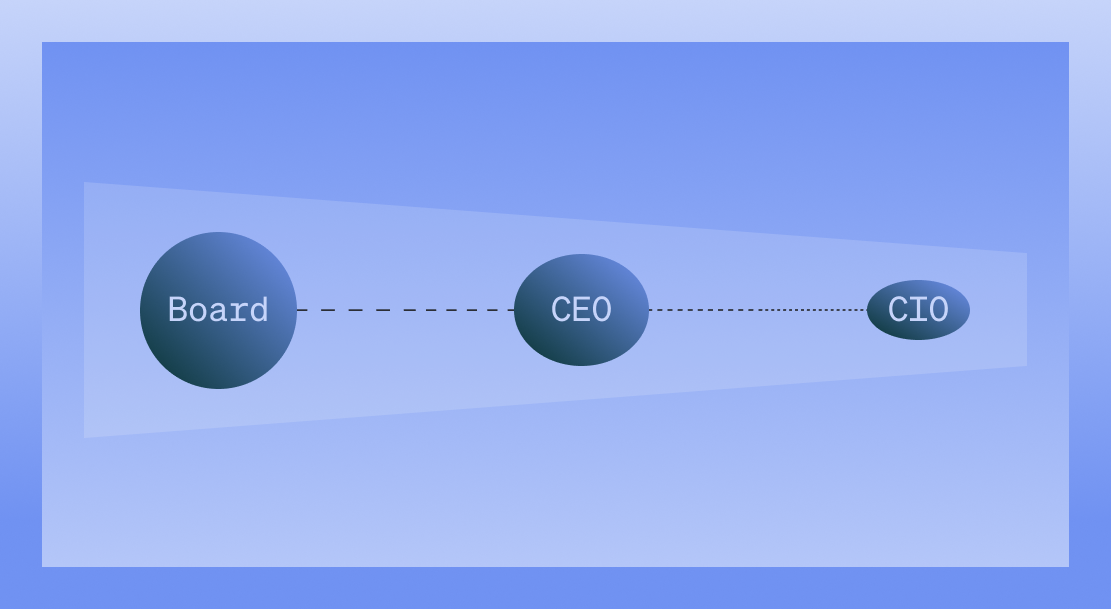
For the past few years, the CIO's AI mandate centered on momentum: bring AI into the enterprise, expand access, and keep pace with innovation. With AI now embedded across teams and workflows, the measure of success has moved to outcomes. Dataiku’s Global AI Confessions Report: CIO Edition, 2026, a survey of 685 enterprise CIOs conducted with The Harris Poll, shows how that shift created a chain of accountability that runs from the boardroom to the CEO to the CIO.
This post kicks off our six-part series on the report. We're starting with the pressure chain — where it begins, how fast it moves, and why the CIO's timeline is tighter than it looks.
Board pressure on AI has been building for some time. This year, it reached nearly every CIO in the study with 97% of CIOs reporting an increase in board pressure to demonstrate measurable AI ROI compared with 2025.
The comparison with 2025 is the telling part. Boards were already asking about AI a year ago. The data shows that pressure is accelerating for almost every CIO surveyed.
Scale helps explain why. AI has moved well past the pilot stage, and across the study, 67% of CIOs estimate that 51 or more AI agents are actively running in production. As AI's footprint grows, so do its share of spend and its exposure to risk. Boards are responding the way they would to any major investment, by asking what it returns.
The emphasis on measurable raises the bar. Boards want AI's value expressed in numbers they can track over time. Meeting that standard takes measurement capabilities that connect AI activity to enterprise results. That's a harder problem than it sounds, and it's the focus of our next post.
In the pressure chain, the next link is the CEO, and that's where the clock speeds up.
Boards hold CEOs accountable first, and CEOs feel it. In our companion Global AI Confessions Report: CEO Edition, 2026, 80% of CEOs believe their role will be at risk if their company fails to deliver measurable business gains from AI by the end of 2026.
That deadline is short. It gives CEOs a tighter window than the one CIOs see for themselves, and it sets the pace for everyone below them.
CEOs are also putting their own jobs behind the outcome. In the same study, 87% of CEOs would stake their job on delivering measurable AI results. That figure signals conviction: CEOs believe AI can deliver, and they're willing to be measured on it. For CIOs, that commitment brings strong executive backing for AI, along with expectations to match.
It also reshapes the CEO–CIO relationship. A CEO whose role depends on AI results is relying on the CIO to deliver them. The CIO becomes the executive the CEO's own success runs through, which explains why the pressure travels downward so quickly and so directly. That reliance also shows up in how closely CEOs watch the technology decisions underneath AI.
CEOs are passing that urgency down, often directly: 86% of CIOs say their CEO has warned them that their job security depends on AI outcomes. The message is often direct. More than half (56%) have heard it explicitly, including nearly a quarter (23%) who have heard it explicitly multiple times.
For those CIOs, AI accountability has become a recurring conversation. The stakes reach well beyond the current role:
Reputation: 88% say their professional reputation or career trajectory will be shaped by their success with AI.
Compensation: 86% believe their own compensation will be linked to measurable AI outcomes.
Job security: 76% believe their CIO role will be at risk if their company fails to deliver measurable business gains from AI by the end of 2027.
Compensation is the detail worth pausing on. When CIOs expect their pay to track AI outcomes, accountability shows up in every planning cycle and every performance review.
The chain covers more than results. CEOs are also examining the decisions underneath them. Among U.S. CEOs, 45% say they have challenged their CIO's AI vendor or platform selections multiple times in the past year, compared with 23% overall.
CIOs are questioning those choices too, with 79% of CIOs globally regretting at least one major AI vendor or platform selection made in the past 18 months. That leaves CIOs accountable on two fronts: for the results, and for the stack that produces them.
A 2027 deadline sounds like breathing room. The budget data shortens that runway, with 72% of CIOs saying their AI budget is likely to be cut or frozen if performance targets are missed by the end of 2026. Their role deadline may be 2027, but their budget deadline matches the CEO's.
That timing compounds the risk. Scaling AI takes continued investment, and protecting that investment now depends on showing returns from what's already running. A cut or frozen budget at the end of 2026 would leave CIOs chasing their 2027 targets with less room to maneuver. In practice, CIOs are working on their CEO's clock.
The pattern holds globally, with meaningful variation:
U.S.: CIOs face the highest budget risk globally, with 87% saying their AI budget is likely to be cut or frozen if performance targets are missed by the end of 2026.
South Korea: CEOs face the highest career stakes, with 93% believing their role will be at risk if their company fails to deliver measurable AI gains by the end of 2026.
Japan: CIOs report the lowest career exposure in the study, with 59% believing their role will be at risk without measurable AI gains by the end of 2027.
Later in this series, we'll dig deeper into all eight markets.
Every link in the chain asks for the same thing: proof. Boards want measurable ROI. CEOs want measurable gains. CIOs need clear evidence that the AI running across their enterprise is delivering, plus the ability to step in when it drifts off course.
That's also where the opportunity lies. The CIOs who can show what their AI is doing, what it costs, and what it returns will define their tenure on their own terms. For them, AI accountability becomes the foundation of their legacy.
Over the next five posts, we'll unpack what it takes to get there, starting with the four confessions at the heart of the report:
Proving whether AI agents are actually working
Catching agents that operate as designed and still miss business intent
Keeping pace as agents multiply faster than IT can govern them
Building governance into distributed AI creation
With the end of 2026 one quarter away, the first deadline in the chain is already in view.
Tags