Five times a Leader: a live look at what AI success actually requires
August 18, 2026/4 min read/Julia Berman
Everyone can push out an AI agent now. Far fewer can tell you whether that agent is making a good decision, spending tokens on anything that matters, or holding up under an audit. That gap — between agents that run and agents that deliver — was the throughline of our recent webinar, "The Platform for AI Success," where Kurt Muehmel, Head of AI Strategy, and Austin Cook, VP of Solutions Engineering, walked through one continuous build inside Dataiku.
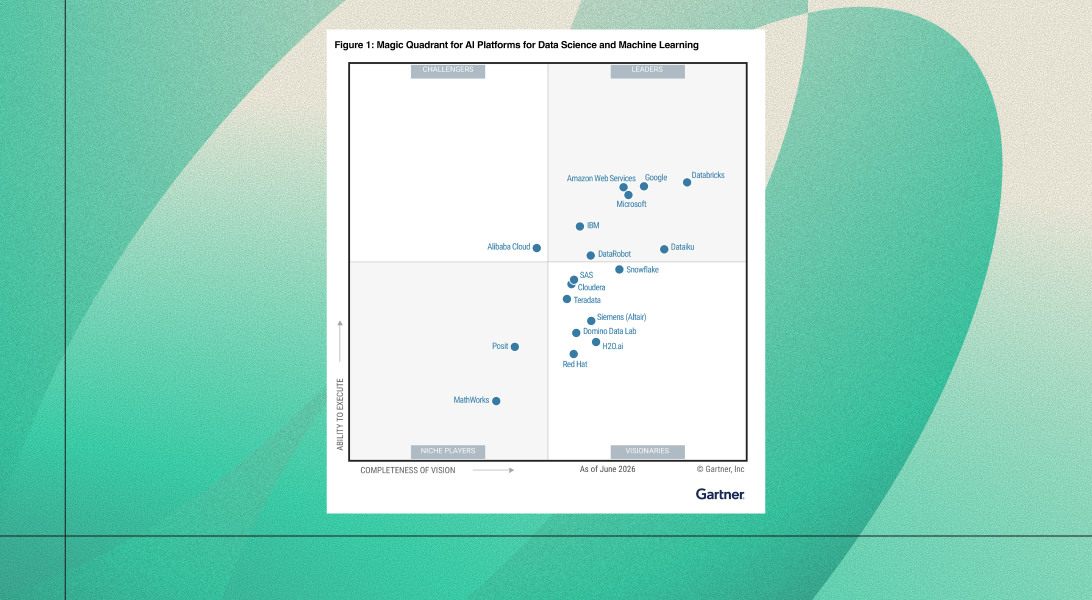
The occasion: Dataiku was named a Leader in the 2026 Gartner® Magic Quadrant™ for AI Platforms for Data Science and Machine Learning for the fifth consecutive time.
Watch below to see Kurt and Austin show the work behind it. Or, read on for the highlights.
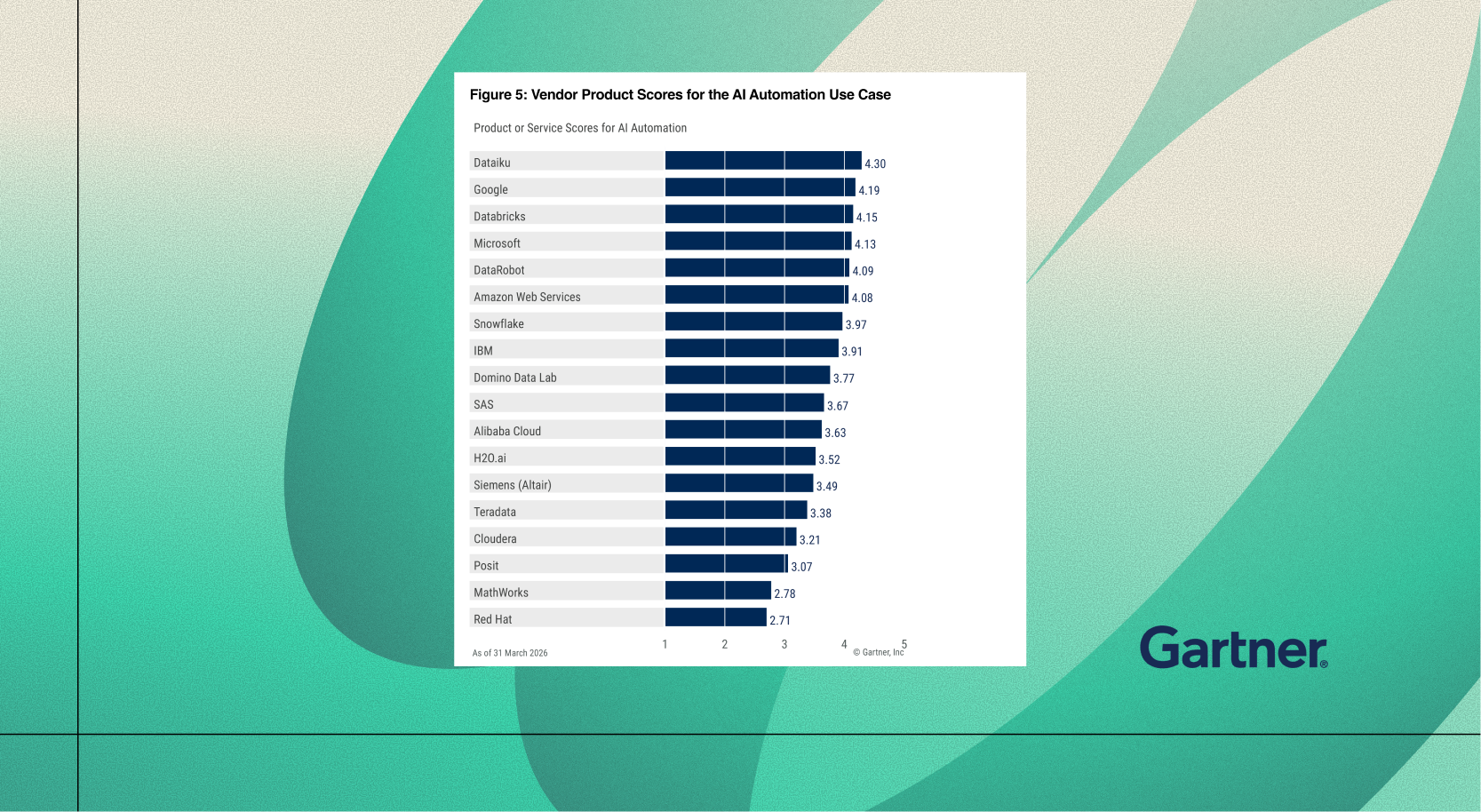
In addition to Dataiku’s Magic Quadrant recognition, Dataiku was also recognized in the companion 2026 Gartner® Critical Capabilities report for scoring highest in the AI Automation Use Case and the AI Insights Generation Use Case categories.
We believe this recognition reflects a simple idea that ran through the entire session, that enterprise AI succeeds when data, models, agents, and governance live on one foundation instead of scattered across disconnected tools.
Kurt opened with the shift underneath all of this: the enterprise that once ran on employees, assets, and processes will increasingly run on agents, data, and code. That new foundation can be built well or badly. And the same technology, run two different ways, produces very different results.
Kurt called this the AI success divide. On the unoptimized side are pipelines so hastily coded that nobody can audit them, data nobody has qualified, and agents burning tokens without moving a single business metric. On the optimized side, data is turned into usable context, the enterprise's most important agents are owned by the people who act on their decisions, and every agent's value is actively tracked.
One side generates activity. The other generates value.
To make it concrete, Austin ran a single scenario end to end — one bank, one project, one loop to improve agent performance. These were structured around three moves:
AI can read your data. It can't yet understand your enterprise.
Basic agents are easy to build. Agents you'd trust with a credit decision are not.
Your agents are running. Their value is invisible.
Each move started with the problem, then the platform response, then a live demo.
The problem is familiar to anyone running enterprise data: it's spread across clouds and warehouses, its meaning is locked in analysts' heads, and the pipelines connecting it are often vibe-coded and impossible to audit.
Austin's answer was business context, engineered. Meaning, one pipeline spanning a distributed data landscape, loan policies embedded as retrievable knowledge, and an analyst extending the flow directly with Cobuild. The point is that meaningful information that used to live in people's heads becomes something the platform can retrieve and act on.
Confidence is not the same as correctness. An agent that answers fluently but can't show which numbers it used, whether it was evaluated, or how it would perform in production isn't ready for a decision that carries risk.
Dataiku's approach treats a trusted agent as a structured system versus a prompt. Through Expert-to-Agent, business experts design the reasoning pathways, every answer is backed by real models, policies, and live data, and an evaluation pipeline scores the output run after run. Austin demonstrated a loan agent in the Agent Hub that researches, decides, and escalates with every answer graded.
Here's the problem that the webinar's companion session names directly: uptime gets measured, outcomes don't. Tokens get burned against no business KPI, and when an audit arrives, lineage gets reconstructed by hand.
Austin closed the loop inside the loan officer's own app, the agent working where the work happens, every prediction traced back to its source, and enterprise-wide governance across the lifecycle. This is where Dataiku Agent Management comes in for performance management, observability, and governance across every agent on every platform, so teams can reduce risk and prove business impact rather than guess at it.
Pull back, and the pattern is clear. Domain experts across supply chain, finance, manufacturing, sales, operations, risk, and marketing sit at the top. Enterprise infrastructure — i.e. cloud, data platforms, legacy systems, LLM providers, and enterprise apps — sits at the bottom. Dataiku is the orchestration layer in between to build, orchestrate, deploy, and govern across agents, models, and analytics.
We think that's the shape of the platform Gartner recognized, and it's the shape of the loop Austin built live.
The recording includes both live demos in full, plus an audience Q&A on enterprise agent platforms and governance guardrails.
Watch the on-demand recording above or here, and download the full 2026 Gartner Magic Quadrant for AI Platforms for Data Science and Machine Learning report below to see all vendors who were recognized.
Gartner, Magic Quadrant for AI Platforms for Data Science and Machine Learning, 22 June 2026, Yogesh Bhatt Et Al.
Gartner does not endorse any company, vendor, product or service depicted in its publications, and does not advise technology users to select only those vendors with the highest ratings or other designation. Gartner publications consist of the opinions of Gartner’s business and technology insights organization and should not be construed as statements of fact. Gartner disclaims all warranties, expressed or implied, with respect to this publication, including any warranties of merchantability or fitness for a particular purpose.
GARTNER, Magic Quadrant and Peer Insights are trademarks of Gartner and/or its affiliates. Gartner Peer Insights content consists of the opinions of individual end users based on their own experiences with the vendors listed on the platform, should not be construed as statements of fact, nor do they represent the views of Gartner or its affiliates. Gartner does not endorse any vendor, product or service depicted in this content nor makes any warranties, expressed or implied, with respect to this content, about its accuracy or completeness, including any warranties of merchantability or fitness for a particular purpose.
This graphic was published by Gartner, Inc. as part of a larger research document and should be evaluated in the context of the entire document. The Gartner document is available upon request from Dataiku.
Tags