Skip to content

AI in business: driving operational efficiency

Operational efficiency has become a defining responsibility for technology leadership because every department now depends on data-driven systems to plan work, allocate resources, and deliver consistent results.

As expectations increase across finance, supply chain, marketing, and customer service, for example, even small delays or manual steps compound into higher costs and slower execution.

Artificial intelligence in business offers a practical way to reduce that friction by embedding learning systems directly into everyday operations, where decisions occur continuously rather than during periodic reviews.

This article explains how AI supports enterprise efficiency, where it delivers measurable value, and how you can scale it responsibly across your organization. For CIOs and data leaders, the priority shifts from experimentation to creating the structure that allows insights to move reliably from data to action.

At a glance:

  • Artificial intelligence in business creates measurable efficiency when models connect directly to operational workflows instead of remaining isolated experiments.
  • Enterprise results depend on collaboration, integration, and governance working together rather than separate technical initiatives.
  • Dataiku, the Platform for AI Success , unifies business and technical teams on one platform so insights move smoothly from data to decisions.

Screenshot 2026-03-11 at 9.03.53 AM-1

What is AI in business?

Artificial intelligence in business refers to systems that combine data analysis, learning models, and rules to support decisions within everyday operational processes.

These systems differ from traditional analytics because they don't simply describe what has happened in the past but also generate predictions and recommendations that influence future actions. They also differ from basic automation, which follows fixed rules and struggles with variability, because AI adapts as conditions change and new information appears.

Within enterprise operations, AI functions as a strategic efficiency lever that improves how resources are allocated, risks are managed, and customer experiences are delivered. Rather than acting as a technology trend or isolated innovation project, it becomes a layer that supports planning, execution, and monitoring across departments. 

When deployed correctly, AI reduces manual effort while improving accuracy and speed, which allows teams to focus on higher-value activities. This shift in operating model is what enables sustained performance gains rather than short-lived pilot successes.

What are the key benefits and ROI drivers of AI in business?

AI delivers measurable value when embedded directly into operational workflows rather than isolated pilots. According to The State of Enterprise AI 2025 report by OpenAI, enterprise users report that AI saves them 40–60 minutes per day by streamlining decision tasks and accelerating execution across functions, and workers increasingly complete new types of work they couldn’t before. This reflects deeper workflow integration and tangible operational efficiency gains as organizations shift from casual use to repeatable processes.

The latest McKinsey 2025 global survey finds AI adoption broadening across business functions, with 88% of organizations using AI and more firms embedding AI into multiple workflows. While full firm-wide EBIT impact remains early for many firms, use-case level benefits are widely reported.

Beyond these findings, enterprises typically see impact across four operational dimensions:

  • Higher efficiency: Routine tasks, approvals, and data processing move faster when AI operates directly inside workflows.
  • Lower operating costs: Automation reduces manual effort, rework, and process friction across high-volume functions.
  • Revenue growth: Forecasting, targeting, and pricing decisions improve when predictive models continuously inform operations.
  • Customer satisfaction and risk reduction: Intelligent routing and anomaly detection strengthen service quality while reducing operational exposure.

AI use cases across business functions

Artificial intelligence delivers the greatest operational value when it integrates directly into the systems your teams already use each day, rather than remaining confined to dashboards or experimental notebooks.

Efficiency improves when predictions automatically trigger actions inside customer relationship management platforms, ticketing systems, inventory software, and financial workflows. In these environments, intelligence supports decisions continuously, which reduces manual review and shortens response time.

The following examples show how artificial intelligence in business translates into specific, repeatable improvements across core enterprise functions.

Marketing and sales

Marketing and sales teams frequently manage hundreds of thousands or even millions of leads, contacts, and transactions across customer relationship management systems such as Salesforce or HubSpot, which makes manual prioritization unrealistic at scale.

Predictive lead scoring models analyze historical conversion data, behavioral signals, and firmographic attributes to assign probability scores to each opportunity, which automatically surfaces high-likelihood prospects to representatives. Instead of reviewing long lists or applying intuition, sales teams begin each day with ranked pipelines that direct effort toward the accounts most likely to close.

Campaign management systems also apply AI to personalize content and timing based on browsing activity, purchase history, and engagement patterns. Email sequences adjust automatically, advertisements target narrower segments, and product recommendations update in real time inside digital storefronts.

Dynamic pricing engines factor in demand trends, inventory levels, and competitor data to adjust pricing without manual intervention, which protects margins during promotions or supply constraints.

Because decisions occur directly inside CRM and campaign systems, marketing and sales teams operate with continuously updated priorities rather than static reports. This reduces manual review and improves precision at scale.

Customer service

Customer service operations process thousands of daily requests through platforms such as ServiceNow, Zendesk, or internal ticketing systems, which creates bottlenecks when each ticket requires manual triage. AI classification models read the ticket content, determine intent, assign priority, and route the request to the correct team within seconds.

This automated intake eliminates the need for supervisors to sort queues manually and reduces the time customers wait for an initial response.

Virtual assistants and chatbots handle repetitive inquiries such as order status checks, password resets, and appointment scheduling, which represent a large share of total volume.

These systems operate continuously, allowing customers to resolve common issues without waiting for an agent. Sentiment analysis flags frustrated or urgent cases, which helps managers intervene before problems escalate into churn or complaints.

Organizations that implement intelligent routing and self-service automation often reduce service costs, shorten resolution times, and improve customer satisfaction because agents can concentrate on complex cases that require human judgment.

AI for business process automation

Business process automation traditionally relies on scripted robotic processes that repeat the same actions consistently but struggle with variability.

AI extends these capabilities by adding learning systems that interpret documents, classify inputs, and make context-aware decisions. This combination allows processes to handle exceptions without constant manual intervention.

Common quick wins often include invoice processing, employee onboarding, and inventory restocking because these areas involve high volumes and predictable patterns.

Tools such as UiPath and Blue Prism are frequently used alongside AI capabilities to connect automation with intelligence. By elevating robotic automation with learning systems, you achieve greater reliability and flexibility across critical operations.

Enterprise-level AI operations framework

Scaling AI in enterprise operations requires a structured framework that aligns technology, people, and governance within one consistent operating model. Without that structure, even strong models stall after development because deployment depends on manual coordination, inconsistent standards, and disconnected systems. 

A repeatable approach allows teams to collaborate in shared environments and creates predictable delivery cycles. Over time, this framework turns AI from isolated projects into a dependable capability that supports daily business performance.

Four pillars typically support sustainable adoption:

1. Data infrastructure provides consistent pipelines, trusted sources, and shared access so every team works from the same foundation. Centralized data reduces duplication, improves lineage, and shortens preparation time, which allows teams to focus on solving business problems rather than cleaning inputs.

2. Model lifecycle establishes clear processes for building, testing, deploying, and monitoring models. Standardization improves version control, simplifies updates, and maintains reliability as usage grows, which makes scaling safer and faster.

3. Governance embeds audit trails, approvals, and risk controls directly into workflows. Continuous oversight increases transparency and protects compliance without slowing delivery through last-minute reviews.

4. Change management supports adoption through training, communication, and shared ownership. When business users understand how AI improves their work, participation rises, and benefits spread more quickly across departments.

Together, these pillars create a continuous cycle where data feeds models, models drive actions, performance is monitored, and improvements follow. Dataiku supports this structure through the Dataiku Flow, Dataiku Govern, and the Dataiku LLM Mesh, which bring collaboration, control, and orchestration into one unified platform.

Real-world case studies of AI operations in business

Artificial intelligence in business becomes credible when you look at deployments inside recognizable enterprises rather than abstract scenarios. The most reliable gains occur when intelligence connects directly to production systems and automatically triggers operational actions.

Several organizations illustrate how AI moves from analytics into daily execution.

Manufacturing: Siemens

Siemens-supported predictive maintenance solutions, such as the Senseye technology deployed at BlueScope Steel, use sensor data and AI-driven analytics to detect early signs of equipment degradation and enable proactive maintenance.

In BlueScope’s case, this approach helped save approximately 2,000 hours of unplanned downtime across several global facilities, improving operational continuity and reducing production interruptions.

Retail: Walmart

Walmart applies machine learning (ML) forecasting to point-of-sale data, weather signals, and local demand trends to automate replenishment decisions across thousands of stores. Inventory and ordering updates feed directly into its supply chain systems rather than relying on manual planning.

In documented implementations, forecast error for weekly store-SKU predictions has been reduced from roughly 30% to 15–20%, leading to fewer stockouts, lower excess inventory, and more stable replenishment cycles.

Healthcare: Kaiser Permanente

Kaiser Permanente developed predictive risk models to identify patients at high risk of readmission and paired these risk scores with targeted care coordination after hospital discharge. In an observational evaluation across 21 Kaiser Permanente hospitals, patients identified as high-risk and enrolled in a supportive intervention showed a statistically significant reduction in 30-day readmissions compared with those discharged before implementation of the program.

These cases demonstrate how integrated AI produces operational gains across sectors.

A step-by-step AI adoption roadmap

Once clear use cases and value drivers are defined, execution depends on disciplined sequencing. The following steps outline a practical path from initial opportunity to sustained operational impact.

1. Identify the operational need: Define a specific business problem with clear impact on cost, speed, or risk.
2. Audit available data: Confirm that reliable, accessible data exists to support the use case.
3. Build the business case: Establish baseline metrics and define expected operational or financial outcomes.
4. Select a focused pilot: Start with a contained initiative that can demonstrate value quickly.
5. Choose technology and partners: Prioritize platforms that support scalability, integration, and governance.
6. Scale successful initiatives: Extend proven use cases using standardized deployment and monitoring processes.
7. Monitor and optimize continuously: Track performance, retrain models as needed, and refine workflows over time.

Providing stakeholders with a simple checklist of responsibilities and milestones can accelerate alignment and reduce friction during expansion.

Challenges, risks, and ethics

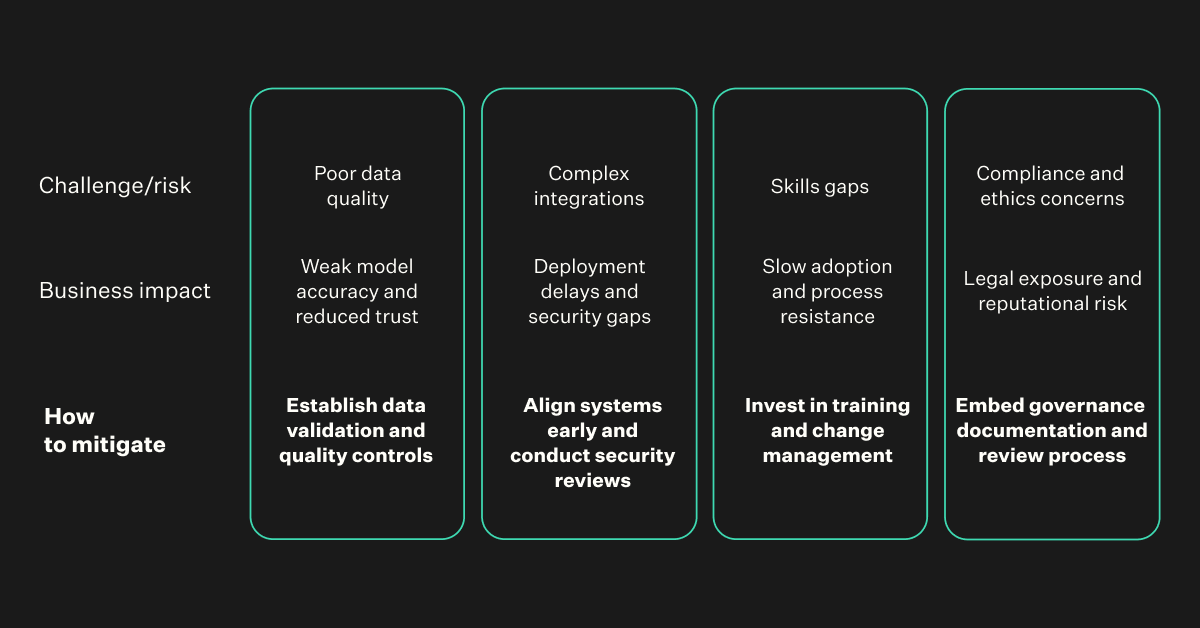
AI initiatives introduce operational and ethical responsibilities that require deliberate oversight from the beginning. The most common AI adoption risks and the controls that address them include the following:

SEO - chart1 VERTICAL- Blog image

Selecting tools and partners

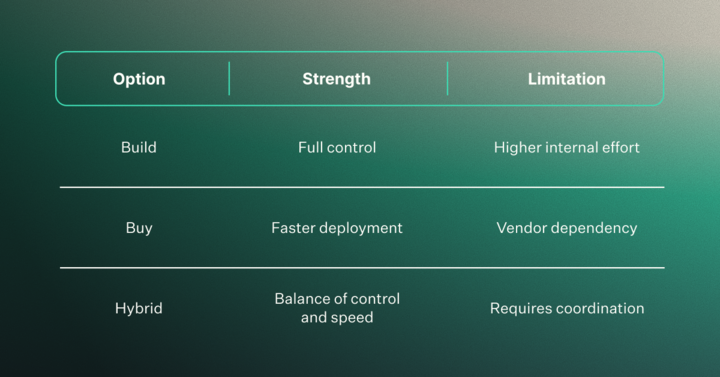
Choosing the right technology and partners significantly influences long-term success. Decision criteria often include scalability across departments, integration with existing systems, compliance capabilities, and overall cost of ownership.

seo_-_chart2_-_blog_image_720

Vendor due diligence should examine security practices, governance features, and support models. A unified platform approach simplifies this decision. For example, Dataiku integrates data preparation, machine learning, generative AI, agents, and governance in one environment.

Measuring success of AI in business: KPIs and analytics

Clear metrics demonstrate whether artificial intelligence in business delivers the operational value you expect. Without defined measurements, improvements remain anecdotal and difficult to justify at the executive level. Effective KPIs translate technical performance into financial and operational outcomes that leadership can track consistently. 

Most organizations evaluate results across four categories that include efficiency, revenue, quality, and compliance.

Efficiency metrics focus on how quickly and consistently work moves through the system. Common calculations include:

  • Cost per transaction = Total operating cost ÷ Number of transactions

  • Cycle time reduction (%) = (Baseline time − Current time) ÷ Baseline time × 100

  • Average resolution time = Total handling time ÷ Total cases

Revenue metrics measure how AI influences growth and customer value:

  • Conversion rate (%) = Conversions ÷ Total leads × 100

  • Customer lifetime value (CLV) = Average revenue × Retention period − Acquisition cost

  • Revenue uplift (%) = (Post-AI revenue − Baseline revenue) ÷ Baseline revenue × 100

Quality metrics assess accuracy and consistency:

  • Error rate (%) = Errors ÷ Total processed items × 100

  • Forecast accuracy (%) = 1 − |Forecast − Actual| ÷ Actual × 100

Compliance metrics confirm that processes follow required standards:

  • Compliance rate (%) = Compliant cases ÷ Total cases × 100

Establishing baseline measurements before deployment allows you to quantify improvement objectively and communicate results clearly to stakeholders. Continuous monitoring and regular reviews reinforce accountability and help teams refine models as conditions change.

What’s evolving in enterprise AI operations?

Enterprise AI is moving from isolated pilots into governed, production environments that support daily operations at scale. The focus has shifted from experimentation to reliability, oversight, and measurable business outcomes. 

Organizations now embed intelligence directly into core systems while maintaining clear controls around risk and compliance. Several operational patterns are emerging across mature enterprises:

Generative AI in workflows  

Legal teams summarize contracts automatically, support teams draft responses from knowledge bases, and marketing groups generate campaign content inside approved systems, which reduces turnaround time while keeping data controlled.

Agent-based automation

Digital agents monitor inventory, trigger replenishment orders, validate invoices, and escalate only exceptions, which removes routine manual steps and shortens processing cycles across finance and supply chain operations.

Governance and observability

Platforms track data lineage, model versions, approvals, and performance metrics, while alerts flag drift or anomalies early to prevent operational or compliance issues.

Human-in-the-loop oversight

AI scores and recommends decisions in areas such as lending, claims, or patient outreach, while final approval remains with staff to maintain accountability.

These practices allow AI in enterprise operations to scale safely while delivering consistent efficiency gains.

Operationalize AI for long-term advantage

Operational efficiency rarely improves through isolated technology upgrades, because sustainable progress depends on how well systems, teams, and decisions work together over time. As AI becomes part of everyday operations, the real advantage comes from creating an environment where insights move smoothly into action and oversight remains built into the process rather than added later. 

Organizations that treat intelligence as shared infrastructure rather than a side initiative tend to move faster, adapt more easily, and maintain stronger control as complexity grows.

Dataiku supports this kind of operating model through the Platform for AI Success, bringing data, machine learning, generative AI, agents, and governance into one connected workspace. If you are looking to make AI a dependable part of how your enterprise runs each day, exploring how Dataiku fits into your ecosystem is a practical next step.

Move from pilots to production with Dataiku

Make enterprise AI an organizational asset

FAQs about artificial intelligence in business

1. How do we use AI in business?

You typically begin by identifying high-volume or high-impact processes where predictions or automation can improve speed and accuracy. From there, you integrate models directly into operational systems so that decisions occur automatically rather than through manual review.

2. What skills do teams need to adopt AI successfully?

Teams benefit from a combination of data literacy, process knowledge, governance awareness, and collaboration between business stakeholders and technical specialists. Training and shared platforms help align these capabilities and support sustainable adoption.

3. What are the risks of AI?

AI introduces operational, technical, and ethical risks, including biased or inaccurate outcomes from poor data, security and privacy vulnerabilities, compliance challenges, and over-automation that reduces necessary human oversight. 

You May Also Like

Explore the Blog
AI in business: driving operational efficiency

AI in business: driving operational efficiency

Operational efficiency has become a defining responsibility for technology leadership because every department...

Introducing The Platform for AI Success

Introducing The Platform for AI Success

Somewhere inside your organization, an AI agent is making a decision right now. You didn’t authorize it. You...

Why Traditional Evaluation Doesn't Work for Agentic AI

Why Traditional Evaluation Doesn't Work for Agentic AI

For years, “human-in-the-loop” has been enterprise AI’s safety valve. If a model might behave unpredictably,...